Essential Features in the Best Accounting Software for Small Business with No Employees
Scr0ll d0wn to D0VVNL0AD

When you operate as a sole proprietor, contractor, or single-member LLC, your bookkeeping requirements look dramatically different from those of a multi-staff enterprise. You do not need complex multi-tiered employee permission levels, nor do you need software that charges you hefty base subscriptions just to host payroll setup tools you never open. Instead, finding the best accounting software for small business with no employees comes down to securing a lean, dependable platform that tracks cash movement, minimizes admin hours, and keeps you fully compliant at tax time.
Core Bookkeeping Without Payroll Requirements
Many traditional accounting platforms build their price tags around employee headcount and integrated payroll processing. Traditional cloud payroll tools often carry an average monthly base fee around $40 plus per-employee processing charges. For an independent business owner who takes owner draws or simple distributions, paying for these features adds unnecessary overhead.
Core bookkeeping for a solo enterprise revolves around a few fundamental functions:
- Income and Expense Categorization: Consolidating your earnings and business expenses into clean buckets so you know exactly where your revenue originates and where your cash flows.
- Double-Entry Accounting Capabilities: Even if you do not have a formal finance background, having underlying double-entry accounting mechanics ensures that your profit and loss statements and balance sheets balance accurately when reviewed by a tax professional.
- Receipt Capture and Document Storage: Mobile receipt scanning lets you snap quick photos of paper receipts on the fly, auto-categorizing expenses and building audit-proof records without cluttering your physical desk.
- Tax Schedule Readiness: Tracking standard tax deduction categories continuously throughout the year prevents a stressful rush every April. For U.S. sole proprietors, the IRS provides official guidance on Schedule C business income and expenses, which can help you understand why consistent categorization matters.
By avoiding software bloated with unused staff management tools, you can streamline your daily workflow. In fact, modern automated bookkeeping platforms demonstrate how solopreneurs can cut monthly financial administration down from 10 hours to quick weekly check-ins simply by relying on self-driving bookkeeping systems.
Evaluating Free and Low-Cost Accounting Tiers
Finding a low-cost or free accounting tier is one of the highest priorities for micro-businesses. Fortunately, software developers offer several entry points designed specifically for non-employer operations:
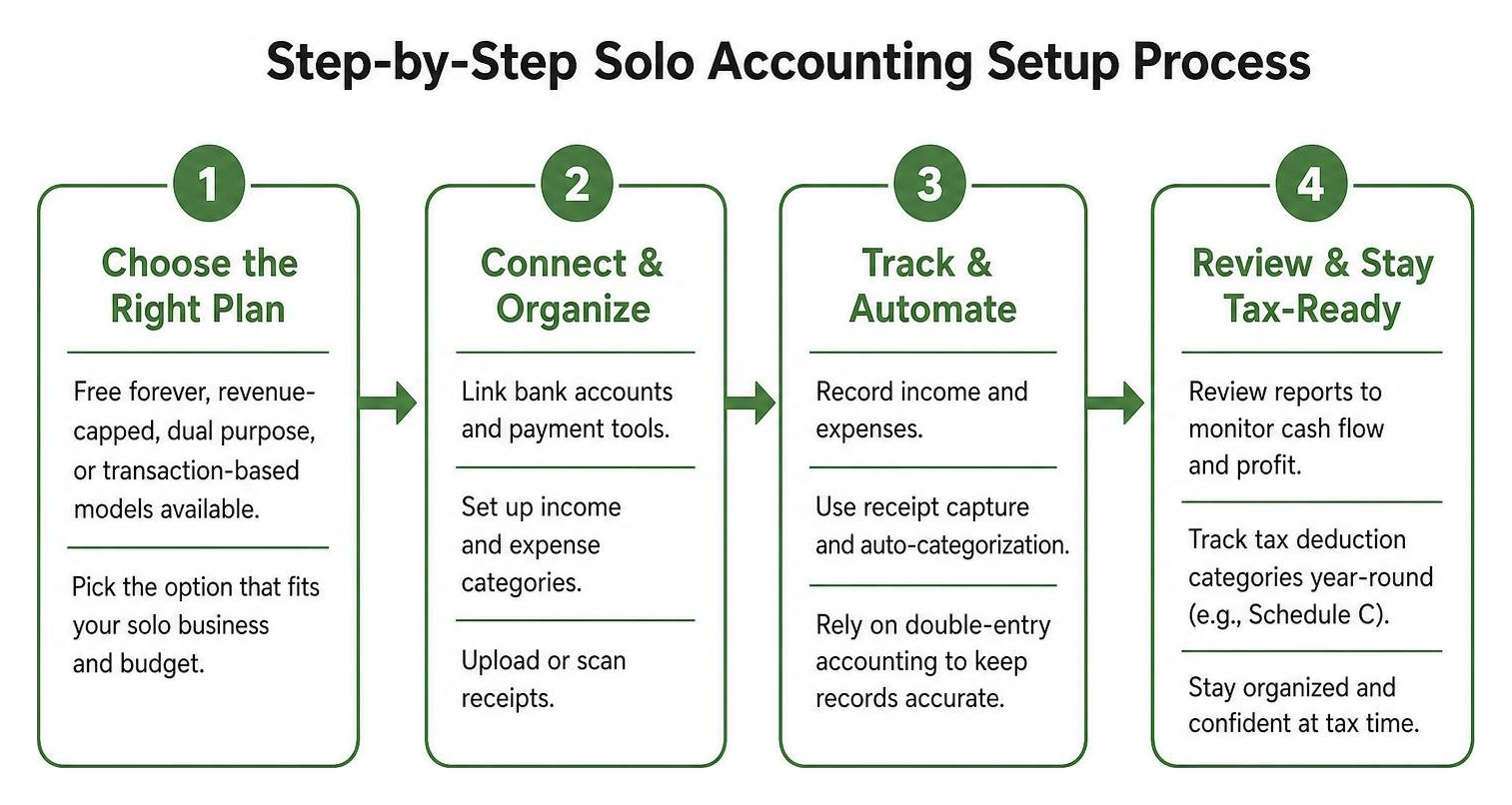
- Free-Forever Basic Plans: Leading free starter solutions offer plans that are free forever, providing unlimited income and expense tracking, custom estimates, invoicing, and vendor tracking for a single user.
- Revenue-Capped Tiers: Certain micro-business software options offer completely free software tiers for businesses earning $50,000 or less in annual revenue. These plans support up to 1,000 invoices and 1,000 expenses annually, making them an ideal entry point for modest single-person operations.
- All-in-One Dual Purpose Platforms: Dual-purpose personal and business management solutions offer modest introductory pricing (such as $4.99 per month) that allows you to manage both your personal wealth investments and up to 10 distinct business entities under a single account.
- Transaction-Based Models: Instead of high monthly subscription fees, many modern platforms keep their core software free and generate revenue solely through standard payment processing fees (typically around 3% + $0.30 per invoice transaction) when clients pay you online.
When evaluating free or cheap tiers, always check for hidden boundaries like transaction caps, invoice limits, or restrictions on exporting your own financial statements.
Comparing Top Tools for Solopreneurs, Freelancers, and Micro-Businesses
To help you decide which platform fits your operational model, we have synthesized key details across top solo-friendly software solutions in the comparative breakdown below.
| Software Solution | Ideal Business Model | Starting Cost | Key Feature Highlight | Bank Integration & Privacy |
|---|---|---|---|---|
| Free Starter Solutions | Micro-businesses & Freelancers | Free Starter Plan | Unlimited custom invoices & receipt scanning | Automated bank feeds or manual import options |
| Revenue-Capped Free Tiers | Micro-businesses (<$50k revenue) | Free tier available | Up to 1,000 invoices/year & workflow rules | Automated bank feeds with reconciliation |
| Tiered Paid Apps | Growing Solopreneurs | Tiered paid plans | Deep accountant adoption & broad app ecosystem | Direct bank connection & auto-mileage tracking |
| Service Provider Portals | Service Providers & Consultants | Paid entry tiers | Estimates-to-invoice conversion & client portal | Automated reconciliation & credit card processing |
| Integrated Banking & Accounting | Freelancers & Contractors | Free basic banking | Integrated 1.75% APY checking & automated books | All-in-one FDIC-insured banking & invoicing |
| Dual-Purpose Tools | Side-Hustlers & Multi-Entity Owners | Introductory ~$4.99/mo | Tracks business balance sheet alongside personal net worth | Cloud or desktop personal & business feed sync |
| Open-Source Offline Software | Technical or Privacy-Focused Solos | Free (Open-Source) | Completely local double-entry checkbook ledger | 100% offline local desktop storage |
Best Accounting Software for Small Business with No Employees for Simple Invoicing
For service professionals, consultants, and creative freelancers, fast payment turnarounds are the lifeblood of cash flow. Choosing software that excels at invoicing ensures you spend less time chasing unpaid accounts.
When evaluating software primarily for invoicing and receivables:
- Quote-to-Invoice Conversion: Look for platforms where you can send a project estimate or proposal to a client and convert it into an active, payable invoice with a single click once accepted.
- Recurring Invoices and Automated Reminders: If you manage retainer clients, setting up recurring billing cycles and payment follow-ups saves hours of monthly routine tasks. Businesses utilizing payment links and online payment options frequently notice a dramatic reduction in late payments.
- Custom Branding: Creating clean, professionally branded invoice templates instills confidence in your clients and maintains a high standard of professionalism.
Top free-tier invoicing solutions provide robust, unlimited invoice creation with zero monthly subscription cost, earning high praise from sole proprietors who find traditional enterprise platforms overly technical or complex.
Best Accounting Software for Small Business with No Employees Seeking Banking Integration
A growing trend among modern financial platforms is the combination of business banking and automated accounting into a unified dashboard. For a solopreneur, managing separate software subscriptions for checking accounts, invoicing tools, and expense trackers creates unnecessary friction.
Integrated freelancer banking and bookkeeping platforms—featuring FDIC insurance alongside high-yield checking options around 1.75% APY—eliminate manual reconciliation entirely. When a client pays an invoice generated through your account, the transaction instantly clears into your checking account and updates your double-entry bookkeeping ledgers automatically.
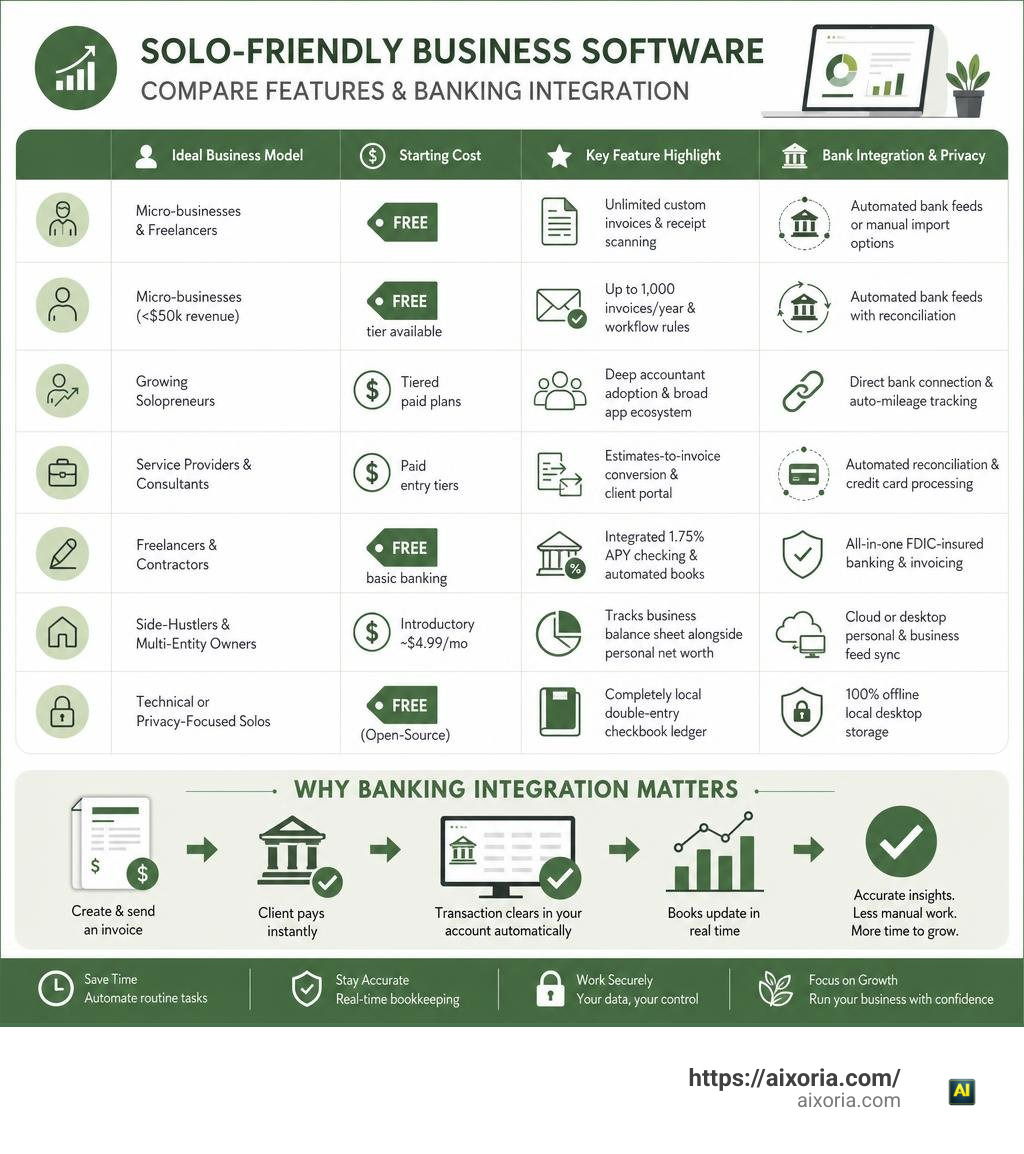
This direct link between cash accounts and income ledgers ensures your profit and loss metrics remain accurate in real time without importing CSV spreadsheets or configuring third-party integration bridges.
Advanced Considerations: Mobile Apps, Local Taxes, and Accountant Preferences

Beyond basic invoicing and expense categories, operating a business with no employees presents specialized scenarios regarding mobile workflows, data privacy, and quarterly tax filings.
Mobile Functionality and Offline Privacy Options
Managing a business on your own means you are rarely tied to a single office desk. Mobile bookkeeping apps have evolved from simple viewing tools into fully capable administrative hubs. Today, allocating bank statement transactions, issuing on-site client estimates, or snapping photo receipts directly on a smartphone during lunch is second nature.
However, if you handle sensitive client data or prefer complete control over your financial records, cloud-based connections might not always align with your preferences:
- Local Encryption & Data Privacy: Open-source desktop tools operate entirely on local hardware (Windows, macOS, Linux), guaranteeing that zero financial data leaves your computer.
- Client-Side Tax Tools: For single-member LLCs or sole proprietors dealing with self-employment filings, specialized browser-native utilities utilize high-grade client-side encryption (AES-256-GCM) to calculate state tax obligations and generate mandatory quarterly zero-filing returns completely inside your local browser without requiring cloud uploads or costly monthly subscriptions.
Regional Compliance and Accountant Collaboration
Your physical operational location and external accounting support can heavily influence your software choice.
In Australia, for example, micro-businesses navigating tax compliance must account for Single Touch Payroll (STP) rules if paying working directors, alongside Goods and Services Tax (GST) tracking. Established tax software platforms lead market share, but micro-business owners often leverage low-cost entry points to maintain clean records before sending year-end files to their registered tax agent.
Furthermore, sharing access with your accountant or tax preparer should be painless:
- Dedicated Accountant Roles: Leading platforms allow you to invite an external accountant or bookkeeper with specific view-and-edit permissions, protecting administrative settings while granting full access to general ledgers.
- Exporting Clean Statements: If your accountant prefers working in a specific platform, ensure your chosen solo tool easily exports standardized General Ledger, Balance Sheet, and Trial Balance reports in CSV or PDF formats.
Frequently Asked Questions About Solo Accounting Software
Can I use free accounting software effectively without bank feeds or staff?
Yes, absolutely. If you prefer not to connect your online bank login credentials to cloud accounting apps due to security or privacy preferences, you can easily maintain accurate books manually. Most free platforms allow you to import monthly bank statements via standardized CSV, QFX, or OFX files. Alternatively, you can enter income payments and vendor expenses manually using basic double-entry checkbook registers. Since a business without staff does not need to reconcile complex payroll liabilities, manual transaction entry or periodic file uploads take only a short time each month.
What is the cheapest way to manage invoicing and expenses for a one-person business?
The absolute cheapest method is using a free-forever cloud platform, or a revenue-capped free tier (if your annual revenue is under $50,000). These platforms give you professional invoice generation, automated payment links, client records, and expense categorization at $0 per month. You only pay standard third-party processing fees if your clients choose to pay invoices online via credit card or ACH transfer.
Should I choose accounting software based on my accountant’s recommendation?
If you rely on a certified public accountant (CPA) or bookkeeper to prepare your annual tax returns, their preferred system holds significant weight. Selecting a platform familiar to your accountant saves them time, which directly reduces your professional accounting fees. However, if an accountant recommends an enterprise-level platform that costs $80+ per month when your solo business only needs simple invoicing, ask if you can simply provide them with exported end-of-year profit and loss statements and general ledger reports from a lower-cost or free alternative instead.
Conclusion

Finding the best accounting software for small business with no employees does not mean buying the most expensive or feature-heavy tool on the market. It means matching your day-to-day routine with a tool that handles invoicing, expense categorization, and financial reporting with minimal effort.
https://www.mediafire.com/file/qmku1m9f6hv1tju/Grand_City_Auto_BY_MCMPDL.mctemplate/file
Whether you opt for a free cloud platform, an all-in-one financial banking solution, a dual-purpose personal and business tool, or a broader paid app, the main goal is maintaining consistent, audit-ready records all year long. By removing unnecessary payroll modules and prioritizing automation, you free up valuable time to focus on doing what you do best: running and growing your business.
To explore how smart automation and modern digital tools can further streamline your single-person enterprise, explore our guide on AI productivity solutions for 2026 to optimize your daily workflow.
2 thoughts on “Best Accounting Software for Small Business With No Employees”