Why Most Drivers Overpay for Car Insurance (And How to Stop)
Scr0ll d0wn to D0VVNL0AD
How to get the maximum discount on car insurance is simpler than most drivers think — but it requires action, because insurers almost never apply savings automatically.
Here’s the quick answer:
- Stack your highest-value discounts first — bundling, multi-vehicle, and safe driver discounts each save 10–25%
- Enroll in a telematics program — safe drivers can save up to 30–40%
- Pay your full premium upfront — saves 5–10% instantly
- Improve your credit score — moving from “fair” to “good” cuts premiums by an average of $971/year
- Do a discount audit at every renewal — ask your insurer to list every discount you qualify for
- Shop competing quotes annually — drivers who do this save an average of $1,127/year
- Raise your deductible — going from $500 to $1,000 cuts collision/comprehensive costs by 15–30%
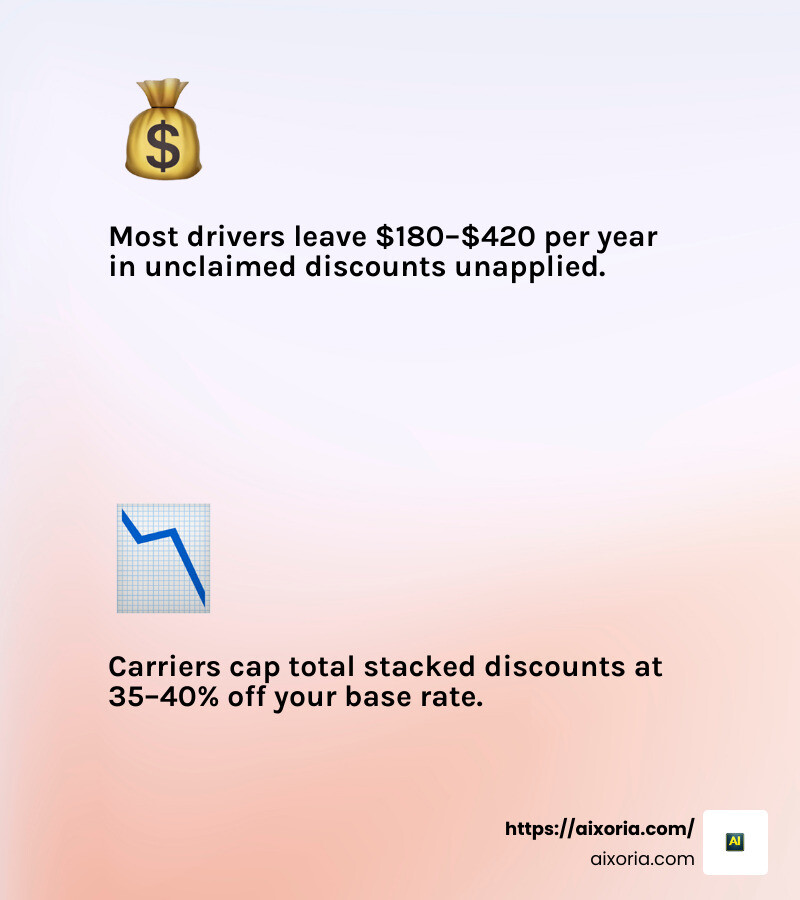
Most carriers cap total stacked discounts at 35–40% off your base rate. The goal is to hit that cap as fast as possible — using the highest-percentage discounts first.
The average policyholder leaves $180–$420 per year in unclaimed discounts sitting on the table. That’s not because the discounts don’t exist. It’s because carriers don’t proactively apply them, and most drivers never ask.
The national average full-coverage premium is $2,314 per year. With the right discount stack, many drivers can realistically get that number down by $600–$900 or more — without reducing a single dollar of coverage.
This guide walks you through every lever available, how to pull them in the right order, and how to claim savings without accidentally triggering a rate increase.
How to get the maximum discount on car insurance?
To understand how to get the maximum discount on car insurance, we first need to pull back the curtain on how insurance companies actually calculate your rate. Most drivers assume that if they qualify for five different 10% discounts, they will receive a clean 50% off their premium.
Unfortunately, insurance marketing materials can be highly misleading. In the real world, insurance discounts compound multiplicatively rather than adding up additively.
Let’s look at how this compounding math works. If we start with a baseline premium of $1,800 per year and apply four separate 10% discounts, the calculation is not: $1,800 - 40% = $1,080
Instead, the insurer applies the discounts sequentially:
- First Discount (10%): $1,800 becomes $1,620
- Second Discount (10%): $1,620 becomes $1,458
- Third Discount (10%): $1,458 becomes $1,312.20
- Fourth Discount (10%): $1,312.20 becomes $1,180.98
In this scenario, the actual total savings is roughly 34.4% ($619), not the 40% ($720) you might expect.
Furthermore, nearly all major insurance carriers enforce a hard cap on stacked discounts, typically limiting total savings to 35% to 40% of the standard rate. Once you hit this maximum discount cap, qualifying for additional discounts yields zero extra savings.
This is why our master strategy focuses on claiming the highest-percentage discounts first. By securing your largest potential savings upfront, you hit that carrier cap quickly and efficiently. Learn more about discount stacking to see how to structure your policy for maximum mathematical leverage.
How to get the maximum discount on car insurance with telematics?
For drivers looking to make a massive dent in their premiums, telematics—also known as usage-based insurance (UBI)—is one of the most powerful tools available today. These programs track your real-world driving habits through a mobile app or a device plugged into your car’s OBD-II port.
While carriers frequently advertise maximum savings of up to 40% for perfect driving, the real-world median savings is usually closer to $120 per year. However, if you are a safe driver who avoids hard braking, late-night driving, and rapid acceleration, telematics is highly worth the effort.
Before enrolling, it is vital to understand the privacy trade-off. Telematics apps track your location, driving times, speed, and phone usage while driving. For drivers who score in the top 30% of safe driving metrics, this trade-off is incredibly lucrative. However, if you have a heavy foot, commute during congested rush hours, or frequently drive between midnight and 4:00 AM, some telematics programs in 2026 can actually raise your rates at renewal.
If you are hesitant about telematics but still want to secure a rock-bottom rate, you should focus on finding the cheapest auto full coverage insurance that fits your budget without tracking your every move.
How to get the maximum discount on car insurance by stacking policies?
If you want to make an immediate, double-digit cut to your insurance costs, bundling policies is the single most reliable method. When we combine our auto insurance with a homeowners, condo, or renters policy under the same carrier, we trigger a multi-policy discount that reduces auto premiums by an average of 16% (and up to 25% with select insurers).
Here is a pro-tip that many drivers overlook: even if you do not own a home, bundling a cheap renters insurance policy can be incredibly profitable. In many cases, the multi-policy discount applied to your auto insurance premium is actually larger than the entire annual cost of the renters policy itself!
Alongside bundling different types of policies, you should always take advantage of the multi-vehicle discount. Insuring more than one vehicle on the same primary policy can save you 10% to 25% per vehicle. Insurers offer this because households with multiple cars statistically have better-than-average claims experience, and it reduces the carrier’s administrative overhead. To find the absolute best combination of savings, check out our guide on the best homeowners car insurance bundle in 2026 save more on home auto.
Unlocking Overlooked Driver and Vehicle Safety Discounts
Beyond the major bundles, there are several highly valuable driver-based and vehicle-based discounts that frequently go unclaimed:
- Good Student Discount (Up to 25% savings): Statistically, students who maintain good grades are more responsible behind the wheel. If your high school or college driver maintains a 3.0 GPA (B average) or ranks in the top 20% of their class, submitting a transcript can yield massive savings. Check our specialized resources on cheap auto insurance for teens to see how to offset the high cost of young drivers.
- Student Away at School (10% to 30% savings): If your child attends a college over 100 miles away from home and leaves the family car behind, you can secure a major rate reduction while still keeping them covered when they return for breaks. This is a crucial strategy when looking for the cheapest car insurance for young adults.
- Defensive Driving Course (5% to 15% savings): Completing an approved, state-certified accident prevention course online is an easy way to lock in a discount that typically lasts for three years. In some states, carriers are legally mandated to provide this discount to drivers who complete the training.
- Low-Mileage & Pleasure Use (5% to 15% savings): If you transitioned to a remote or hybrid work model and drive fewer than 7,500 miles per year, notify your insurer. Changing your vehicle’s primary usage classification from “Commuter” to “Pleasure Use” will instantly lower your risk tier.
- Vehicle Safety Features & Anti-Theft Devices (5% to 40% savings): Built-in safety features like passive restraint systems (airbags), anti-lock brakes (ABS), and factory-installed anti-theft alarms automatically reduce your premium. Carriers read your 17-digit VIN to identify these features, but it is always smart to double-check that they are being credited. Passive restraint discounts specifically target the medical-related portion of your coverage, sometimes slashing those specific costs by up to 40%.
Smart Policy Adjustments and Financial Optimization
While discounts are fantastic, they are only one side of the coin. To truly minimize your insurance overhead in 2026, we must look at coverage-neutral structural changes. This means adjusting how your policy is built to lower your premiums without stripping away the essential liability protection you need to safeguard your personal assets.
To explore this philosophy in depth, read our guide on how to Save money on car insurance while keeping full coverage.
Raising Deductibles and Adjusting Coverage Limits
The fastest way to immediately lower your comprehensive and collision premiums is to increase your deductibles. Your deductible is the out-of-pocket amount you pay before your insurance coverage kicks in during a claim.
Moving your deductible from $500 to $1,000 typically cuts those specific coverage costs by 15% to 30%. However, this is only a smart financial move if you have a liquid emergency fund ready to cover that $1,000 tomorrow.
Let’s do the break-even math:
- Suppose raising your deductible from $500 to $1,000 saves you $180 per year in premiums.
- The difference in out-of-pocket risk is $500.
- To break even on this change, you must go 2.8 years without filing a comprehensive or collision claim (
$500 / $180 = 2.77).
If you have a clean driving history and rarely file claims, this is a highly statistically favorable bet. To test different scenarios for your own vehicle, utilize the best lower car insurance premium calculator to find your financial sweet spot.
The Impact of Credit Scores on Premium Rates
In 46 states, insurance companies use credit-based insurance scores to help determine your likelihood of filing a claim. Actuarial data shows a strong correlation between high credit scores and responsible driving habits.
The financial impact of your credit score on car insurance is staggering:
- Drivers with poor credit (scores below 580) pay an average of $4,317 per year for full coverage.
- Drivers with good credit (670–739) pay an average of $2,150 per year for the exact same coverage.
- Drivers with no credit history pay an average of 67% more than those with excellent credit.
Improving your credit score from “fair” to “good” can reduce your auto premium by an average of $971 per year. You can boost your credit-based insurance score quickly by paying down revolving credit card balances to keep your credit utilization below 30% and avoiding opening new credit accounts within six months of your policy renewal.
Note: If you live in California, Hawaii, Massachusetts, or Michigan, state laws completely prohibit or severely restrict insurers from using credit scores to calculate auto insurance rates.
If you live in a state where credit is factored in, improving your credit score is the ultimate key to unlocking the top 10 cheapest car insurance quotes.
Payment-Related and Administrative Savings
If you want “set-it-and-forget-it” savings, administrative discounts are incredibly easy to claim. Most carriers offer three distinct payment-related discounts:
- Paid-in-Full Discount (5% to 10% savings): Paying your entire 6-month or 12-month premium upfront eliminates installment fees and earns you an immediate discount. It is one of the highest-ROI cash moves you can make.
- Paperless Billing and Auto-Pay (3% to 5% savings): Opting out of paper mailings and setting up automatic electronic fund transfers (EFT) saves the carrier administrative costs, which they pass directly to you.
- Early Quote / Advance Purchase (3% to 10% savings): If you shop around and sign your new policy 7 to 14 days before your current policy expires, insurers reward your proactive behavior with an early shopper discount.
By combining these simple administrative tweaks, you can easily save $100 or more per year. To compare which carriers offer the most robust administrative discounts, review our analysis of the top 5 affordable auto insurance companies.
The Strategic Discount Audit: How to Claim Without Rate Hikes
Now that you know which discounts exist, you need to know how to claim them. Many drivers make the mistake of calling their insurance company and saying, “My bill is too high, can you lower my rate?”
This simple phrase can accidentally trigger a full policy re-underwriting. The agent may pull a fresh motor vehicle record (MVR) or credit report, which could uncover a recent minor violation, a drop in credit score, or a change in your ZIP code’s risk tier—resulting in a rate increase instead of a discount.
Instead, we must protect ourselves from “price optimization”—the industry practice where insurers slowly raise base rates for loyal, long-term customers because data shows they are unlikely to shop around. To combat this, we must use a highly specific strategy. You can access our comprehensive Checklist of 32 auto insurance discounts to prepare your evidence before reaching out to your carrier.
How to Ask for Discounts Safely
To audit your policy without triggering a re-rate, always handle the request as an administrative verification rather than a rate negotiation.
We highly recommend conducting your discount audit in writing via your insurer’s secure online chat portal or email. This creates a paper trail and prevents customer service representatives from verbally initiating a policy re-underwrite.
If you do call, use this exact script:
“I am reviewing my active policy declarations page. I want to perform an administrative discount audit to verify which specific discounts are currently active on my account, and run through the checklist of available discounts to see if I qualify for any that are not currently applied.”
This framing keeps the interaction purely administrative. If you find that your current carrier is unwilling to apply the discounts you deserve, it is time to run an insurance car quotes online comparison to find a competitor who will.
The Risks of Claiming Unqualified Discounts
While we want to maximize our savings, we must emphasize the importance of absolute honesty. Approximately 5% of auto insurance policies are randomly audited by carriers each year.
Falsifying information to qualify for a discount—such as misrepresenting your annual mileage, lying about a student’s GPA, claiming a vehicle is garaged in a rural ZIP code when it is parked in the city, or failing to list an active household driver—is considered insurance fraud.
If you are caught claiming a discount you do not qualify for during an audit, the carrier can:
- Retroactively bill you for the unpaid premium difference.
- Void your policy entirely, leaving you uninsured.
- Deny coverage on a pending claim, exposing you to massive personal liability.
Always stick to legitimate, verifiable discounts. To ensure you are working with a trustworthy provider that handles audits and claims fairly, consult our rankings of the most reputable car insurance companies in 2026 top 10 ranked.
Frequently Asked Questions About Car Insurance Discounts
| Discount Category | Average Savings Range | Verification Requirement | Best For |
|---|---|---|---|
| Multi-Policy Bundle | 10% – 25% | Active policy numbers | Homeowners, renters, multi-line households |
| Telematics (UBI) | 5% – 30% (Up to 40%) | Mobile app / plug-in device | Safe, low-mileage, daytime drivers |
| Multi-Vehicle | 10% – 25% | Multiple VINs on one policy | Families, multi-car households |
| Good Student | 10% – 25% | School transcript (3.0+ GPA) | Parents of high school/college drivers |
| Paid-in-Full | 5% – 10% | Lump-sum payment | Drivers with upfront cash flow |
| Defensive Driving | 5% – 15% | Course completion certificate | Drivers over 55, safe drivers |
What is the maximum discount cap across major insurers?
Most major car insurance carriers place a hard cap on total stacked discounts, typically limiting total savings to 35% to 40% off your standard base rate. Even if you qualify for a dozen different discounts that theoretically add up to 60%, the compounding math and carrier caps will stop your savings at this threshold to protect the insurer’s loss ratios.
Do car insurance discounts expire or need to be renewed?
Yes, many high-value discounts are temporary. Defensive driving course discounts typically expire after 3 years and require you to retake the course to renew the savings. Good student discounts must be renewed every semester or school year by submitting a fresh report card or transcript. Keep track of these dates to prevent silent rate creep on your policy.
Can discounts be applied retroactively to my policy?
Generally, insurance companies will not refund you retroactively for discounts you qualified for but failed to claim in the past. However, if you discover an eligible discount mid-term, most carriers will apply a mid-term endorsement to your active policy, reducing your remaining monthly installments or issuing a pro-rated credit at your next renewal.
Conclusion
At Aixoria, we believe that managing your personal auto insurance should not feel like a passive monthly subscription. Complacency is the single most expensive mistake a driver can make in today’s algorithm-driven insurance market. By performing a strategic discount audit every 12 months, stacking your high-value bundles, and optimizing your policy structure, you can reclaim hundreds of dollars that would otherwise be left on the table.
Be proactive, demand transparency from your carrier, and Explore the latest AI updates and insurance insights to stay ahead of the curve and keep your hard-earned money in your pocket.
C
1 thought on “How to Get the Maximum Discount on Car Insurance in 2026 (Save Up to 40%)”