Why Cheap Auto Insurance for Teens Costs More – And What You Can Do About It
Scr0ll d0wn to D0VVNL0AD
Finding cheap auto insurance for teens is one of the biggest financial surprises parents face when their child gets a driver’s license.
Here’s the quick answer most parents need:
The cheapest way to insure a teen driver:

| Option | Average Annual Cost |
|---|---|
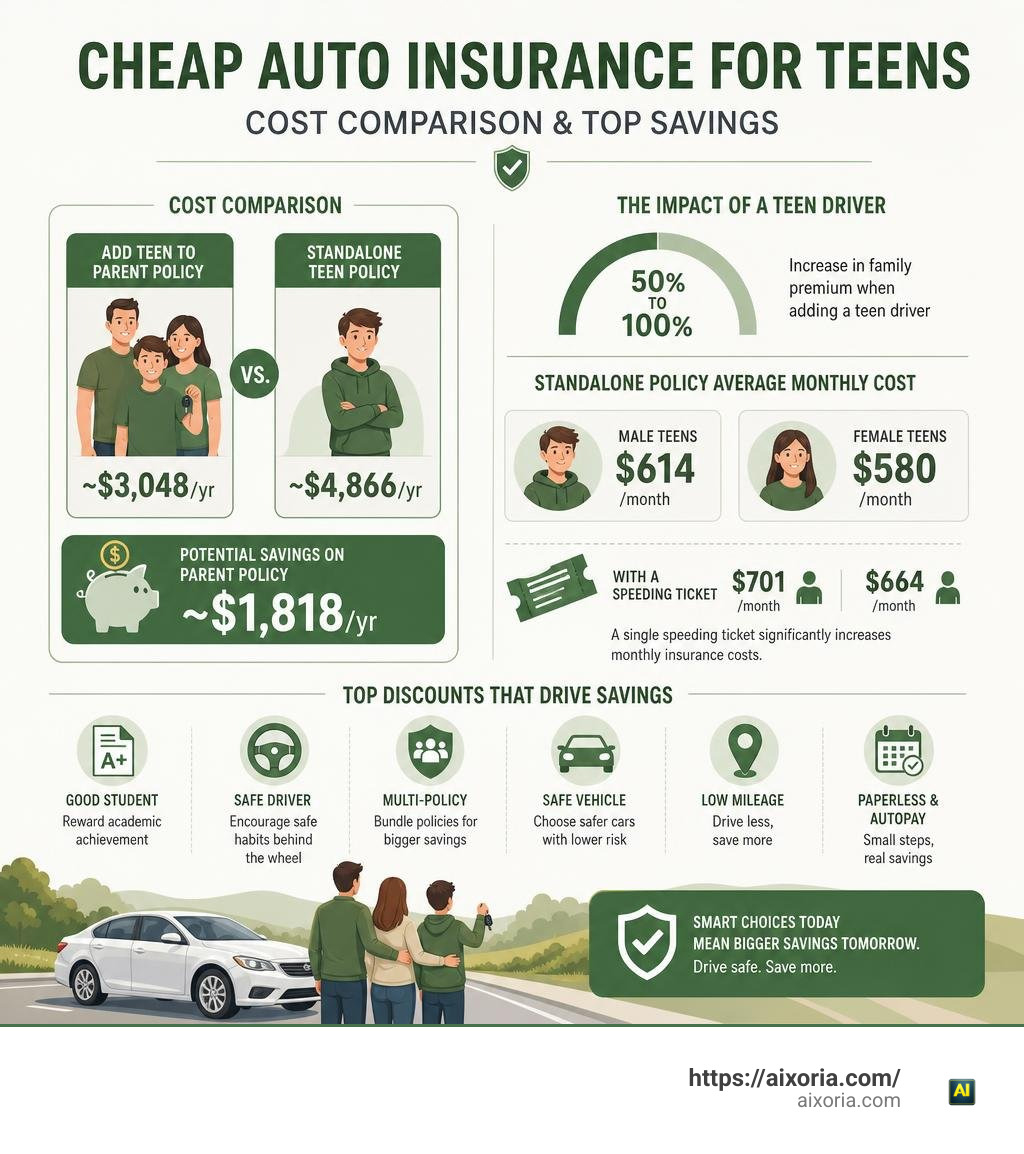
| Add teen to parent’s existing policy | ~$3,048/yr |
| Teen on a separate standalone policy | ~$4,866/yr |
| Potential savings on parent policy | ~$1,818/yr |
- The lowest base rates for teens in national quote samples can start around $206/month on a family policy for a 16-year-old
- Male teens average $614/month; female teens average $580/month on standalone policies
- A single speeding ticket pushes those averages up to $701 and $664 per month respectively
- Teen drivers can raise a family’s existing premium by 50% to 100%
The core reason teen insurance is so expensive is simple: teens crash more. The motor vehicle crash rate for 16- to 17-year-olds is more than double that of drivers aged 20 to 30. Insurance companies price that risk directly into premiums.
The good news? There are real, proven strategies – from discount stacking to smart vehicle choices – that can cut costs significantly. This guide walks through all of them.
Understanding the Cost of Cheap Auto Insurance for Teens
When we look at the numbers in July 2026, the reality of insuring a teenager hits hard. On average, adding a teen driver to a family policy can increase your premiums by 50% to 100%. If they get their own standalone policy, the cost can easily double.
Why is this the case? Insurance companies are in the business of predicting risk. Statistically, young drivers have less experience on the road, are more prone to distractions, and have higher rates of accidents and traffic violations.
Gender Differences in Teen Premiums
Historically, male teen drivers pay more for car insurance than female teen drivers. This is because young men are statistically more likely to engage in risky driving behaviors, speed, and get into more severe accidents. Nationwide, insuring a 16-year-old male costs an average of $504 more per year than insuring a 16-year-old female of the same age.
However, where you live matters. Seven states legally prohibit insurance companies from using gender as a rating factor:
- California
- Hawaii
- Massachusetts
- Michigan
- Montana
- North Carolina
- Pennsylvania
In these states, insurers must rely on other factors like driving history, location, and the type of vehicle driven to set rates.
Age Milestones and Rate Declines
The good news is that the higher teen premium period does not last forever. Rates typically peak at age 16 and begin a steady downward trend as the driver gains experience and maintains a clean record.
Here is how rates typically decline as a teen gets older:
- At age 18: Rates drop by approximately 14%
- At age 19: Rates drop by another 11%
- By age 21: Rates decrease by an additional 18%
By the time a driver reaches their mid-twenties, around age 25, their rates will normalize to standard adult premiums, provided they have kept a clean driving record.
| Age | Average Monthly Rate (Male) | Average Monthly Rate (Female) | Key Driver |
|---|---|---|---|
| 16 Years Old | $323 / month | $292 / month | Newly Licensed |
| 17 Years Old | $285 / month | $260 / month | 1 Year Experience |
| 18 Years Old | $245 / month | $224 / month | High School Graduate |
| 19 Years Old | $218 / month | $199 / month | College Age |
Average Rates for Young Drivers
If you are looking for the absolute cheapest starting point, the carrier you choose makes a massive difference. According to national data, the cheapest car insurance for 16-year-olds can start at $206 per month when added to a family policy.
To put this in perspective, let us look at the massive gap between the cheapest and most expensive carriers. For a 16-year-old on a standalone policy, one low-cost quote sample averaged $456 per month, while the most expensive insurer in the same market charged up to $1,201 per month. That is a staggering $745 monthly difference for the exact same driver.
As you shop around, keep in mind that the cheapest carrier at age 16 is often not the cheapest at age 19. Pricing can shift as your teen gains experience, maintains a clean record, and becomes eligible for more discounts.
To explore what different carriers can offer your family, we highly recommend reading our guide on the Top 10 Cheapest Car Insurance Quotes to see how major national brands stack up.
Key Factors Influencing Teen Premiums
To find cheap auto insurance for teens, we have to understand the specific risk factors that insurers look at when calculating rates. It is not just an arbitrary youth surcharge – it is a mathematical reflection of real-world driving habits.

- Inexperience: According to industry data, inexperience alone accounts for 38% of all teen crashes. New drivers simply lack the muscle memory and visual scanning habits required to anticipate hazards on the road.
- High Crash Rates: The risk of motor vehicle crashes is highest during the first six months of solo driving. In fact, 20% of teen drivers experience an accident within their very first year of driving.
- Risk-Taking Behaviors: Speeding is a major contributor to teen accidents, causing roughly 31% of all fatal teen crashes. Young drivers are also more likely to underestimate dangerous situations or tailgating risks.
- Distracted Driving: Distraction plays a role in 60% of all teen crashes. Cell phones are the most common culprit, with mobile data showing that teens use their phones during roughly 11% of all driving trips. Furthermore, hands-free voice commands can actually cause more cognitive distraction than parents realize, as they still take the driver’s mind off the road.
Policy Structure: Parent Policy vs. Standalone Coverage
One of the first decisions you need to make is how to structure the policy. Should you add your teen to your existing family policy, or should they get their own standalone coverage?
For almost every household, the math points to a clear winner. Adding a teen to a family policy costs $3,048 annually on average, which is $1,818 less than a separate individual policy for the same teen (which averages $4,866 annually). On a monthly basis, this saves families about $150 to $440.

By keeping your teen on your policy, you can leverage household-level benefits like multi-car discounts, multi-policy bundling (such as combining your auto and home insurance), and your own established loyalty status. If you want to compare the overall market leaders for household policies, you can read our breakdown of the Top 10 Cheapest Car Insurance Companies.
Why Adding a Teen to Your Policy is Cheaper
When you add a teen to your policy, the insurance company still applies a surcharge, but the base rate is insulated by the parents’ driving history and credit profile.
Furthermore, if your household shares vehicles, a family policy allows you to assign the teen as an occasional driver on the cheapest, safest car in your driveway (such as an older family sedan), rather than listing them as the primary driver of a newer, more expensive vehicle.
To get a sense of how different insurers handle these family additions, you can check out our analysis of the Top 5 Affordable Auto Insurance Companies to find a carrier that keeps parent surcharges to a minimum.
When a Separate Policy Makes Sense
While adding a teen to your policy is almost always the cheapest route, there are a few rare scenarios where a separate standalone policy actually makes financial sense:
- The Teen Drives a Luxury Vehicle: If your teen is driving an expensive luxury car, adding them to the family policy could trigger a massive rate hike across all household vehicles. In this case, separating them onto their own policy with that specific car protects the parents’ rates.
- Poor Parent Driving Records: If a parent has a history of DUIs, multiple at-fault accidents, or severe moving violations, the parent’s insurance rates will already be exceptionally high. Adding a teen to that policy could cause the premium to skyrocket to unsustainable levels. A separate policy for the teen prevents their rate from being inflated by the parents’ driving records.
- Vehicle Registration and Titling: In many states, if a vehicle is titled and registered solely in the teenager’s name, insurance companies will not allow them to be on the parent’s policy. The vehicle title must remain in the parent’s name to keep them on the family plan.
- Permanent Relocation: If your teen moves out of the household permanently (and is not just away at college), they are legally required to purchase their own standalone car insurance policy.
How to Find Cheap Auto Insurance for Teens
Finding the best rate requires a systematic approach. You shouldn’t just accept the renewal rate from your current carrier without looking at what else is out there.
We recommend comparing quotes from at least three to five different auto insurance companies every year as your teen ages. To get started, you can use our guide on Insurance Car Quotes Online Comparison to quickly evaluate options.
Top Strategies for Cheap Auto Insurance for Teens
Beyond shopping around, there are several structural policy adjustments you can make to secure cheap auto insurance for teens:
- Raise Your Deductibles: Increasing your comprehensive and collision deductibles from $500 to $1,000 can lower your monthly premium by $30 to $60 (or roughly 10% to 15%). Just make sure you keep that deductible amount set aside in an emergency fund in case you need to file a claim.
- Drop Unnecessary Coverages on Older Cars: If your teen is driving an older vehicle worth less than $5,000, the annual cost of comprehensive and collision coverage might exceed the actual cash value of the car minus your deductible. In this case, dropping down to liability-only coverage can save you hundreds of dollars a year.
- Choose the Right Carrier: Some companies offer specialized programs specifically designed to keep teen rates low. To see which national brands offer the most reputable service and competitive rates, take a look at the Most Reputable Car Insurance Companies In 2026 Top 10 Ranked.
Stacking Discounts for Cheap Auto Insurance for Teens
One of the most effective ways to lower your bill is to stack multiple discounts. Many families miss out on hundreds of dollars in savings simply because they don’t ask their agent to apply these common teen-centric discounts:
- Good Student Discount: Most major insurers offer a discount of 10% to 35% (saving roughly $300 to $800 annually) for students under 25 who maintain a “B” average (3.0 GPA) or higher. You will just need to submit a report card or transcript once or twice a year.
- Driver’s Education and Safe Driving Courses: Completing an approved professional driver’s education course or defensive driving class can yield a 5% to 15% discount. Some insurers also provide extra savings for teens who complete certified training.
- Distant Student / Student Away at School Discount: If your teen goes to college more than 100 miles away from home and leaves the family car behind, you can secure a 10% to 25% discount. They will still be covered when they come home to visit for holidays or summer break.
- Telematics and Usage-Based Insurance (UBI): Enrolling your teen in a telematics program can yield an immediate enrollment discount of up to 15%. Safe driving habits tracked via a mobile app can lead to renewal discounts of up to 30% to 40%.
For more details on safe driving practices and vehicle safety research, review the Insurance Institute for Highway Safety ratings before choosing a car for your teen.
Choosing the Right Vehicle and Coverage Types
The vehicle your teen drives has a massive impact on their insurance rate. If you buy your teen a high-performance sports car, a luxury sedan, or a highly stolen vehicle model, your insurance costs will reflect that extreme risk.
Instead, look for modest, mid-sized sedans or compact SUVs with top safety ratings from the Insurance Institute for Highway Safety (IIHS). These vehicles are built to withstand crashes, have lower repair costs, and cost significantly less to insure.
Cheapest Vehicles to Insure for Teens (Average Annual Insurance Cost):
- Subaru Forester: $1,891/year
- Subaru Outback: $1,912/year
- Honda CR-V: $1,935/year
- Mazda CX-5: $1,957/year
- Ford Escape: $1,980/year
If you want to estimate your potential savings based on different vehicles and coverage limits, you can use our Best Lower Car Insurance Premium Calculator to run the numbers.
When structuring coverage, we highly recommend maintaining high liability limits. While state-minimum liability is cheap, it rarely provides enough protection if your teen causes a multi-car accident. Consider adding a Personal Liability Umbrella Policy (PLUP) to protect your family’s home and savings from major lawsuits.
To learn more about how direct underwriting works for these coverage types, read our guide on How Does Direct Auto Insurance Work.
Frequently Asked Questions About Teen Car Insurance
Navigating teen auto insurance can be confusing. Here are answers to some of the most common questions parents ask.
Do I have to add my teen to my policy if they only drive occasionally?
Yes. In almost all cases, insurance companies require you to disclose and list all licensed household members who have regular access to your vehicles.
Some parents try to bypass this by claiming their teen “only drives occasionally” or “only drives the family car once a month.” However, if a resident teen is involved in an accident and is not listed on the policy, the insurer can deny the claim entirely, leaving you personally liable for tens of thousands of dollars in damages.
If you absolutely do not want your teen to drive your cars, some states allow a Named Driver Exclusion. This legally removes the teen from your policy, meaning they have zero coverage. If they drive your car anyway and get into an accident, you will have no insurance protection.
What happens to my rates if my teen gets a ticket or has an accident?
If your teen gets a speeding ticket or is involved in an at-fault accident, expect your rates to increase significantly.
- Speeding Ticket: A single speeding ticket can increase a teen’s insurance premium by roughly 14%. On average, a ticket pushes monthly costs to $701 for males and $664 for females.
- At-Fault Accident: An at-fault accident typically raises auto insurance premiums by 20% to 40%. This surcharge will remain on your policy for three to five years.
To protect your family from these sudden rate hikes, look for carriers that offer Accident Forgiveness programs. Some companies will forgive a driver’s first minor at-fault accident or ticket, keeping your premium stable.
When will my teen’s car insurance rates start to decrease?
Your teen’s car insurance rates will start to decrease gradually every year they maintain a clean driving record.
The first major rate drop typically occurs at age 18 (about a 14% decrease), followed by another drop at age 19 (about 11%). The most significant drops occur once the driver reaches age 21 and eventually age 25, at which point they are no longer classified in the highest-risk driver category.
To keep rates on a downward trend, encourage your teen to build a history of safe driving, avoid moving violations, and participate in telematics programs that reward smooth braking and safe speeds.
Conclusion
Securing cheap auto insurance for teens is undeniably a challenge, but it is entirely possible with the right approach. By keeping your teen on a family policy, choosing a safe and reliable vehicle, and systematically stacking discounts like good student and telematics rewards, you can save thousands of dollars a year.
At Aixoria, we are dedicated to helping families navigate complex financial decisions with ease. To stay up to date on the latest industry trends, smart saving strategies, and technology updates, we invite you to Explore our latest AI updates and insurance insights. Happy driving, and keep those records clean!
1 thought on “Cheap Auto Insurance for Teens in 2026: Best Ways to Save Money”