Why AI Is Changing the Rules of Brand Visibility

How AI products can improve brand visibility without large marketing budgets is one of the most important questions small and mid-sized businesses are asking right now — and the answer is more practical than most people expect.
Here is the short version:
- Optimize for AI answer engines, not just Google rankings — AI tools like ChatGPT, Gemini, and Perplexity now recommend brands directly, skipping the traditional results page entirely.
- Build third-party credibility — AI cites external sources (Reddit, YouTube, reviews, press mentions) roughly 6.5 times more often than a brand’s own website.
- Publish structured, answer-first content — 44.2% of ChatGPT citations come from the first 30% of an article.
- Stay fresh — half of everything AI cites is less than 13 weeks old, and new content gets picked up in a median of just 6.8 days.
- Use affordable AI tools to automate content creation, SEO research, and social scheduling — saving lean teams 10+ hours per week.
For decades, big brands won visibility by outspending everyone else. Bigger ad budgets meant more eyeballs. That equation is breaking down fast.
Today, when someone wants to find the best project management tool for a remote team or the most trusted sustainable skincare brand, many of them don’t scroll through search results anymore. They ask an AI. And the AI gives them a short list — or sometimes just one name.
That shift changes everything. AI doesn’t care how much you spent on ads last quarter. As one insight from the research puts it plainly: “AI doesn’t care about your brand history or advertising budget — it cares about the quality and depth of your content.”
This levels the playing field in a real way. A small brand with clear, well-structured, widely-referenced content can outrank a corporate giant that relies on legacy domain authority and paid media. The rules of the game have changed — and smaller teams are often faster to adapt.
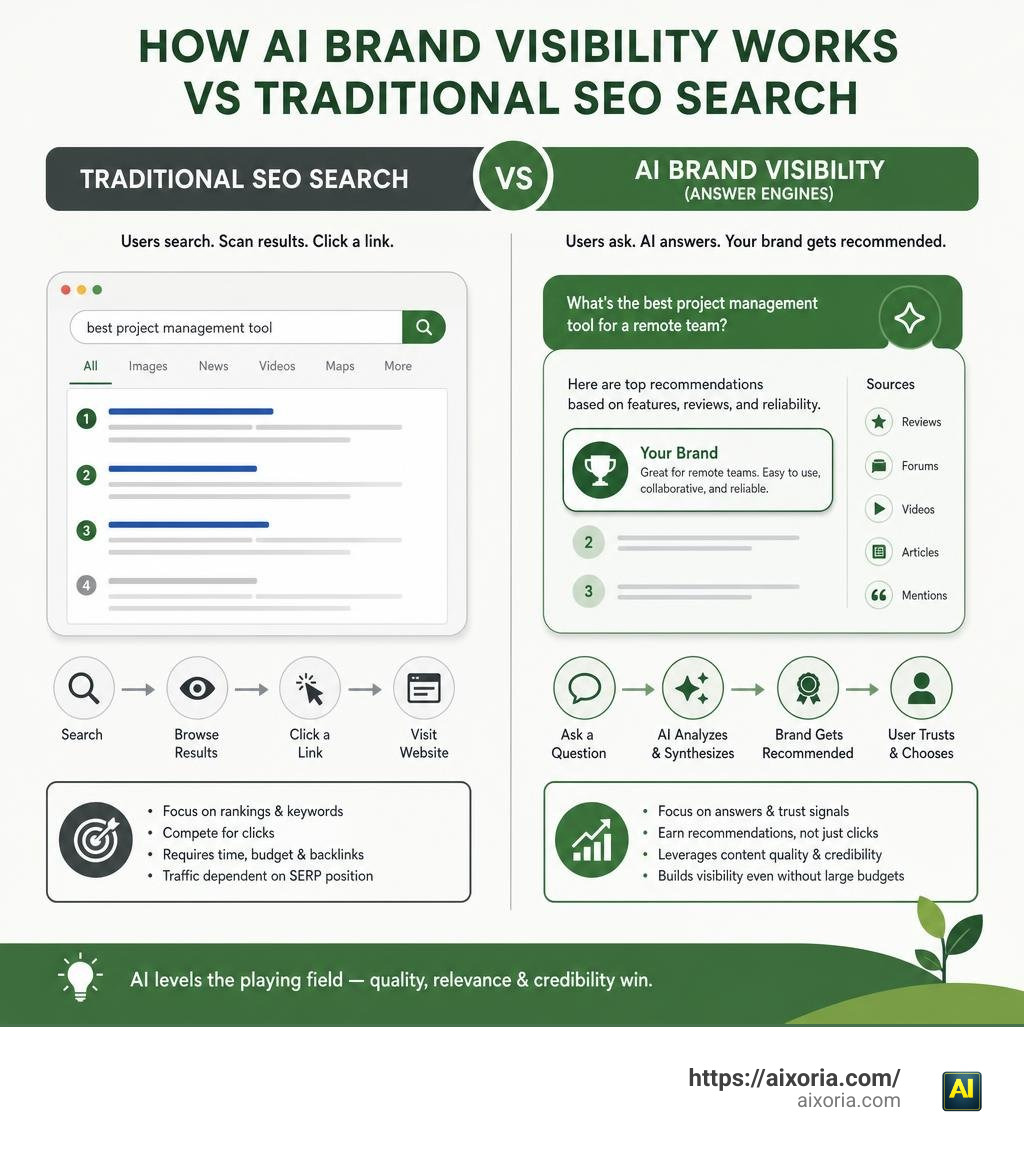
Traditional SEO vs. AI-Driven Brand Visibility
To win in this new era, we have to understand that traditional Search Engine Optimization (SEO) and Answer Engine Optimization (AEO) are two different beasts.
Traditional SEO focuses on earning a high-ranking spot on a Search Engine Results Page (SERP). It is built around keywords, backlink volume, and domain authority. If you rank in the top three spots, you get the traffic.
AI-driven brand visibility is different. AI search engines (like Perplexity, ChatGPT, and Google’s AI Overviews) do not just list links; they synthesize information from multiple sources to answer a prompt directly. Because of this, zero-click searches have skyrocketed. In fact, close to 60% of Google searches now result in users never leaving the search results page. When AI Overviews appear, they cut the click-through rates on top organic results by roughly 58%.
Furthermore, there is only a tiny 7.2% domain overlap between Google AI Overviews and standard chatbot results. This means that just because you rank well on Google, it does not guarantee ChatGPT or Claude will recommend your brand.
To help visualize these differences, we have broken down the core mechanics of both approaches:
| Feature | Traditional SEO | AI-Driven Brand Visibility (AEO/GEO) |
|---|---|---|
| Primary Goal | Rank on the first page of search engines | Get cited inside the synthesized AI answer |
| User Experience | Scrolling through a list of blue links | Reading a direct, personalized recommendation |
| Key Metrics | Keyword density, backlink volume, domain authority | Entity clarity, third-party trust, structured data |
| Traffic Destination | Directly to your website’s landing page | Zero-click answers, with citations as secondary clicks |
| Source Trust | Heavily weights owned website authority | Heavily weights third-party reviews and community forums |
Instead of focusing solely on keywords, AI engines rely on entity recognition. They view your brand as a node in a massive knowledge graph, linking your business name to specific attributes, products, and reviews. If your digital footprint is fragmented or inconsistent, the AI cannot confidently verify who you are, and it will recommend a competitor instead.
To bridge this gap, modern marketers must utilize specialized software. You can explore the Best AI Tools for Enhancing Visibility in 2026 to see how modern software helps align your business with these algorithmic shifts. Transitioning to an AI-first framework is no longer optional; as outlined in the Brand Building With AI Visibility: Proven 2026 Framework, establishing trust across the web is the only way to remain relevant.
How AI Products Can Improve Brand Visibility Without Large Marketing Budgets

Historically, launching a nationwide or global brand awareness campaign required a war chest of venture capital or a massive corporate budget. Today, affordable AI products act as a force multiplier, allowing lean teams of one or two people to match the output and presence of an entire marketing department.
By automating repetitive, time-consuming tasks, small brands can bypass the “marketing tax” that historically kept them out of the spotlight. For a deep dive into the software making this possible, check out our guide on the Best AI Tools for Entrepreneurs in 2026.
Understanding How AI Products Can Improve Brand Visibility Without Large Marketing Budgets
The core value of using AI for brand visibility is democratization. Advanced machine learning algorithms, predictive analytics, and deep customer profiling tools—which were once restricted to enterprise corporations—are now available as affordable software-as-a-service (SaaS) products.
According to recent data, 88% of organizations now use AI in at least one business function, and almost 60% of small businesses have integrated AI into their operations. This widespread adoption is driven by massive cost and time efficiencies. On average, marketing teams using AI save more than 10 hours a week on administrative and repetitive tasks, while content creators save roughly three hours per piece.
Additionally, roughly 65% of businesses report measurable improvements in their SEO performance once they bring AI into their workflow. According to studies on AI integration, over 54% of companies have successfully reduced their operational costs by automating manual data processing and content distribution.
By utilizing these tools, small brands can build an automated, highly targeted digital presence. This shift is explained in detail in the guide on How AI Products Can Improve Brand Visibility Without Large Marketing Budgets, which highlights how small teams can compete on a shoestring budget.
Actionable Steps on How AI Products Can Improve Brand Visibility Without Large Marketing Budgets
If you want to maximize your organic reach without burning through cash, we recommend focusing on four core areas:
- Automated Content Generation: Use AI writing assistants to draft blog posts, social media captions, and product descriptions. Always apply a human edit to ensure the tone matches your unique brand voice.
- AI-Powered Keyword Research: Instead of guessing what your audience wants, use semantic search tools to identify the exact conversational prompts and questions your buyers are asking AI assistants.
- Smart Social Scheduling: Deploy AI scheduling platforms that analyze real-time engagement patterns to automatically publish your content when your target audience is most active.
- 24/7 Automated Support: Implement AI-driven conversational chatbots to handle basic customer service inquiries. This ensures your brand is always responsive, building trust with minimal human intervention.
To find the right software for your workflow, you can review the Best AI Tools for Content Creation in 2026 to streamline your drafting and optimization processes.
The 90-Day Playbook for Low-Budget AI Visibility
Building authority in AI recommendation engines does not happen overnight, especially for new brands. When you launch a brand-new company, you start at absolute zero. AI models have no historical training data on you, and real-time retrieval systems cannot find you.
To overcome this, we have designed a structured, budget-friendly 90-day playbook. You can track your progress using the 20 Best AI Search Visibility Tools in 2026 to measure your brand’s growing footprint.
This playbook is built on sequential phases, moving from establishing your identity to securing external proof, and finally optimizing your owned content. This structured process is heavily supported by The AI search Visibility Playbook: What Marketers Should Do in 90 Days.
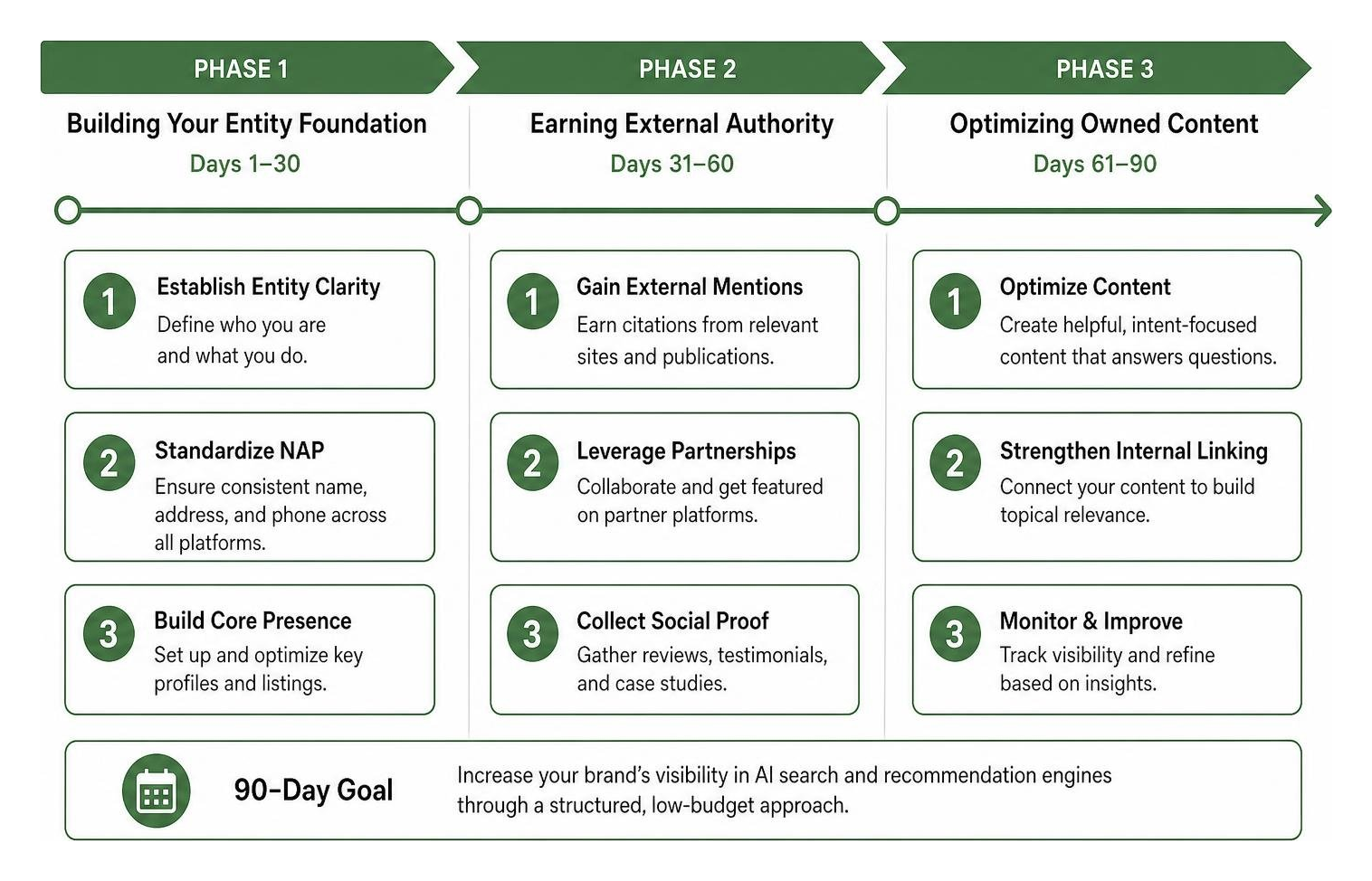
Phase 1: Building Your Entity Foundation (Days 1-30)
Before you try to get cited, you must make sure AI engines actually know you exist. AI models do not just read websites; they build relationships between entities. Your goal in the first 30 days is to establish entity clarity.
- Standardize Your NAP (Name, Address, Phone): Ensure your brand name, address, and contact details are identical across your website, social profiles, and local directories. AI treats “TechCo Inc.” and “TechCo, LLC” as separate, competing entities, which dilutes your authority.
- Create a Wikidata Entry: Wikidata is a primary structured data source for many large language models. Creating a neutral, well-sourced entry with your founding date, product categories, and key details is a massive step for entity recognition.
- Optimize Your LinkedIn Company Page: LinkedIn is heavily crawled by professional AI engines like Microsoft Copilot. Post at least once a week to signal active operations.
As detailed in the guide on How to Build AI Visibility for a Brand New Company | BabyPenguin.AI, establishing this foundational entity node is critical; otherwise, real-time search crawlers will simply ignore your website.
Phase 2: Securing Third-Party Coverage (Days 31-60)
Once your foundation is set, you must secure third-party validation. AI engines are highly skeptical of what you say about yourself. They look for corroboration across the web.
- Target Niche Publications: Pitch guest posts or share original data with industry bloggers. AI crawlers love authoritative, independent third-party articles.
- Provide Expert Quotes: Use free platforms to connect with journalists looking for expert insights. Earning a quote in a major industry publication creates a powerful, highly trusted citation source for AI engines.
- Encourage Organic Discussions: Participate in community forums and discussions. When real people talk about your brand on platforms like Reddit, AI models index these conversations as genuine social proof.
This approach is highly cost-effective. As explained in the analysis on Why Lean Marketing Teams Need AI Visibility to Compete – Perhaps.com, lean teams can easily outmaneuver slow enterprise competitors by building a highly coordinated web of third-party mentions.
Phase 3: Optimizing Owned Content (Days 61-90)
With a strong foundation and external mentions in place, you can now optimize your own website to make it incredibly easy for AI crawlers to read and cite.
- Write Answer-First Content: Structure your articles so they directly answer user queries within the first few sentences.
- Publish Original Data: Conduct small customer surveys or analyze public data to create unique benchmarks. Original research acts as a “citation magnet” because AI engines must reference the source of the data.
- Build Comprehensive FAQ Pages: Group questions by intent and provide short, clear, factual answers.
Optimizing Your Content for AI Search Engines
Optimizing your website for AI search engines is called Answer Engine Optimization (AEO). The goal is simple: make your content as legible and structured as possible so AI crawlers can extract your data without running into technical errors.
To help speed up this optimization process, we recommend utilizing the Top AI Search Optimization Tools for Content Creators 2026 Guide.
Structuring Web Pages for AI Crawlers
AI crawlers prefer clean, structured, and predictable code. To ensure your site is easy to crawl, focus on these technical elements:
- Use JSON-LD Schema Markup: Add Organization, Product, and FAQ schema to your key pages. This provides machine-readable metadata that explicitly tells the AI what your business does, who you serve, and what products you sell.
- Implement Semantic HTML: Use clear header hierarchies (H1, H2, H3) to organize your content. This helps AI models understand the relationship between different topics on a page.
- Audit Your Robots.txt: Ensure your robots.txt file is not accidentally blocking major AI crawlers (like GPTBot or ClaudeBot). If they cannot crawl your site, they cannot recommend you.
- Optimize Page Speed: AI crawlers value efficiency. Ensure your pages load quickly and render perfectly even if JavaScript is disabled.
Writing for AI Extraction and Citations
Writing for AI is slightly different than writing for traditional search engines. AI models value directness, factual accuracy, and objectivity over marketing hype.
- Apply the First 30% Rule: Data shows that 44.2% of ChatGPT citations come from the first 30% of an article. Front-load your most valuable insights, answers, and statistics. Do not bury the lead.
- Adopt a Neutral, Factual Tone: Avoid overly promotional language, exclamation points, and subjective claims (e.g., “We are the absolute best skincare brand on earth”). Instead, use clear, evidence-based statements (e.g., “Our organic moisturizer is formulated with 100% cold-pressed rosehip oil”).
- Maintain High Publishing Velocity: The median time for AI to pick up fresh content is just 6.8 days, and 90% of content gets cited within 37 days. Because half of everything AI cites is less than 13 weeks old, you must publish fresh content consistently to avoid falling out of the active citation window.
By structuring your content this way, you make it incredibly easy for AI engines to extract your facts. You can learn more about how these technical tweaks translate to traffic in our guide on How AI Search Optimization Tools Increase Organic Traffic in 2026.
Leveraging Third-Party Validation and Creator Authority
One of the biggest mistakes small brands make is relying solely on their own website to build authority. AI engines are built to combat self-promotion. They know that every brand claims to be the best. Because of this, AI models value third-party validation far more than owned media.
To build a trusted digital footprint, small brands must leverage user-generated content (UGC), community discussions, and creator partnerships. If you run an online storefront, you can explore the Best AI Tools for Ecommerce in 2026 to see how automated software helps manage reviews and scale social proof.
The Power of Reddit, YouTube, and LinkedIn
AI platforms rely heavily on massive, highly active social ecosystems to understand consumer sentiment. Different AI models have clear platform-to-AI pipelines that you can target:
- Reddit (The ChatGPT Pipeline): OpenAI has direct partnerships to access real-time Reddit data. When users ask ChatGPT for honest recommendations, it heavily pulls from Reddit discussions. Engaging genuinely in relevant subreddits is one of the highest-ROI activities for organic visibility.
- YouTube (The Google & Copilot Pipeline): Video citations are rising rapidly. YouTube moved from roughly #247 to #34 in ChatGPT citations and from #61 to #13 in Copilot citations. Creating short, educational tutorial videos or product comparisons on YouTube is a highly effective way to earn high-authority citations.
- LinkedIn (The Copilot Pipeline): Because Microsoft Copilot draws heavily from professional networks, publishing consistent, high-value industry insights on LinkedIn is critical for B2B brands.
Building Trust Through Independent Reviews
AI engines continuously search the web for corroboration. If your brand is mentioned on your website, but nowhere else, the AI will not trust you.
According to research on trust, 86% of consumers still want to verify AI-provided information against an original source. This means getting cited is only half the battle; you must also be believable.
To build this trust, focus on earning independent reviews, expert round-up mentions, and customer success stories. These independent trust signals are highly valued by algorithms, a concept explored in depth in the AI Brand Recommendation Strategy: Complete AEO Guide.
Measuring and Tracking AI Visibility Without Expensive Tools
You do not need an enterprise budget to track how well your brand is performing in AI search engines. While automated tracking software is highly useful, you can easily set up a manual tracking system for free.
- Run Manual Prompt Tests: Once a month, open ChatGPT, Gemini, and Perplexity. Ask them real, conversational questions your buyers would ask (e.g., “What are the best budget-friendly project management tools for small teams?”). Note whether your brand is recommended, how it is described, and which sources the AI cites.
- Track Your Share of Voice: Calculate how often your brand appears in these recommendations relative to your top three competitors.
- Analyze Sentiment: Pay attention to the adjectives the AI uses to describe your brand. Is it framing you as a “budget option,” a “premium choice,” or is it hallucinating incorrect details?
- Implement Self-Reported Attribution: Add a simple, free “How did you hear about us?” field to your signup or checkout forms. Include “AI Search or Chatbot” as an option. This is often the most accurate way to track zero-click conversions.
If you are ready to scale your tracking, you can review our curated list of the Best AI Visibility Tools for Marketers in 2026 to find affordable tracking software.
Frequently Asked Questions about AI Brand Visibility
How fast does AI index and cite new content?
AI search engines index the web incredibly fast. The median time it takes for an AI engine to pick up and cite fresh content is just 6.8 days. Furthermore, 90% of content gets cited within about 37 days. However, because AI engines prioritize freshness, half of everything they cite is less than 13 weeks old. This means content has a relatively short shelf-life, making consistent publishing crucial.
Which platforms offer the highest ROI for organic AI visibility?
Currently, YouTube, Reddit, and LinkedIn offer the highest ROI. Over the last six months, social and user-generated content rose dramatically as a share of citations across almost all major AI engines. YouTube in particular has seen explosive citation growth, leaping from #247 to #34 in ChatGPT citations and from #61 to #13 in Copilot citations.
What is the difference between retrieval and recommendation in AI search?
- Retrieval is the technical process of an AI crawler finding your content and extracting the facts to answer a specific query.
- Recommendation is when the AI trusts your brand enough to actively put your name forward as a top solution unprompted.
While retrieval relies on technical SEO and schema markup, recommendation relies on third-party trust signals, reviews, and consistent brand mentions across the web.
Conclusion
The shift from traditional search engines to AI-driven answer engines represents a massive opportunity for small and mid-sized brands. By focusing on entity clarity, structured data, and third-party validation, lean teams can easily outmaneuver corporate competitors without spending thousands on paid ads.
Winning in the AI era is not about being the loudest; it is about being the most trusted, clear, and easily indexable source of information in your niche. By implementing the steps in this guide, you can build a highly visible, AI-friendly digital footprint that drives sustainable, organic growth.
If you are looking to streamline your operations and free up more time to focus on strategic brand building, explore our guide on What is the Best AI for Productivity in 2026 to find the ultimate tools for your daily workflow.
Nice post. I learn something totally new and challenging on blogs
I stumbleupon everyday. It’s always helpful to read through
content from other writers and practice a little something from other websites.