Why Homeowners Short Term Rental Insurance Is Not Optional in 2026

Homeowners short term rental insurance is a specialized policy that protects property owners from the unique financial risks that come with renting out a home — or part of one — to paying guests on platforms like Airbnb or Vrbo.
Here’s the quick answer most hosts need:
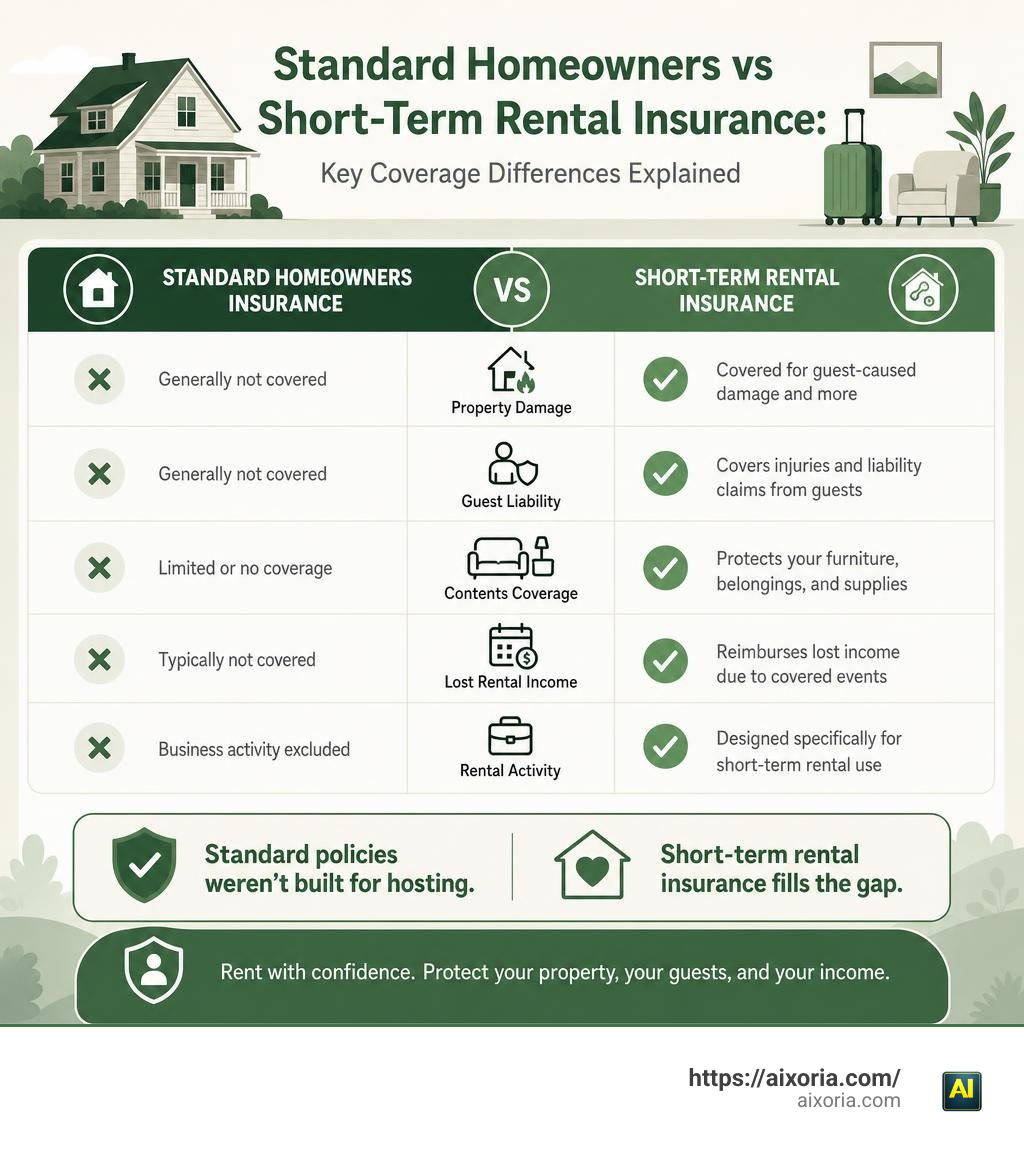
- Standard homeowners insurance does NOT cover short-term rentals. Most policies exclude damage or injuries that occur when you rent to guests, treating it as a business activity.
- Platform coverage (like Airbnb’s AirCover) is not a full insurance policy. It only applies to bookings made through that specific platform and has significant limitations.
- Specialized short-term rental insurance fills the gap — covering property damage, guest liability, contents loss, and lost rental income.
- Some states require it by law. Massachusetts, for example, mandates at least $1,000,000 in liability coverage for every short-term rental property.
The short-term rental market has exploded. The number of short-term rental properties in the U.S. has grown from roughly 200,000 a decade ago to over 2,000,000 today. That’s a lot of homeowners taking on real financial risk — often without realizing their existing policy leaves them completely exposed.
As Massachusetts regulators put it plainly: “Typical home insurance policies do not cover property damage or injury when renting to others.”
If you’re listing your home — even just occasionally — you need to understand what you’re covered for, what you’re not, and what it takes to fix the gap.
What is Homeowners Short Term Rental Insurance?
At its core, homeowners short term rental insurance is a hybrid insurance policy. It is specifically designed to replace or supplement your standard homeowners insurance policy when your property is being used as a commercial vacation rental.
Unlike a standard home policy, which assumes you (the owner) are living in the home full-time, short-term rental coverage is built to handle what the industry calls “quadruple occupancy.” This means the policy remains active and fully protective whether the property is occupied by short-term guests, mid-term tenants, yourself for personal vacation days, or if it sits completely vacant between bookings.

When you decide to list your property, your risk profile changes completely in the eyes of insurance underwriters. You are no longer just a homeowner; you are running a hospitality business. Whether you are renting out a spare bedroom, an accessory dwelling unit (ADU), or an entire secondary investment property, you need coverage that recognizes this commercial exposure.
To understand how your specific setup impacts your risk, it is highly useful to evaluate your property category and how your building type dictates your insurance needs.
Why Standard Homeowners Policies Exclude Short-Term Rentals
Standard homeowners policies (often referred to as HO-3 policies) are built on the assumption of a stable residency. They contain strict “residence premises” definitions, meaning the policy is priced and written under the condition that the owner resides in the home.
The moment you invite paying guests into your home, you trigger the “business activity” exclusion found in almost every standard policy. Because vacation rentals involve frequent guest turnover, insurance companies view them as significantly higher risk. There is a greater chance of accidental fires, water damage, theft, and liability claims when temporary occupants are unfamiliar with the home’s layout or safety systems.
If you attempt to file a claim for guest-caused damage under a standard policy, your insurer is highly likely to deny the claim entirely—and they may even cancel your policy on the spot for material misrepresentation of risk. To see how standard residential policies handle other types of tenant arrangements, you can read our State Farm Renters Insurance Review 2026 Coverage Cost Discounts.
How Short-Term Rental Insurance Differs from Landlord Insurance
A common point of confusion for new hosts is the difference between short-term rental coverage and traditional landlord insurance (often called dwelling fire or DP-3 policies).
Landlord policies are designed for long-term tenancies—typically leases of six months or a year. They assume a consistent tenant who signs a lease, pays a security deposit, and takes basic care of the property over an extended period. Landlord policies also assume the home will rarely sit vacant.
In contrast, short-term rentals experience a rotating door of guests who may only stay for a weekend. Landlord policies typically exclude short-term guest occupancy and do not provide commercial general liability. Furthermore, standard landlord policies often have strict vacancy clauses; if a property sits empty for more than 30 or 60 consecutive days during the off-season, coverage can be severely restricted. Short-term rental insurance is specifically structured to eliminate these gaps, offering seamless coverage regardless of occupancy frequency.
Key Coverage Types Included in Short-Term Rental Policies
When you purchase a dedicated homeowners short term rental insurance policy, you are securing a comprehensive safety net designed to protect your physical asset, your personal property, and your financial livelihood.
To help you visualize how these different insurance types stack up, here is a quick comparison of the three primary policy forms:
| Coverage Feature | Standard Homeowners (HO-3) | Standard Landlord (DP-3) | Commercial Short-Term Rental |
|---|---|---|---|
| Primary Occupancy | Owner-occupied | Long-term tenant | Rotating short-term guests |
| Business Activity Exclusion | Yes (Strictly excluded) | Yes (Limited to rental) | No (Fully covered) |
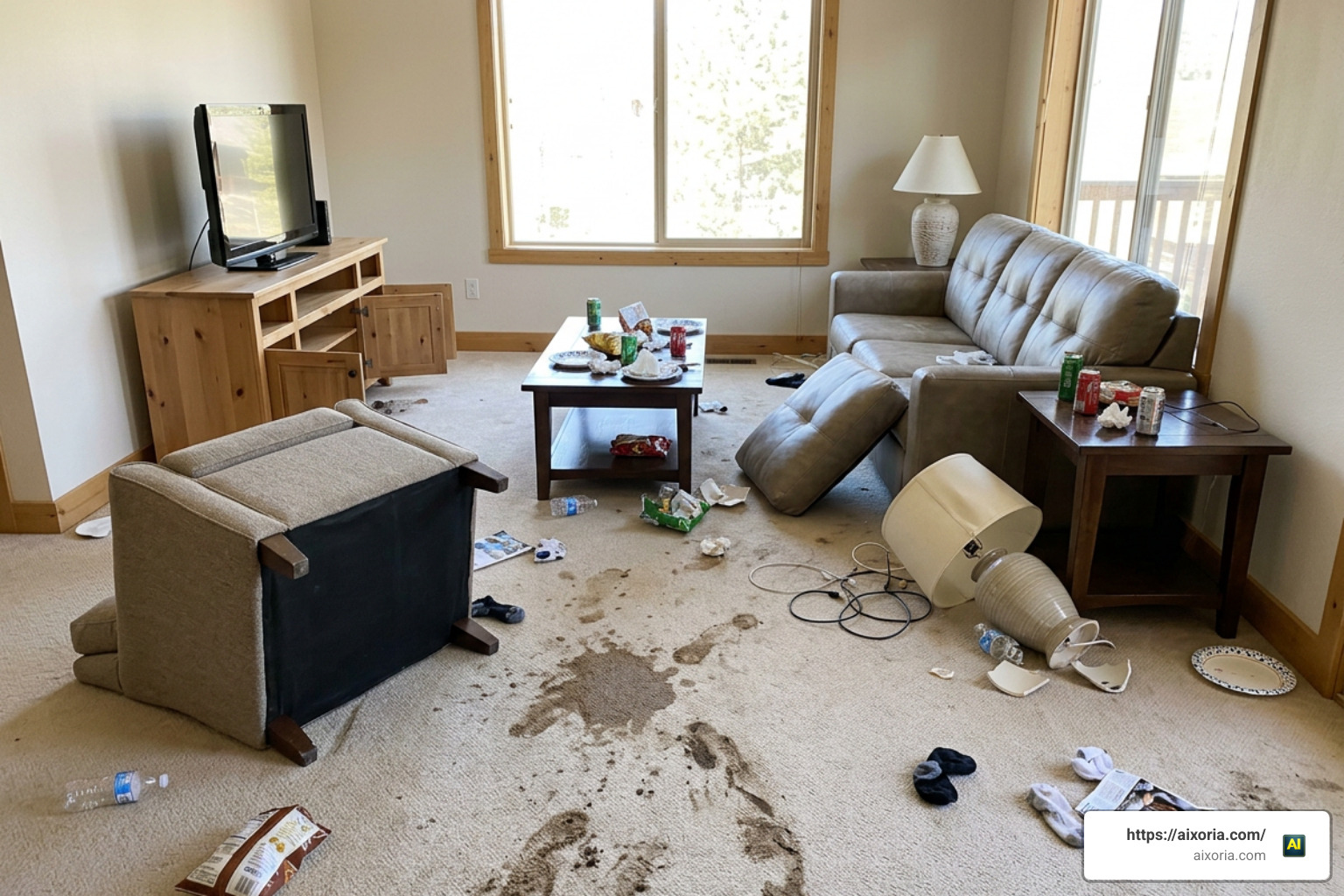
| Guest-Caused Property Damage | Excluded | Excluded / Limited | Included (No sub-limits) |
| Liability Coverage Type | Personal Liability | Premises Liability | Commercial General Liability |
| Loss of Rental Income | No | Yes (For long-term lease) | Yes (Actual Loss Sustained) |
| Amenity Liability (Pools, Bikes) | Excluded if used by guests | Excluded | Included (On & Off-premises) |
Property and Contents Protection
Your vacation rental is filled with valuable structural elements and high-end furnishings designed to make your guests feel at home. A robust short-term rental policy covers both the physical structure of your home (dwelling protection) and the items inside it (contents protection) on a replacement cost basis.
This means if a guest accidentally starts a kitchen fire, ruins your hardwood floors, or steals your smart TVs, the policy will pay to replace the items at current market prices without deducting for depreciation. Specialized insurers in this space offer incredibly robust property protection.
For a deeper look at how specialized property insurers structure their dwelling and personal property coverage, check out our American Modern Insurance Review 2026 Coverage Cost Pros Cons.
Commercial General Liability and Amenity Coverage
Liability is the single greatest risk vacation rental owners face. If a guest slips on an icy step, falls down your stairs, or suffers a serious injury while using your property, you could be held personally liable for their medical bills, lost wages, and pain and suffering.
Short-term rental policies provide Commercial General Liability (CGL) rather than standard personal liability. CGL is the same level of commercial protection used by major hotels. Specialized providers offer $1,000,000 of commercial general liability coverage as a standard, with options to increase that limit to $2,000,000 or more.
Crucially, this commercial liability extends to your property’s amenities. If your listing features a hot tub, a swimming pool, bicycles, a golf cart, or kayaks, a standard policy will almost certainly exclude injuries related to their use. A commercial short-term rental policy specifically covers these amenities, protecting you even if a guest is injured using your provided bicycle blocks away from the property.
Business Revenue Protection for Hosts
If a pipe bursts or a fire breaks out, the physical damage is only half the battle. Your property could be unrentable for weeks or even months while repairs are completed. During this time, you aren’t just losing out on potential future bookings—you may have to refund guests who have already reserved the space.
Business revenue protection (also known as Loss of Rental Income) steps in to reimburse you for the actual revenue you would have generated during the restoration period. Rather than placing a strict time limit on your recovery, premium commercial policies pay out based on your “actual loss sustained,” using your historical booking data and seasonal trends to calculate exactly what you are owed.
To ensure you have this vital business protection in place, you can explore specialized short-term rental policies that keep your cash flow steady when disaster strikes.
Evaluating Platform Coverage, Costs, and Policy Selection
Many hosts assume they do not need independent homeowners short term rental insurance because platforms like Airbnb and Vrbo offer built-in protection plans. While these programs are an excellent secondary layer of defense, relying on them as your primary insurance is a dangerous gamble.
To truly protect your investment, you need a dedicated policy that integrates seamlessly with your hosting style. For instance, some specialized providers offer on-demand insurance that can be integrated directly with your property management software to automate guest coverage.
Limitations of Airbnb and Vrbo Protection Plans
Airbnb’s AirCover and Vrbo’s basic liability policies are not actual insurance contracts. They are corporate guest-protection programs, and they come with major fine print:
- No Coverage for Direct Bookings: If you decide to book a guest directly to save on platform fees, or if you use another booking channel like Booking.com, platform-provided coverage will not protect you.
- Strict Claim Timelines: AirCover requires you to submit claims and document damage within tight windows (often before the next guest checks in), which can be nearly impossible if you manage your property remotely.
- Exclusions and Denials: These programs often exclude deep-cleaning costs, bed bug infestations, mold, and damage caused by guest pets.
- Slow Payouts: If you do have to file a claim through a platform, you may face weeks of negotiations and administrative hurdles before seeing a dime.
By contrast, specialized insurance companies prioritize rapid claims handling, often resolving claims within just a few days. If you want to understand how different types of travel-related insurance and booking protection plans compare on a broader scale, take a look at our Travel Insurance Comparison 2026 Compare Plans Save Money.
Legal Requirements and State Mandates for Homeowners Short Term Rental Insurance
As the vacation rental industry has matured, local and state governments have stepped in to regulate how these properties are insured. It is no longer just a matter of personal risk management—in many jurisdictions, carrying commercial-grade liability insurance is the law.
Massachusetts is a prime example of this regulatory shift. Under Massachusetts law (specifically Chapter 337 of the Acts of 2018), all short-term rental operators are legally required to maintain at least $1,000,000 of liability insurance to cover each short-term rental. This coverage must specifically defend against bodily injury and property damage claims brought by guests or third parties.
If you fail to maintain this coverage, you risk heavy fines, loss of your rental permit, and complete personal exposure in a lawsuit. To read the official state guidelines and check compliance requirements for your own property, you can review the Short-Term Rental Insurance | Mass.gov portal.
Steps to Secure Adequate Homeowners Short Term Rental Insurance
Securing the right policy doesn’t have to be overwhelming. We recommend following these three clear steps:
- Conduct a Thorough Risk Assessment: Walk through your property and list your highest risk factors. Do you have a pool? A wood-burning fireplace? Do you allow pets? Knowing your specific exposures helps you choose the right endorsements.
- Accurately Value Your Assets: Don’t guess on your contents value. Document your furniture, electronics, and high-end amenities with photos and receipts. Ensure your policy’s contents limit matches the actual replacement cost of these items.
- Compare Dedicated STR Providers: Reach out to specialized short-term rental insurance carriers rather than trying to force a standard residential insurer to cover your business. Look for providers that offer custom quotes, high liability aggregates, and loss-of-income coverage.
To help you get started with comparing competitive quotes from top-rated short-term rental specialists, you can work with a specialized broker. Having a specialized broker compare quotes ensures you get the best possible rate without sacrificing critical coverage. If you are also interested in seeing how top-tier traditional carriers are ranked for their claims handling and customer service reputation, check out our guide on the Most Reputable Car Insurance Companies In 2026 Top 10 Ranked.
Frequently Asked Questions about Short-Term Rental Insurance
Navigating commercial property coverage can raise a lot of questions. Here are the answers to the most common queries we receive from hosts.
What is typically excluded from short-term rental insurance?
While short-term rental policies are incredibly broad, they do have standard exclusions. Most policies will not cover:
- Intentional Damage by the Owner: If you deliberately damage your own property, it will not be covered.
- Normal Wear and Tear: Gradual deterioration, such as carpet staining over time or minor wall scuffs, is considered a cost of doing business and is not covered.
- Acts of Nature (Without Specific Riders): Standard policies may exclude or limit coverage for floods, earthquakes, and hurricanes unless you purchase specific regional catastrophe riders.
- Unsecured High-Value Valuables: Extremely expensive jewelry, fine art, or physical cash left in the home are typically excluded or subject to very low coverage limits.
Can I just add a home-sharing endorsement to my existing policy?
Many traditional insurance companies offer a “home-sharing endorsement” as a cheap add-on to your existing homeowners policy. While this might sound like an easy fix, these endorsements are usually designed for very limited situations—such as a homeowner who rents out a single room while they remain in the house, or someone who swaps houses for a single weekend once a year.
These endorsements typically carry strict limitations, such as a cap on the number of rental days per year (often 62 days or fewer) or a limit on the total rental income you can earn. If you exceed these limits, your coverage can be voided entirely. Furthermore, they rarely cover guest-caused vandalism, pet damage, or off-premises amenity liability.
If you want to see how specialty insurance reviews help clarify what is and isn’t covered in niche policies, read our Aspire General Insurance Review 2026 Coverage Claims Customer Ratings.
How much liability coverage do I actually need as a host?
As a general rule of thumb, you should carry a minimum of $1,000,000 in Commercial General Liability coverage per occurrence. If you own a high-value property, host large groups, or have high-risk amenities like a swimming pool, hot tub, or waterfront access, you should strongly consider upgrading to a $2,000,000 or $3,000,000 limit.
In our highly litigious society, a single serious slip-and-fall accident can easily result in medical bills and legal fees that exceed $1,000,000. Having a robust commercial liability policy—potentially backed by a commercial umbrella policy—ensures your personal assets and future earnings are completely protected.
If you are leasing a property from a landlord and subletting it on short-term platforms, you face these exact same liability risks. To protect yourself in this specific business model, you should secure specialized rental arbitrage insurance that covers vacation rental subleasing.
Conclusion
Operating a successful vacation rental in 2026 is an incredibly rewarding venture, but it requires a professional approach to risk management. Relying on standard homeowners insurance, basic landlord policies, or platform-provided protection plans leaves your most valuable assets dangerously exposed.
By securing a dedicated homeowners short term rental insurance policy, you protect your physical property, your hard-earned rental income, and your personal financial future from the unexpected. Take the time to evaluate your property type, calculate your true replacement costs, and partner with a specialized insurer who understands the unique demands of the modern sharing economy.
We are dedicated to helping you navigate the evolving landscape of insurance, technology, and risk management. To stay ahead of the curve and discover how emerging technologies are transforming the vacation rental and insurance industries, Explore our latest AI updates and industry insights.
3 thoughts on “Homeowners Short-Term Rental Insurance in 2026: What Every Host Needs to Know”