Why Best Website Content Writing Is the Foundation of Your Online Growth
Scr0ll d0wn to D0VVNL0AD
Finding the best website content writing service or tool is one of the most important decisions you can make for your business online. But with dozens of options out there, it’s easy to feel overwhelmed.
Here’s a quick answer to help you decide fast:
| Need | Best Option Type |
|---|---|
| High-quality, human-written content | Freelance writers or managed platforms (e.g., WriterAccess) |
| Fast, scalable blog content | AI writing tools (e.g., Jasper, Byword, Writesonic) |
| SEO-focused articles that rank | SEO-first platforms with keyword research built in |
| Budget-friendly content | AI tools with free tiers (e.g., Ubersuggest AI Writer) |
| Niche or technical content | Specialist human writers with industry expertise |

The stakes are real. Content marketing generates roughly 3 times as many leads as traditional outbound marketing — at about 62% less cost. And companies that publish 16 or more blog posts per month get 3.5 times more traffic than those publishing just a handful.
Yet most small business owners don’t have hours to spend writing, editing, and optimizing content every week. That’s exactly why choosing the right writing service or tool matters so much.
The landscape in 2026 looks very different from just a few years ago. You now have a mix of human-led writing platforms, AI-powered content generators, and hybrid solutions that blend both. Each has real strengths — and real trade-offs.
This guide breaks it all down in plain language, so you can pick the right fit for your business without needing a marketing degree.
What Defines the Best Website Content Writing in 2026?
In 2026, the best website content writing is no longer just about stuffing keywords into a 500-word blog post and hoping for the best. Search engines have evolved, and readers have zero patience for fluff.
Today, top-tier web content must strike a delicate balance between search engine optimization (SEO) and exceptional user experience (UX). It starts with understanding search intent—knowing exactly what a user is looking for when they type a query into a search bar. Is it a quick answer, a detailed comparison, or a step-by-step tutorial?
To capture organic traffic and keep eyes on your page, your content needs to be highly readable. This means using common language, short paragraphs (ideally 70 words or fewer), bulleted lists, and clear headers that let readers scan the page. In fact, studies show that web users typically read only about 20% of the text on a page. If your content is a massive wall of text, they will bounce.
To stay ahead of these trends, many businesses are adopting advanced tools to streamline their processes. If you want to see how the landscape has shifted, check out our guide on the Best Ai Tools For Content Creation In 2026 to understand how modern technology supports high-performance writing.

Human Writers vs. AI Writing Tools: A Comparative Analysis
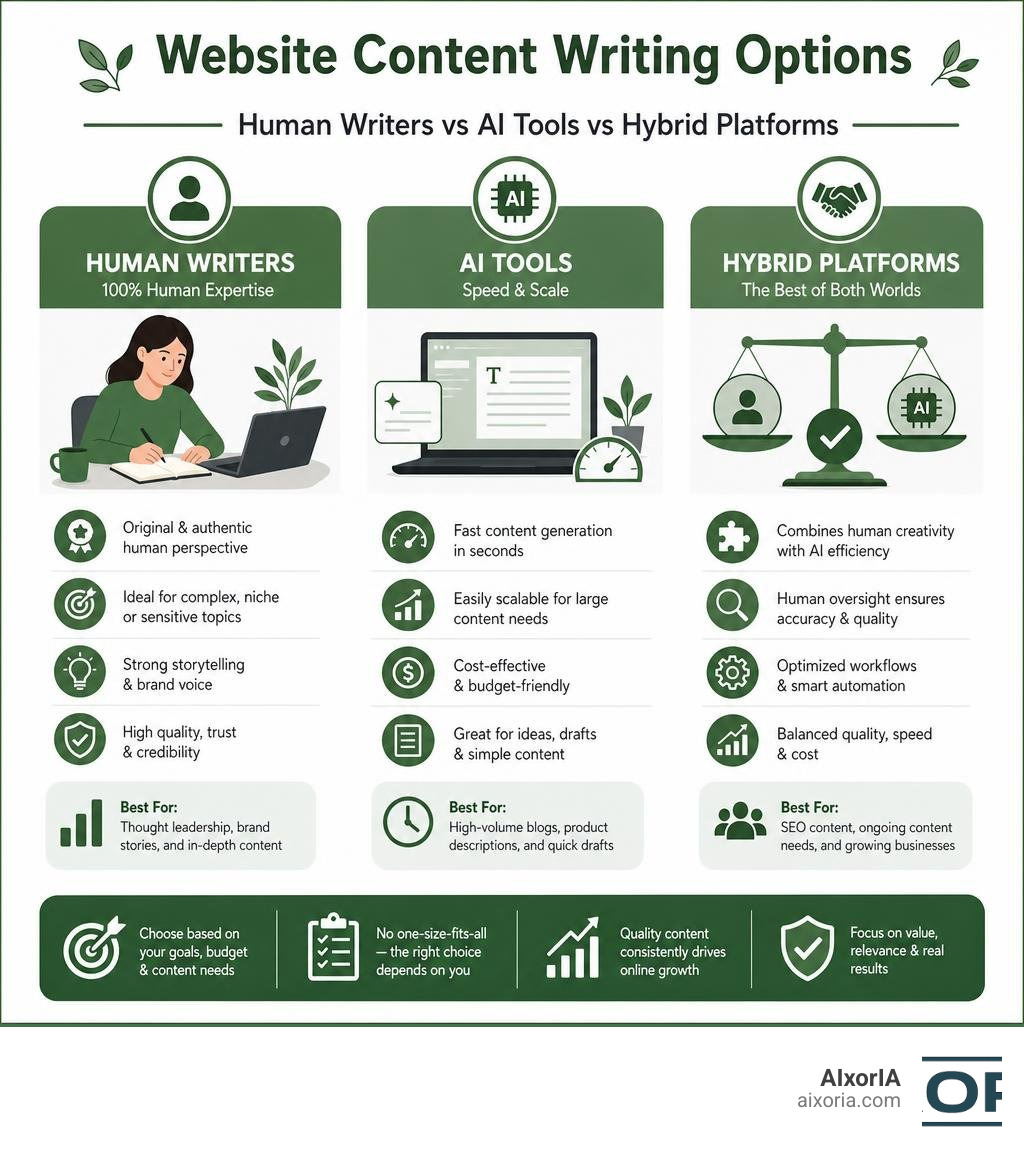
When planning your content strategy, one of the biggest decisions is choosing between human-led writing services and AI-powered writing tools. Both options offer unique advantages depending on your budget, timeline, and quality requirements.
| Feature | Human Writers | AI Writing Tools |
|---|---|---|
| Content Scalability | Low to Moderate (limited by human hours) | High (can generate dozens of articles in minutes) |
| Emotional Depth | High (uses storytelling, empathy, and real-life experiences) | Low (can feel repetitive or generic without heavy editing) |
| Cost Efficiency | Higher upfront cost (per word or per hour) | Extremely low cost per article |
| SEO Optimization | Excellent (when paired with a skilled strategist) | Built-in and rapid, but requires factual verification |
| Originality | High (unlikely to hallucinate or copy directly) | Moderate (relies on existing training data) |
For many businesses, the sweet spot lies in a hybrid approach: using AI to handle the heavy lifting of research and drafting, and then employing human editors to refine the tone. If you are polishing AI drafts, using the Best Ai Paraphrasing Tool For Marketing Content 2026 can help you keep your copy unique and engaging. Alternatively, you can rely on platforms that focus on human-led content creation to ensure your brand voice remains soulful and authentic.
The Role of Human Expertise in the Best Website Content Writing
While AI has gotten incredibly smart, there are elements of writing that machines simply cannot replicate. Human writers bring empathy, cultural nuance, and deep industry expertise to the table. They understand how to weave your unique brand voice into a narrative that builds trust with your audience.
Furthermore, human writers can conduct original research, conduct interviews, and share real-world anecdotes that make an article stand out in a sea of automated search results. This is especially critical for competitive niches like legal, medical, or SaaS, where generic advice won’t cut it. Utilizing professional SEO content writing services ensures that your pages are built by hand, thoroughly researched, and specifically structured to convert readers into paying customers.
Leveraging AI Generators for the Best Website Content Writing
On the other side of the coin, AI generators are unmatched when it comes to speed, brainstorming, and overcoming writer’s block. If you need to map out fifty blog post outlines or generate initial drafts for simple topics, AI can save you hours of staring at a blank screen.
Today’s specialized tools are designed specifically for search performance. For example, you can use a high-velocity AI article writer to generate research-backed articles in under two minutes, or leverage an AI content writer for SEO to automatically build rich snippets, FAQs, and external links. Even if you are on a tight budget, using a free AI content generator can help you spin up click-worthy blog ideas and structured outlines on semi-autopilot.
Tools like Writesonic and Jasper have also popularized brand voice customization, allowing you to upload past writing samples so the AI can mimic your specific style.
Key Criteria for Choosing a Content Writing Platform
Not all content platforms are created equal. To find the one that fits your workflow, keep these five essential criteria in mind:
- Pricing Models: Decide whether you prefer a pay-per-word model, a monthly subscription, or a flat rate for a managed service.
- Turnaround Time: AI tools can deliver drafts in under two minutes, while professional human writers typically require three to seven days to research and write a comprehensive piece.
- Plagiarism Checks: Ensure the platform integrates reliable scanning tools (like Copyscape) to guarantee that all delivered content is 100% original.
- SEO Integration: Look for built-in features like real-time keyword density scoring, search intent analysis, and automated internal linking recommendations.
- Niche Expertise: If your business is highly technical, choose a platform that allows you to filter writers by their specific industry credentials.

Frequently Asked Questions about Website Content Writing
How do content platforms handle plagiarism and originality?
Most reputable content writing platforms take originality very seriously. Human-led platforms typically run every submission through plagiarism detection software like Copyscape before delivering it to the client.
For AI tools, the risk of direct plagiarism is relatively low because large language models generate text by predicting the next logical word rather than copying and pasting. However, AI can still produce repetitive structures or “hallucinate” facts. The best practice is always to run AI-generated drafts through a plagiarism checker and have a human editor review the facts and sources before hitting publish.
What is the average ROI of professional web content?
Investing in the best website content writing yields excellent long-term return on investment (ROI). Unlike paid ads, which stop driving traffic the moment you stop paying, optimized blog posts and pillar pages act as permanent digital assets.
High-quality web content builds compounding organic traffic over time. By targeting specific search queries, you attract high-intent visitors who are actively searching for solutions. This leads to higher conversion rates, stronger brand authority, and a steady stream of incoming leads at a fraction of the cost of traditional outbound advertising.
How long does it take for optimized content to rank on Google?
Once your new content is published and indexed, you will typically start seeing impressions in Google Search Console within 7 to 14 days. However, meaningful ranking movement for moderate-competition keywords generally takes between 30 and 90 days.
This timeline depends heavily on your website’s existing domain authority and how well your content satisfies search intent compared to competitors on the search engine results page (SERP). If you are updating an existing URL with a content refresh, you will often see ranking improvements much faster because search crawlers are already familiar with the page.
Conclusion
Whether you choose a human-only approach, fully automated AI generation, or a smart hybrid model, the key to successful website content writing lies in consistency and quality.
At AIxorIA, we are dedicated to helping businesses navigate this rapidly evolving digital landscape. We provide custom AI solutions, tool training workshops, practical tutorials, and thorough performance audits to empower your team to write smarter and rank faster. We believe in providing simple language help, affordable services, and fast support to make your digital transformation as seamless as possible.
Ready to supercharge your content creation workflow and boost your team’s efficiency? Explore our AI Productivity Category for more guides, tools, and expert tips designed to help you succeed online!
1 thought on “Best Website Content Writing 2026: High-Converting Content That Ranks and Sells”