Why Understanding the 5 Categories of Social Media Tools Changes Everything
Scr0ll d0wn to D0VVNL0AD
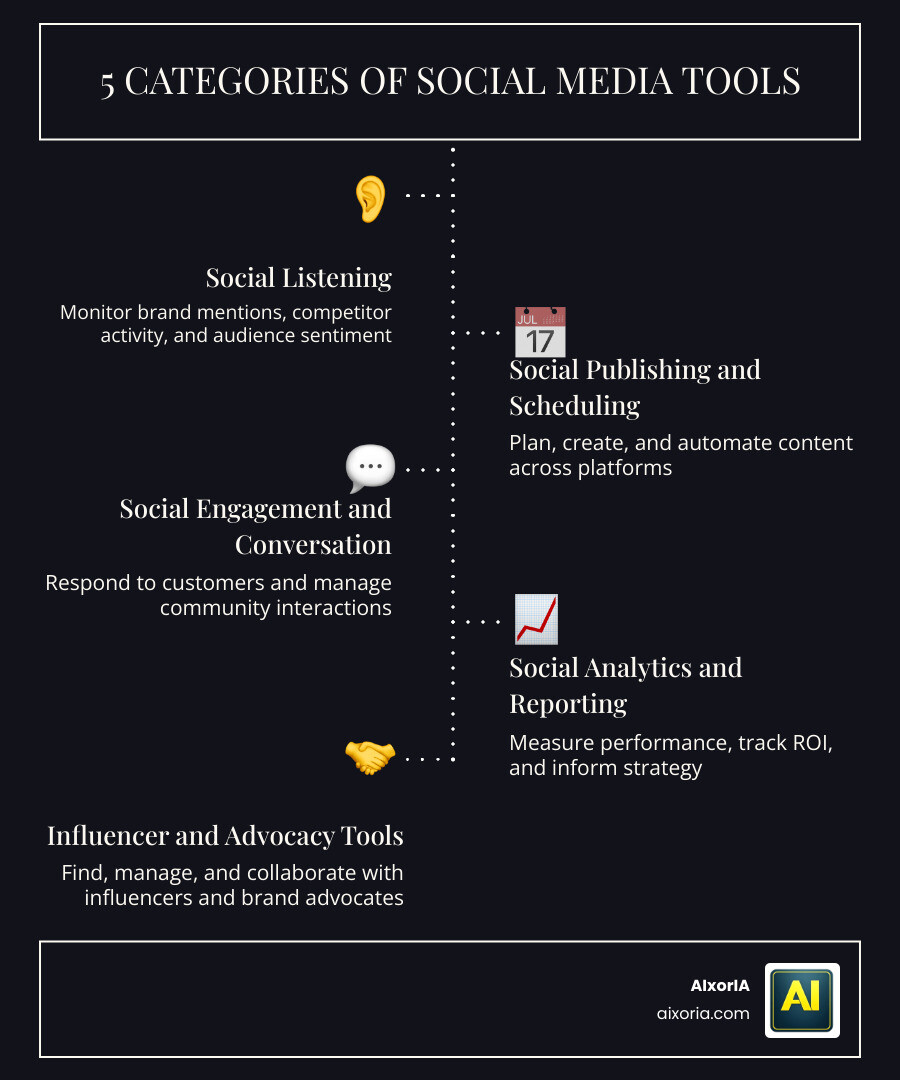
If you’ve ever wondered what are the 5 categories of social media tools, here’s the quick answer:
- Social Listening — Monitor brand mentions, competitor activity, and audience sentiment
- Social Publishing and Scheduling — Plan, create, and automate content across platforms
- Social Engagement and Conversation — Respond to customers and manage community interactions
- Social Analytics and Reporting — Measure performance, track ROI, and inform strategy
- Influencer and Advocacy Tools — Find, manage, and collaborate with influencers and brand advocates
Right now, around 4.76 billion people use social media — that’s 59% of the entire global population. For a small business owner, that’s an enormous opportunity.
But here’s the problem most beginners run into: they sign up for a tool, post a few times, and then… nothing. No clear results. No idea what’s working.
That usually happens because they grabbed one tool without understanding why different tools exist in the first place.
Social media tools aren’t all the same. Each category solves a different problem — from finding out what people say about your brand, to publishing content on autopilot, to proving that your effort is actually paying off.
Once you understand the five categories, choosing the right tools becomes much simpler. And you stop wasting money on software you don’t actually need.
What are the 5 categories of social media tools?
When we talk about social media software, it is easy to get lost in a “feature war.” One tool says it does everything, while another claims to be a specialist. To make sense of it all, we like to look at things from a functional perspective. This means we focus on the actions the tools enable rather than just their shiny buttons.
Research into The 5C categorization of social media tools suggests that successful social media initiatives treat tools as enablers for specific business purposes. Whether you are communicating, collaborating, or connecting, each tool should serve a strategic goal.
In May 2026, the landscape is more crowded than ever, but these five categories remain the bedrock of any digital strategy. Here is a quick breakdown to help you differentiate them:
| Tool Category | Primary Goal | User Type | Key Action |
|---|---|---|---|
| Social Listening | Market Intelligence | Researchers / PR | Monitoring |
| Publishing | Content Distribution | Content Creators | Scheduling |
| Engagement | Customer Support | Community Managers | Responding |
| Analytics | ROI & Performance | Strategists / Owners | Measuring |
| Influencer | Trust & Reach | Marketers | Partnering |
Deep Dive into the 5 Essential Tool Types
As we navigate the 2026 digital world, it is clear that no single platform solves every problem. We often find that the most effective marketing teams use a “stack” of 4 to 8 different tools that work together. Understanding What Are Social Media Tools? | Conbersa helps us see that these software products are designed to help us operate across multiple channels—like TikTok, LinkedIn, and Instagram—without losing our minds.
Let’s dive into each category so you can identify which ones your business needs right now.
1. Social Listening: Understanding What are the 5 categories of social media tools?
Social listening is like having “digital ears” across the entire internet. It isn’t just about seeing who tagged you in a post; it’s about tracking brand mentions, competitor benchmarking, and “category chatter” even when your handle isn’t mentioned.
In 2026, listening tools are essential for detecting PR crises before they explode and for finding “pain points” that your competitors are ignoring. For example, many brands use these tools to monitor Reddit threads to see what customers really think about a product. If you’re looking for the right software to start with, check out these 9 Social Media Management Tools With Listening In 2026.
Primary Use Cases:
- Sentiment analysis (Are people happy or annoyed?)
- Monitoring industry trends.
- Identifying brand advocates who are talking about you organically.
2. Social Publishing and Scheduling
This is the category most beginners are familiar with. These tools allow us to build editorial calendars and manage multiple accounts from one dashboard. Instead of logging into five different apps every day, you can spend one afternoon scheduling a whole week’s worth of content.
With global social media advertising spend projected to exceed $268 billion in 2026, being organized is no longer optional—it’s a requirement for survival. Tools in this category help with post-optimization, ensuring your content goes live when your audience is most active. If you need a reliable way to automate your feed, we recommend looking at these 9 Best Social Media Management Tools Like Recurpost In 2026.
Key Features:
- Visual “drag-and-drop” calendars.
- Multi-platform publishing (post once to many sites).
- Automated recycling of your best-performing content.
3. Social Engagement and Conversation
While publishing is about talking to your audience, engagement is about talking with them. These tools are the heavy lifters for customer service. They aggregate all your DMs, comments, and mentions into a single “social inbox.”
For businesses in 2026, speed is everything. About 73.5% of customers say they are comfortable with brands using AI to deliver faster customer service on social media. These tools allow for “conversation assignment,” where a manager can route a technical question to the support team and a sales lead to the growth team. To find a tool that handles high-volume interactions well, see Which Is The Best Social Media Management Tool In 2026.
Why it matters:
- Prevents missed customer questions.
- Builds a sense of community and brand loyalty.
- Enables real-time engagement during live events.
4. Social Analytics and Reporting
If you can’t measure it, you can’t improve it. Social analytics tools move beyond “vanity metrics” (like likes) and focus on real ROI. They help us conduct performance audits to see which campaigns actually drove traffic to our website or resulted in sales.
In 2026, data-driven decisions are the only way to combat declining organic reach. These tools generate reports that show you exactly what content types—like carousels (which make up 25% of branded Instagram content) or short-form videos—are actually working. For a deep dive into campaign tracking, explore these 9 Best Social Media Campaign Management Software In 2026.
Common Metrics Tracked:
- Conversion rates from social links.
- Audience demographics (who is actually following you?).
- Competitive performance (how do you stack up against the shop next door?).
5. Influencer and Advocacy Tools: Finalizing What are the 5 categories of social media tools?
The final category focuses on the “human” element of social media. 92% of marketers say sponsored influencer content performs better on average than organic content. These tools help you identify the right influencers, manage those relationships, and track the success of sponsored posts.
It’s not just about celebrities, though. “Advocacy” tools also help turn your own employees or loyal customers into brand ambassadors. Since 64% of social users are willing to buy from a brand when it partners with an influencer they like, having a system to manage these collaborations is vital.
Actions enabled:
- Searching for influencers by niche and engagement rate.
- Managing contracts and content approvals.
- Tracking the specific sales generated by a partner’s unique link.
How to Choose the Right Social Media Stack in 2026
Building your “stack” doesn’t mean you need to buy five different expensive subscriptions on day one. Most small teams start with one tool that covers 2 or 3 of these categories (usually Publishing, Engagement, and Analytics).
As you grow, you’ll want to look for AI integration. AI is no longer a luxury; it is used for trend prediction, sentiment analysis, and even content ideation. Since users spend about 22% of their online time on social networks, your budget allocation should reflect where your customers are.

Frequently Asked Questions about Social Media Tools
Why are there different types of social media platforms?
Different platforms exist because users engage with content in different ways. Some people want professional networking (LinkedIn), while others want visual storytelling (Instagram) or community discussion (Reddit). Because user behavior varies so much, tools have to be specialized to handle the unique formats—like short-form video or long-form articles—of each platform.
Can beginners use free social media tools effectively?
Absolutely! Many tools offer free tiers that are perfect for solo creators or very small businesses. While these free versions often require more manual tasks and lack advanced automation, they are a great way to learn the ropes during a trial period before you scale your operations.
How does AI improve social media tool performance?
AI has revolutionized the 2026 social media landscape. It helps with trend prediction (telling you what will be popular tomorrow), sentiment analysis (understanding the mood of your audience), and automated scheduling. With global social media advertising spend hitting record highs, AI helps ensure you aren’t wasting money on content that won’t resonate.
Conclusion
Navigating social media doesn’t have to be overwhelming. By understanding what are the 5 categories of social media tools, you can build a strategy that actually moves the needle for your business. Whether you’re listening to your customers, publishing engaging videos, or analyzing your ROI, the right tools act as your team’s “superpowers.”
At AIxorIA, we specialize in making technology simple. We provide custom AI solutions, tool training workshops, and performance audits to help you stay ahead of the curve. If you’re ready to empower your business with the latest tech, we offer affordable services and fast customer support to get you started. More info about AI productivity services is available on our website to help you find the perfect fit for your workflow.
1 thought on “What Are the 5 Categories of Social Media Tools? (2026 Guide) | AIxorIA”