What Exactly Are the 4 Essential Tools of Marketing?
Scr0ll d0wn to D0VVNL0AD
The 4 Ps of Marketing are the cornerstone of any effective marketing strategy, providing a clear framework for businesses to analyze and optimize their offerings. These four fundamental elements are:
- Product: What you offer to meet customer needs.
- Price: How much customers pay for your offering.
- Place: Where and how your product is distributed and sold.
- Promotion: How you communicate your offering to your target audience.
This framework, formalized by E. Jerome McCarthy in 1960, built upon earlier ideas of the “marketing mix” and remains incredibly relevant today, even as the marketing landscape continually evolves. It’s the starting point for any business looking to strategically position its products or services in the market. The 4 Ps of Marketing: What They Are and How to Use Them Successfully
What is “Product” in the Marketing Mix?
The “Product” element encompasses everything a business offers to satisfy customer needs or wants. This isn’t just the tangible item itself, but also its features, benefits, quality, design, branding, and packaging. A successful product solves a problem, fulfills a desire, or provides value to its target consumer.
When we consider “Product,” we ask:
- What problem does our product solve?
- What unique features and benefits does it offer?
- How does its quality compare to competitors?
- How is it branded and packaged to appeal to our target audience?
For instance, Netflix, originally a DVD rental service, adapted its product to digital streaming, offering convenience and a vast library of content. Apple’s iPhone revolutionized mobile communication by integrating music, internet, and calling features into a single, intuitive device. These examples highlight how understanding customer needs and continuously evolving the product are key to success. 1.2 The Marketing Mix and the 4Ps of Marketing – Principles of Marketing | OpenStax
How Does “Price” Influence Marketing Decisions?
“Price” refers to the amount customers pay for a product or service. This isn’t just the monetary cost, but also the perceived value, discounts, allowances, payment terms, and financing options. Pricing decisions are critical because they directly impact revenue, profitability, and customer perception.
Common pricing strategies include:
- Cost-plus pricing: Adding a markup to the production cost.
- Competitive pricing: Setting prices based on what competitors charge.
- Value-based pricing: Pricing based on the perceived value to the customer.
- Penetration pricing: Setting a low initial price to attract market share.
- Price skimming: Setting a high initial price for innovative products, then gradually lowering it.
Luxury brands often maintain exclusivity and aspirational positioning through high pricing, while companies like UNIQLO focus on offering high-quality clothing at accessible prices through efficient production and bulk purchasing. The key is to find a price point that reflects value to the customer while ensuring profitability for the business.
Where Does “Place” Fit into the Marketing Strategy?
“Place” (also known as distribution) is all about making the product available to the target customer at the right time and location. This involves decisions about distribution channels, logistics, inventory management, market coverage, and the physical or digital presence where transactions occur.
Key considerations for “Place” include:
- Where do our customers look for our product?
- Should we sell through physical retail stores, online platforms, or direct sales?
- How can we ensure efficient logistics and inventory to meet demand?
- What level of market coverage (intensive, selective, exclusive) is appropriate?
Amazon Prime exemplifies a comprehensive “Place” strategy, offering vast product selection and rapid delivery directly to consumers’ homes. Innovations like vertical farming aim to reduce transportation costs and environmental impact by growing produce closer to urban centers, directly impacting the “Place” element for fresh goods. The goal is to maximize accessibility and convenience for the customer.
What Role Does “Promotion” Play in Reaching Customers?
“Promotion” involves all the activities a business undertakes to communicate the value of its product or service to its target audience and persuade them to buy. This includes advertising, public relations, sales promotions, content marketing, social media engagement, and personal selling.
Effective promotion requires:
- Identifying the target audience and their preferred communication channels.
- Crafting a clear, compelling message that highlights product benefits.
- Integrating various communication methods for a consistent brand voice.
Absolut Vodka’s long-running, iconic advertising campaigns, which consistently featured its distinctive bottle, are a classic example of successful promotion. Red Bull has built its brand through extensive promotion via extreme sports events and its own media channels, creating a strong association with energy and adventure. The aim is to create awareness, generate interest, stimulate desire, and ultimately drive action. The Marketing Mix and the 4Ps of Marketing
How Have These Core Marketing Tools Evolved Over Time?
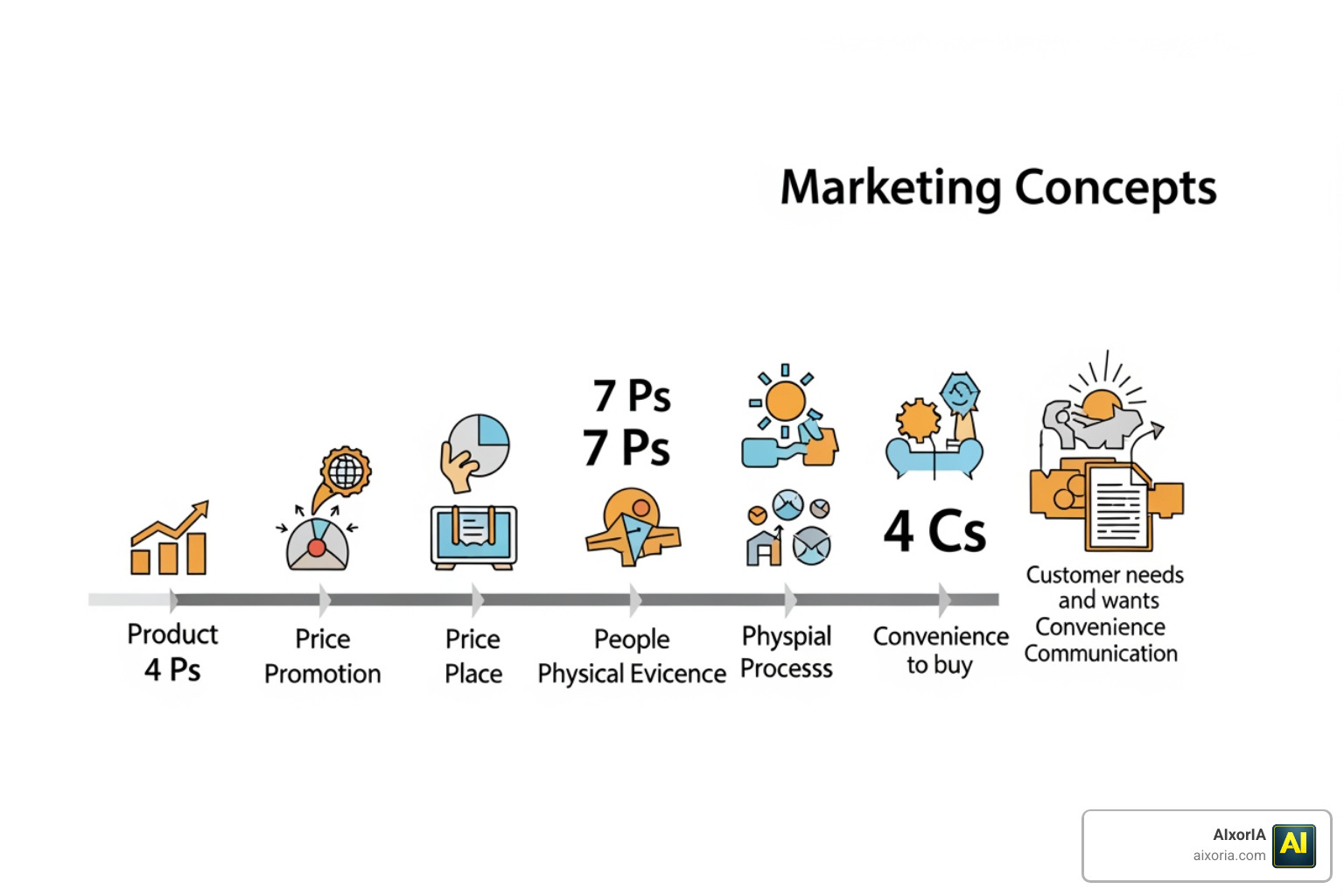
While the 4 Ps provide a robust foundation, the marketing landscape has continually evolved, leading to extensions and alternative models. The original 4 Ps, primarily focused on tangible products, sometimes fell short in addressing the unique characteristics of services or the increasingly customer-centric market. This led to the expansion to the 7 Ps, and later, the customer-focused 4 Cs, among other frameworks. However, the 4 Ps remain the core, adapting and integrating with these newer concepts.
What Additional Elements Do the 7 Ps of Marketing Address?
Recognizing the limitations of the 4 Ps for service-based industries, the marketing mix was expanded to include three additional elements, creating the 7 Ps of Marketing:
- People: This refers to all individuals involved in the product or service delivery, including employees, customer service representatives, and even other customers. Their competence, attitude, and service quality directly impact the customer experience. Investing in our employees, making them brand ambassadors, and ensuring they are valued is more crucial than ever in May 2026.
- Process: This encompasses the systems and procedures involved in delivering the product or service. A streamlined, efficient, and customer-friendly process enhances the overall experience, from initial inquiry to post-purchase support.
- Physical Evidence: For services, which are intangible, physical evidence refers to the tangible cues that customers use to evaluate the quality of the service. This can include the physical environment (store layout, office design), website design, branding, packaging, and even employee uniforms. A professional presentation, whether in a physical store or through an intuitive website, builds trust and credibility.
These additional Ps are particularly vital for service businesses, where the interaction between people, the efficiency of the process, and the surrounding physical environment significantly shape customer perception and satisfaction.
How Do the 4 Cs Offer a Customer-Centric Perspective?
As marketing shifted towards a more customer-centric approach, the 4 Cs model emerged, offering a buyer-focused alternative to the seller-focused 4 Ps. Developed by Robert Lauterborn, the 4 Cs are:
- Consumer (instead of Product): Focuses on understanding the customer’s needs and wants, rather than just the product’s features. What does the customer truly desire or need?
- Cost (instead of Price): Considers the total cost to the customer, which includes not only the monetary price but also the time, effort, and psychological costs involved in acquiring and using the product.
- Convenience (instead of Place): Emphasizes how easy it is for the customer to find, purchase, and use the product. This includes accessibility, ease of ordering, and overall user experience.
- Communication (instead of Promotion): Advocates for a two-way dialogue with customers, fostering engagement and understanding, rather than just one-way promotional messaging.
Here’s a quick comparison:
| 4 Ps (Seller-Centric) | 4 Cs (Customer-Centric) |
|---|---|
| Product | Consumer |
| Price | Cost |
| Place | Convenience |
| Promotion | Communication |
The 4 Cs encourage businesses to view their offerings through the eyes of their customers, leading to strategies that are more aligned with customer expectations and behaviors.
Are There Other Modern Marketing Frameworks to Consider?
Beyond the 4 Ps, 7 Ps, and 4 Cs, other frameworks have emerged to address specific aspects of modern marketing. One notable example is the 4 Es: Experience, Exchange, Evangelism, and Everyplace. These models further emphasize customer experience, value exchange, brand advocacy, and omnipresent distribution. While these frameworks offer valuable perspectives, the 4 Ps remain an enduring and foundational model, constantly adapting to new technologies and consumer behaviors. They serve as the essential starting point from which all other marketing considerations branch.
How Do Digital Marketing Tools Enhance the Traditional 4 Ps Framework?
The rise of digital marketing has not rendered the traditional 4 Ps obsolete; rather, it has transformed and amplified their power. Digital tools provide unprecedented opportunities to execute each P with greater precision, personalization, and reach. The shift from traditional to digital channels means that businesses can now leverage technology to enhance every aspect of their marketing mix.
How Do Digital Tools Impact Product Development and Enhancement?
Digital tools have revolutionized how we develop and enhance products:
- Data-driven product insights: Web analytics, social listening, and customer feedback platforms provide real-time data on consumer preferences, pain points, and usage patterns, guiding product improvements.
- Rapid prototyping and testing: Software allows for quick development of minimum viable products (MVPs) and A/B testing of features, accelerating the product development cycle.
- Personalization and customization: Digital platforms enable us to offer personalized product recommendations and customizable options at scale, tailoring offerings to individual customer needs.
- Feedback loops and continuous improvement: Online reviews, surveys, and community forums create direct channels for customer feedback, fostering continuous product iteration.
- AI-driven product recommendations: Artificial intelligence analyzes vast datasets to suggest relevant products to customers, enhancing their shopping experience and driving sales.
What Are the Dynamic Pricing Strategies in the Digital Age?
Digital marketing allows for highly dynamic and sophisticated pricing strategies:
- Algorithmic pricing: Using algorithms to automatically adjust prices based on factors like demand, competitor pricing, and inventory levels.
- Personalized pricing: Offering different prices to different customers based on their browsing history, purchase behavior, or demographic data.
- Subscription models and bundles: Digital services often thrive on recurring revenue from subscriptions or by bundling multiple products/services for added value.
- Real-time price adjustments: E-commerce platforms can change prices instantly in response to market conditions, promotions, or competitor actions.
- A/B testing for optimal pricing: Experimenting with different price points to determine which yields the best conversion rates and revenue.
How Do Businesses Optimize Digital Place and Distribution?
“Place” in the digital age goes far beyond physical storefronts:
- E-commerce platforms and marketplaces: Online stores, Amazon, eBay, and specialized marketplaces provide global reach and 24/7 accessibility.
- Omnichannel strategies: Integrating online and offline channels to provide a seamless customer experience, whether they shop in-store, online, or via mobile.
- Global reach and accessibility: Digital distribution removes geographical barriers, allowing businesses to reach customers worldwide.
- Supply chain optimization with technology: Advanced logistics software and data analytics improve efficiency in warehousing, shipping, and delivery.
- Digital content distribution: For digital products like software, e-books, or streaming services, “Place” is entirely digital, relying on robust platforms and fast internet.
How Is Promotion Transformed by Digital Channels?
Digital channels have revolutionized how we promote products, offering unprecedented targeting and measurement capabilities:
- Targeted advertising: Pay-per-click (PPC) ads, social media advertising, and display ads allow us to reach specific demographics, interests, and behaviors with precision.
- Content marketing and SEO: Creating valuable content (blogs, videos, guides) that attracts and engages target audiences naturally, while optimizing it for search engines to improve visibility.
- Social media engagement and influencer marketing: Building communities, interacting directly with customers, and collaborating with influencers to amplify brand messages.
- Email marketing automation: Sending personalized emails at scale, from welcome sequences to promotional offers, based on customer behavior.
- Web analytics for campaign optimization: Tools like Google Analytics provide detailed data on campaign performance, allowing for real-time adjustments and continuous improvement.
For managing our social media campaigns effectively in May 2026, we often leverage specialized software. 9 Best Social Media Campaign Management Software in 2026
What Role Do Modern Martech Stacks Play in Integrating the 4 Ps?
The proliferation of marketing technology (martech) has created a complex but powerful ecosystem for businesses. A “martech stack” is a collection of technologies that marketers use to manage, execute, and improve their marketing efforts. Building a cohesive, integrated martech stack is crucial for effectively integrating the 4 Ps in May 2026.
However, unifying data across these diverse tools remains a significant challenge, with only 31% of marketers satisfied with their ability to unify data across their marketing tools. Despite this, the benefits are clear: companies with fully-integrated, high-performing tech stacks can grow revenue up to 35% faster than their peers. This highlights the importance of strategic martech adoption.

How Do Customer Data Platforms (CDPs) and CRMs Support the 4 Ps?
Customer Data Platforms (CDPs) and Customer Relationship Management (CRM) systems are central to integrating the 4 Ps:
- Centralizing customer data: Both CDPs and CRMs collect and unify customer data from various touchpoints, creating a single, comprehensive view of each customer.
- Understanding consumer needs for Product: This rich data helps us understand customer preferences, behaviors, and pain points, informing product development and enhancements.
- Tracking sales and revenue for Price: CRMs track sales pipelines, revenue, and pricing performance, allowing for data-driven adjustments to pricing strategies.
- Managing customer interactions across channels for Place: CRMs help manage customer interactions across all sales and service channels, ensuring a consistent experience wherever the customer engages.
- Personalizing outreach for Promotion: With detailed customer profiles, we can segment audiences and deliver highly personalized promotional messages, improving engagement and conversion.
For businesses looking to leverage their customer data more effectively, we offer custom AI solutions to derive deeper insights and automate processes. More info about custom AI solutions
What is the Impact of Marketing Automation and AI Tools?
Marketing automation and AI tools are transforming how we execute the 4 Ps:
- Automating repetitive tasks: Tools automate email sends, social media posting, lead nurturing, and other routine tasks, freeing up our teams for more strategic work.
- Personalizing customer journeys: AI-powered platforms can dynamically adapt content and offers based on individual customer behavior, creating highly personalized experiences.
- Predictive analytics for better decision-making: AI analyzes historical data to forecast future trends, helping us optimize pricing, product demand, and promotional timing.
- Generative AI for content creation: AI tools can assist in drafting marketing copy, social media posts, and even ad creatives, significantly boosting content production efficiency.
At AIxorIA, we offer custom AI solutions and tool training workshops to help businesses leverage these advanced capabilities effectively, ensuring our clients stay ahead in the rapidly evolving digital landscape. We also provide expert reviews and use cases for the best AI tools in sales and marketing. Best AI Tools for Sales and Marketing in 2026 Expert Reviews Use Cases
How Do Web Analytics and Consumer Research Tools Inform Strategy?
Web analytics and consumer research tools are essential for understanding our audience and measuring our efforts:
- Tracking website performance: Tools like Google Analytics 4 (used by around 13.5 million websites globally) provide critical data on website traffic, user behavior, and conversion funnels.
- Understanding user behavior: Heatmaps, session recordings, and A/B testing platforms reveal how users interact with our digital “Place,” informing design and content improvements.
- Identifying market trends and segments: Consumer research platforms help us uncover emerging trends, understand market dynamics, and segment our audience for more targeted strategies.
- Creating buyer personas: By analyzing data, we can develop detailed buyer personas that guide product development, pricing, and promotional messaging.
- Measuring campaign effectiveness: Analytics allow us to track the ROI of our promotional activities, ensuring we allocate resources to the most effective channels.
AIxorIA provides performance audits to ensure your analytics are delivering actionable insights, helping you make informed decisions about your 4 Ps strategy.
What Are the Key Lead Generation and Conversion Tools?
These tools are vital for attracting and converting prospects, directly impacting our “Promotion” and “Place” efforts:
- Landing page builders: Create optimized pages specifically designed to capture leads or drive conversions from promotional campaigns.
- SEO tools: Help us optimize our online content and website structure to rank higher in search results, making our “Place” more discoverable.
- Email marketing platforms: Enable us to build subscriber lists, send targeted campaigns, and nurture leads through automated sequences.
- CRM integration for lead nurturing: Connecting lead generation efforts with our CRM ensures that new leads are properly tracked, qualified, and moved through the sales funnel.
- Optimizing conversion funnels: Tools that analyze user journeys and identify bottlenecks, allowing us to refine our website and processes to improve conversion rates.
For e-commerce businesses, choosing the right email marketing tools is particularly crucial for lead nurturing and customer retention. 7 Best Email Marketing Tools for E-commerce in 2026
How Can Businesses Practically Apply the 4 Ps (and Beyond) for Success?
Applying the 4 Ps effectively requires a strategic, integrated approach, rather than treating each element in isolation. It’s about ensuring all parts of your marketing mix work together harmoniously to achieve your business objectives. Continuous optimization and measurement are key to adapting to market changes and maximizing ROI.
What Are the Practical Steps for Developing a 4 Ps Strategy?
Here are actionable steps to develop and refine your 4 Ps strategy:
- Define your target audience and their needs: Deeply understand who your customers are, what problems they face, and what they value. This informs all other Ps.
- Analyze your product’s unique value proposition: Clearly articulate what makes your product or service stand out. What specific benefits does it offer that competitors don’t?
- Determine competitive and value-based pricing: Research competitor pricing and assess the perceived value of your product to customers. Consider different pricing models (e.g., subscription, tiered) to maximize appeal and profitability.
- Identify optimal distribution channels: Based on your target audience and product, decide where and how your customers prefer to purchase. This could be direct-to-consumer online, through retailers, or a hybrid model.
- Craft a compelling promotional message: Develop clear, consistent messaging that highlights your product’s benefits and resonates with your target audience. Choose the right channels (digital, traditional) to deliver this message effectively.
- Ensure consistency across all Ps: Make sure your product, price, place, and promotion are all aligned. A premium product shouldn’t be promoted with discount messaging in a low-end channel, for example.
How Do Real-World Examples Illustrate the 4 Ps in Action?
Let’s look at how the 4 Ps play out in different industries:
Vertical Farming:
- Product: Fresh, locally grown, often organic or pesticide-free produce with a longer shelf life due to reduced transportation.
- Price: Often a premium for freshness, sustainability, and quality, but competitive with high-end organic options.
- Place: Direct-to-consumer sales via online ordering and local delivery, partnerships with high-end grocery stores, or even on-site farm stands. The “place” is often closer to the consumer, reducing logistics costs.
- Promotion: Emphasizing sustainability, health benefits, supporting local economies, farm-to-table narratives, and potentially farm tours or educational content.
E-commerce:
- Product: A wide selection of goods, often with personalized recommendations, user reviews, and easy return policies.
- Price: Dynamic pricing, frequent discounts, loyalty programs, and subscription options for recurring purchases.
- Place: A user-friendly website and mobile app, global shipping capabilities, and integration with various payment gateways.
- Promotion: Highly targeted digital ads (social media, search engines), influencer collaborations, email marketing campaigns, and content marketing (blogs, videos) to drive traffic and engagement.
Why Is Continuous Optimization and Measurement Crucial?
The marketing landscape is constantly shifting, making continuous optimization and measurement indispensable:
- Tracking key performance indicators (KPIs): Regularly monitor metrics like sales, website traffic, conversion rates, customer acquisition cost, and customer lifetime value to assess the effectiveness of your 4 Ps strategy.
- A/B testing and experimentation: Continuously test different elements of your product, pricing, distribution, and promotional messages to identify what resonates best with your audience.
- Adapting to market changes and consumer feedback: Be agile and willing to adjust your strategy based on new market trends, competitor actions, and direct customer feedback.
- Proving the ROI of marketing activities remains one of the top challenges for marketers. By diligently tracking and analyzing data, we can demonstrate the tangible impact of our efforts.
- Regular review and adjustment of the marketing mix: Periodically re-evaluate your entire 4 Ps framework to ensure it remains aligned with your business goals and market realities.
At AIxorIA, we offer tutorials and simple language help to empower your team in understanding and acting on these insights, making data-driven optimization accessible to everyone.
Frequently Asked Questions About Marketing Tools
What is the primary difference between the 4 Ps and the 4 Cs of marketing?
The primary difference lies in their perspective. The 4 Ps (Product, Price, Place, Promotion) represent a seller-centric view, focusing on what the company offers and how it delivers it. In contrast, the 4 Cs (Consumer, Cost, Convenience, Communication) shift to a buyer-centric perspective, emphasizing the customer’s needs, the total cost to them, their ease of access, and two-way dialogue.
Why are the 4 Ps still relevant in the age of digital marketing?
The 4 Ps remain foundational because they address universal business challenges: what to sell (Product), for how much (Price), where to sell it (Place), and how to tell people about it (Promotion). Digital tools haven’t replaced these core questions; instead, they provide new, more powerful, and precise ways to execute each of these Ps, offering unprecedented targeting, personalization, and measurement capabilities.
How can a small business effectively use the 4 Ps with limited resources?
Small businesses can effectively use the 4 Ps by focusing on deep customer understanding to create a highly targeted product. They can leverage cost-effective digital channels for promotion (e.g., social media, content marketing, email) and place (e-commerce platforms, local delivery). For price, they can focus on value-based pricing that resonates with their niche. Integrating affordable CRM and analytics tools can significantly amplify their efforts by providing data insights without a large budget.
Conclusion
The 4 Ps of Marketing—Product, Price, Place, and Promotion—are not just historical concepts; they are the enduring pillars upon which all successful marketing strategies are built. From their inception in the mid-20th century to their evolution into the 7 Ps and the customer-centric 4 Cs, these tools provide a comprehensive framework for understanding and influencing the market.
In May 2026, the integration of digital marketing tools and sophisticated martech stacks has not replaced the 4 Ps but rather amplified their power, enabling businesses to execute more targeted, personalized, and measurable campaigns than ever before. By mastering these essential tools and embracing modern technologies, businesses can navigate the complexities of the market, engage customers effectively, and achieve sustainable growth.
For assistance in leveraging custom AI solutions, tool training, or performance audits to optimize your marketing mix, explore how AIxorIA can empower your business with affordable services and fast customer support.
1 thought on “4 Essential Tools of Marketing: The 4 Ps Explained (2026)”