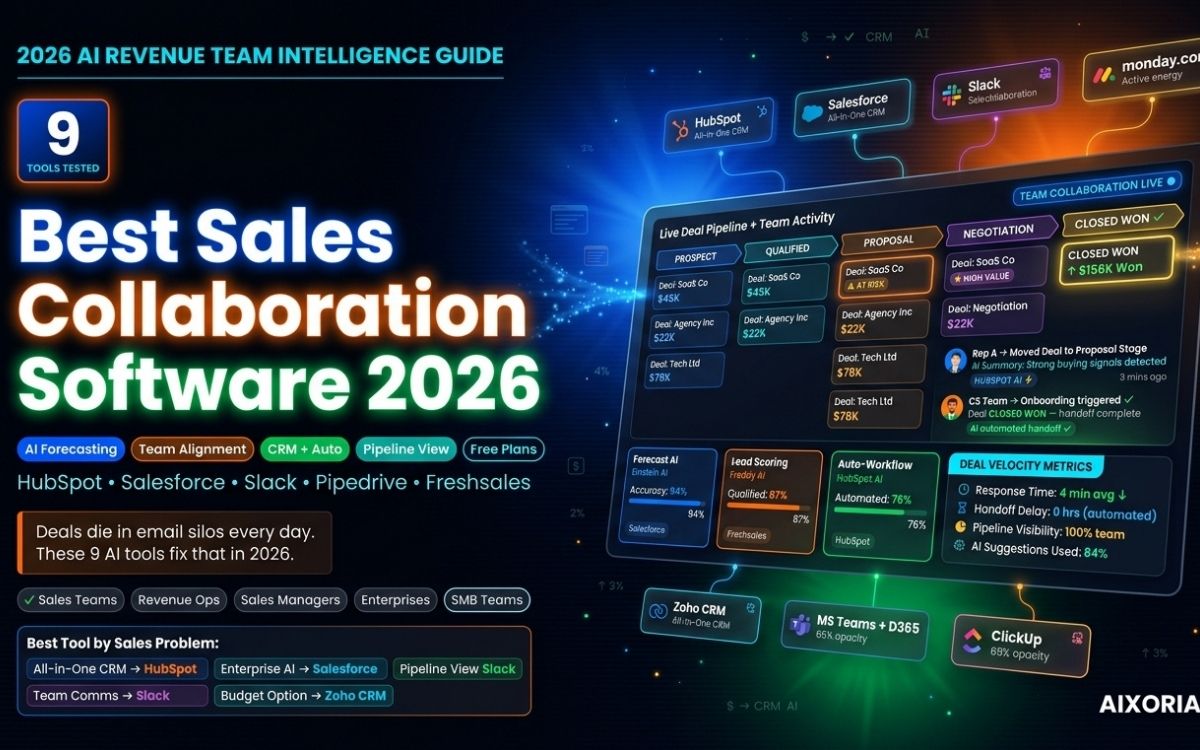
Sales collaboration software is no longer just about team chat or a shared CRM dashboard. In 2026, high-performing sales teams rely on connected systems that combine communication, pipeline visibility, task automation, AI-powered forecasting, and real-time decision-making.
But here’s where most “best software” lists fail: they mix CRM platforms, messaging apps, and workflow tools without explaining who should actually use what.
Sales collaboration and CRM are related, but they are not the same.
A CRM helps manage customer relationships and deal pipelines. Sales collaboration software focuses on how teams work together across sales, marketing, customer success, and leadership to close deals faster. The best platforms often combine both.
Over the last year, I reviewed multiple sales collaboration tools used by startups, agencies, SaaS teams, and enterprise sales departments. Some were excellent for communication, some were stronger for pipeline visibility, and others stood out because of AI automation.
This guide breaks down the 9 best sales collaboration software platforms for US businesses based on actual use cases, collaboration strength, workflow automation, pricing clarity, and practical business value—not just feature lists.
Table of Contents
2026 Sales Collaboration Software Comparison Matrix
| Tool | Best For | Best Feature | Starting Price | G2 Rating |
|---|---|---|---|---|
| HubSpot Sales Hub | Full sales collaboration | CRM + workflows + AI | Free plan available | 4.4/5 |
| Salesforce Sales Cloud | Enterprise teams | Advanced forecasting | From $25/user/month | 4.3/5 |
| Slack | Internal communication | Fast team collaboration | Free plan available | 4.5/5 |
| monday.com Sales CRM | Workflow-driven teams | Visual sales workflows | From $9/seat/month | 4.7/5 |
| Pipedrive | Growing sales teams | Visual pipeline tracking | From $14/user/month | 4.2/5 |
| Zoho CRM | Budget-friendly teams | Affordable automation | From $14/user/month | 4.1/5 |
| Microsoft Teams + Dynamics 365 | Microsoft ecosystem | Native integration | Varies by plan | 4.4/5 |
| ClickUp | Cross-functional teams | Tasks + docs + collaboration | Free plan available | 4.7/5 |
| Freshsales | AI-driven lead management | Freddy AI insights | From $15/user/month | 4.5/5 |
What Makes the Best Sales Collaboration Software?
The best sales collaboration software should improve speed, visibility, and accountability across your revenue team.
It should not simply store customer records. It should help people work better together.
Here are the core features that matter most:
Shared team visibility
Everyone should see the same deal progress, customer notes, and next actions. This reduces missed follow-ups and internal confusion.
Workflow automation
Manual lead assignment, approval chains, meeting scheduling, and follow-up reminders create bottlenecks. Good automation removes repetitive work.
AI-powered assistance
AI now helps sales teams prioritize leads, summarize calls, predict risks, and improve forecasting. This is becoming a major decision factor.
Cross-platform integrations
Your collaboration system should connect with email, meetings, chat apps, CRM tools, support systems, and proposal platforms.
Reporting and forecasting
Managers need accurate visibility into deal health, team performance, and pipeline risks without waiting for manual updates.
Top 9 Best Sales Collaboration Software
1. HubSpot Sales Hub
Best for Full Sales Collaboration Across Teams
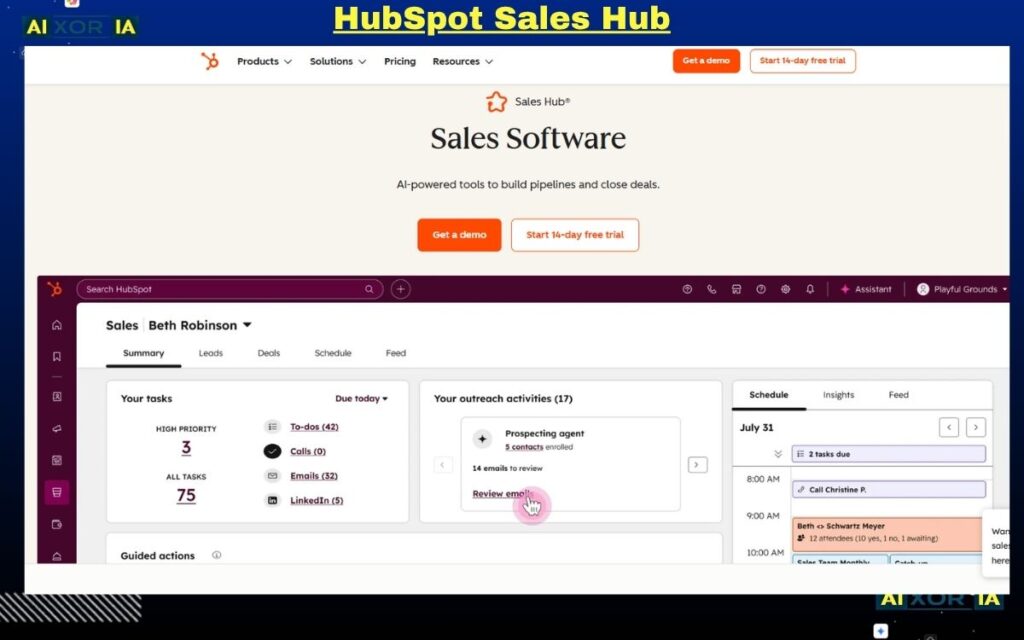
HubSpot Sales Hub is one of the strongest choices for businesses that want sales collaboration, CRM, and automation inside one platform.
It combines contact management, deal tracking, workflow automation, reporting, internal collaboration, and AI-driven insights without forcing teams to switch between multiple systems.
Sales, marketing, and customer success teams all work inside the same ecosystem, which improves lead handoffs and reduces lost information between departments.
Its AI tools in 2026 are significantly stronger than previous versions. Teams can use AI for email drafting, meeting summaries, lead prioritization, forecasting suggestions, and next-step recommendations.
My Experience with HubSpot
I tested HubSpot with Slack integration for a SaaS sales workflow. Every time a deal moved to “Closed Won,” Slack instantly notified the onboarding and customer success teams.
This reduced onboarding delays significantly because teams no longer waited for manual updates.
For fast-moving teams, this kind of automation improves collaboration more than most people expect.
Pros
- Excellent all-in-one collaboration system
- Strong AI tools for sales workflows
- Excellent sales + marketing alignment
- Clean reporting and dashboards
Cons
- Workflow automation becomes powerful only in Professional tier, which can be expensive for startups
- Large feature set creates onboarding complexity for smaller teams
Pricing
Free CRM available. Paid plans start around $20/user/month, while advanced workflow automation is mainly available in higher-tier plans.
My Verdict
Best for companies that want one platform instead of five disconnected tools.
READ MORE – Best AI Tools for Sales and Marketing
2. Salesforce Sales Cloud
Best for Enterprise Sales Operations
Salesforce is built for companies with large teams, complex approval systems, and advanced forecasting needs.
Its biggest strength is process control.
Territory management, lead routing, enterprise forecasting, account ownership rules, and approval flows can all be customized deeply.
Its Einstein AI engine helps predict deal risks, score leads, forecast revenue, and identify hidden opportunities across large pipelines.
My Experience with Salesforce
In enterprise environments, Salesforce works best when leadership needs reporting accuracy more than speed.
It is not the easiest tool for reps—but for management visibility, it is extremely powerful.
Pros
- Strong enterprise reporting and forecasting
- Deep workflow customization
- Einstein AI improves strategic decisions
- Excellent large-team visibility
Cons
- Requires implementation support for advanced setups
- Small teams often overpay for features they rarely use
Salesforce Sales Cloud Pricing
Starts around $25/user/month, but serious enterprise usage usually costs significantly more.
My Verdict
Best for enterprise sales leaders, not early-stage startups.
3. Slack
Best for Real-Time Sales Communication
Slack is often underestimated in sales collaboration because people see it as only a messaging app.
In reality, it is one of the fastest collaboration tools for approvals, deal escalation, and urgent internal coordination.
Dedicated deal channels, account-specific conversations, and approval workflows keep communication visible and fast.
Its AI features now summarize discussions and surface key updates automatically.
My Experience with Slack
The biggest win with Slack is speed.
When approvals happen inside email, deals slow down.
When sales leaders approve discounts directly inside Slack, response time drops dramatically.
Pros
- Fastest internal collaboration tool
- Excellent CRM integrations
- AI summaries reduce missed context
- Great for urgent deal coordination
Cons
- Without strong channel rules, teams create too much noise
- Not a replacement for CRM or pipeline management
Pricing
Free plan available. Paid plans start around $8.75/user/month.
My Verdict
Best collaboration layer for fast-moving sales teams.
4. monday.com
Best for Workflow-Based Sales Teams
monday.com works especially well for teams that want process visibility instead of traditional CRM-heavy systems.
Its visual boards make deal progress, onboarding, proposal approvals, and cross-team handoffs easy to manage.
Its automation system is simple enough for non-technical users while still being powerful.
My Experience with monday.com
Teams that dislike rigid CRMs often perform better with monday because the workflow feels closer to how they already work.
It improves adoption because reps actually use it.
Pros
- Strong workflow visibility
- Easy automation setup
- Excellent for team collaboration
- Great dashboard usability
Cons
- Advanced automation requires higher plans
- Less CRM depth than Salesforce or HubSpot
Pricing
Starts around $9/seat/month.
My Verdict
Best for teams prioritizing workflow clarity over CRM complexity.
5. Pipedrive
Best for Growing Sales Teams
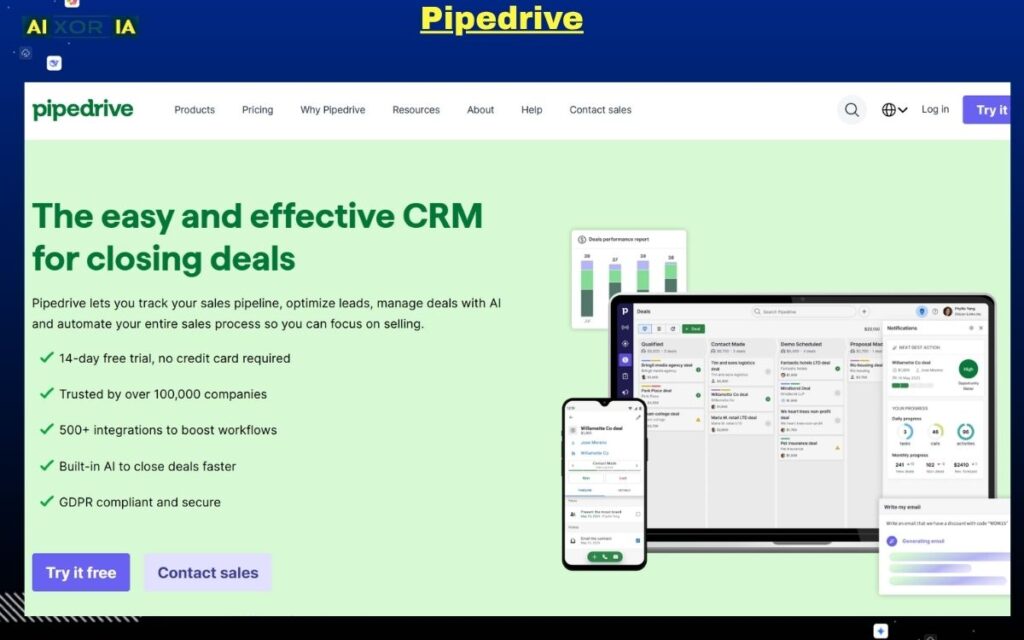
Pipedrive focuses on simplicity and strong visual pipelines.
It helps smaller sales teams manage deals clearly without enterprise complexity.
Its AI Sales Assistant highlights deal risks, suggests next actions, and improves follow-up discipline.
Pros
- Very easy to use
- Excellent visual pipeline tracking
- Helpful AI recommendations
Cons
- Limited enterprise customization
- Less suitable for large cross-functional operations
Pricing
Starts around $14/user/month.
My Verdict
Best for growing teams that want simplicity first.
6. Zoho CRM
Best for Budget-Conscious Teams
Zoho CRM offers strong automation and collaboration features at a lower cost than most competitors.
Its AI assistant, Zia, helps with lead scoring, anomaly detection, and sales forecasting.
Pros
- Affordable pricing
- Strong automation features
- Good AI support for smaller teams
Cons
- Interface feels less modern than competitors
- Setup can require customization time
Pricing
Starts around $14/user/month.
My Verdict
Best for teams that want value without enterprise pricing.
7. Microsoft Teams + Microsoft Dynamics 365
Best for Microsoft-Centered Businesses
For organizations already built on Microsoft 365, Teams + Dynamics creates a strong collaboration environment.
Approvals, CRM updates, meetings, and forecasting stay inside one ecosystem.
Microsoft Copilot improves summaries, forecasting, and sales insights.
Pros
- Excellent Microsoft integration
- Strong AI through Copilot
- Familiar user experience
Cons
- Less flexible outside Microsoft ecosystem
- Can feel complex for smaller teams
Pricing
Varies depending on licensing structure.
My Verdict
Best for Microsoft-heavy organizations.
8. ClickUp
Best for Cross-Functional Collaboration
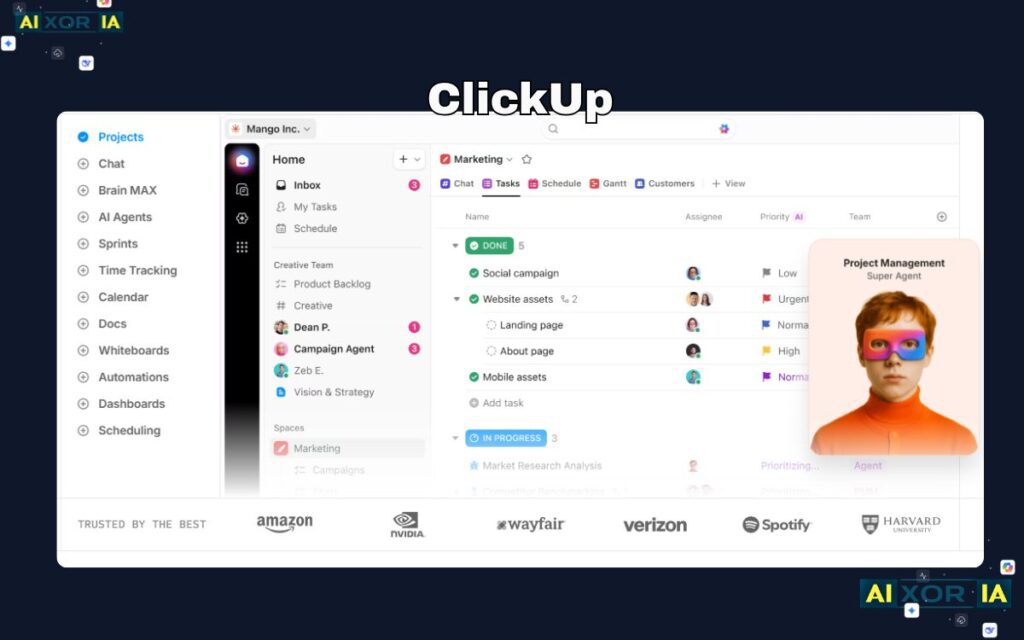
ClickUp is excellent when sales collaboration includes operations, onboarding, and project delivery.
It combines tasks, docs, dashboards, and workflows into one system.
Pros
- Excellent cross-team visibility
- Strong documentation system
- Useful AI summaries
Cons
- Initial setup can feel overwhelming
- Less CRM-focused than dedicated sales platforms
ClickUp Pricing
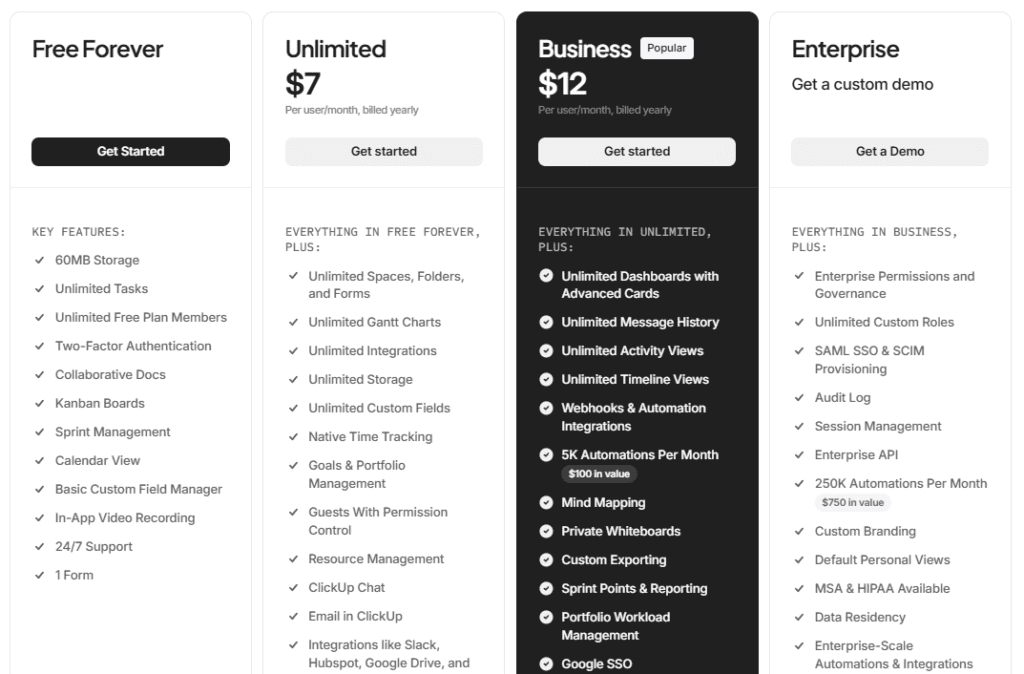
Free plan available. Paid plans start around $10/user/month.
My Verdict
Best for service businesses with heavy post-sale collaboration.
9. Freshsales
Best for AI-Powered Lead Management
Freshsales stands out because of Freddy AI.
It helps teams prioritize leads, predict outcomes, and identify deal risks faster.
This improves collaboration because teams spend less time debating priorities.
Pros
- Strong AI-powered lead management
- Good usability
- Strong value for price
Cons
- Smaller ecosystem than HubSpot or Salesforce
- Reporting depth is lighter for enterprise use
Pricing
Starts around $15/user/month.
My Verdict
Best for teams that want stronger AI without enterprise complexity.
READ MORE – Best AI Sales Automation Tools
Final Thoughts
The best sales collaboration software depends on where collaboration breaks down inside your business.
If communication is the problem, Slack helps most.
If visibility is the problem, HubSpot or Salesforce becomes stronger.
If adoption is the problem, monday.com or Pipedrive often wins.
The goal is not simply choosing software.
The goal is building a system where deals move faster, teams stay aligned, and revenue does not get lost between departments.
2 thoughts on “9 Best Sales Collaboration Software in 2026 (Tested & Reviewed)”