Why Developers Can’t Afford to Ignore AI Productivity Tools in 2026

The best AI productivity tools for developers can save you hours every single day — here’s a quick look at the top options:
| Tool | Best For | Starting Price |
|---|---|---|
| GitHub Copilot | Code generation & autocomplete | $10/month |
| Cursor | Codebase-aware editing & multi-agent | $0.50/M tokens |
| Tabnine | Team autocomplete & reusable functions | $9/month/user |
| Greptile | Code review & codebase intelligence | $30/dev/month |
| Sourcegraph Cody | Code search & understanding | $9/month |
| Claude Code | Agentic coding & multi-file edits | $17/month |
| Amazon CodeWhisperer | AWS-integrated code suggestions | Free tier available |
| DeepCode AI | Security analysis & bug detection | Free tier available |
New AI developer tools are launching almost every week right now. That’s exciting — and completely overwhelming.
If you’re a small business owner or a developer trying to stay competitive, you’ve probably asked yourself: “Which of these tools actually moves the needle?”
The answer matters more than ever. Developers using AI coding assistants report completing tasks 55% faster and seeing 46% higher productivity on average. Repetitive coding work — the stuff that drains your day — can be cut by up to 70%.
That’s not a small edge. That’s a fundamentally different way of working.
But not every tool delivers equally. Some shine at writing new code. Others are built for understanding large, messy codebases. A few handle security scanning and code review. And some are starting to run entire workflows on your behalf while you sleep.
This guide cuts through the noise. We’ve organized the best options by what they actually do — so you can find the right fit for your workflow, your team size, and your budget, without wasting time testing tools that weren’t built for your situation.
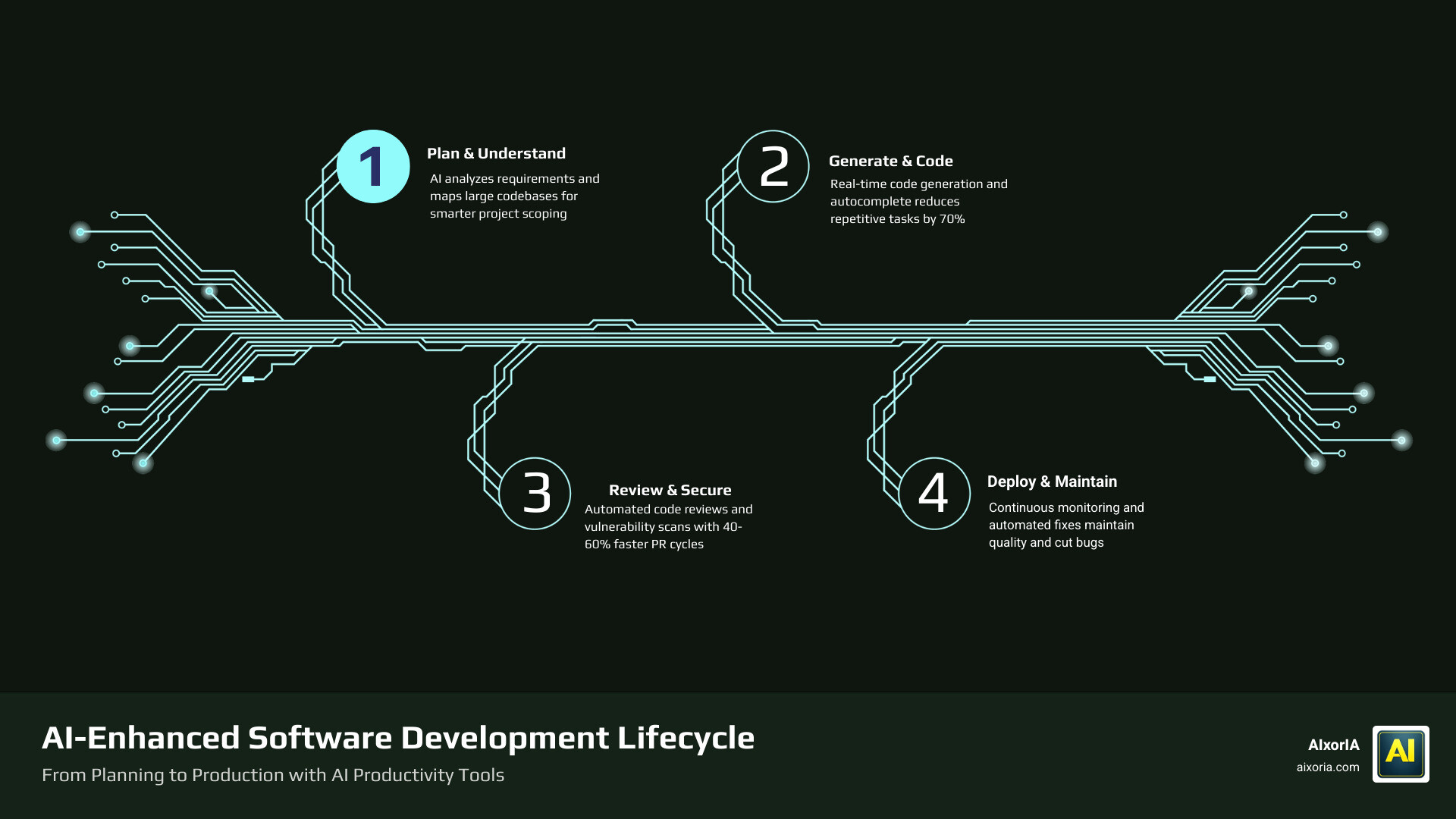
How AI Assistants Transform the Development Lifecycle
The software development lifecycle (SDLC) used to be a linear, often grueling process of manual planning, typing, testing, and debugging. In 2026, the best AI productivity tools for developers have turned this into a collaborative dance between human logic and machine speed.

AI doesn’t just “write code” anymore. It acts as a force multiplier across every phase:
- Planning and Architecture: Tools can now analyze a PRD (Product Requirements Document) and suggest the most efficient system architecture, identifying potential cross-service dependency issues before a single line is written.
- Implementation: Real-time refactoring and boilerplate automation allow us to focus on high-level logic. Instead of typing out another MySQL database connection, we describe the intent, and the AI handles the execution.
- Review and Maintenance: This is where the magic happens for teams. Using AI for code review can shorten PR (Pull Request) review times by 40-60%. These tools catch bugs that would otherwise reach production, significantly reducing bug recurrence.
By integrating The Best AI Productivity Tools in 2026, developers can offload the “grunt work.” Over 70% of developers now report improved code quality because they use these assistants for refactoring and suggestions. If you’re curious about how these stack up against each other, we’ve seen Best AI Productivity Tools for Coders in 2026 Tested results that prove AI is no longer optional for high-velocity teams.
Ranking the Best AI Productivity Tools for Developers in 2026
When we evaluate the best AI productivity tools for developers, we look at three main pillars: context window (how much of your code the AI can “see” at once), integration ease, and language support.
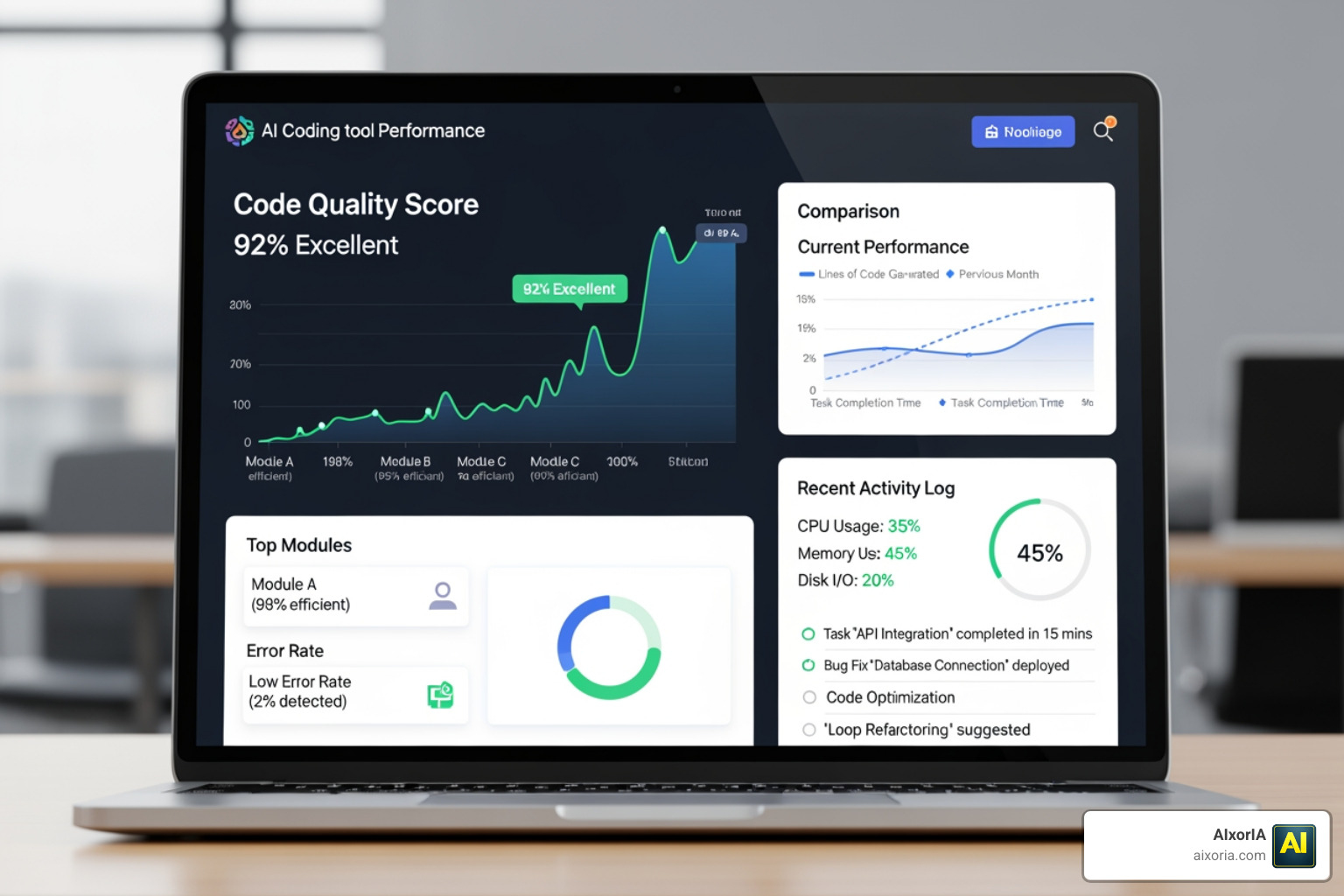
In 2026, the industry has moved toward “Agentic AI”—tools that don’t just suggest code but can actually take actions like running tests or creating PRs. Here is how the top contenders currently stack up for Best AI Tools for Developers in 2026:
Best AI Productivity Tools for Developers: Code Generation and Autocomplete
For most of us, our first interaction with AI was through autocomplete. These tools have evolved from simple “Tab-to-complete” features into sophisticated partners that understand the intent behind your keystrokes.
- GitHub Copilot: Still the industry titan. It uses internal studies to show that users complete tasks 55% faster. It’s excellent for boilerplate and real-time syntax suggestions.
- Tabnine: A favorite for those who prioritize privacy and team-specific logic. It excels at suggesting reusable functions based on your team’s existing patterns.
- Amazon CodeWhisperer: If you are deep in the AWS ecosystem, this is a no-brainer. It is optimized for AWS APIs and offers a generous free tier.
Using these tools is like having a pair programmer who has read every public repository on Earth. They are essential for Best AI Productivity Software in 2026 Agentic AI Tested workflows where speed and syntax accuracy are paramount.
Best AI Productivity Tools for Developers: Codebase Intelligence and Review
Writing code is only 20% of the job; the other 80% is understanding what’s already there. This is where “Codebase Intelligence” tools shine.
- Greptile: This tool is a leader in understanding complex microservice architectures. Unlike tools that only look at the file you’re currently editing, Greptile analyzes your entire codebase to provide natural language summaries and identify dependency issues.
- Sourcegraph Cody: Known for its massive context handling, Cody helps you search and understand your code using neural search. It’s like having a search engine specifically for your company’s private logic.
- DeepCode AI: By combining symbolic AI with generative models, DeepCode focuses heavily on security. It uses tree-sitter AST parsing to analyze the “blast radius” of code changes, ensuring that a fix in one place doesn’t break something three services away.
- Claude Fulcrum: For those who want to unify their tools, ORION2809/claude-Fulcrum acts as an “operating system” for AI development. it provides a shared memory layer so that your context isn’t lost when you switch between different AI assistants.
Security, Quality, and Technical Debt in AI Workflows
One of the biggest concerns we hear at AIxorIA is: “Will AI make my code less secure?” It’s a valid question. If left unchecked, AI can produce code duplication or introduce subtle vulnerabilities.
However, when used correctly, the best AI productivity tools for developers actually improve security. Leading tools now incorporate:
- Vulnerability Mitigation: Automatically scanning for hardcoded secrets or SQL injection patterns before the code is even committed.
- Hallucination Reduction: Modern models like Claude 3.5 Sonnet or GPT-4o are trained with “human-in-the-loop” feedback to prioritize ethical AI principles and factual accuracy.
- Quality Enforcement Loops: Advanced setups use deterministic scoring to review AI-generated code up to five times before presenting it to a human.
By balancing speed with Best AI Tools for Productivity and Time Management strategies, you can ensure that your ship velocity doesn’t lead to a mountain of technical debt. Always remember: AI is a co-pilot, not the captain. Human approval gates remain the most important part of the workflow.
Frequently Asked Questions about AI Coding Tools
Are AI productivity tools secure for enterprise codebases?
Yes, provided you choose the right tier. Most enterprise-grade AI tools offer “Zero-knowledge” policies, meaning your proprietary code is never used to train their global models. Many also provide local or self-hosted options and end-to-end encryption. For high-security environments, you can even use tools that have limited internet access, only communicating with a trusted list of destinations.
Can AI tools handle multi-language translation and cross-platform support?
Absolutely. Tools like CodeT5 and CodeGeeX are specifically designed for cross-language logic mapping. If you need to migrate a legacy Java service to Go, these tools can translate the business logic while maintaining the architectural intent. Most of the best AI productivity tools for developers also offer seamless integration across VS Code, JetBrains, and even terminal-based environments.
Do AI assistants create long-term technical debt?
They can if used blindly. There is a risk of code duplication if the AI isn’t aware of your existing utility libraries. However, modern codebase intelligence tools (like Greptile or Cody) mitigate this by “remembering” your institutional memory. By using automated refactoring and maintainability audits, you can actually use AI to clean up old technical debt faster than a human team could manually.
Conclusion
The landscape of software development has changed forever. Whether you’re a solo dev or leading an enterprise team, the best AI productivity tools for developers are your ticket to staying relevant in a high-speed market.
At AIxorIA, we specialize in helping businesses navigate this transition. We provide custom AI solutions, tool training workshops, and performance audits to ensure your team isn’t just using AI, but using it right. Our goal is to make complex technology simple and affordable, providing the support you need to boost your productivity without the headache.
Ready to transform your workflow? Explore more of our guides at https://aixoria.com/category/ai-productivity/ or reach out to us for a consultation. Let’s build the future of your development team together.
3 thoughts on “Best AI Productivity Tools for Developers in 2026: Top Picks”