Why Enterprise Document Management Matters in 2026
Scr0ll d0wn to D0VVNL0AD
Finding the Best Enterprise Document Management Software is the most important step your business can take to stop “content chaos” and start scaling. In 2026, managing files is no longer just about storage; it is about making your data searchable, secure, and ready for AI tools.
If you are looking for a quick recommendation, here are the top-rated systems based on specific business needs:
- Best for Microsoft 365 Users: Microsoft SharePoint
- Best for AI-Powered Context: M-Files
- Best for High-Volume Scalability: OpenText Documentum
- Best for Automating Workflows: Laserfiche
- Best for User Experience: DocuWare
- Best for Engineering & Assets: Accruent Meridian
Most businesses are drowning in files. Experts estimate that 70% to 90% of enterprise data is unstructured. This means your most valuable information is often trapped in emails, PDFs, and random folders where nobody can find it.
The stakes are high. Nearly half of all employees struggle to find the data they need to do their jobs. This leads to a massive waste of time and money.
However, the right system offers a huge payoff. Research shows that businesses can see a 404% return on their investment over five years. Some even see a full return in just eight months.
Choosing the right platform helps you:
- Find any file in seconds using AI search.
- Automate boring tasks like data entry and routing.
- Stay compliant with strict privacy laws.
- Keep your data safe from leaks or hacks.
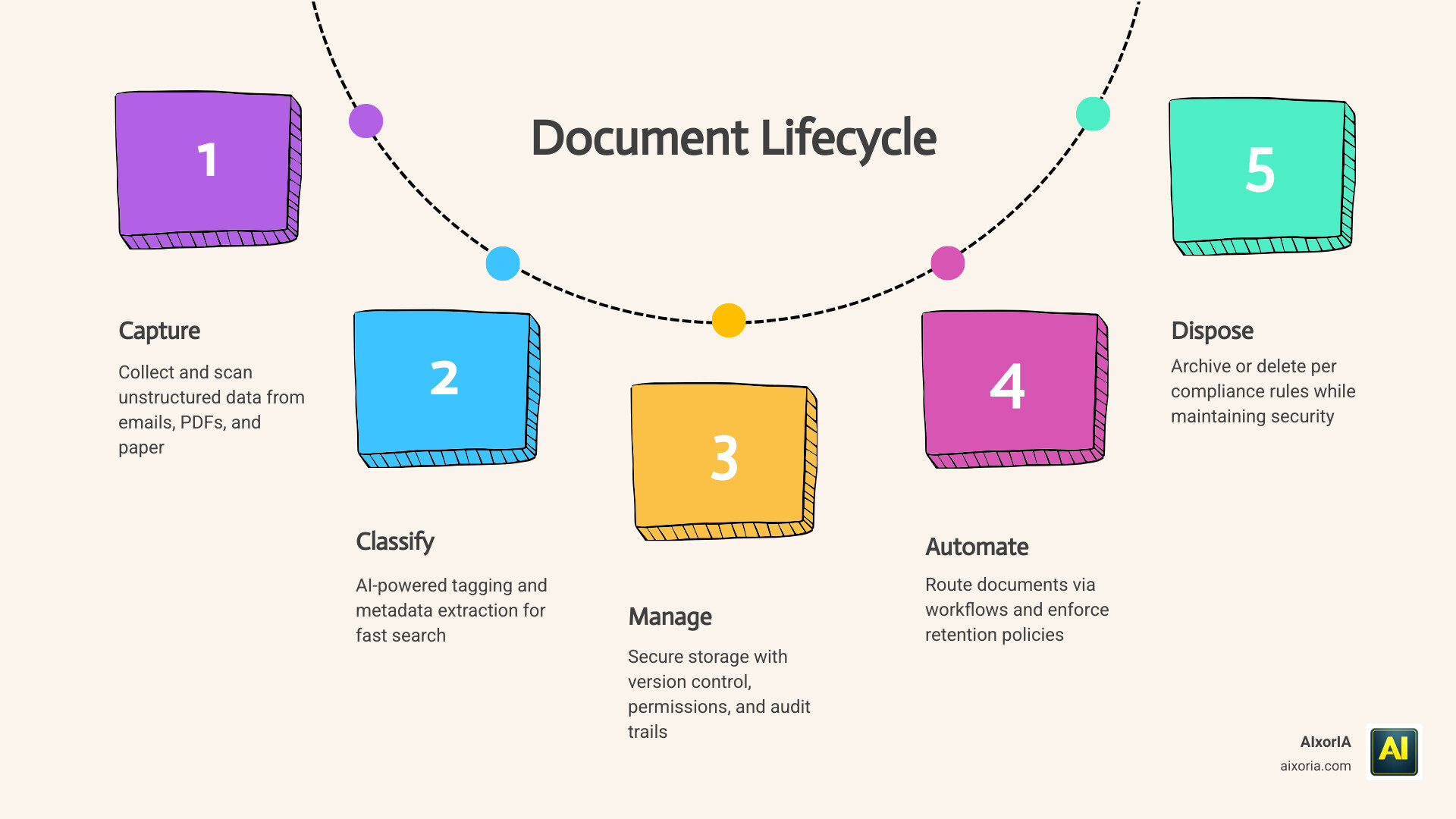
Key Features of the Best Enterprise Document Management Software
When we look for the Best Enterprise Document Management Software, we aren’t just looking for a digital filing cabinet. We need a powerhouse that can handle the sheer volume of modern business data.
Scalability is non-negotiable. Leading systems like Document Management Software | OpenText are built to manage over 80 billion documents without breaking a sweat. If your software can’t grow with you, it’s just a temporary fix.

Security and control are the next big pillars. We recommend prioritizing platforms that offer role-based permissions. This ensures that while the HR team can see payroll records, the summer intern cannot. Coupled with audit trails, which track every single click and edit, you create a transparent environment where “who did what and when” is never a mystery.
To see how these features stack up across the top players, check out our detailed breakdown of the 7 Best Enterprise Document Management Software In 2026.
AI-Powered Search and Metadata Tagging in Best Enterprise Document Management Software
The “magic” of modern DMS lies in AI. In the past, we had to manually name files like “InvoiceFinalV2REALLYFINAL.pdf.” Today, AI-Powered Document Management System | M-Files uses a context-first architecture. It doesn’t care where a file is stored; it cares what the file is.
Using OCR (Optical Character Recognition) and intelligent data extraction, these tools can read a scanned document, identify it as an invoice from “Vendor X,” and automatically tag it with the correct project code and due date. This turns unstructured data into a goldmine of insights.
If you want to boost your team’s output, integrating these capabilities is essential. You can explore more about this in our guide on the Best Ai Tools For Business Productivity and learn how to connect your data streams with the Best Ai Tools For Data Integration In 2026.
Regulatory Compliance and Security in Best Enterprise Document Management Software
For enterprises, compliance isn’t just a “nice to have”—it’s a legal requirement. Whether it’s GDPR for privacy, HIPAA for healthcare, or SOX for finance, the Best Enterprise Document Management Software acts as your digital compliance officer.
Platforms like Enterprise Content Management | Products | Laserfiche allow you to set strict retention policies. For example, you can program the system to keep tax records for exactly seven years and then automatically purge them. This reduces “compliance friction” and protects you during audits.
Furthermore, Zero Trust governance and data encryption (both at rest and in transit) ensure that even if a breach occurs, your sensitive information remains unreadable to outsiders. Many top solutions now also integrate electronic signatures, making sure that approvals are legally binding and fully traceable.
Top-Rated Solutions for Workflow Automation and ROI
One of the most exciting findings in recent research is that 90% of employees experience greater efficiency when using automation. This is where the ROI really kicks in. Instead of a document sitting in an executive’s inbox for three days, the system can automatically route it for approval, send reminders, and file it once signed.

Systems like Hyland OnBase Content Management Solution | Hyland use AI to orchestrate these “content-centric processes.” By feeding high-quality data directly into your ERP or CRM, you eliminate manual data entry errors. 91% of businesses say poor data quality hurts their operations.
To see which tools lead the pack in this category, dive into our review of the Best Workflow Automation Software In 2026 Tested.
Comparing Deployment Models: Cloud, On-Premise, and Hybrid
Choosing how to deploy your DMS is a strategic decision. While the world is moving toward the cloud, many large organizations still prefer hybrid models for better control over sensitive data.
| Feature | Cloud-Based | On-Premise | Hybrid |
|---|---|---|---|
| Scalability | Instant & Elastic | Manual Hardware Upgrades | Flexible Balance |
| Maintenance | Handled by Vendor | Internal IT Team | Shared Responsibility |
| Data Residency | Global Data Centers | Local Server Room | Both Local & Cloud |
| Upfront Cost | Low (Subscription) | High (Hardware/Licenses) | Moderate |
| Accessibility | Anywhere with Internet | Often requires VPN | Best of both worlds |
For those looking for open-source flexibility, Alfresco | Open Source Content, Process & Governance Management| Hyland offers a cloud-native suite that is highly customizable. Meanwhile, if you want to eliminate silos without moving everything to a new server, look into Content Federation options offered by Optimize Business with Content Management | Hyland . This allows you to search and manage documents across multiple existing systems from one single interface.
Implementation Strategies and Best Practices for 2026
We’ve seen many enterprises fail because they tried to do too much at once. The “big bang” approach rarely works. Instead, we recommend a phased migration.
- Start with a Pilot Program: Pick one department, like HR or Finance, where the paperwork is the heaviest.
- Define Measurable Goals: Are you trying to reduce document retrieval time by 50%? Or cut down on paper costs?
- Prioritize User Adoption: If the software is too hard to use, people won’t use it. Choose tools with a clean interface and provide role-specific training.
- Integrate Early: Ensure your DMS talks to your CRM (like Salesforce) and your ERP (like SAP).
Using the Best Ai Productivity Tools For Enterprise In 2026 can help bridge the gap between old habits and new digital workflows, ensuring your team feels empowered rather than overwhelmed.
Frequently Asked Questions about Enterprise Document Management
What is the difference between document management and document control?
Think of document management as the “how” of organizing and finding files across your team. It’s about efficiency. Document control is the “police” side of the equation—it enforces strict rules to ensure only the latest, approved version of a document is used. This is critical in industries like engineering or healthcare where using an old version of a file could be dangerous.
How does AI improve document search and retrieval?
AI uses Natural Language Processing (NLP) to understand the meaning of your search, not just the keywords. This leads to 50% faster search times. Instead of searching for “Invoice 123,” you can ask the system, “Show me all unpaid contracts from last quarter,” and it will pull the relevant data instantly from unstructured files.
What are the typical costs and pricing models for enterprise DMS?
Pricing varies wildly. Some tools like SharePoint are included in your Microsoft 365 subscription (starting around $5-$10/user/month). High-end engineering solutions like Accruent RedEye can cost upwards of $6,600 per month for an enterprise-wide license. Most modern vendors have moved to a subscription model, though implementation fees for setup and data migration can still be a significant one-time cost.
Conclusion
The future of the Best Enterprise Document Management Software is incredibly bright. We are already seeing emerging trends like blockchain verification to prove a document hasn’t been tampered with and advanced metadata that allows AI to write summaries of 100-page reports in seconds.
At AIxorIA, we know that every business handles information differently. Whether you are a global manufacturer or a fast-growing tech firm, the right DMS is the foundation of your digital transformation. We specialize in providing custom AI solutions and tool training to help you navigate these complex choices without the headache.
Ready to turn your “content chaos” into a competitive advantage? Learn more about AI tools for business ROI and see how we can help you build a smarter, faster enterprise.