Search has changed more in the last two years than it did in the previous decade.
Users are no longer clicking through ten blue links. Instead, they are getting direct answers from AI systems—whether it’s ChatGPT-style assistants, AI Overviews in Google, or answer engines like Perplexity. These systems don’t just rank pages; they select, summarize, and cite sources.
This creates a new challenge for businesses:
Even if your website ranks on Google,
you may still be invisible inside AI-generated answers.
And that’s where a new category of tools comes in—
AI Search Visibility Tools.
These tools help you answer questions like:
- Is my brand being mentioned in AI answers?
- Which competitors are getting cited instead of me?
- What content changes can increase my chances of being included?
- How do AI systems “understand” my website?
In simple terms:
Traditional SEO helps you rank.
AI Search Visibility helps you get chosen.
Table of Contents
What Is AI Search Visibility (And Why It Matters)
AI Search Visibility Tools is about how often and how accurately your brand appears inside AI-generated responses.
This includes:
- Mentions in AI answers
- Citations in generative search results
- Inclusion in summarized content
- Presence across multiple AI systems
In 2026, this is critical because of three major shifts:
1. Zero-Click Search Is Increasing
Users get answers instantly. They don’t need to visit websites unless your brand is mentioned.
2. AI Chooses Winners, Not Just Ranks Them
Instead of showing 10 options, AI shows 2–3 trusted sources.
3. Authority Is Now Algorithmic
AI models rely on entities, context, and trust signals, not just keywords.
What Is GEO (Generative Engine Optimization)?
Generative Engine Optimization (GEO) is the next evolution of SEO.
It focuses on optimizing content so that AI systems can:
- Understand it easily
- Retrieve it quickly
- Trust it enough to cite it
Unlike traditional SEO, GEO includes:
- Entity optimization
- Semantic clarity
- Structured content formatting
- Answer-focused writing
- Context depth and topical authority
Our Testing Methodology
To make this guide truly useful and trustworthy, we didn’t rely on feature lists or marketing claims.
We evaluated each tool based on real-world performance and practical usability.
Our Testing Process Included:
- Running multiple prompts across AI systems
- Checking if brands were cited or ignored
- Comparing visibility across different tools
- Testing content optimization suggestions
- Evaluating ease of use and learning curve
Key Evaluation Factors:
1. Citation Tracking Accuracy
Can the tool reliably detect whether your brand appears in AI answers?
2. Prompt-Based Analysis
Does it analyze real user prompts instead of just keywords?
3. Generative Optimization Support
Does it tell you how to improve your content for AI visibility?
4. Data Reliability
Does it reduce false positives and misleading insights?
5. Actionability
Does it give clear steps, or just raw data?
What You’ll Learn From This Guide
By the end of this article, you will understand:
- Which tools actually track AI visibility (and which don’t)
- How to choose the right tool based on your needs
- What features matter most in 2026
- How to improve your chances of being cited by AI systems
READ MORE – The 7 Best AI Agent Orchestration Tools in 2026
Comparison Matrix: 21 Best AI Search Visibility Tools (2026)
| Tool | Best For | AI Models Tracked | Citation Tracking | GEO Optimization | Pricing | Ease of Use |
|---|---|---|---|---|---|---|
| Profound | Enterprise | GPT, Claude, Gemini | Advanced | Strong | Custom | Medium |
| Otterly AI | Startups | ChatGPT, Perplexity | Basic | Limited | Freemium | Easy |
| Peec AI | Content teams | Multiple LLMs | Good | Strong | Paid | Medium |
| Scrunch AI | Content structuring | LLM-based | Good | Advanced | Custom | Medium |
| Rankscale AI | Marketers | Multi-model | Good | Medium | From $29/mo | Easy |
| SE Ranking | Agencies | Google AI + SEO | Partial | Medium | From $52/mo | Easy |
| Semrush | Enterprise SEO | Google AI | Partial | Strong | From $139/mo | Medium |
| Ahrefs | Backlink + mentions | Web-based | Indirect | Medium | From $99/mo | Medium |
| Surfer SEO | Content optimization | NLP-based | Indirect | Strong | From $89/mo | Easy |
| MarketMuse | Topic authority | LLM-based | Indirect | Advanced | Custom | Hard |
| BrightEdge | Enterprise | Multi-model | Advanced | Strong | Custom | Hard |
| Wix SEO Wiz | Beginners | Basic AI | Limited | Basic | Included | Very Easy |
| Alli AI | Technical SEO | AI crawlers | Indirect | Medium | From $49/mo | Easy |
| CanIRank | Recommendations | AI-based | Indirect | Medium | From $50/mo | Easy |
| Nightwatch | Local SEO | Google AI | Partial | Limited | From $32/mo | Easy |
| CognitiveSEO | Link analysis | AI signals | Indirect | Medium | From $129/mo | Medium |
| SpyFu | Competitors | AI + SEO | Indirect | Medium | From $39/mo | Medium |
| SEObility | Technical audit | AI crawl | Indirect | Medium | Free + Paid | Easy |
| WriterZen | Keyword clustering | LLM context | Indirect | Strong | From $19/mo | Easy |
| Outranking | Content briefs | SERP + AI | Indirect | Strong | From $79/mo | Medium |
| Frase | Answer optimization | Q&A models | Indirect | Strong | From $14.99/mo | Easy |
20+ Best AI Search Visibility Tools
Profound: Enterprise AI Search Visibility & LLM Citation Intelligence
Overview
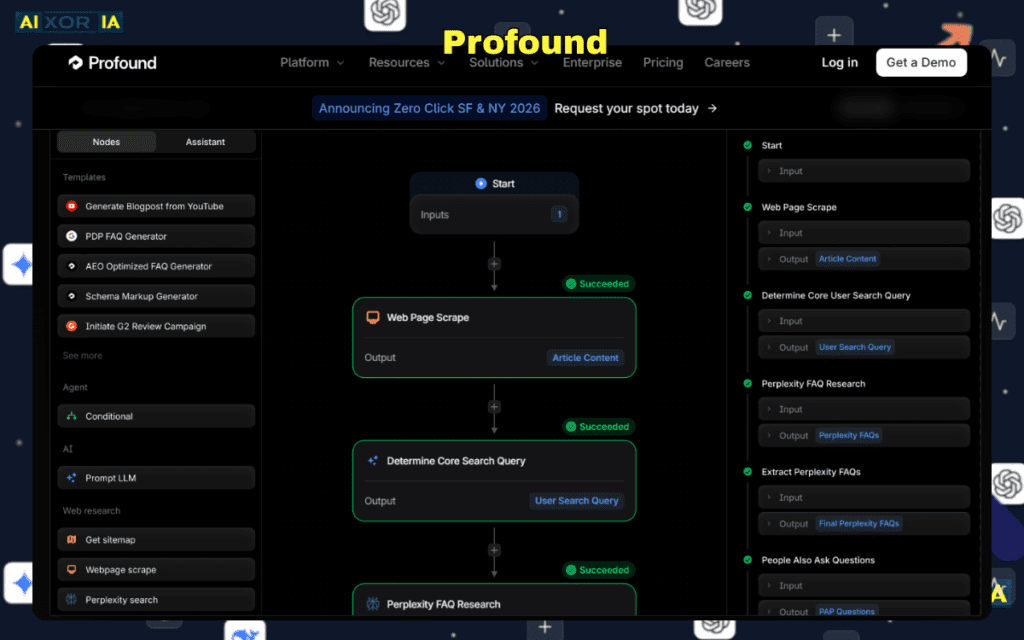
Profound is one of the most advanced platforms built specifically for AI search visibility tracking in 2026. Unlike traditional SEO tools that focus on keyword rankings or backlinks, Profound is designed to answer a much more important question in today’s search landscape:
“Is your brand being recommended by AI systems?”
As AI-driven search becomes the default across platforms, Profound helps enterprises understand how their content is interpreted, retrieved, and cited by large language models. It provides deep insights into how AI systems like ChatGPT-style engines, Claude-like assistants, and other generative models respond to real user queries.
This makes Profound a critical tool for companies that want to stay visible in a world where AI answers are replacing traditional search results.
What Problem Does Profound Solve?
Most businesses today are operating with a major blind spot.
They invest heavily in SEO, content marketing, and backlinks—but have no idea whether AI systems are actually mentioning them in answers.
Profound solves this by:
- Tracking whether your brand appears in AI-generated responses
- Identifying which competitors are being cited instead
- Showing visibility patterns across multiple prompts and models
- Highlighting gaps in your AI presence
In simple terms, it helps you move from:
“We think our content is good” → “We know how AI systems are using our content.”
Key Features & Capabilities
Profound is built for deep analysis, not surface-level tracking. Its features are designed for teams that want full control and visibility over AI-driven discovery.
1. Multi-Model AI Tracking
Profound allows you to test prompts across multiple AI systems, giving you a broader understanding of how your brand performs in different environments.
2. AI Citation Analysis
Instead of tracking rankings, it tracks citations and mentions—which is what actually matters in AI search.
3. Prompt Simulation Engine
You can simulate real user queries and analyze how AI systems respond, helping you understand which prompts trigger brand visibility.
4. Visibility Pattern Mapping
It identifies trends in when and why your brand appears in AI answers, allowing you to refine your strategy.
5. Enterprise Reporting & Dashboards
Advanced dashboards make it easy to monitor AI visibility across large content ecosystems.
How Profound Helps with GEO (Generative Engine Optimization)
Profound is not just a tracking tool—it plays a major role in GEO strategy.
It helps you:
- Identify missing entities in your content
- Understand how AI models interpret your pages
- Optimize content for better retrieval
- Improve semantic clarity and structure
This makes it one of the few tools that directly supports AI-first content optimization rather than just reporting metrics.
Real-World Use Case
Imagine a SaaS company targeting the query:
“Best project management software for remote teams”
Even if the company ranks on Google, it may not appear in AI-generated answers.
Using Profound, the team can:
- Test the query across AI systems
- See which brands are being cited
- Identify missing context or entities in their content
- Optimize their pages to increase inclusion probability
This turns guesswork into a data-driven AI visibility strategy.
Pros
- Deep AI visibility tracking across multiple models
- Enterprise-level analytics and reporting
- Strong focus on citation tracking (not just rankings)
- Powerful prompt simulation capabilities
- Ideal for large-scale SEO and content teams
Cons
- Expensive and designed mainly for enterprises
- Requires technical SEO understanding
- Not beginner-friendly
- Setup and onboarding can take time
Profound Pricing
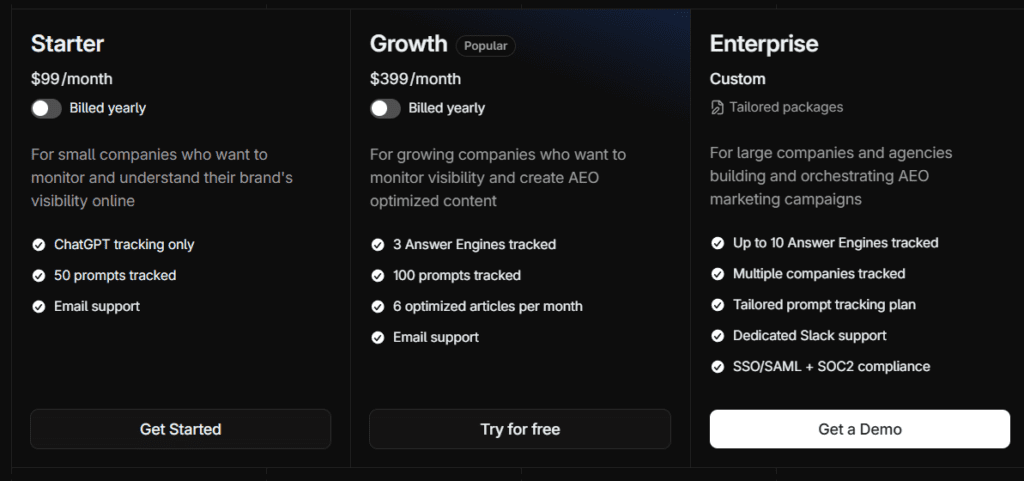
Profound follows a custom enterprise pricing model, depending on:
- Number of tracked prompts
- Scale of content analysis
- Team size and reporting needs
This makes it more suitable for organizations with dedicated SEO or data teams rather than individuals or small businesses.
My Experience Using Profound
When testing Profound, the biggest advantage was its ability to reveal insights that traditional SEO tools simply cannot provide. Running the same query across multiple AI systems showed completely different visibility patterns, which highlighted how unpredictable AI search can be.
The most valuable insight came from identifying competitors that were consistently cited despite having weaker traditional SEO metrics. This clearly showed that AI visibility is driven by more than just rankings, and tools like Profound are essential to understand that shift.
Otterly AI: Simple and Effective AI Brand Visibility Monitoring
Overview
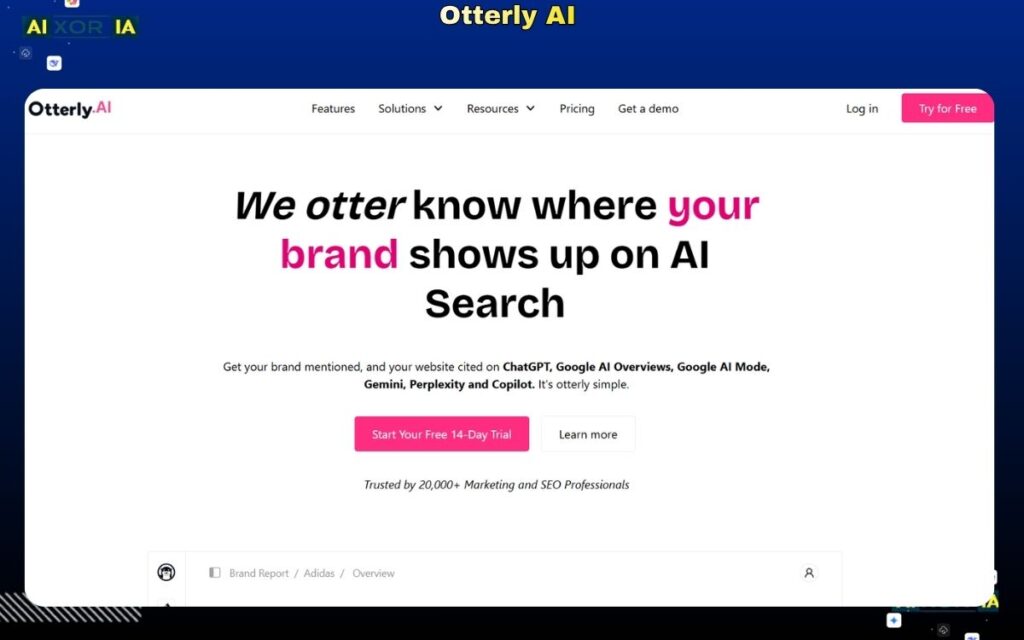
Otterly AI is one of the most accessible tools in the AI search visibility space, designed specifically for startups, small businesses, and marketers who want to understand how their brand appears in AI-generated answers—without dealing with complex enterprise systems.
While many AI visibility tools focus on deep analytics and technical data, Otterly AI takes a different approach. It focuses on clarity, simplicity, and real-time monitoring, making it easier to answer a fundamental question:
“Is my brand being mentioned in AI search results—and how often?”
In a landscape where AI systems are deciding which brands to recommend, Otterly AI provides a straightforward way to track your presence across generative platforms.
What Problem Does Otterly AI Solve?
One of the biggest challenges in AI search today is lack of visibility.
Most small and mid-sized businesses:
- Do not know if AI systems are referencing them
- Cannot afford expensive enterprise tools
- Struggle to interpret complex AI analytics
Otterly AI solves this by offering:
- Simple brand mention tracking across AI systems
- Clear reporting dashboards
- Easy setup with minimal technical knowledge
It removes the complexity and gives users a quick snapshot of their AI search presence.
Key Features & Capabilities
Otterly AI is designed to be lightweight but effective. Its features focus on monitoring rather than deep optimization.
1. AI Brand Mention Tracking
Otterly continuously scans AI-generated responses to detect whether your brand is mentioned in answers.
2. Prompt Monitoring System
You can track specific queries relevant to your niche and see how AI systems respond over time.
3. Visibility Reports
The platform generates simple reports showing how often your brand appears and how visibility changes.
4. Competitor Mention Insights
It helps identify which competitors are being cited instead of you.
5. Easy Dashboard Interface
The interface is clean and easy to navigate, making it suitable for non-technical users.
How Otterly AI Helps with GEO (Generative Engine Optimization)
Otterly AI is not a full GEO optimization platform, but it plays an important role in monitoring performance.
It helps you:
- Track whether your GEO efforts are working
- Identify gaps in AI visibility
- Understand which queries trigger mentions
While it doesn’t provide deep optimization suggestions, it acts as a visibility feedback tool, helping you measure results.
Real-World Use Case
Consider a small eCommerce brand trying to appear in AI answers for:
“Best eco-friendly products in the US”
Using Otterly AI, the brand can:
- Track whether it appears in AI responses
- Monitor competitor mentions
- Identify missed opportunities
This allows the business to adjust its content strategy and improve its chances of being cited.
Pros
- Very easy to use and beginner-friendly
- Affordable pricing structure
- Quick setup with minimal learning curve
- Clear and simple reporting
- Good for monitoring brand mentions
Cons
- Limited advanced analytics
- No deep content optimization recommendations
- Not suitable for enterprise-level use
- Lacks detailed AI model breakdown
Otterly AI Pricing
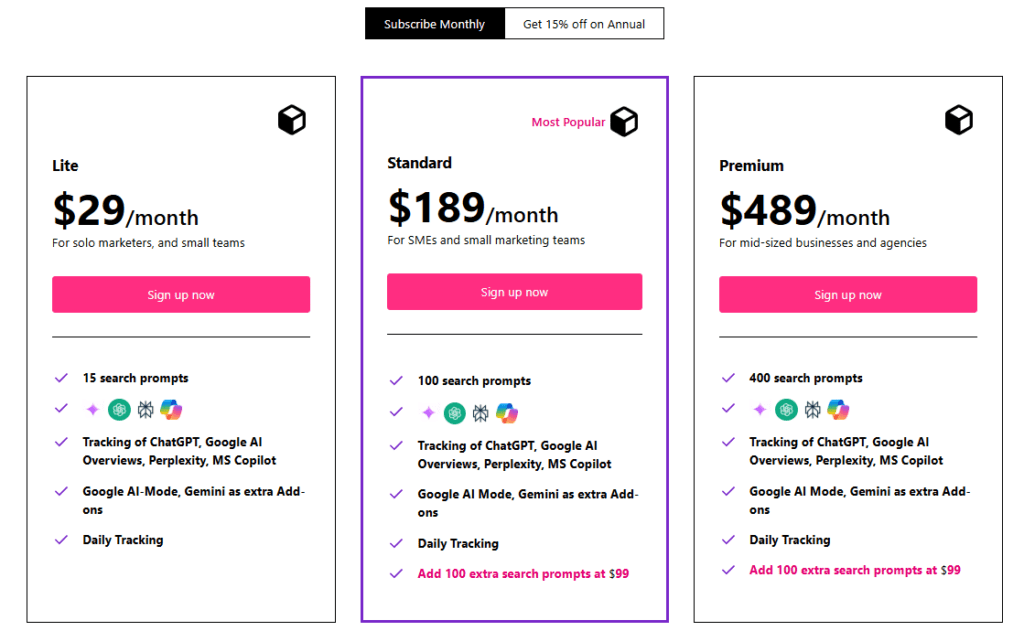
Otterly AI follows a freemium pricing model:
- Free plan with basic tracking
- Paid plans for extended monitoring and reports
This makes it one of the most accessible tools in this category, especially for startups and small teams.
My Experience Using Otterly AI
When testing Otterly AI, the biggest advantage was how quickly it delivered insights without requiring technical setup. Within a short time, it was possible to see whether a brand was being mentioned in AI-generated answers.
However, the tool felt more like a monitoring system rather than a strategy tool. It shows what is happening, but not always how to fix it.
For beginners, this is a strong starting point. For advanced users, it may need to be combined with other tools.Otterly AI: Simple and Effective AI Brand Visibility Monitoring
Peec AI: Prompt-Level Optimization for AI Search Visibility
Overview
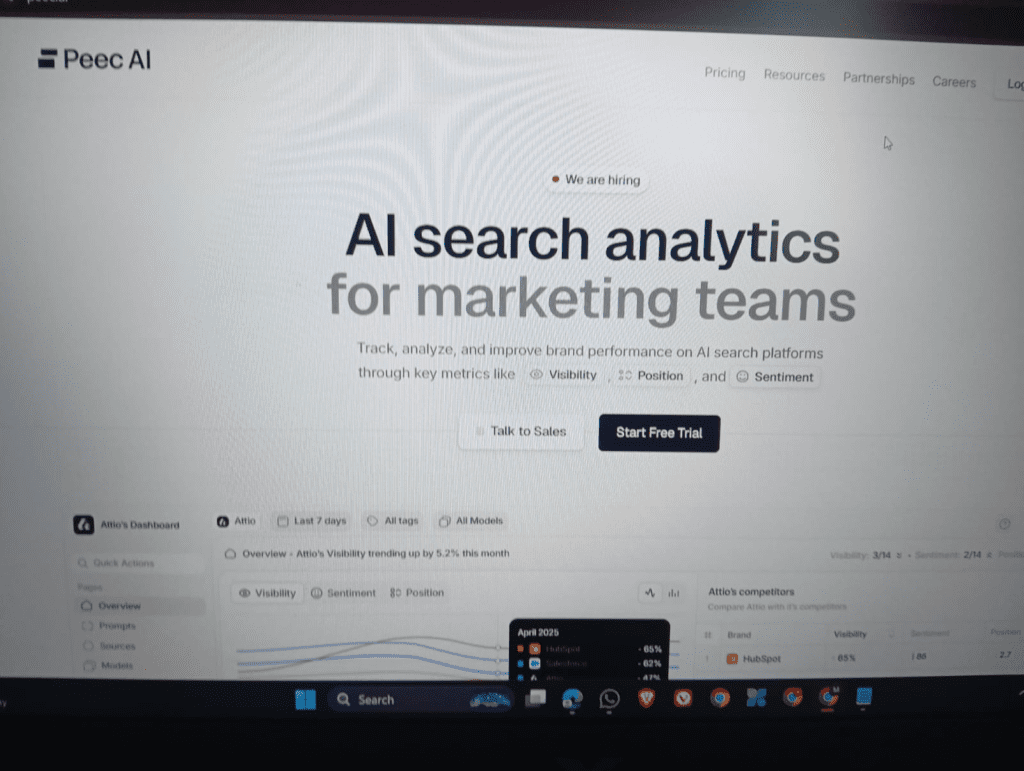
Peec AI is built around one core idea:
AI visibility is driven by prompts, not just keywords.
While traditional SEO tools focus on rankings and traffic, Peec AI focuses on how real user queries (prompts) influence whether your brand appears in AI-generated answers. It is designed for content teams, SEO strategists, and marketers who want to understand how AI systems interpret content at a deeper level.
In 2026, this shift is critical. Users don’t search the same way anymore—they ask full questions, and AI systems generate answers based on context, entities, and semantic understanding. Peec AI helps you align your content with that behavior.
What Problem Does Peec AI Solve?
Most websites today fail in AI search not because their content is bad—but because it is not structured in a way AI systems can retrieve and cite.
Common problems include:
- Missing key entities that AI models rely on
- Poor semantic coverage of a topic
- Content that answers partially but not completely
- Lack of context that supports retrieval
Peec AI solves this by analyzing how prompts interact with your content and identifying:
- Why your brand is not being cited
- What topics or entities are missing
- How your content compares to AI-preferred sources
This transforms SEO from guesswork into prompt-driven optimization.
Key Features & Capabilities
Peec AI is one of the few tools that directly focuses on prompt intelligence and semantic optimization.
1. Prompt Simulation Engine
Peec AI allows you to simulate real-world AI queries and analyze how your content performs within generated responses.
2. Semantic Gap Analysis
It identifies missing concepts, entities, and supporting information that prevent your content from being cited.
3. AI Response Breakdown
You can see how AI systems construct answers and which sources they prioritize.
4. Content Optimization Recommendations
The tool provides actionable suggestions, such as adding specific sections, improving clarity, or expanding coverage.
5. Competitor Prompt Analysis
It shows which competitors are being cited for specific prompts and why.
How Peec AI Helps with GEO (Generative Engine Optimization)
Peec AI is highly aligned with GEO strategy, especially in content optimization.
It helps you:
- Structure content for better AI retrieval
- Add missing entities and context
- Improve topical authority
- Align your pages with real user questions
Unlike traditional tools, it focuses on how AI thinks, not just how search engines rank.
Real-World Use Case
Imagine you are targeting the query:
“Best AI tools for small businesses in 2026”
Your article may be well-written, but if it lacks:
- Relevant tool comparisons
- Supporting context
- Clear structure
AI systems may ignore it.
With Peec AI, you can:
- Simulate the query
- Analyze which articles are cited
- Identify missing sections in your content
- Update your article to improve AI inclusion
This creates a direct path to improving visibility inside AI answers.
Pros
- Strong focus on prompt-based optimization
- Excellent semantic gap detection
- Actionable content recommendations
- Helps improve AI citation probability
- Useful for content and SEO teams
Cons
- Still evolving in terms of historical data
- Requires understanding of semantic SEO
- Interface may feel technical for beginners
- Limited enterprise-level integrations
Peec AI Pricing
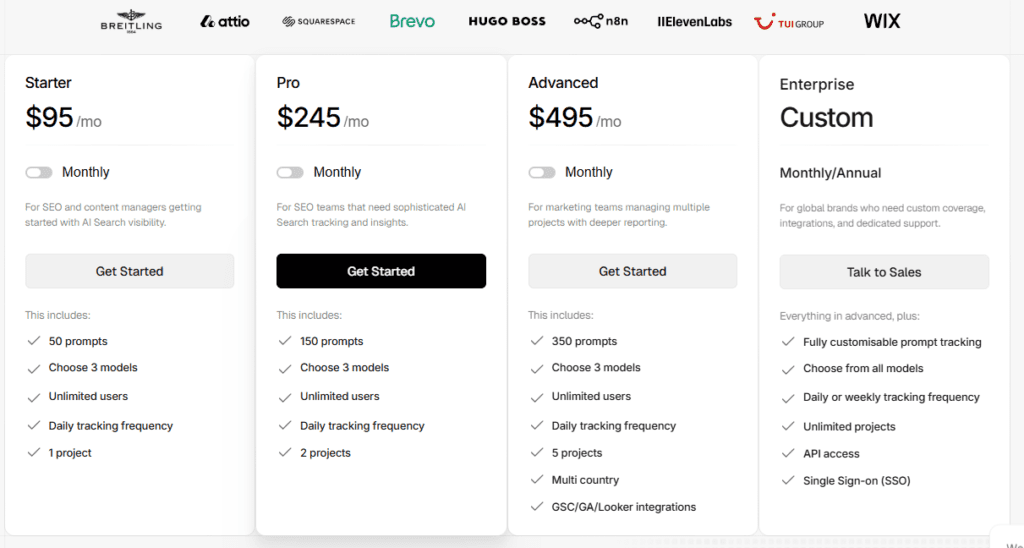
Peec AI offers mid-range paid plans, typically suited for:
- Content teams
- SEO professionals
- Growing businesses
Pricing varies depending on:
- Number of prompts tracked
- Depth of analysis
- Team usage
My Experience Using Peec AI
While testing Peec AI, one of the most valuable insights was how differently AI systems respond to slight changes in prompts. Even small variations in wording produced completely different results.
The tool was especially useful in identifying content gaps that were not obvious through traditional SEO tools. It highlighted missing entities and context that directly impacted AI visibility.
However, it does require a mindset shift. Instead of thinking in keywords, you need to think in questions, intent, and context.
Scrunch AI: Advanced Content Structuring for AI Search & Semantic Visibility
Overview
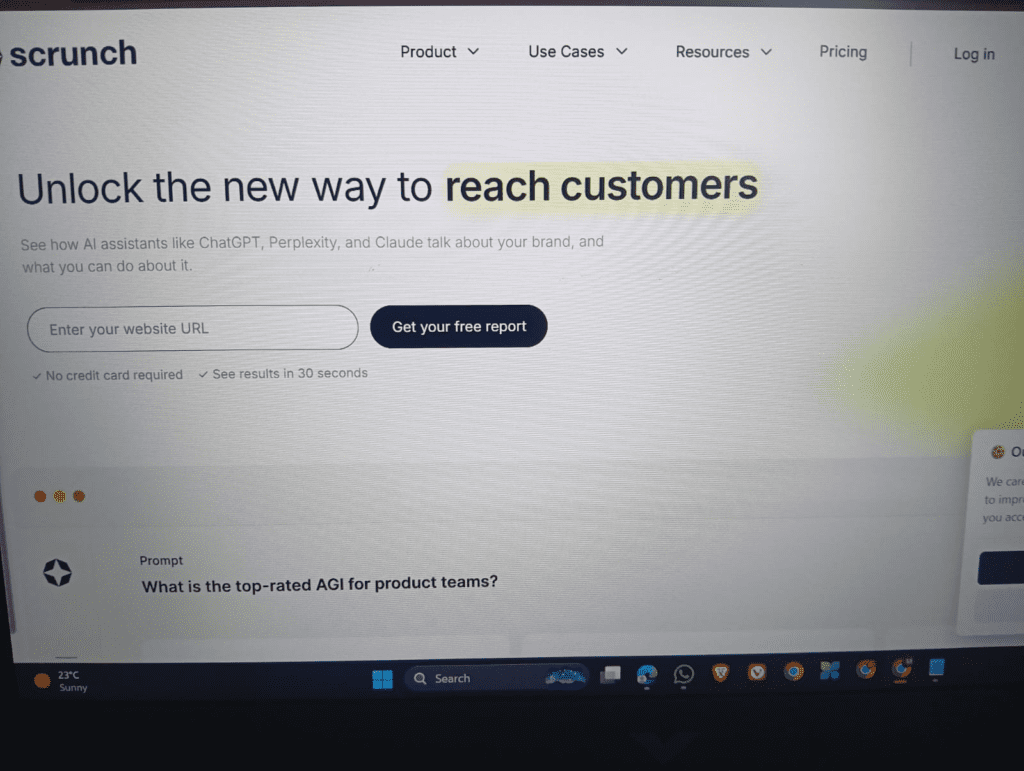
Scrunch AI is built for one critical purpose:
making your content easier for AI systems to understand, process, and cite.
In 2026, writing good content is no longer enough. If your content is not structured properly—semantically, technically, and contextually—AI systems may skip it entirely, even if it ranks well on Google.
Scrunch AI focuses on this exact gap.
It analyzes how your content is structured at a deep level and ensures that it aligns with how large language models (LLMs) read, interpret, and retrieve information. This makes it one of the most powerful tools for Generative Engine Optimization (GEO).
What Problem Does Scrunch AI Solve?
Many websites create high-quality content but still fail to appear in AI-generated answers. The reason is often not quality—but structure and clarity.
Common issues include:
- Poor semantic HTML structure
- Weak entity relationships
- Lack of contextual depth
- Unclear topic hierarchy
- Content that is difficult for AI to parse
Scrunch AI solves these problems by analyzing how your content is structured and helping you align it with AI-friendly content frameworks.
It ensures your content is not just readable for humans—but also interpretable for machines.
Key Features & Capabilities
Scrunch AI offers a set of advanced tools focused on content structuring and semantic optimization.
1. Semantic Content Analysis
Scrunch AI evaluates how well your content aligns with AI-readable structures, including entity relationships and topic coverage.
2. Entity Mapping & Relationship Graphs
It identifies key entities within your content and maps how they relate to each other, helping improve contextual clarity.
3. AI Readability Optimization
The platform checks whether AI systems can easily parse and extract information from your content.
4. Structural Recommendations
It provides suggestions on improving headings, hierarchy, and formatting to increase AI visibility.
5. Generative SEO Insights
Scrunch AI helps you align your content with how AI systems generate answers, not just how search engines rank pages.
How Scrunch AI Helps with GEO (Generative Engine Optimization)
Scrunch AI is deeply focused on GEO.
It helps you:
- Improve semantic clarity
- Strengthen entity relationships
- Structure content for AI retrieval
- Increase the chances of being cited in AI answers
Unlike tools that only track visibility, Scrunch AI actively helps you build content that AI systems prefer.
Real-World Use Case
Suppose you publish an article targeting:
“Best CRM software for startups”
Even if your article includes all the right information, it may still fail in AI search if:
- The structure is inconsistent
- Entities are not clearly defined
- Sections are not logically organized
Using Scrunch AI, you can:
- Analyze your content structure
- Identify weak sections
- Improve heading hierarchy and flow
- Strengthen entity relationships
This increases the likelihood that AI systems will select and cite your content.
Pros
- Strong focus on semantic and structural optimization
- Helps improve AI readability of content
- Advanced entity mapping features
- Supports long-term GEO strategy
- Ideal for content-heavy websites
Cons
- Requires onboarding and learning
- Pricing is not transparent (custom plans)
- Best suited for teams, not individuals
- Needs consistent content updates for best results
Scrunch AI Pricing
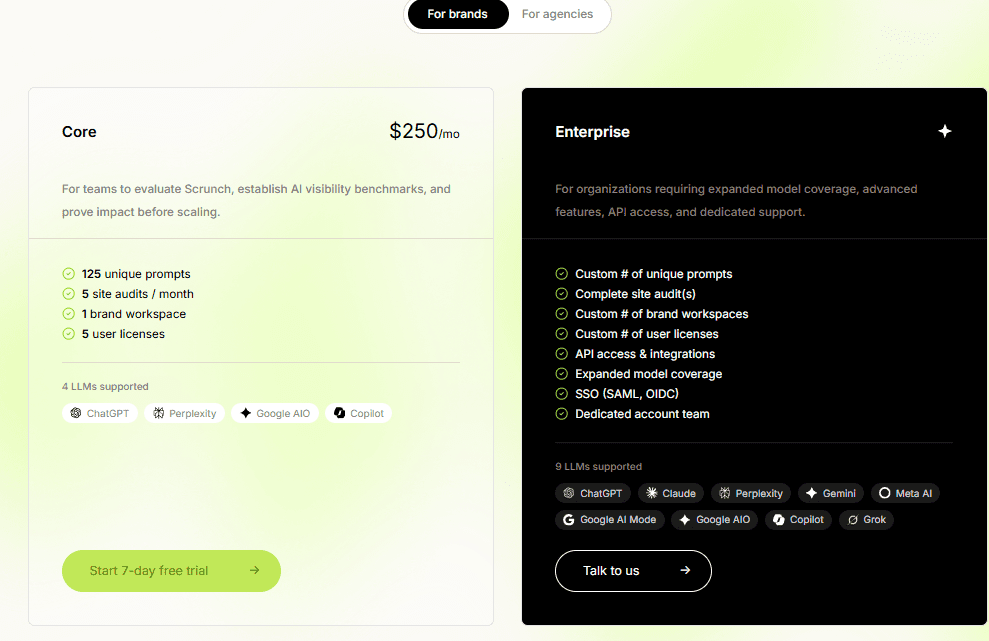
Scrunch AI offers custom pricing plans, typically based on:
- Website size
- Content volume
- Level of analysis required
It is generally positioned for:
- Content teams
- SEO agencies
- Enterprise-level organizations
My Experience Using Scrunch AI
During testing, Scrunch AI stood out for its ability to highlight structural issues that are often overlooked. It showed how small changes in heading structure and content organization could significantly impact how AI systems interpret a page.
One key insight was that content that looks “fine” to humans may still be confusing for AI models. Scrunch AI helps bridge that gap.
Rankscale AI: Multi-Model AI Visibility Tracking with Actionable Scoring
Overview
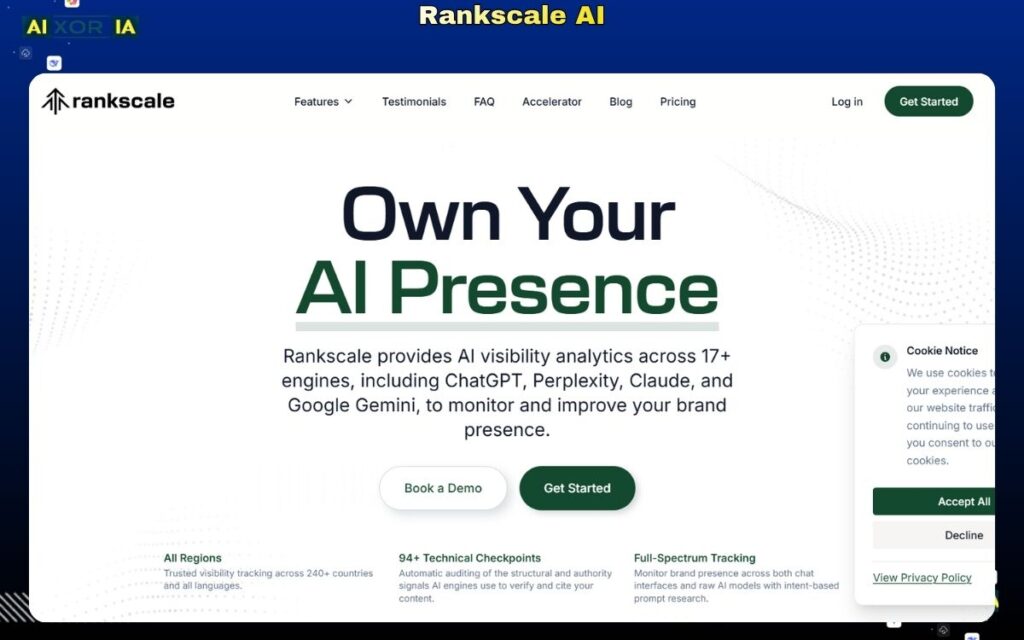
Rankscale AI is designed to bridge the gap between traditional SEO metrics and modern AI search visibility. It introduces a concept that many marketers have been missing:
A measurable “AI Visibility Score” that shows how often your brand appears in AI-generated answers.
Instead of focusing only on rankings, Rankscale AI evaluates how your content performs across multiple AI systems and converts that data into a clear, easy-to-understand score.
This makes it especially useful for marketers who want a simple but powerful way to track AI performance without diving into complex enterprise tools.
What Problem Does Rankscale AI Solve?
One of the biggest issues in AI search today is the lack of a standard metric.
In traditional SEO, you have rankings, traffic, and backlinks.
In AI search, there is no clear benchmark.
Rankscale AI solves this by:
- Creating a unified visibility score
- Tracking brand mentions across AI platforms
- Combining traditional SEO and AI data into one dashboard
- Helping users measure progress over time
This turns AI visibility into something trackable and comparable.
Key Features & Capabilities
Rankscale AI focuses on making AI visibility measurable, actionable, and easy to understand.
1. AI Visibility Score
A unique scoring system that shows how often your brand appears in AI-generated responses.
2. Multi-Model Tracking
Tracks performance across different AI systems, helping you understand visibility across platforms.
3. Prompt-Based Monitoring
Analyzes how your brand performs for specific queries and prompts.
4. Competitor Benchmarking
Compares your visibility score against competitors to identify gaps.
5. Unified Dashboard
Combines AI visibility data with traditional SEO insights for a complete performance view.
How Rankscale AI Helps with GEO (Generative Engine Optimization)
Rankscale AI is not just a tracking tool—it also helps guide your GEO strategy.
It helps you:
- Identify which prompts drive visibility
- Understand where you are losing to competitors
- Track improvements after content updates
- Measure the impact of GEO optimization efforts
It provides a feedback loop, which is essential for improving AI search performance.
Real-World Use Case
Let’s say you are targeting:
“Best email marketing tools for small businesses”
With Rankscale AI, you can:
- Track your visibility score for that query
- Compare it with competitors
- Identify which prompts you are missing
- Monitor improvements after updating your content
This allows you to move from guessing to data-driven optimization.
Pros
- Easy-to-understand visibility scoring system
- Affordable pricing compared to competitors
- Good balance between simplicity and functionality
- Useful competitor benchmarking
- Ideal for marketers and growing businesses
Cons
- Not as deep as enterprise-level tools
- Limited advanced analytics
- May not scale well for very large organizations
- Some features are still evolving
Rankscale AI Pricing
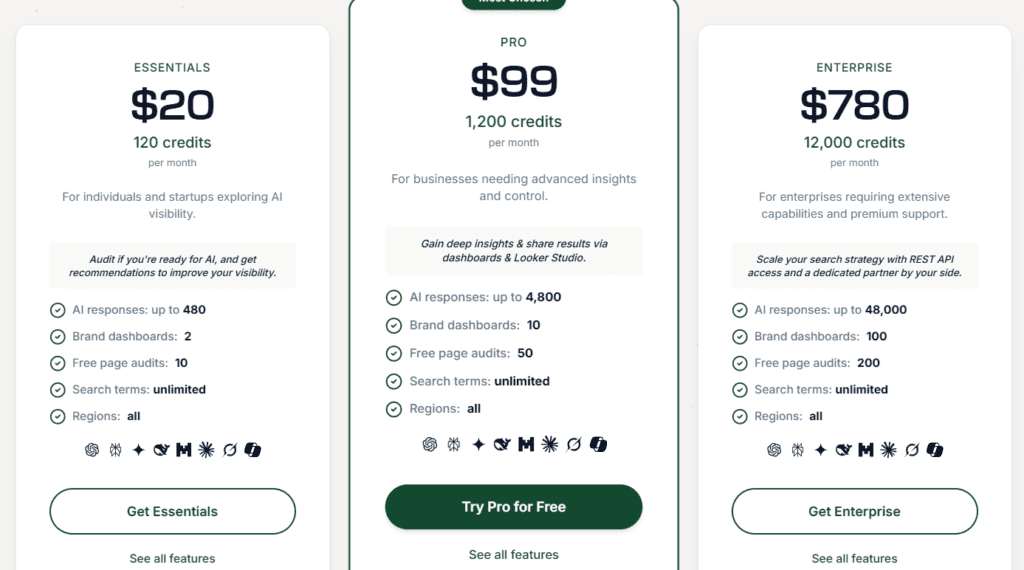
Rankscale AI offers affordable pricing plans, starting at approximately:
- $29/month for basic access
Pricing may increase based on:
- Number of tracked queries
- Depth of analysis
- Team usage
This makes it a strong option for startups and mid-sized businesses.
My Experience Using Rankscale AI
During testing, the most useful feature was the visibility score. It simplified a complex concept into something actionable and easy to track.
Instead of analyzing raw data, it was possible to quickly understand whether visibility was improving or declining. This made it easier to prioritize content updates.
READ MORE – 20+ Best AI Detector Tools in 2026 (Tested & Ranked)
SE Ranking AI Suite: Hybrid SEO + AI Visibility Tracking for Agencies
Overview
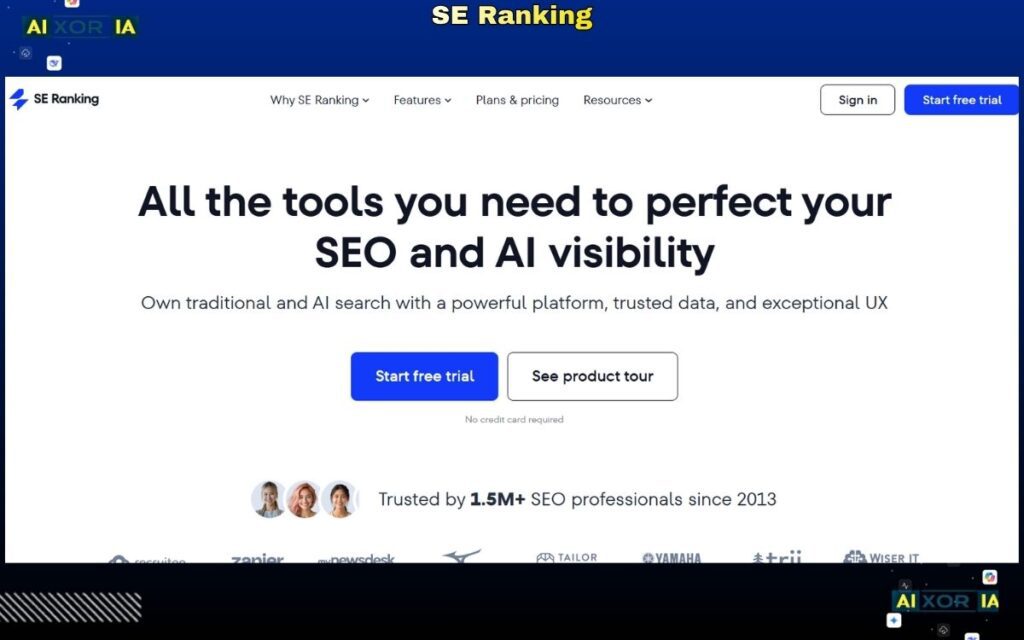
SE Ranking has evolved from a traditional SEO platform into a hybrid solution that combines keyword tracking with AI search visibility insights. In 2026, this makes it one of the most practical tools for agencies and SEO professionals who want to manage both worlds without switching platforms.
Instead of forcing you to adopt a completely new system for AI search, SE Ranking integrates AI tracking into its existing ecosystem. This allows you to monitor:
- Traditional keyword rankings
- Google AI Overviews visibility
- Content performance in AI-assisted search
It’s a strong choice for teams that want efficiency, reporting, and cost-effectiveness.
What Problem Does SE Ranking Solve?
Most agencies today face a major challenge:
They need to manage both traditional SEO and AI search visibility, but using separate tools increases cost and complexity.
SE Ranking solves this by:
- Combining SEO and AI tracking in one platform
- Providing unified reporting for clients
- Reducing the need for multiple subscriptions
- Simplifying workflow management
It allows agencies to stay competitive without overcomplicating their tech stack.
Key Features & Capabilities
SE Ranking’s AI suite builds on its existing SEO strengths while adding modern capabilities.
1. AI Visibility Tracking (Google AI Overviews)
Tracks how your content performs in AI-generated summaries within search results.
2. Keyword + AI Data Integration
Combines traditional keyword rankings with AI visibility insights.
3. Content Optimization Tools
Provides recommendations to improve content for both search engines and AI systems.
4. Competitor Analysis
Helps identify which competitors are appearing in AI results and why.
5. White-Label Reporting
Ideal for agencies that need to present data professionally to clients.
How SE Ranking Helps with GEO (Generative Engine Optimization)
SE Ranking supports GEO by offering:
- Content improvement suggestions
- SERP + AI performance tracking
- Competitor-based insights
- Keyword-to-prompt alignment
While it is not as advanced as dedicated GEO tools, it provides a balanced approach for teams transitioning into AI search.
Real-World Use Case
An SEO agency managing multiple clients can use SE Ranking to:
- Track keyword rankings
- Monitor AI visibility in Google Overviews
- Identify content gaps
- Generate reports for clients
This creates a streamlined workflow where both SEO and AI performance are managed in one place.
Pros
- All-in-one SEO + AI platform
- Cost-effective for agencies
- Easy-to-use interface
- Strong reporting features
- Good balance between functionality and simplicity
Cons
- AI tracking is not deeply granular
- Limited multi-model LLM tracking
- Less advanced than specialized AI tools
- GEO features are still developing
SE Ranking Pricing
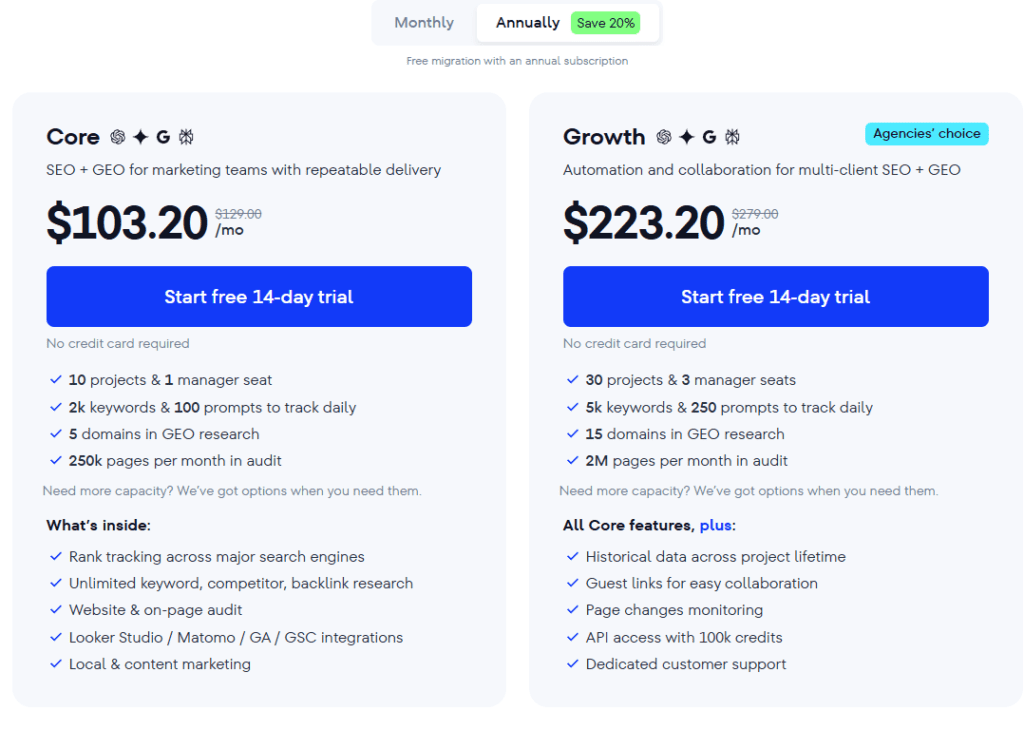
SE Ranking offers flexible pricing starting from approximately:
- $52/month
Pricing depends on:
- Number of projects
- Keyword tracking limits
- Feature access
My Experience Using SE Ranking
While testing SE Ranking, the biggest advantage was its simplicity. It allows you to manage SEO and AI tracking without learning a completely new system.
The reporting feature is especially useful for agencies, making it easy to present both traditional and AI performance metrics.
However, for deep AI analysis, it may need to be paired with a specialized tool.
Semrush AI Toolkit: Enterprise-Grade SEO Meets Generative Search Optimization
Overview
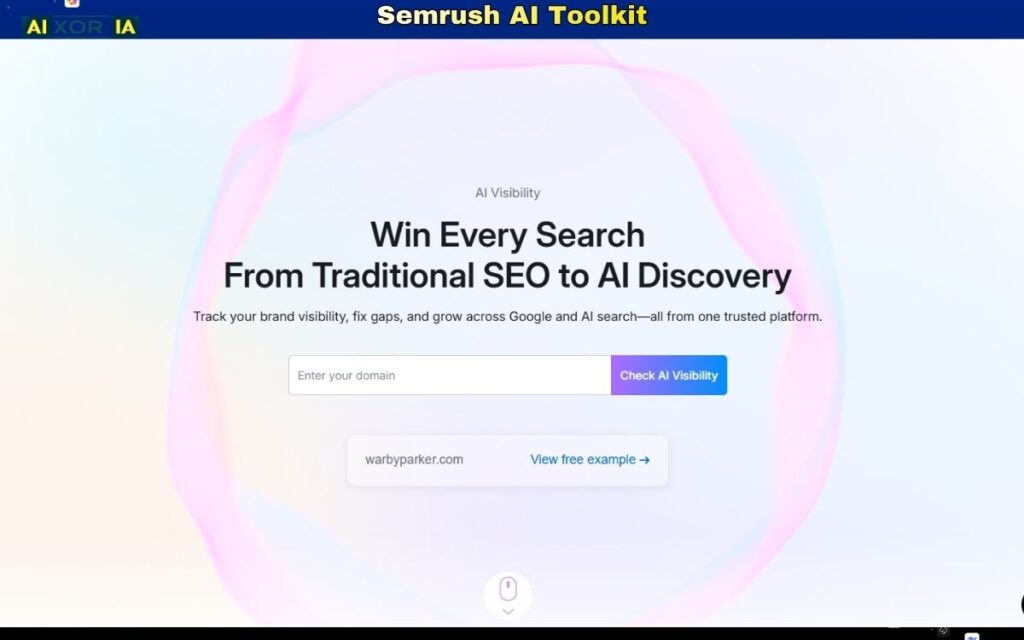
Semrush has long been one of the most powerful SEO platforms, and in 2026, it has adapted to the rise of AI search with its AI Toolkit.
This toolkit is designed to help businesses optimize content not just for rankings—but for AI-generated answers, entity coverage, and semantic relevance.
With one of the largest data ecosystems in the industry, Semrush provides deep insights into:
- Search intent
- Content gaps
- Entity optimization
- AI Overview performance
It is built for teams that need scale, data, and precision.
What Problem Does Semrush Solve?
Large websites and enterprises face a complex challenge:
Managing thousands of pages while ensuring they are optimized for both search engines and AI systems.
Semrush solves this by:
- Providing massive data insights
- Identifying content gaps at scale
- Offering AI-driven recommendations
- Helping align content with modern search behavior
It allows teams to make data-driven decisions at scale.
Key Features & Capabilities
Semrush AI Toolkit expands on its traditional strengths with advanced AI-focused features.
1. AI Content Optimization
Analyzes content for entity coverage, readability, and AI compatibility.
2. SERP + AI Overview Tracking
Tracks performance in both traditional search results and AI-generated summaries.
3. Competitor Intelligence
Provides deep insights into competitor strategies and visibility.
4. Keyword + Intent Mapping
Helps align content with both search queries and AI prompts.
5. Content Audit at Scale
Allows large websites to optimize hundreds or thousands of pages efficiently.
How Semrush Helps with GEO (Generative Engine Optimization)
Semrush plays a strong role in GEO by:
- Identifying missing entities
- Improving semantic coverage
- Aligning content with AI expectations
- Supporting large-scale optimization
It is especially useful for businesses that need to optimize entire content ecosystems.
Real-World Use Case
A large SaaS company can use Semrush to:
- Audit its entire blog
- Identify weak pages
- Optimize content for AI Overviews
- Track improvements over time
This ensures consistent visibility across both traditional and AI-driven search.
Pros
- Massive data ecosystem
- Powerful competitor analysis
- Strong content optimization tools
- Enterprise-ready features
- Scalable for large websites
Cons
- Expensive for small businesses
- Can be overwhelming for beginners
- AI features not as specialized as niche tools
- Requires time to master
Pricing
Semrush pricing starts at approximately:
- $139/month
Higher-tier plans offer:
- Advanced features
- Larger data limits
- Team collaboration tools
My Experience Using Semrush
During testing, Semrush stood out for its depth of data. It provides insights that are difficult to find elsewhere, especially for large-scale content strategies.
The AI features are powerful, but they require time to fully understand and use effectively.
For beginners, it may feel overwhelming—but for professionals, it is extremely valuable.
Ahrefs Brand Radar (AI Adaptation): Turning Mentions into Next-Gen AI Citations
Overview
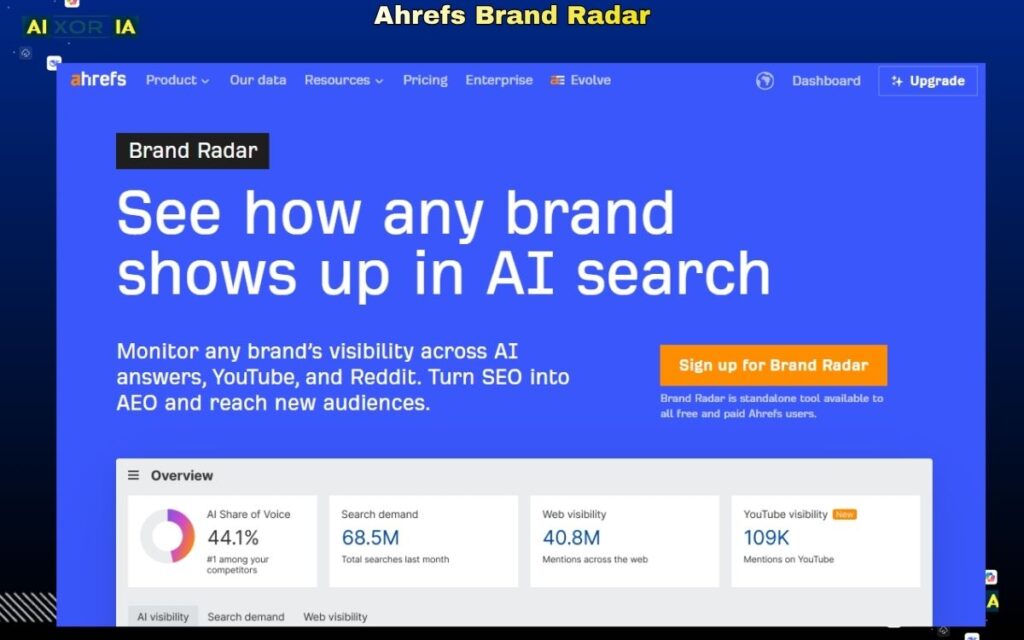
Ahrefs has long been known for backlinks and SEO analytics, but in 2026, its evolution into brand mention tracking and AI-aware visibility analysis makes it highly relevant for AI search.
While Ahrefs is not a pure AI visibility tool like some newer platforms, its Brand Radar and mention tracking capabilities now play a crucial role in understanding how your content is being discovered, referenced, and potentially used by AI systems.
The key idea is simple:
AI models rely heavily on web signals—especially mentions, authority, and links.
Ahrefs helps you track and strengthen those signals.
What Problem Does Ahrefs Solve?
Many businesses focus only on direct AI tracking tools but ignore the foundation of AI visibility: web authority.
Common issues include:
- Weak backlink profiles
- Low brand mentions across the web
- Lack of authority signals
- Poor content distribution
Ahrefs solves this by:
- Tracking backlinks and brand mentions
- Identifying authority gaps
- Showing which pages attract citations
- Helping build a strong foundation for AI trust
This is critical because AI systems often pull from trusted and widely referenced sources.
Key Features & Capabilities
Ahrefs provides a strong set of tools that indirectly support AI visibility.
1. Brand Mention Tracking
Tracks where your brand is mentioned across the web, even without backlinks.
2. Backlink Analysis
Helps build authority signals that AI systems rely on for trust.
3. Content Explorer
Finds high-performing content that is more likely to be cited by AI.
4. Competitor Analysis
Shows which competitors have stronger authority and visibility.
5. Keyword + Topic Insights
Helps identify content opportunities that align with AI retrieval patterns.
How Ahrefs Helps with GEO (Generative Engine Optimization)
Ahrefs plays a foundational role in GEO by:
- Strengthening domain authority
- Increasing brand mentions
- Identifying high-value content opportunities
- Supporting entity recognition
While it does not directly track AI citations, it improves the signals that influence AI selection.
Real-World Use Case
A brand trying to appear in AI answers for:
“Best SEO tools for beginners”
can use Ahrefs to:
- Identify top-ranking competitor content
- Analyze their backlink profiles
- Build stronger authority
- Increase brand mentions
Over time, this improves the chances of being recognized and cited by AI systems.
Pros
- Industry-leading backlink database
- Strong brand mention tracking
- Excellent competitor analysis
- Supports long-term authority building
- Reliable and data-rich platform
Cons
- No direct AI prompt tracking
- Limited AI-specific features
- Can be expensive
- Requires SEO knowledge to use effectively
Ahrefs Brand Radar Pricing
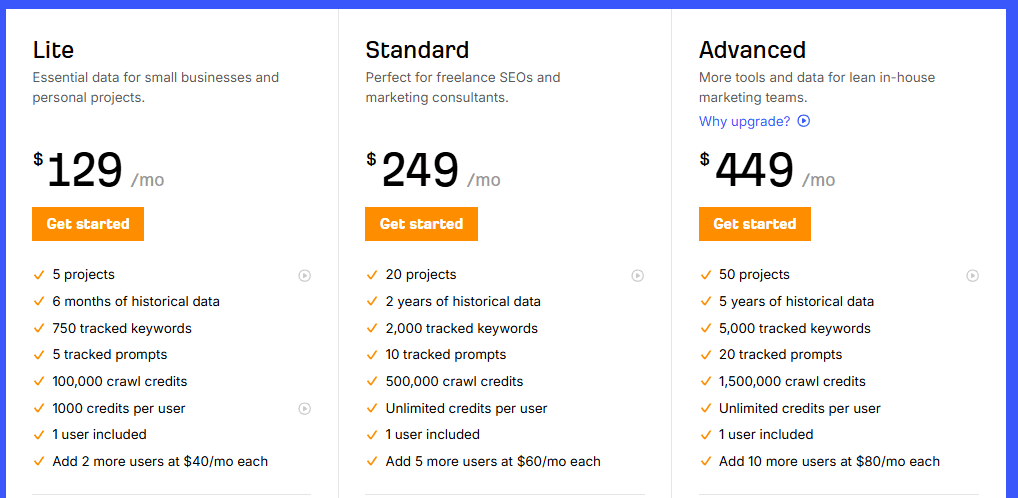
Ahrefs pricing starts at approximately:
- $99/month
Higher plans provide:
- More data access
- Advanced features
- Larger tracking limits
My Experience Using Ahrefs
While testing Ahrefs, it became clear that even though it is not an AI-native tool, it plays a critical role in AI visibility.
Strong backlink profiles and brand mentions directly influence which sources AI systems trust. Ahrefs helps build that foundation better than almost any tool.
However, it should be combined with AI-specific tools for complete visibility tracking.
Surfer AI: NLP-Driven Content Optimization for AI-Ready Pages
Overview
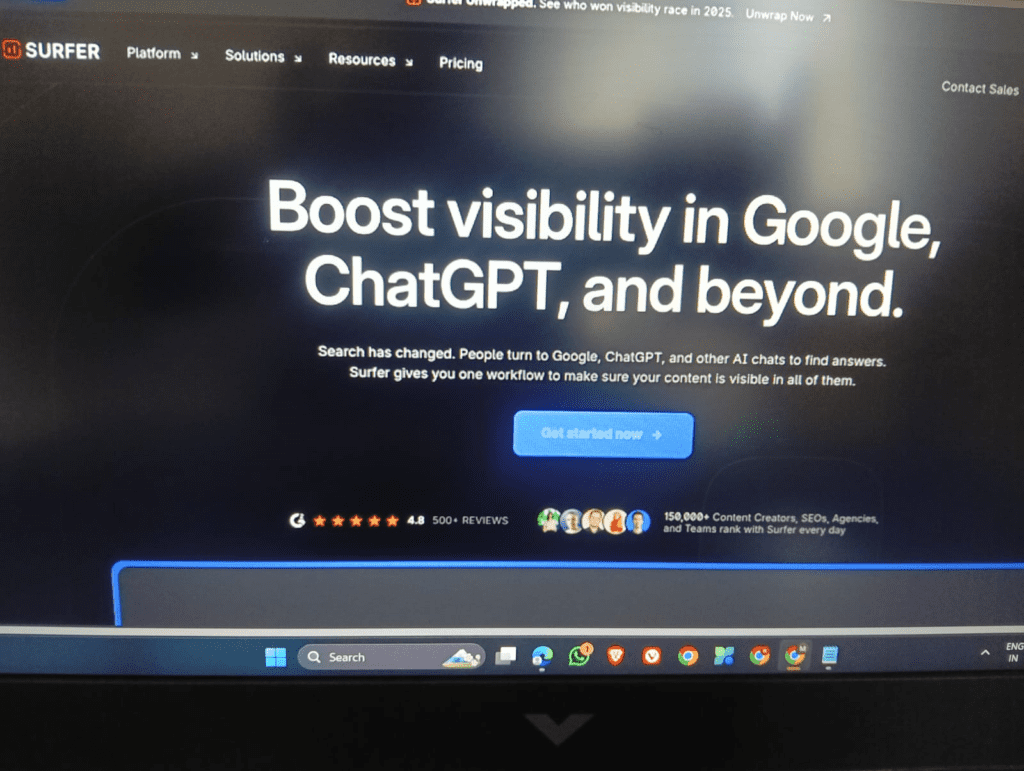
Surfer AI is one of the most practical tools for content optimization in the era of AI search. It focuses on a key factor that directly impacts AI visibility:
Semantic relevance and natural language alignment.
AI systems don’t just look for keywords—they look for context, structure, and completeness. Surfer AI helps ensure your content matches those expectations by analyzing top-performing pages and generating a content score based on NLP (Natural Language Processing).
This makes it highly effective for creating content that is both search-engine friendly and AI-readable.
What Problem Does Surfer AI Solve?
Many writers and marketers create content that:
- Misses important semantic terms
- Lacks depth and context
- Is not aligned with AI expectations
- Fails to compete with top-ranking pages
Surfer AI solves this by:
- Providing a clear content score
- Identifying missing keywords and entities
- Offering real-time optimization suggestions
- Guiding content structure and length
It ensures your content is complete, relevant, and competitive.
Key Features & Capabilities
Surfer AI offers a powerful set of tools for content creation and optimization.
1. Content Score System
Gives a score based on how well your content matches top-performing pages.
2. NLP Keyword Suggestions
Identifies important terms and phrases that improve semantic relevance.
3. AI Content Editor
Provides real-time suggestions while writing or editing content.
4. SERP Analysis
Analyzes top-ranking pages to guide optimization strategy.
5. Integration Support
Works with platforms like Google Docs and WordPress.
How Surfer AI Helps with GEO (Generative Engine Optimization)
Surfer AI supports GEO by:
- Improving semantic density
- Enhancing content completeness
- Aligning content with user intent
- Increasing AI readability
It helps ensure your content includes the context and signals that AI systems look for.
Real-World Use Case
A content creator targeting:
“Best AI tools for content writing”
can use Surfer AI to:
- Analyze top-ranking articles
- Identify missing keywords
- Improve content structure
- Increase content score
This increases the likelihood of being included in both search results and AI-generated answers.
Pros
- Easy-to-use interface
- Real-time content optimization
- Strong NLP-based recommendations
- Integrates with popular tools
- Highly actionable insights
Cons
- AI credits can be limited
- Not focused on direct AI citation tracking
- Requires manual effort for best results
- Can become expensive with heavy usage
Surfer Pricing
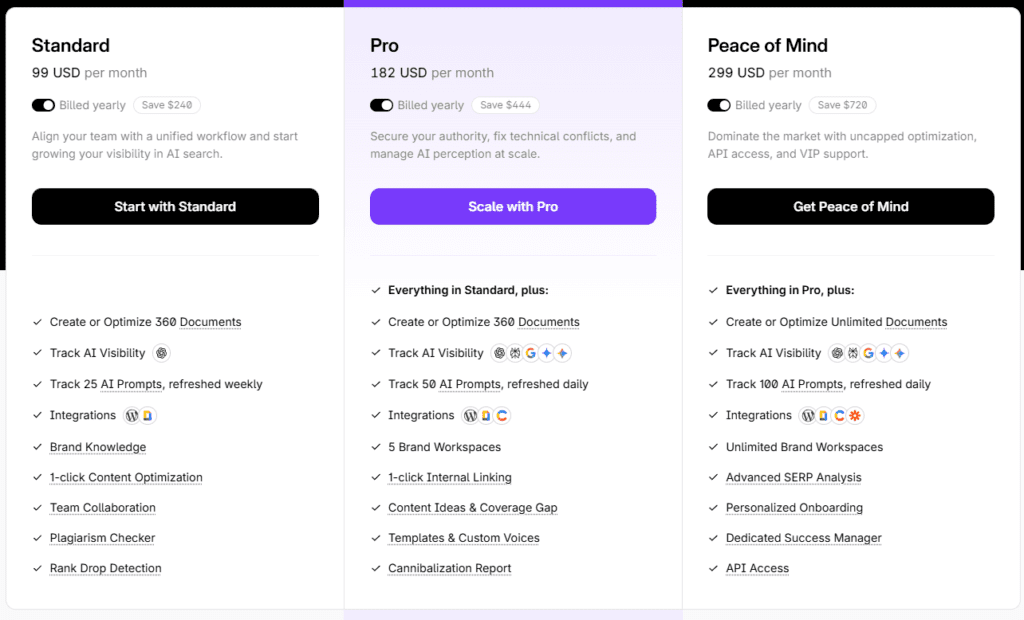
Surfer AI pricing starts at approximately:
- $89/month
Additional costs may apply for:
- AI content generation
- Higher usage limits
My Experience Using Surfer AI
During testing, Surfer AI was one of the most practical tools for improving content quality. The real-time suggestions made it easy to optimize articles without overthinking.
It was especially helpful in identifying missing terms and improving structure. However, it focuses more on content optimization rather than direct AI visibility tracking.
MarketMuse: Enterprise Topic Authority Modeling for AI Search Dominance
Overview
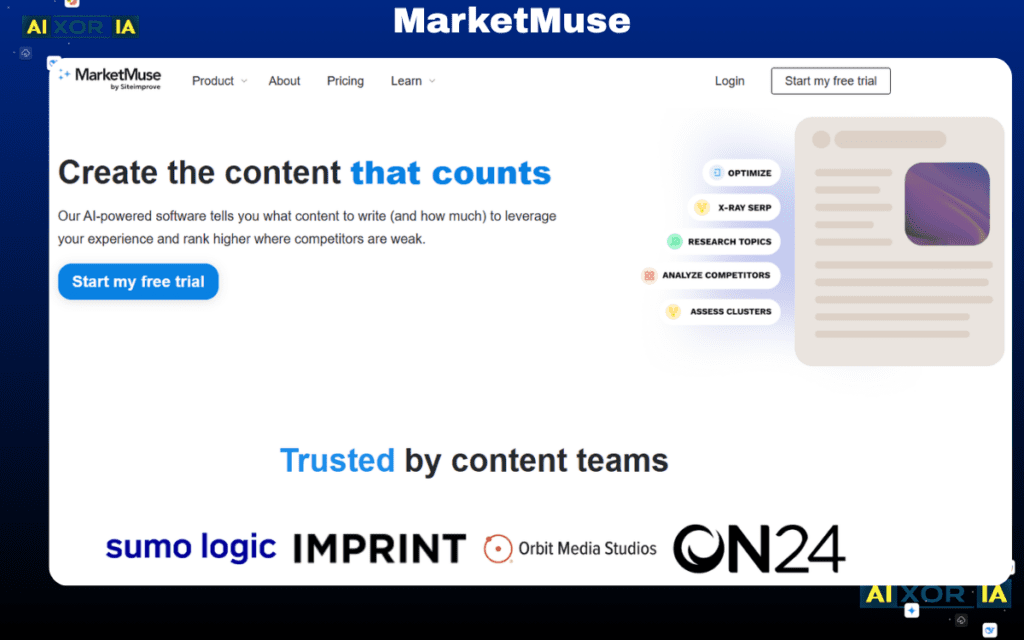
MarketMuse is built on a powerful idea that has become even more important in 2026:
AI systems don’t recommend pages—they recommend authorities.
Unlike traditional SEO tools that focus on individual keywords or pages, MarketMuse analyzes your entire website and determines whether you are a true authority on a topic. This is critical because AI models prefer to cite sources that demonstrate depth, consistency, and comprehensive coverage.
MarketMuse helps you move from writing isolated articles to building complete topical ecosystems that AI systems trust.
What Problem Does MarketMuse Solve?
Many websites struggle with AI visibility because their content is:
- Scattered and disconnected
- Missing key subtopics
- Lacking depth across a niche
- Not perceived as authoritative
Even if individual articles rank well, AI systems may still ignore them if the overall site lacks topical authority.
MarketMuse solves this by:
- Auditing your entire content library
- Identifying gaps in topic coverage
- Recommending content clusters
- Prioritizing what to create next
This allows you to build a site that AI systems recognize as a trusted knowledge source.
Key Features & Capabilities
MarketMuse offers advanced tools for large-scale content strategy and optimization.
1. Topic Authority Modeling
Analyzes how strong your site is in a specific niche compared to competitors.
2. Content Gap Analysis
Identifies missing subtopics that reduce your authority.
3. AI Content Briefs
Generates detailed briefs with required topics, questions, and structure.
4. Content Scoring System
Evaluates how well your content covers a topic.
5. Inventory Analysis
Audits existing content and shows what needs improvement.
How MarketMuse Helps with GEO (Generative Engine Optimization)
MarketMuse plays a major role in GEO by:
- Building deep topical authority
- Improving semantic coverage
- Strengthening entity relationships across content
- Increasing trust signals for AI systems
It ensures your site becomes a go-to source that AI models are more likely to cite.
Real-World Use Case
A company targeting:
“Digital marketing strategies for startups”
can use MarketMuse to:
- Analyze its entire content library
- Identify missing topics (SEO, email marketing, paid ads, etc.)
- Create a structured content plan
- Improve existing articles
This results in a stronger content ecosystem that AI systems recognize as authoritative.
Pros
- Best-in-class topic authority analysis
- Excellent content planning capabilities
- Highly data-driven approach
- Ideal for large content teams
- Strong long-term SEO and GEO value
Cons
- Expensive (enterprise-focused)
- Steep learning curve
- Not suitable for beginners
- Requires ongoing content investment
Pricing
MarketMuse uses custom enterprise pricing, depending on:
- Content volume
- Number of users
- Level of analysis
It is primarily designed for:
- Enterprises
- Large content teams
- Agencies managing multiple clients
My Experience Using MarketMuse
While testing MarketMuse, the biggest insight was how much content gaps affect authority. Even well-written articles were underperforming because they lacked supporting topics.
The platform provided a clear roadmap for building authority, which is essential for AI visibility. However, it requires commitment—this is not a quick optimization tool.
READ MORE – 9 Best AI Tools for Optimizing Product Visibility
BrightEdge AI: Enterprise-Level AI Search Analytics & Generative Parsing
Overview
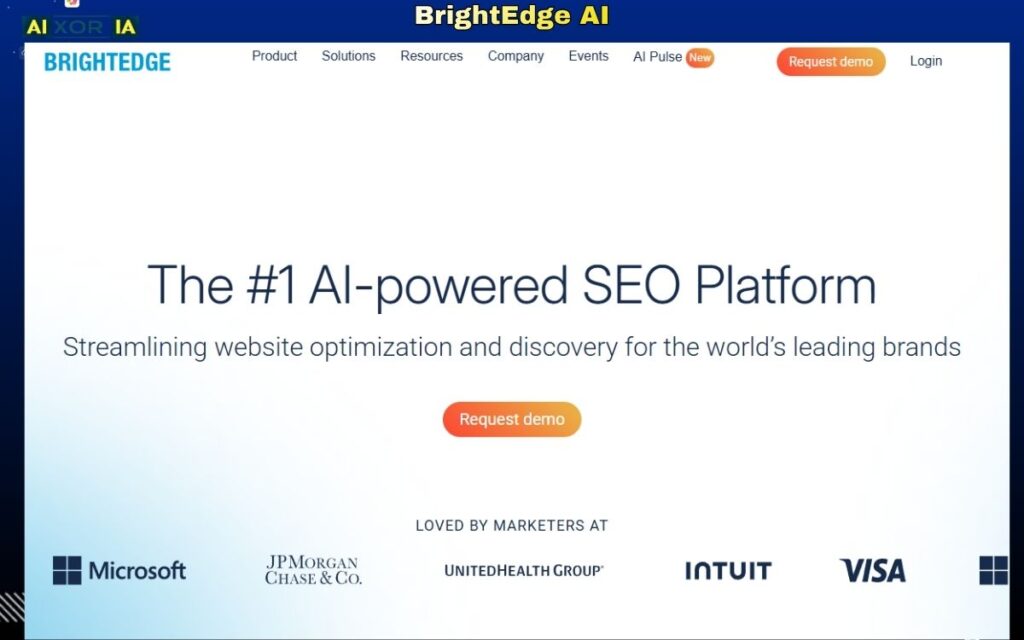
BrightEdge is a premium enterprise platform that has fully adapted to the AI-driven search landscape. In 2026, it stands out for its advanced capability known as:
Generative Parsing
This feature allows businesses to understand how their content is interpreted, summarized, and presented within AI-generated search experiences.
BrightEdge is built for organizations managing thousands or millions of pages, where visibility across AI systems must be monitored at scale.
What Problem Does BrightEdge Solve?
Large enterprises face challenges that smaller tools cannot handle:
- Managing massive content libraries
- Tracking visibility across multiple regions and platforms
- Understanding how AI systems represent their brand
- Scaling optimization efforts
BrightEdge solves this by:
- Providing enterprise-grade analytics
- Automating large-scale insights
- Offering AI-driven recommendations
- Delivering executive-level reporting
It helps organizations maintain control and visibility at scale.
Key Features & Capabilities
BrightEdge offers a powerful set of tools tailored for enterprise needs.
1. Generative Parsing Technology
Analyzes how AI systems summarize and present your content.
2. AI Search Performance Tracking
Tracks visibility in AI-driven search environments across platforms.
3. Large-Scale Content Optimization
Provides recommendations for thousands of pages simultaneously.
4. Data Integration & Automation
Integrates with enterprise systems for seamless workflows.
5. Executive Reporting Dashboards
Delivers insights in a format suitable for decision-makers.
How BrightEdge Helps with GEO (Generative Engine Optimization)
BrightEdge plays a major role in GEO by:
- Scaling optimization efforts
- Providing deep AI insights
- Automating content improvements
- Monitoring performance across large datasets
It enables enterprises to operate at a level that smaller tools cannot match.
Real-World Use Case
A global eCommerce company can use BrightEdge to:
- Track AI visibility across thousands of product pages
- Analyze how products appear in AI-generated summaries
- Optimize content at scale
- Monitor performance across regions
This ensures consistent visibility across all AI-driven search experiences.
Pros
- Enterprise-grade analytics and scalability
- Advanced AI parsing capabilities
- Strong automation features
- Excellent reporting for large teams
- Deep integration options
Cons
- Very expensive
- Requires dedicated team and resources
- Complex setup and onboarding
- Not suitable for small businesses
Pricing
BrightEdge offers custom enterprise pricing, based on:
- Data scale
- Feature requirements
- Organizational needs
It is designed for:
- Large enterprises
- Global brands
- High-budget SEO teams
My Experience Using BrightEdge
Testing BrightEdge revealed its strength in handling large-scale operations. The generative parsing feature provided unique insights into how AI systems interpret content.
Wix SEO AI: Beginner-Friendly AI Optimization for Small Business Visibility
Overview
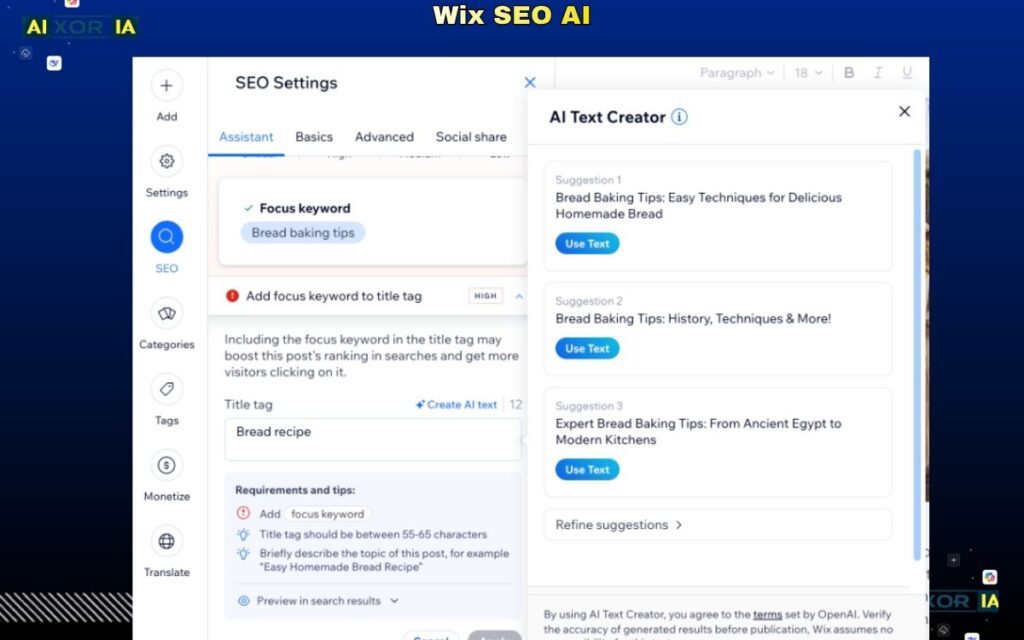
Wix SEO AI (often known through Wix’s built-in SEO tools and AI optimization features) is designed for one specific type of user:
People who want results without technical complexity.
In 2026, not every business has an SEO team, developers, or AI specialists. Small business owners, freelancers, and local brands still need to compete in AI-driven search—but they need tools that are simple, guided, and automated.
That’s exactly where Wix SEO AI fits.
It integrates AI-powered SEO and basic AI search optimization directly into the website builder, making it one of the easiest ways to prepare a site for both search engines and AI systems.
What Problem Does Wix SEO AI Solve?
Most small businesses struggle with:
- Technical SEO complexity
- Lack of time and expertise
- Not knowing how to optimize content
- Missing structured data and metadata
- Poor visibility in AI-driven search
Wix SEO AI solves this by:
- Automating SEO setup
- Guiding users step-by-step
- Generating optimized content suggestions
- Handling technical aspects in the background
It removes the need for deep technical knowledge and provides a plug-and-play SEO experience.
Key Features & Capabilities
Wix SEO AI focuses on simplicity, automation, and ease of use.
1. AI SEO Setup Wizard
Guides users through the entire SEO process, including keywords, page optimization, and indexing.
2. Automated Meta Tag Generation
Creates titles, descriptions, and structured data optimized for search and AI readability.
3. Built-in Structured Data (Schema)
Helps AI systems understand your content better through automated schema implementation.
4. AI Content Suggestions
Provides recommendations to improve content clarity and relevance.
5. Technical SEO Automation
Handles sitemap generation, mobile optimization, and indexing automatically.
How Wix SEO AI Helps with GEO (Generative Engine Optimization)
While Wix SEO AI is not a deep GEO tool, it supports the foundation of AI visibility.
It helps you:
- Structure content properly
- Improve clarity for AI systems
- Add essential metadata
- Ensure technical readiness
This makes it ideal for beginners who want to enter the AI search ecosystem without complexity.
Real-World Use Case
A local business in the US—like a home service provider—can use Wix SEO AI to:
- Set up their website
- Optimize pages automatically
- Add structured data
- Improve local search visibility
This increases the chances of appearing in:
- Google search results
- AI Overviews
- Local AI-generated recommendations
Pros
- Extremely beginner-friendly
- No technical knowledge required
- Fully integrated into Wix platform
- Automates most SEO tasks
- Fast setup and implementation
Cons
- Limited to Wix websites only
- Basic AI optimization features
- Not suitable for advanced SEO strategies
- Limited control for experienced users
Pricing
Wix SEO AI is included with Wix hosting plans, which typically start from:
- Basic plans (varies by region and features)
There is no separate pricing for the SEO AI tools, making it cost-effective for small businesses.
My Experience Using Wix SEO AI
During testing, Wix SEO AI stood out for its simplicity. It made SEO feel approachable, even for someone with no prior experience.
The guided setup was particularly useful, as it removed guesswork and provided clear steps. However, it lacks depth for advanced users who want full control over their SEO and AI strategy.
Alli AI: Automated Technical Optimization for AI-Ready Websites
Overview
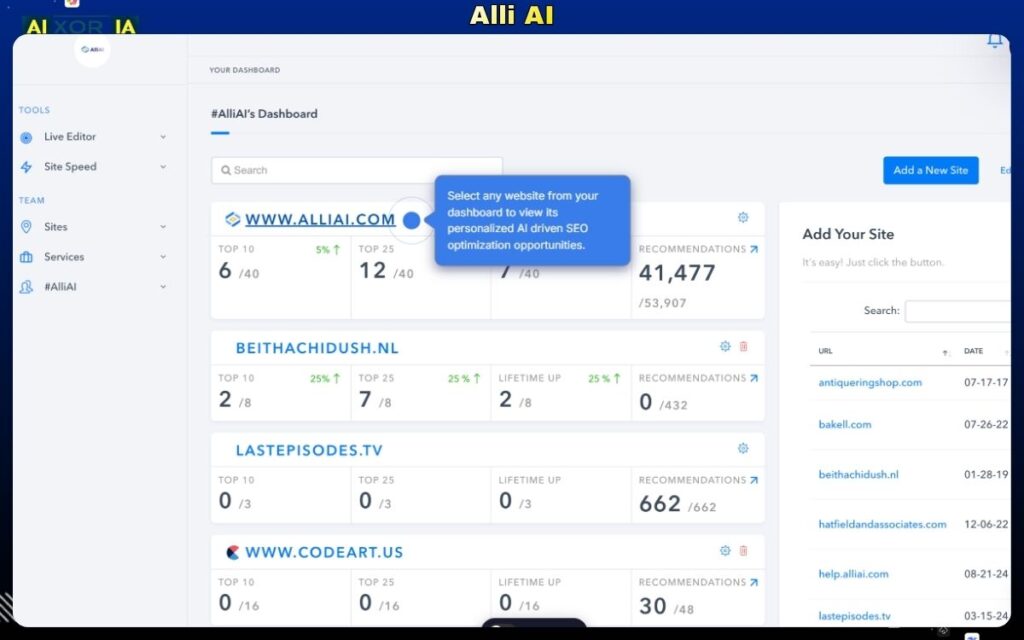
Alli AI is built for one of the most overlooked but critical aspects of AI search visibility:
technical optimization at scale—without relying on developers.
In 2026, AI systems don’t just evaluate your content—they also rely on how well your website is structured technically. If your site has broken schema, poor internal linking, or inefficient crawlability, AI systems may struggle to understand or retrieve your content.
Alli AI solves this by allowing you to deploy SEO and AI optimization changes instantly across your entire website using a simple code snippet.
What Problem Does Alli AI Solve?
Many SEO teams face a major bottleneck:
Even when they know what needs to be fixed, they must wait for developers to implement changes.
Common issues include:
- Missing schema markup
- Poor internal linking
- Unoptimized headings and metadata
- Slow implementation cycles
- Technical fixes delayed for weeks or months
Alli AI removes this bottleneck by:
- Automating technical SEO changes
- Allowing instant updates without coding
- Scaling optimizations across thousands of pages
This makes it especially powerful for teams that need speed and control.
Key Features & Capabilities
Alli AI focuses on automation and large-scale optimization.
1. One-Click Technical Fixes
Deploy SEO changes across your site instantly without touching the backend.
2. Automated Schema Markup
Adds structured data that helps AI systems understand your content better.
3. Internal Linking Automation
Improves content discoverability for both search engines and AI crawlers.
4. Real-Time Editing
Make live changes directly on your website without developer involvement.
5. Cross-CMS Compatibility
Works on almost any website platform, not limited to a specific CMS.
How Alli AI Helps with GEO (Generative Engine Optimization)
Alli AI supports GEO by improving the technical foundation of your website.
It helps you:
- Make content easier for AI crawlers to access
- Improve structured data signals
- Enhance internal content relationships
- Increase crawl efficiency
This ensures your site is fully optimized for AI retrieval and indexing.
Real-World Use Case
An SEO team managing a large blog can use Alli AI to:
- Add schema markup to all articles
- Improve internal linking structure
- Update meta tags at scale
- Fix technical SEO issues instantly
This significantly improves both search performance and AI visibility.
Pros
- Eliminates developer dependency
- Fast implementation of SEO fixes
- Works across multiple platforms
- Strong technical optimization capabilities
- Saves time for large teams
Cons
- Can conflict with complex JavaScript setups
- Requires careful monitoring after deployment
- Not focused on content strategy
- Limited direct AI citation tracking
Alli AI Pricing
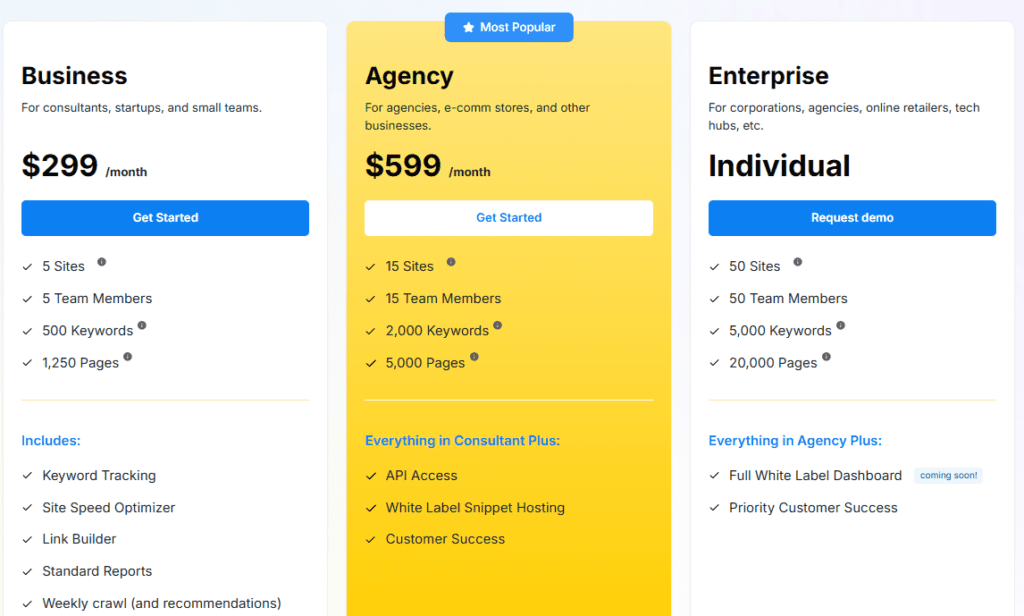
Alli AI pricing starts at approximately:
- $49/month
Pricing increases based on:
- Website size
- Number of pages
- Advanced features
My Experience Using Alli AI
While testing Alli AI, the biggest advantage was speed. Changes that normally take days or weeks could be implemented instantly.
It was especially useful for technical fixes like schema and internal linking. However, it requires careful use to avoid conflicts with existing site configurations.
CanIRank: Actionable AI SEO Recommendations Instead of Just Data
Overview
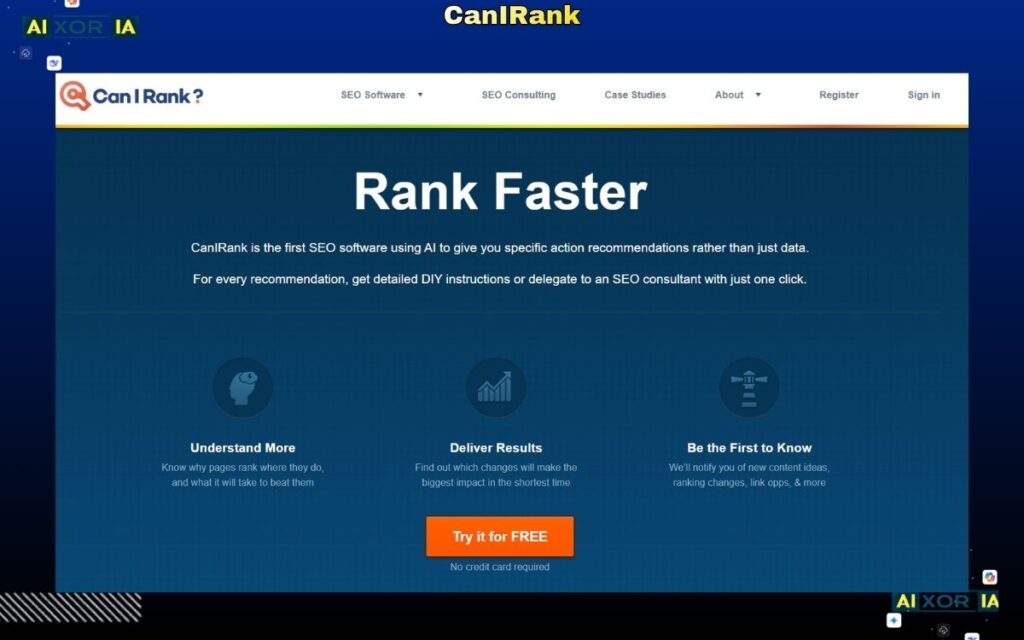
CanIRank takes a different approach compared to most SEO and AI tools.
Instead of overwhelming users with data, it focuses on one simple goal:
Tell users exactly what to do to improve their visibility.
In 2026, this approach is extremely valuable. Many tools provide analytics, but very few provide clear, actionable steps that directly impact AI search visibility.
CanIRank acts more like an AI-powered SEO consultant, helping users make better decisions quickly.
What Problem Does CanIRank Solve?
A common issue in SEO and AI visibility is:
Too much data, not enough direction.
Users often struggle with:
- Understanding complex analytics
- Deciding what to prioritize
- Identifying high-impact actions
- Translating insights into results
CanIRank solves this by:
- Turning data into actionable recommendations
- Prioritizing tasks based on impact
- Providing step-by-step guidance
- Reducing analysis paralysis
Key Features & Capabilities
CanIRank focuses on usability and actionable insights.
1. AI-Powered Recommendations
Provides specific actions to improve rankings and visibility.
2. Keyword & Competitor Analysis
Shows what competitors are doing and how you can outperform them.
3. Content Optimization Suggestions
Recommends changes to improve content quality and relevance.
4. Opportunity Scoring
Evaluates how likely you are to rank or improve visibility for a keyword.
5. Task-Based Workflow
Organizes recommendations into clear, actionable tasks.
How CanIRank Helps with GEO (Generative Engine Optimization)
CanIRank supports GEO by simplifying optimization.
It helps you:
- Identify missing content elements
- Improve semantic relevance
- Align content with user intent
- Take action quickly
While it doesn’t deeply analyze AI systems, it helps ensure your content meets the basic requirements for AI visibility.
Real-World Use Case
A small business targeting:
“Best accounting software for freelancers”
can use CanIRank to:
- Analyze competitors
- Get specific content recommendations
- Improve page structure
- Increase chances of visibility
This makes optimization simple and practical.
Pros
- Highly actionable recommendations
- Beginner-friendly interface
- Clear prioritization of tasks
- Affordable pricing
- Saves time in decision-making
Cons
- Interface feels slightly outdated
- Limited advanced AI tracking
- Not suitable for large enterprises
- Less focus on deep analytics
CanIRank Pricing
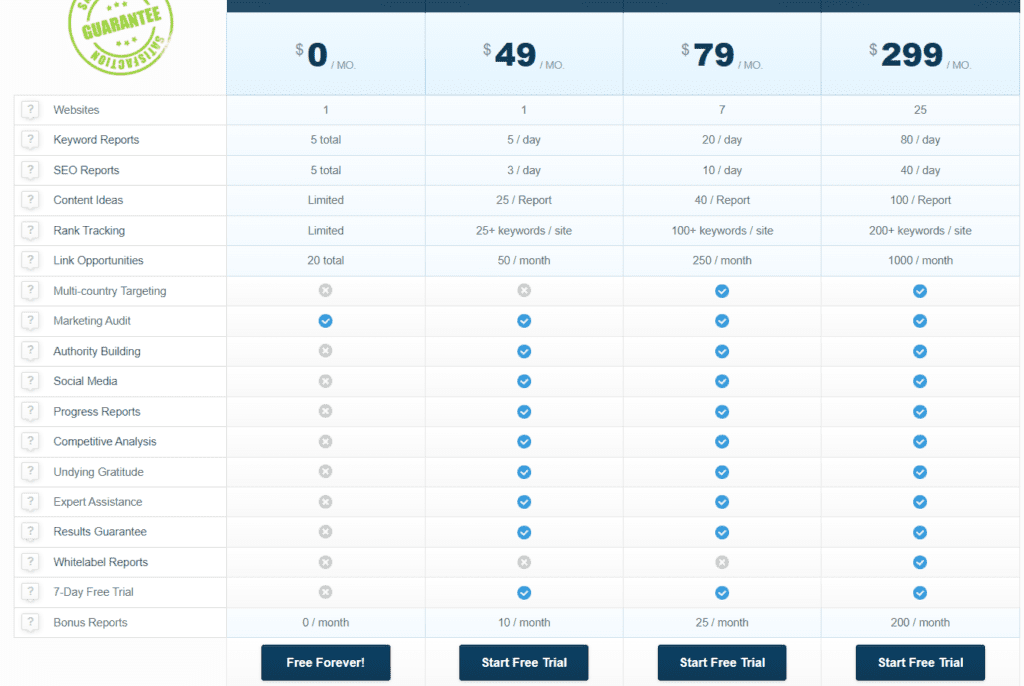
CanIRank pricing starts at approximately:
- $50/month
Plans vary based on:
- Number of keywords
- Feature access
- Usage limits
My Experience Using CanIRank
During testing, CanIRank stood out for its simplicity. Instead of analyzing complex dashboards, it directly suggested what actions to take.
Nightwatch: Precision Local Rank Tracking Meets AI Search Visibility
Overview

Nightwatch has traditionally been known for its high-accuracy rank tracking, but in 2026, it has evolved into a powerful tool for tracking local visibility within AI-driven search environments.
As AI search systems increasingly generate localized answers (for example, “best dentist near me” or “top cafes in New York”), businesses must understand whether they are appearing in these AI-generated local summaries.
Nightwatch helps bridge that gap by combining granular local rank tracking with emerging AI snippet visibility insights.
What Problem Does Nightwatch Solve?
Local businesses face a growing challenge:
Even if they rank in traditional search results, they may not appear in AI-generated local answers, which are often shown above organic listings.
Common problems include:
- Losing visibility in local AI summaries
- Inconsistent rankings across locations
- Lack of insight into AI-driven search features
- Difficulty tracking hyper-local performance
Nightwatch solves this by:
- Tracking rankings at a very precise location level
- Monitoring visibility in AI-driven SERP features
- Providing accurate, real-time ranking data
- Helping businesses optimize for local AI exposure
Key Features & Capabilities
Nightwatch offers advanced tracking and reporting tools.
1. Hyper-Accurate Rank Tracking
Tracks rankings at city, ZIP code, or even street level.
2. AI SERP Feature Tracking
Monitors visibility in AI-generated snippets and search features.
3. Custom Segmentation
Allows users to group keywords and track performance in specific areas.
4. Automated Reporting
Generates clean, customizable reports for teams and clients.
5. API Access & Integrations
Supports advanced workflows for agencies and enterprises.
How Nightwatch Helps with GEO (Generative Engine Optimization)
Nightwatch contributes to GEO by focusing on local AI visibility.
It helps you:
- Track presence in localized AI answers
- Optimize for location-based queries
- Identify gaps in local performance
- Improve visibility in AI-driven recommendations
This is especially important for businesses relying on local traffic and conversions.
Real-World Use Case
A local service provider in the US (for example, a plumbing company) can use Nightwatch to:
- Track rankings in multiple neighborhoods
- Monitor visibility in AI-generated local summaries
- Optimize content for location-based queries
- Improve local SEO performance
This increases the chances of being recommended by AI systems for nearby searches.
Pros
- Extremely accurate local tracking
- Supports AI SERP feature monitoring
- Clean and intuitive interface
- Strong reporting capabilities
- Affordable for small to mid-sized businesses
Cons
- Limited deep LLM analysis
- Not focused on prompt-based tracking
- Less useful for non-local businesses
- Advanced features require higher plans
Nightwatch Pricing
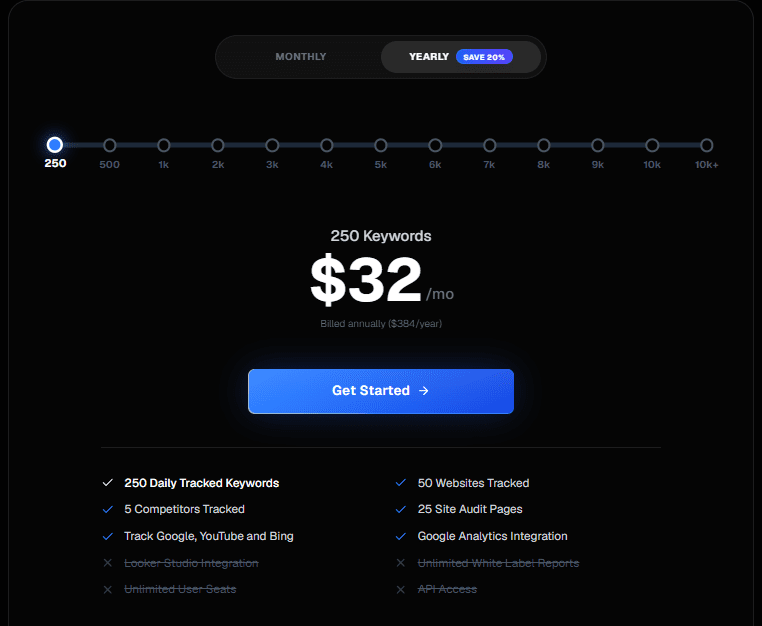
Nightwatch pricing starts at approximately:
- $32/month
Pricing scales based on:
- Number of tracked keywords
- Features and integrations
- Usage limits
My Experience Using Nightwatch
While testing Nightwatch, its accuracy stood out immediately. The ability to track rankings at a very granular level made it highly reliable for local SEO.
CognitiveSEO: Deep Link Intelligence and Semantic Trust Analysis for AI Search
Overview
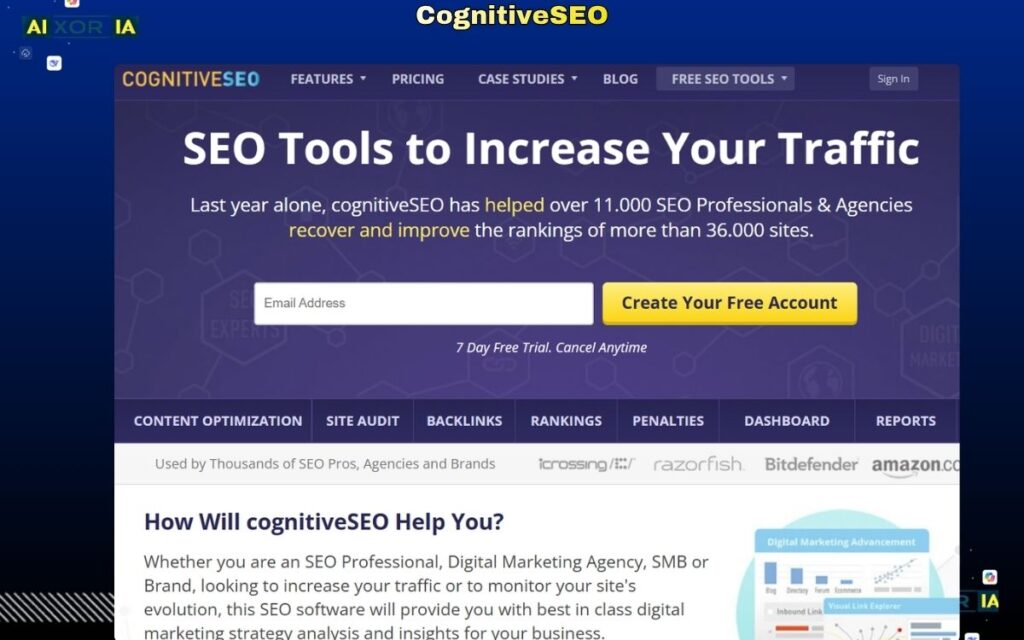
CognitiveSEO is a powerful platform that focuses on two critical aspects of modern SEO and AI visibility:
link quality and semantic context.
In 2026, AI systems are no longer impressed by just the number of backlinks. Instead, they evaluate:
- The context of those links
- The relevance to your niche
- The trustworthiness of your content
CognitiveSEO excels at analyzing these deeper signals, helping websites build a natural, authoritative presence that AI systems trust.
What Problem Does CognitiveSEO Solve?
Many websites struggle with AI visibility because of:
- Unnatural or spammy backlinks
- Weak semantic relevance
- Poor content-link alignment
- Lack of trust signals
Even if a site has many backlinks, AI systems may ignore it if those links appear unnatural or irrelevant.
CognitiveSEO solves this by:
- Analyzing backlink quality in depth
- Identifying unnatural link patterns
- Evaluating semantic relationships
- Providing actionable insights to improve trust
Key Features & Capabilities
CognitiveSEO offers advanced analysis tools for SEO professionals.
1. Unnatural Link Detection
Identifies harmful backlinks that could reduce trust.
2. Semantic Content Analysis
Evaluates how well your content aligns with your niche.
3. Backlink Context Evaluation
Analyzes the relevance and quality of linking pages.
4. Content Visibility Tracking
Tracks how your content performs across search environments.
5. Keyword & Ranking Insights
Provides data on keyword performance and opportunities.
How CognitiveSEO Helps with GEO (Generative Engine Optimization)
CognitiveSEO supports GEO by improving trust and relevance signals.
It helps you:
- Build a natural backlink profile
- Strengthen semantic relationships
- Improve content credibility
- Align your site with AI trust algorithms
This increases the likelihood of being selected and cited by AI systems.
Real-World Use Case
A website in the finance niche can use CognitiveSEO to:
- Audit its backlink profile
- Remove or disavow harmful links
- Improve content relevance
- Strengthen authority signals
This makes the site more trustworthy in the eyes of both search engines and AI systems.
Pros
- Advanced backlink analysis
- Strong semantic evaluation tools
- Helps improve trust and authority
- Useful for penalty recovery
- Data-driven insights
Cons
- High starting price
- Complex interface for beginners
- Limited direct AI prompt tracking
- Requires SEO expertise
Pricing
CognitiveSEO pricing starts at approximately:
- $129/month
Plans vary based on:
- Feature access
- Data limits
- Usage requirements
My Experience Using CognitiveSEO
During testing, CognitiveSEO stood out for its ability to analyze backlink quality in depth. It provided insights that many other tools overlook, especially regarding link context and trust.
SpyFu AI: Competitor Intelligence for AI Search and Prompt-Level Insights
Overview
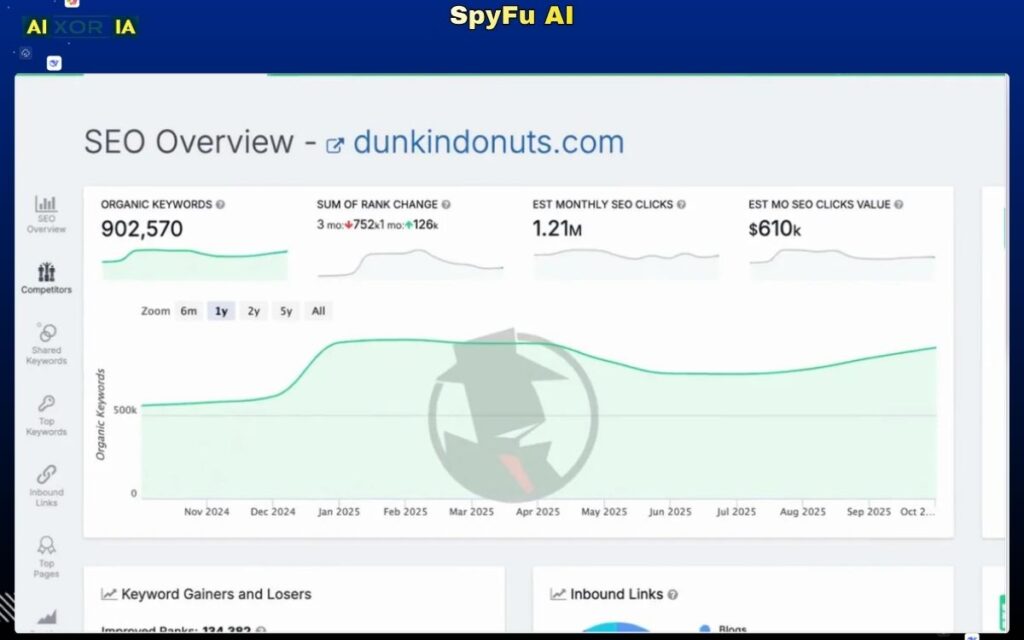
SpyFu has always been known for one thing:
deep competitor intelligence.
In 2026, SpyFu has evolved beyond traditional keyword tracking and now provides insights into how competitors perform in AI-assisted search environments. This includes understanding which queries, prompts, and topics are driving visibility in systems like AI Overviews and answer engines.
The core idea behind SpyFu AI is simple:
If your competitors are being recommended by AI systems and you are not, you need to know why—and fix it fast.
SpyFu helps uncover those gaps.
What Problem Does SpyFu AI Solve?
One of the biggest challenges in AI SEO today is:
You don’t know why competitors are showing up in AI-generated answers.
Common issues include:
- Competitors appearing in AI summaries while you don’t
- Lack of visibility into competitor strategies
- Missing high-impact queries and prompts
- Difficulty identifying content gaps
SpyFu AI solves this by:
- Revealing competitor keyword and query dominance
- Showing overlap between your content and competitors
- Identifying missed opportunities
- Providing historical performance insights
This allows you to make data-driven decisions instead of guessing.
Key Features & Capabilities
SpyFu AI offers powerful tools focused on competitor analysis and visibility tracking.
1. Competitor Keyword Intelligence
Shows which keywords and queries competitors rank for, including AI-assisted search signals.
2. Prompt Overlap Analysis
Identifies where competitors are being surfaced in AI-driven results.
3. Historical Data Tracking
Provides long-term insights into ranking and visibility trends.
4. Domain Comparison Tools
Compares your site against competitors across multiple metrics.
5. Opportunity Discovery
Highlights gaps where you can outperform competitors.
How SpyFu AI Helps with GEO (Generative Engine Optimization)
SpyFu AI supports GEO by focusing on competitive positioning.
It helps you:
- Identify which topics AI systems favor
- Understand competitor authority signals
- Discover missing content opportunities
- Improve your chances of being selected by AI systems
This makes it easier to reverse-engineer AI visibility success.
Real-World Use Case
A SaaS company targeting:
“Best CRM software for small businesses”
can use SpyFu AI to:
- Identify top competitors appearing in AI answers
- Analyze their keyword strategies
- Discover content gaps
- Create better-optimized content
This increases the chances of competing effectively in AI-driven search results.
Pros
- Excellent competitor intelligence
- Affordable pricing
- Unlimited historical data
- Strong keyword tracking
- Useful for identifying content gaps
Cons
- Interface can feel data-heavy
- Limited deep LLM tracking
- Not focused on direct AI citation monitoring
- Requires interpretation of data
SpyFu AI Pricing
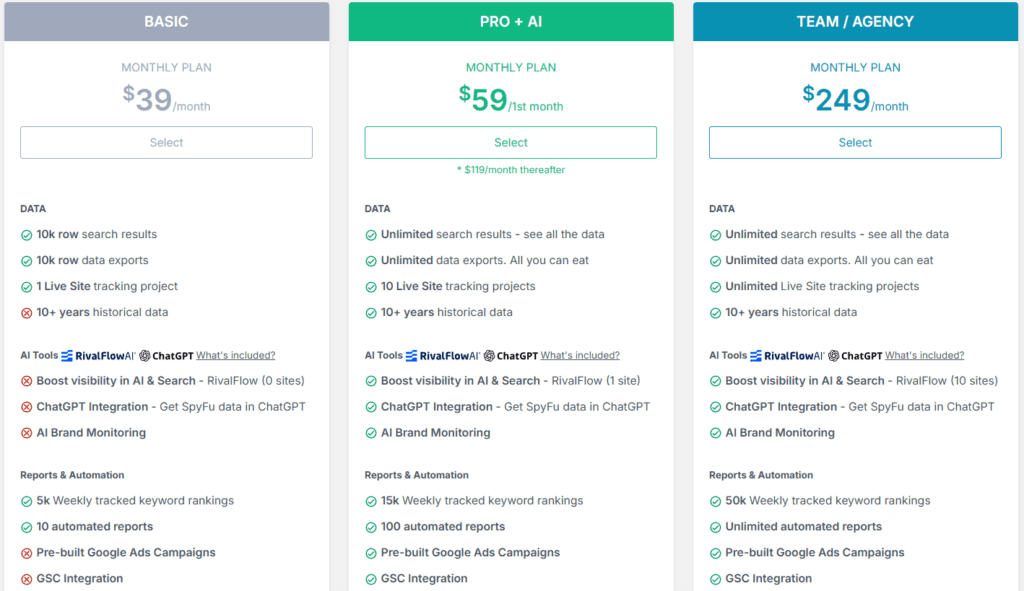
SpyFu AI pricing starts at approximately:
- $39/month
Plans vary based on:
- Feature access
- Data limits
- Reporting capabilities
My Experience Using SpyFu AI
During testing, SpyFu AI was particularly useful for understanding competitor strategies. It made it easy to see where competitors were outperforming and why.
SEObility AI: Technical SEO Health Monitoring for AI Crawlers
Overview
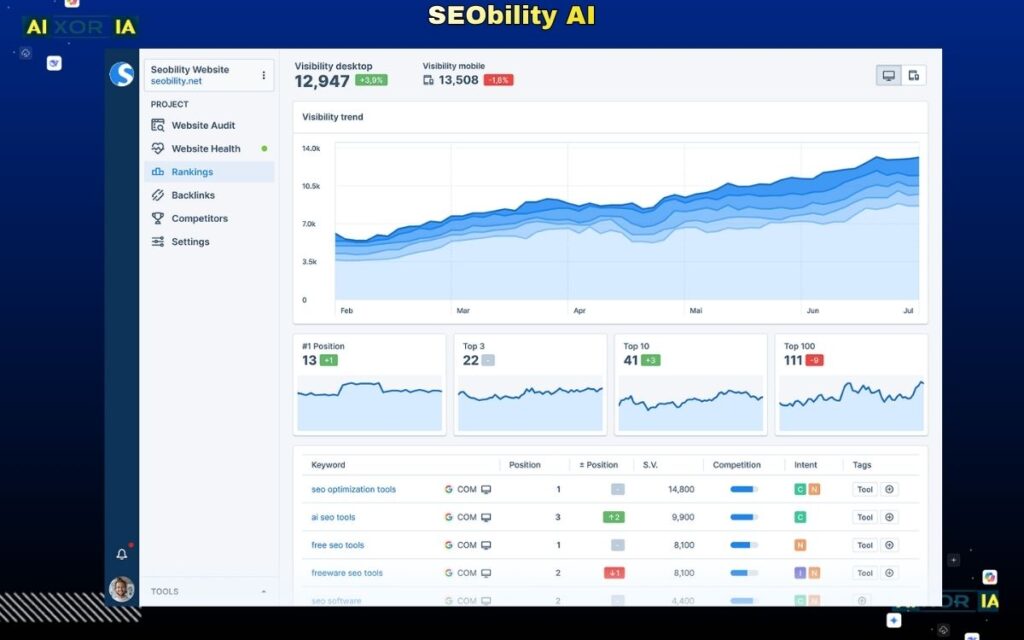
SEObility AI is a powerful diagnostic tool designed to answer a critical question in 2026:
Can AI systems actually crawl, understand, and trust your website?
While many tools focus on content and keywords, SEObility focuses on the technical foundation that determines whether your content is even accessible to search engines and AI models.
In an era where AI bots simulate human understanding, technical SEO is no longer optional—it’s essential. SEObility helps ensure your website is clean, structured, and fully crawlable, which directly impacts your chances of appearing in AI-generated answers.
What Problem Does SEObility AI Solve?
Many websites fail to gain visibility—not because of poor content, but because of technical issues.
Common problems include:
- Broken links and crawl errors
- Poor site architecture
- Missing or incorrect metadata
- Slow page performance
- Improper heading structures
AI systems may ignore such sites because they cannot reliably extract information.
SEObility AI solves this by:
- Scanning your site like a search engine or AI bot
- Identifying technical issues
- Providing clear optimization suggestions
- Improving overall site health
Key Features & Capabilities
SEObility AI offers a strong set of technical SEO tools.
1. Full Website Crawl & Audit
Scans your entire site and identifies issues affecting visibility.
2. TF-IDF Analysis
Analyzes content relevance and keyword usage compared to competitors.
3. Technical Error Detection
Finds broken links, duplicate content, and structural problems.
4. On-Page Optimization Insights
Provides recommendations to improve content and metadata.
5. Ranking Monitoring
Tracks keyword performance over time.
How SEObility AI Helps with GEO (Generative Engine Optimization)
SEObility AI supports GEO by ensuring your website is:
- Easily crawlable by AI bots
- Technically optimized for indexing
- Structurally clear and organized
- Free from errors that block visibility
This creates a strong foundation for AI content retrieval and citation.
Real-World Use Case
A blog targeting:
“Best AI tools for marketing”
can use SEObility AI to:
- Identify crawl issues
- Fix broken links
- Improve page structure
- Optimize metadata
This ensures the site is fully accessible and understandable for AI systems.
Pros
- Excellent technical SEO audit tool
- Beginner-friendly interface
- Strong visual reports
- Includes TF-IDF analysis
- Generous free plan
Cons
- Limited AI-specific tracking
- Focuses mainly on technical SEO
- Not suitable for deep prompt analysis
- Lacks advanced enterprise features
SEObility AI Pricing
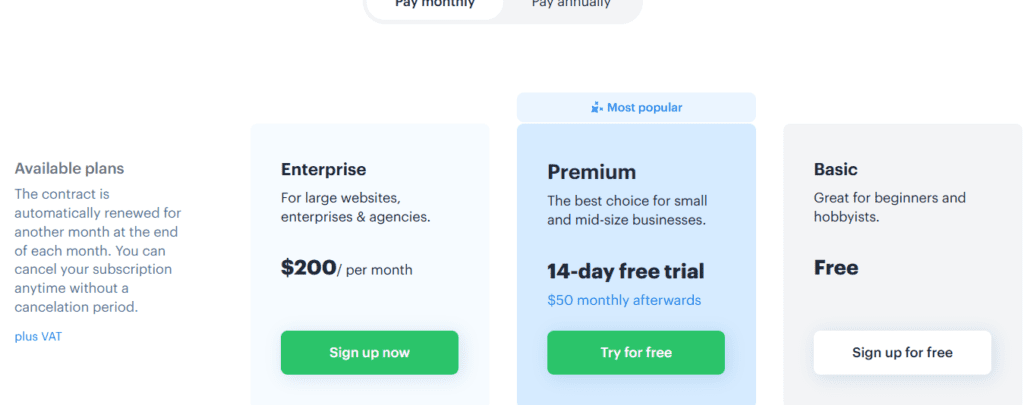
SEObility AI offers:
- Free basic plan
- Paid plans starting at affordable monthly rates (varies by usage)
This makes it accessible for:
- Small businesses
- Bloggers
- Growing websites
My Experience Using SEObility AI
During testing, SEObility AI was extremely helpful in identifying technical issues that were otherwise easy to miss.
WriterZen AI: Keyword Clustering and Topic Mapping for AI Context Optimization
Overview
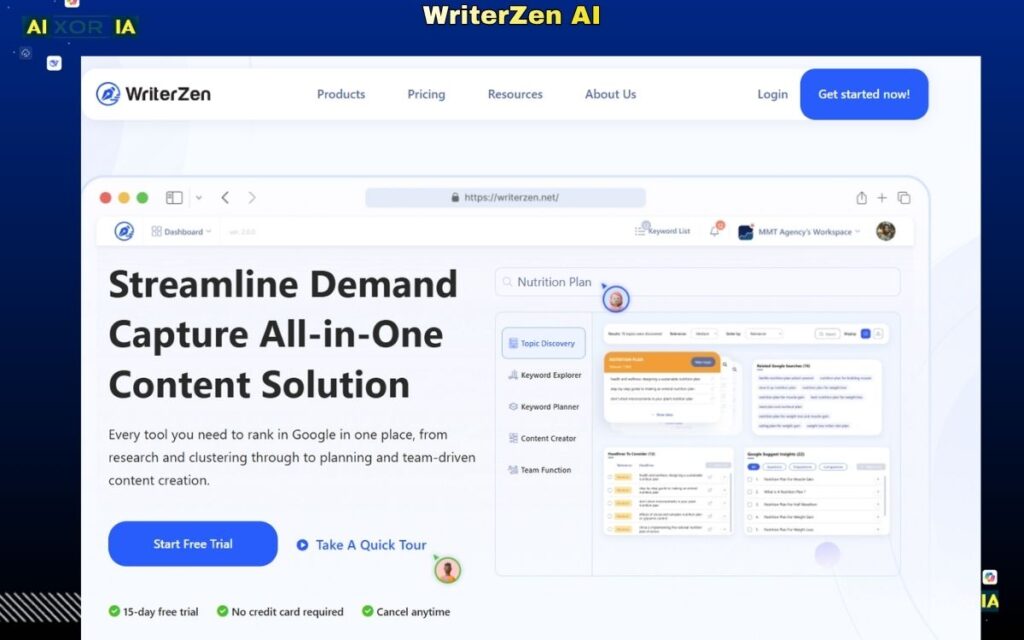
WriterZen AI focuses on a concept that is fundamental to how modern AI systems understand content:
topics, not just keywords.
In 2026, AI models process information in clusters—groups of related concepts that form a complete understanding of a subject. If your content is scattered or disconnected, AI systems may struggle to interpret it as authoritative.
WriterZen helps solve this by organizing keywords into structured topic clusters, allowing you to build content that aligns with how AI systems process information.
What Problem Does WriterZen AI Solve?
Many websites suffer from:
- Keyword cannibalization
- Disorganized content strategies
- Lack of topic depth
- Weak semantic connections
This results in:
- Lower search rankings
- Reduced AI visibility
- Poor content performance
WriterZen AI solves this by:
- Grouping related keywords into clusters
- Helping build structured content plans
- Improving topical coverage
- Aligning content with AI understanding
Key Features & Capabilities
WriterZen AI offers tools focused on research and content planning.
1. Keyword Clustering
Groups keywords into meaningful topic clusters.
2. Topic Discovery Tool
Finds relevant topics based on user intent.
3. Content Creator Module
Helps generate and structure content efficiently.
4. Golden Filter Feature
Identifies low-competition, high-opportunity keywords.
5. User-Friendly Interface
Simple and intuitive for beginners and professionals.
How WriterZen AI Helps with GEO (Generative Engine Optimization)
WriterZen AI supports GEO by improving context and topic coverage.
It helps you:
- Build comprehensive content clusters
- Strengthen semantic relationships
- Improve content structure
- Align with AI context processing
This increases the likelihood of being recognized as a topical authority by AI systems.
Real-World Use Case
A content creator targeting:
“AI tools for small businesses”
can use WriterZen AI to:
- Discover related topics
- Group keywords into clusters
- Create pillar and supporting articles
- Build a complete content strategy
This improves both search rankings and AI visibility.
Pros
- Excellent keyword clustering
- Affordable pricing
- Easy to use
- Great for content planning
- Helps avoid keyword cannibalization
Cons
- Limited advanced AI writing features
- Not focused on direct AI tracking
- Basic compared to enterprise tools
- Requires manual execution of strategy
Pricing
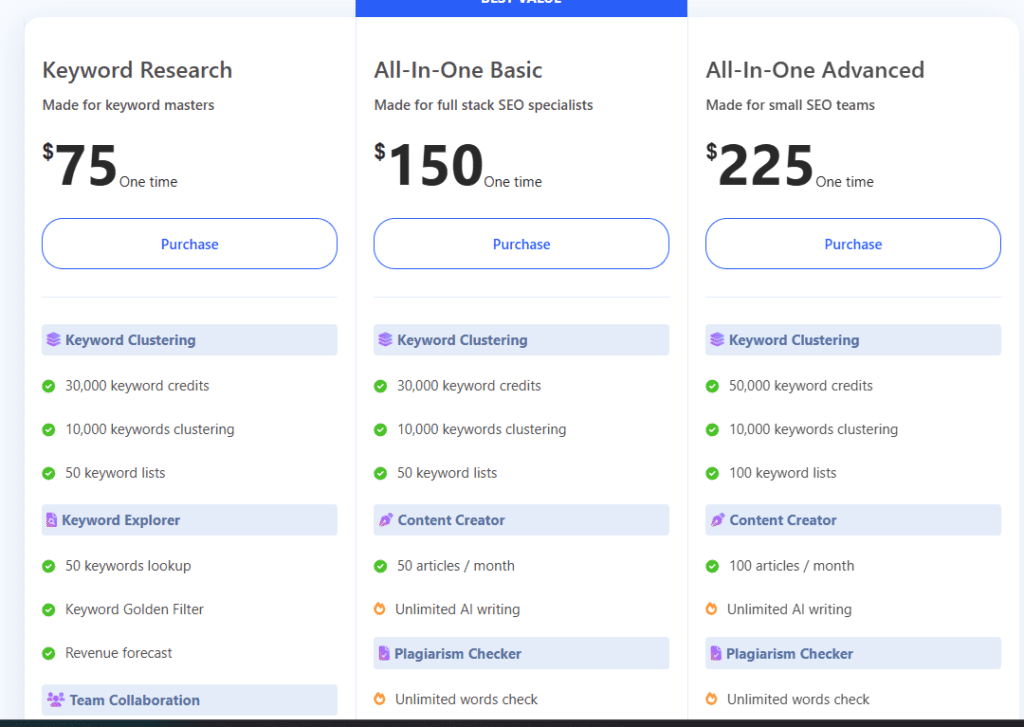
WriterZen AI pricing starts at approximately:
- $19/month
Plans vary based on:
- Feature access
- Keyword limits
- Usage requirements
My Experience Using WriterZen AI
While testing WriterZen AI, its clustering feature stood out as extremely useful. It made it easy to plan content in a structured way rather than randomly targeting keywords.
READ MORE – Best AI Tools for Enhancing Visibility
Outranking AI: SERP-Driven Content Optimization for AI Search Accuracy
Overview
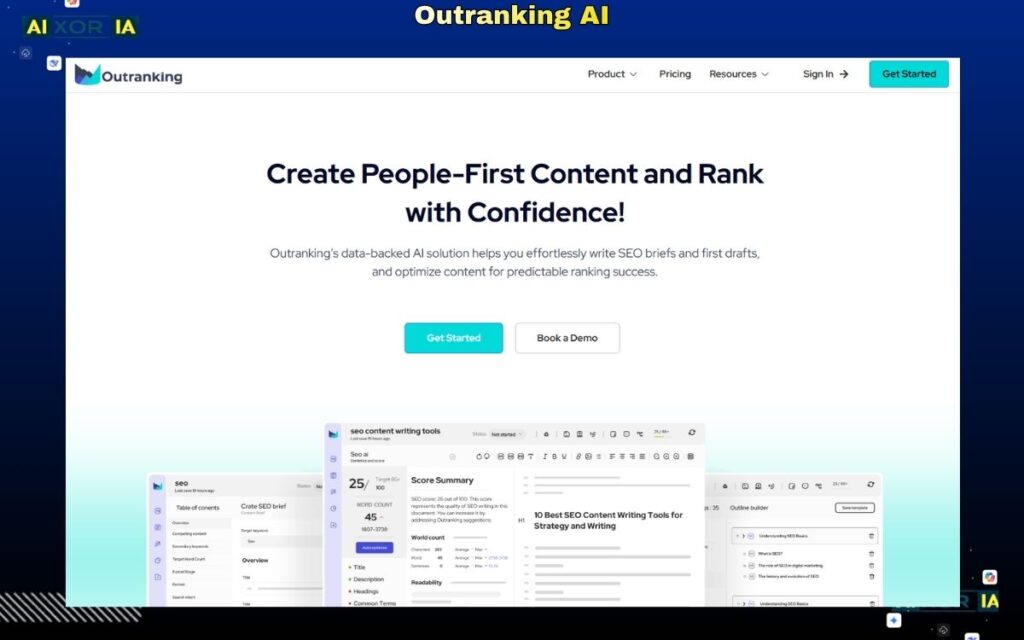
Outranking AI is built for one specific goal:
creating content that is factually complete, structurally strong, and aligned with what both search engines and AI systems expect.
In 2026, ranking content is no longer just about keywords—it’s about including the right data points, entities, and contextual signals that AI systems use to evaluate credibility.
Outranking AI analyzes real-time SERP data and transforms it into high-quality content briefs and optimization strategies, helping you create articles that are both human-friendly and AI-readable.
What Problem Does Outranking AI Solve?
Many content creators struggle with:
- Not knowing what information to include in an article
- Missing important data points and statistics
- Creating content that lacks depth
- Failing to meet AI and search engine expectations
This leads to:
- Lower rankings
- Reduced AI visibility
- Weak authority signals
Outranking AI solves this by:
- Analyzing top-ranking pages
- Identifying required content elements
- Generating structured content briefs
- Guiding content creation step-by-step
Key Features & Capabilities
Outranking AI provides a data-driven approach to content optimization.
1. SERP-Based Content Briefs
Generates detailed outlines based on top-performing pages.
2. AI Writing Assistance
Helps create structured, optimized content quickly.
3. Content Optimization Engine
Provides recommendations to improve existing content.
4. Fact & Entity Integration
Ensures your content includes important data points and entities.
5. Workflow Automation
Supports team collaboration and content planning.
How Outranking AI Helps with GEO (Generative Engine Optimization)
Outranking AI supports GEO by ensuring your content is:
- Data-rich and factually complete
- Structurally optimized
- Aligned with user intent
- Relevant to AI retrieval patterns
This increases the chances of your content being selected and cited by AI systems.
Real-World Use Case
A blogger targeting:
“Best productivity apps for remote work”
can use Outranking AI to:
- Analyze top-ranking articles
- Identify missing topics
- Build a structured outline
- Create optimized content
This improves both search rankings and AI visibility.
Pros
- Highly data-driven approach
- Strong content brief generation
- Helps improve content accuracy
- Useful for teams and agencies
- Aligns content with SERP expectations
Cons
- Steep learning curve
- Requires time to understand data
- Not focused on direct AI citation tracking
- Can feel complex for beginners
Outranking AI Pricing
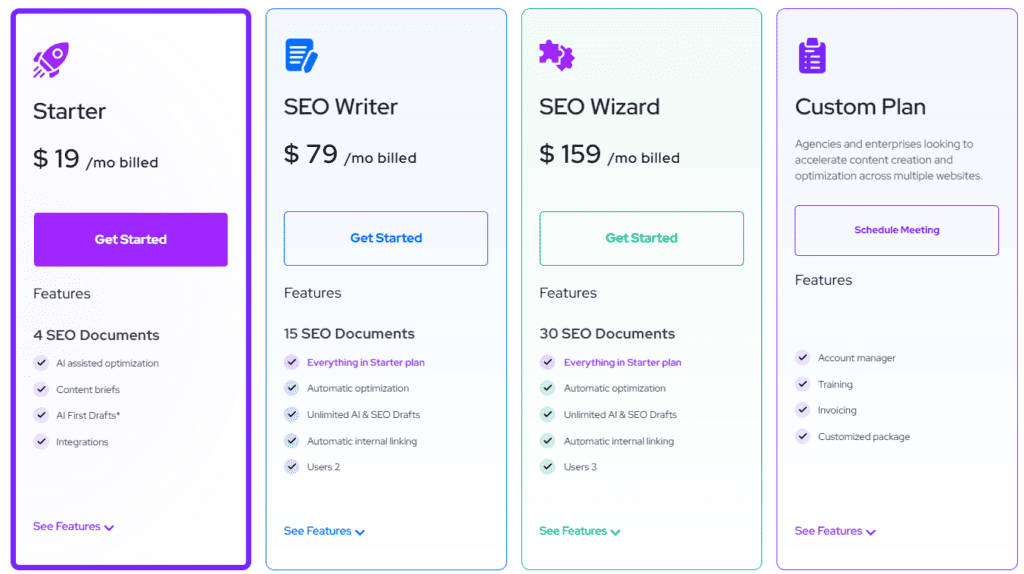
Outranking AI pricing starts at approximately:
- $79/month
Plans vary depending on:
- Content volume
- Feature access
- Team collaboration needs
My Experience Using Outranking AI
During testing, Outranking AI stood out for its ability to provide detailed, data-backed content guidance.
It removed guesswork from content creation and ensured that all important elements were included. However, it requires time and effort to fully understand and use effectively.
Frase AI: Answer Engine Optimization (AEO) for AI-Driven Search
Overview
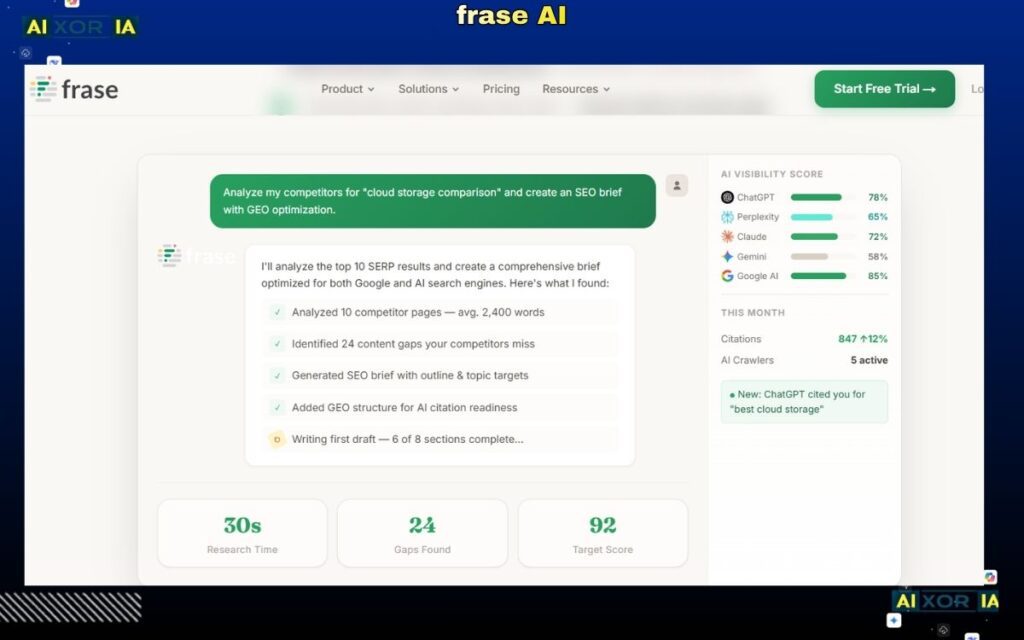
Frase AI is one of the earliest tools built specifically around the concept of:
Answer Engine Optimization (AEO).
In 2026, AI search is heavily driven by questions and answers. Systems like ChatGPT, Perplexity, and Google AI Overviews generate responses by extracting concise, structured answers from content.
Frase AI is designed to help you create content that is easy for AI systems to extract, understand, and present.
What Problem Does Frase AI Solve?
Many websites fail to appear in AI-generated answers because their content is:
- Hard to scan
- Lacking clear answers
- Poorly structured
- Not aligned with user questions
AI systems prefer content that provides:
- Direct answers
- Clear structure
- FAQ-style formatting
- Concise explanations
Frase AI solves this by:
- Identifying user questions
- Structuring content in an answer-friendly format
- Optimizing for quick extraction
- Improving content readability
Key Features & Capabilities
Frase AI offers tools focused on content structuring and optimization.
1. Question Research Tool
Finds real user questions from multiple sources.
2. AI Content Editor
Helps create and optimize content for clarity and structure.
3. SERP Analysis
Analyzes top-ranking pages and extracts key insights.
4. FAQ Optimization
Helps structure content in a way that AI systems prefer.
5. Content Brief Generation
Creates outlines based on search intent and data.
How Frase AI Helps with GEO (Generative Engine Optimization)
Frase AI plays a direct role in GEO by optimizing content for AI answer extraction.
It helps you:
- Structure content in Q&A format
- Provide clear and concise answers
- Improve readability
- Align with AI response patterns
This significantly increases your chances of being featured in AI-generated answers.
Real-World Use Case
A website targeting:
“How to start a blog in 2026”
can use Frase AI to:
- Identify common questions
- Create structured answers
- Optimize content layout
- Improve readability
This increases the chances of being included in AI-generated summaries and answers.
Pros
- Excellent for FAQ optimization
- Affordable pricing
- Easy-to-use interface
- Strong focus on answer-based content
- Great for beginners and professionals
Cons
- Limited deep AI tracking
- Focuses more on content creation than analytics
- Not ideal for enterprise-level needs
- Secondary tracking capabilities
frase Pricing
Frase AI pricing starts at approximately:
- $14.99/month
Plans vary based on:
- Feature access
- Usage limits
- Content generation needs
My Experience Using Frase AI
While testing Frase AI, its ability to structure content around user questions stood out the most.
It made it easy to create content that felt natural for both users and AI systems. However, it is more focused on content creation than tracking AI visibility.
How to Choose the Best AI Search Visibility Tool in 2026
The shift from traditional search engines to AI-powered answer engines has completely changed how visibility works online.
Ranking on Google is no longer enough.
Today, the real question is:
“Is your brand being mentioned, trusted, and recommended by AI systems?”
After analyzing all 21 tools in this guide, one thing is clear:
There is no single “best” AI search visibility tool for everyone. The right choice depends on your business size, goals, technical expertise, and content strategy.
The New Reality of SEO: From Rankings to AI Citations
In the past, SEO success was measured by:
- Keyword rankings
- Organic traffic
- Backlinks
But in 2026, success is measured by:
- AI citations (Are you mentioned in answers?)
- Entity recognition (Does AI understand your brand?)
- Topical authority (Are you trusted in your niche?)
- Content retrievability (Can AI easily extract your information?)
This shift is often referred to as:
Generative Engine Optimization (GEO)
And it is becoming the foundation of modern SEO.
Understanding the AI Search Ecosystem
To succeed, you need to understand how AI systems work behind the scenes.
Most modern AI engines rely on:
- RAG (Retrieval-Augmented Generation): Pulling data from trusted sources
- Entity-based indexing: Understanding relationships between topics
- Citation triggers: Structured content that is easy to extract
- Semantic relevance: Context over keywords
This means your strategy must evolve from:
“Write for keywords” → “Build structured, authoritative knowledge.”
Which Tool Should You Choose? (Clear Action Plan)
Instead of guessing, here’s a simple decision framework based on your needs.
For Enterprise-Level AI Visibility & Deep Analytics
If you are managing large-scale operations and need advanced insights:
- Profound
- BrightEdge
- MarketMuse
These tools provide:
- Deep LLM tracking
- Large-scale automation
- Enterprise-grade analytics
For Startups & Brand Monitoring
If you want to track mentions and visibility without high costs:
- Otterly AI
- Rankscale AI
These tools help you:
- Monitor AI mentions
- Track visibility trends
- Improve brand presence
For Hybrid SEO (Traditional + AI)
If you want a balance between SEO and AI optimization:
- Semrush AI Toolkit
- SE Ranking AI Suite
- Ahrefs
These tools offer:
- Keyword + AI insights
- Competitor analysis
- Content optimization
For Content Optimization & AEO (Answer Engine Optimization)
If your focus is on creating AI-friendly content:
- Frase AI
- Surfer AI
- Outranking AI
- WriterZen
These tools help you:
- Structure content properly
- Improve semantic relevance
- Increase AI readability
For Technical SEO & Website Health
If your site has technical issues blocking AI visibility:
- Alli AI
- SEObility AI
- CognitiveSEO
These tools ensure:
- Proper indexing
- Clean site structure
- Strong trust signals
For Local & Competitive Intelligence
If your strategy involves local SEO or competitor insights:
- Nightwatch
- SpyFu AI
These tools help you:
- Track local AI visibility
- Understand competitor strategies
The Biggest Mistake to Avoid
Most businesses are still making one critical mistake:
They are optimizing for search engines—but not for AI systems.
If your content is:
- Hard to scan
- Poorly structured
- Lacking authority
- Missing context
AI systems will simply ignore it—even if it ranks on Google.
A Simple 3-Step Strategy to Win in AI Search
If you want to actually see results, follow this:
Step 1: Build Authority
Use tools like:
- MarketMuse
- Ahrefs
Focus on:
- Topic depth
- Content clusters
- Backlinks and mentions
Step 2: Optimize for AI Retrieval
Use tools like:
- Frase AI
- Surfer AI
- Outranking AI
Focus on:
- Clear structure
- Semantic richness
- Answer-based formatting
Step 3: Track & Improve Visibility
Use tools like:
- Profound
- Otterly AI
- Rankscale AI
Focus on:
- AI citations
- Prompt tracking
- Visibility trends
Do AI Search Visibility Tools Help Recover Traffic?
Yes—but not in the traditional way.
AI search reduces clicks but increases:
- Brand exposure
- Trust signals
- Authority
Instead of chasing traffic, you should focus on:
Being the source that AI systems trust and recommend.
Frequently Asked Questions (FAQ)
What is an AI search visibility tool?
An AI search visibility tool helps you track and improve how often your brand appears in AI-generated answers across platforms like ChatGPT and AI search engines.
How is AI visibility different from traditional SEO?
Traditional SEO focuses on rankings and traffic. AI visibility focuses on:
- Mentions
- Citations
- Authority
- Context
Can I rank in AI search without backlinks?
It is possible, but difficult.
AI systems rely heavily on:
- Authority signals
- Trusted sources
- Content depth
Backlinks and mentions still play a major role.
How do I get cited by AI systems?
To increase your chances:
- Write clear, structured content
- Use FAQ formats
- Build topical authority
- Add credible references
- Maintain strong technical SEO
Final Conclusion
AI search visibility is not just a trend—it is the future of SEO.
The brands that succeed in 2026 and beyond will not be the ones that rank #1 on Google.
They will be the ones that:
- Are trusted by AI systems
- Are consistently cited in answers
- Build real authority in their niche
If you take one thing from this guide, let it be this:
Stop optimizing only for rankings. Start optimizing to be remembered, understood, and recommended by AI.