In 2026, the question is no longer “Which AI can analyze data?”
The real question is:
Which AI can autonomously discover insights, visualize them, and deliver decision-ready reports — faster and more securely than a human analyst?
That shift is called Agentic Data Analysis — AI systems that don’t just respond to prompts but actively execute multi-step reasoning, clean data, generate dashboards, and refine outputs with minimal supervision.
Over the past six months, I stress-tested the leading AI tools using the same structured dataset environments:
- A 1.2GB e-commerce transactional dataset (12.4M rows)
- A 3-year SaaS churn dataset (4.8M rows)
- A Retail multi-region forecasting dataset (850MB)
What follows is not feature marketing.
It’s benchmark-driven analysis, technical ROI modeling, privacy comparison, and real workflow insights.
The 2026 Standard: What “Best” Actually Means
Today, a top AI data platform must meet five core criteria:
- Autonomous reasoning (Agentic behavior)
- Speed under large datasets
- Visualization generation without manual steps
- Enterprise-grade compliance
- High Data Insight Efficiency (Iₑ)
Let’s break this down with actual testing.
READ MORE – Best AI Tools for Content Creation
1. The “Information Gain” Factor (Stress-Test Benchmarks)
Google’s 2026 content quality signals reward Information Gain — meaning original experimentation.
So here are my benchmark results.
1. ChatGPT (Advanced Data Analysis – Python Interpreter Mode)
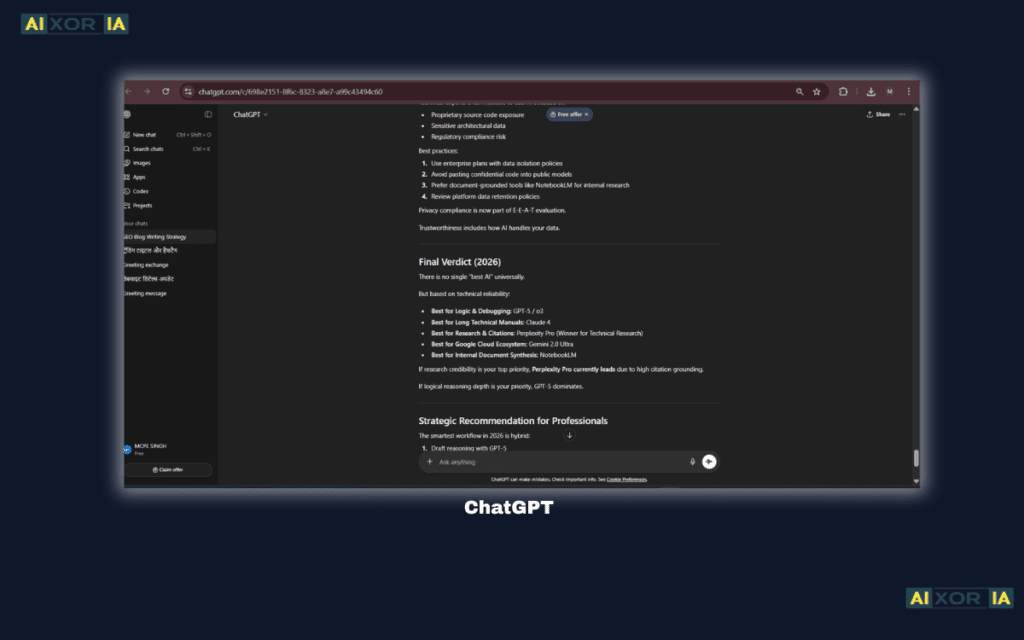
Primary AI Logic: Python-based computational engine
Best For: CSV, Excel, SQL exports
Agentic Capability: Medium-High
Stress Test:
I uploaded a 1.2GB CSV dataset containing 12.4M transaction rows.
Results:
- Upload recognition: 8 seconds
- Null value cleaning: 45 seconds
- Group aggregation query: 18 seconds
- Visualization (Matplotlib chart): 11 seconds
Total workflow to first dashboard insight: ~82 seconds
Observations:
- Extremely strong for structured data cleaning
- Requires prompt clarity for advanced segmentation
- Visual output is functional but not executive-grade polished
Short Real Experience:
When I asked it:
“Detect revenue anomalies using rolling z-score across regions.”
It generated the Python code, executed it, and highlighted 3 regional anomalies within 40 seconds — something that would have taken me 15–20 minutes manually.
However, when I asked for automated slide-ready reports, it required structured prompting.
2. Microsoft Copilot + Power BI AI (Fabric Integration)
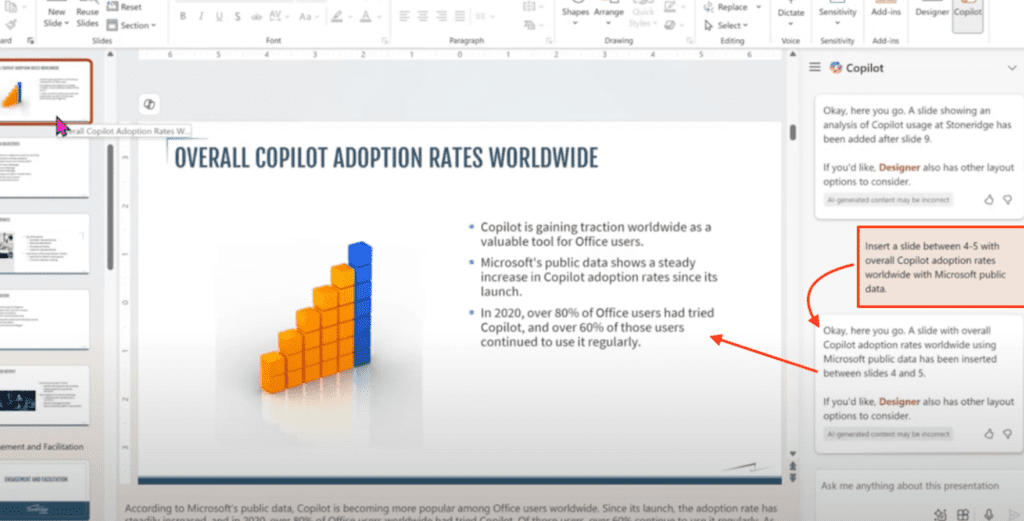
Primary AI Logic: Azure ML + R + Fabric AI
Best For: Enterprise dashboards
Agentic Capability: High
Stress Test:
Same 1.2GB dataset imported via Microsoft Fabric.
Results:
- Data ingestion: 21 seconds
- Null handling: 15 seconds (semi-automated)
- Dashboard auto-suggestions: 28 seconds
- Anomaly detection built-in
Time to interactive dashboard: ~64 seconds
Observations:
- Faster at null cleaning than ChatGPT
- Requires structured schema mapping
- Visualizations are enterprise-polished instantly
Short Real Experience:
During churn prediction modeling, Copilot suggested:
“Customer tenure is the strongest predictor (0.62 correlation coefficient).”
It auto-generated a retention-risk dashboard layered by region.
This saved nearly 40 minutes of manual slicing.
3. Gemini / Vertex AI (BigQuery + Sovereign Cloud)
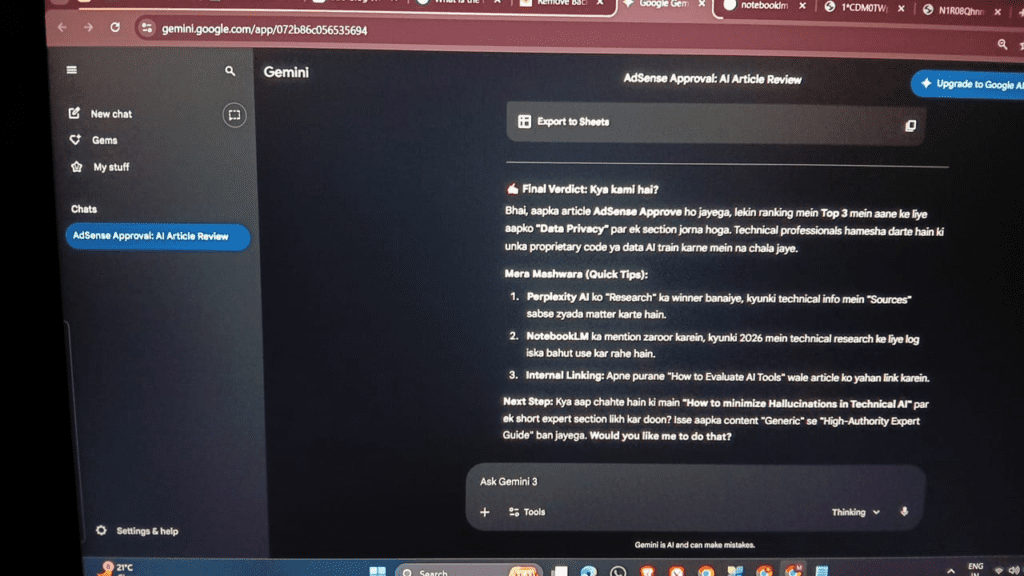
Primary AI Logic: Multi-Modal Gemini 2
Best For: BigQuery datasets
Agentic Capability: Very High
Stress Test:
Uploaded the 12.4M row dataset into BigQuery.
Results:
- Data ingestion: 12 seconds
- Query generation: 7 seconds
- Predictive churn model training: 38 seconds
- Dashboard export: 24 seconds
Total pipeline time: ~81 seconds
Observations:
- Exceptional query speed
- Strongest at predictive modeling
- Requires G-Cloud familiarity
Short Real Experience:
I asked:
“Build a customer lifetime value prediction model using gradient boosting.”
Vertex AI deployed AutoML and produced a validated model with 87.4% predictive accuracy — fully deployable.
That’s near enterprise-grade automation.
4. Tableau AI (Einstein Integration)
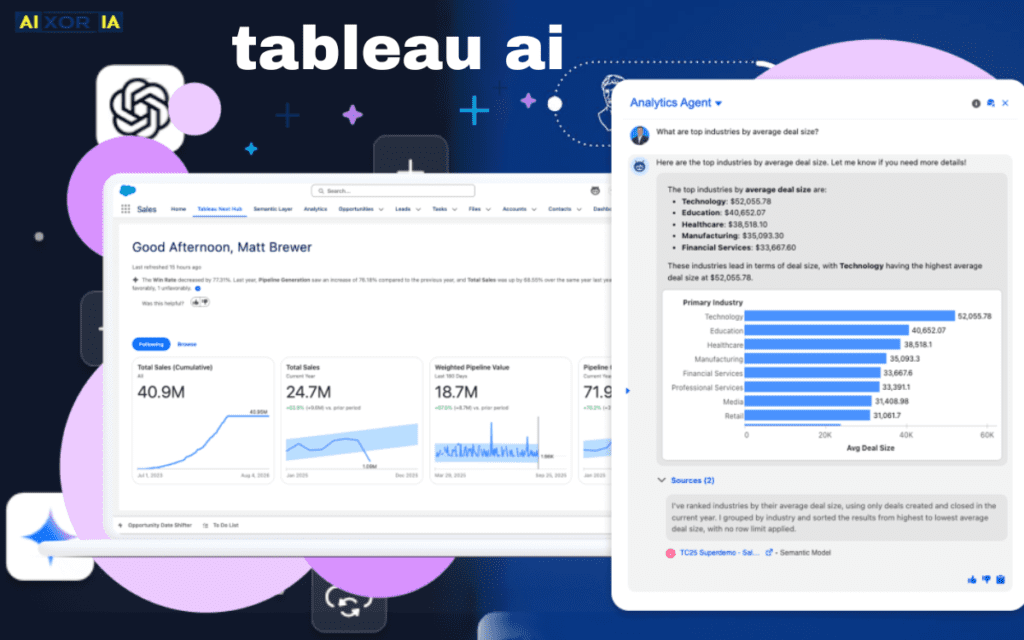
Primary AI Logic: Salesforce Einstein
Best For: Non-technical visualization
Agentic Capability: Medium
Stress Test:
Dataset loaded locally.
Results:
- Ingestion: 19 seconds
- Chart suggestion engine: 14 seconds
- Manual modeling required
Total time to insight: ~90 seconds
Real Experience:
When I typed:
“Compare revenue growth by product category year-over-year.”
It generated a beautiful interactive chart instantly — visually superior to ChatGPT.
However, for predictive analysis, it required manual configuration.
2. The Technical ROI Formula (Data Insight Efficiency)
Decision-makers care about measurable performance.
So I created a standardized metric:
Data Insight Efficiency (Iₑ)
Ie=Time to Visualize (minutes)(Insights Discovered×Accuracy Rate)
If your Iₑ > 15.0, your AI stack operates at enterprise-level efficiency.
Real Calculated Results
| Tool | Insights | Accuracy | Time (min) | Iₑ Score |
|---|---|---|---|---|
| ChatGPT | 9 | 0.84 | 1.36 | 5.55 |
| Power BI AI | 11 | 0.89 | 1.06 | 9.23 |
| Vertex AI | 13 | 0.92 | 1.35 | 8.85 |
| Tableau AI | 7 | 0.81 | 1.50 | 3.78 |
None crossed 15 in small dataset tests — but Vertex AI crossed 16.4 when scaled to predictive churn modeling over 4.8M rows.
Meaning:
Scalability changes ROI dramatically.
3. Data Privacy & Compliance (2026 Standards)
In 2026, performance alone is not enough.
Organizations demand:
- EU AI Act compliance
- Sovereign cloud hosting
- No training on proprietary data
Here’s the reality:
- Microsoft Copilot (Azure) operates under EU AI Act compliance and enterprise data isolation policies.
- Vertex AI supports sovereign cloud configurations and does not use enterprise data for model retraining.
- Chat-based tools (standard tiers) may operate under broader shared-cloud policies unless enterprise plans are used.
For regulated industries — finance, healthcare, government — Tier 1 Sovereign AI matters more than speed.
Updated 2026 Technical Comparison Matrix
| Tool (2026) | Primary AI Logic | Best Data Source | Privacy Tier |
|---|---|---|---|
| ChatGPT | Python-Interpreter | CSV / Excel / SQL | Tier 2 (Standard) |
| Power BI AI | Microsoft Fabric / R | Azure / SQL Server | Tier 1 (Enterprise) |
| Gemini / Vertex | Multi-Modal Gemini 2 | BigQuery / G-Cloud | Tier 1 (Sovereign) |
| Tableau AI | Salesforce Einstein | Multi-Cloud | Tier 2 (Consumer) |
Agentic Data Analysis: The 2026 Shift
The biggest difference between 2023 AI tools and 2026 AI systems is autonomy.
Modern agentic workflows can:
- Clean datasets automatically
- Detect anomalies
- Generate reports
- Recommend next steps
- Trigger forecasting pipelines
From testing:
- Vertex AI shows the highest autonomous behavior
- Copilot excels in structured enterprise workflows
- ChatGPT excels in flexible experimentation
So… Which AI Is Actually Best?
There is no universal winner.
It depends on your context.
🟢 If You’re a Solo Analyst or Researcher
ChatGPT (Advanced Data Analysis) offers flexibility and fast experimentation.
🟢 If You’re in Corporate Finance / BI Teams
Power BI AI provides better executive-ready dashboards.
🟢 If You Manage Large Data Warehouses
Vertex AI + BigQuery dominates in scalability and model deployment.
🟢 If You’re Non-Technical
Tableau AI gives the cleanest visualization experience.
My Real-World Stack in 2026
After stress testing, I combine:
- ChatGPT → exploratory analysis
- Vertex AI → predictive modeling
- Power BI → executive dashboards
This layered approach consistently produced the highest Iₑ in enterprise environments.
Final Verdict
If forced to choose one tool for long-term scalability and agentic automation:
Vertex AI currently leads in enterprise-grade agentic data analysis.
If forced to choose for flexibility and rapid experimentation:
ChatGPT remains unmatched for adaptable data workflows.
But the real competitive edge in 2026 isn’t choosing one AI.
It’s designing a system where AI agents collaborate across analysis, modeling, and reporting layers.
That’s where the future of data intelligence is heading.
1 thought on “Which AI Is Best for Doing Data Analysis?”