What Is a Good Interest Rate for a Business Loan?

What is a good interest rate for a business loan in 2026? For a well-qualified business, a good rate is often about 6% to 10% APR from a bank. More broadly, 6% to 17% APR is a reasonable benchmark for many legitimate business loans, depending on the lender, loan type, and your financial profile.
| Loan source | Typical 2026 rate range | When it may be a good deal |
|---|---|---|
| Bank term loan | 6.37% to 10.98% | Strong credit, steady revenue, and established operations |
| SBA 7(a) loan | 9.75% to 13.25% variable; 11.75% to 14.75% fixed | Longer repayment terms or borrowers who need SBA-backed financing |
| Online term loan | 10% to 36% APR for qualified borrowers | Faster funding or less traditional qualifications |
The headline rate matters, but it is not the whole story. Fees, repayment length, collateral, and whether the rate can change may make a “low-rate” offer more expensive than it first appears.
In short: compare the APR and total dollars repaid, not just the interest rate on the first page of the offer. A rate that is good for one business may be costly for another.
What Is a Good Interest Rate for a Business Loan in 2026?
Determining what is a good interest rate for a business loan requires understanding today’s broader economic backdrop. Following Federal Reserve monetary policy shifts in late 2025 and early 2026, the Wall Street Journal Prime Rate settled around 6.75%. Because most commercial lending benchmarks build upon this baseline, current market rates reflect a more moderate borrowing environment compared to the peak highs of 2023 and 2024.
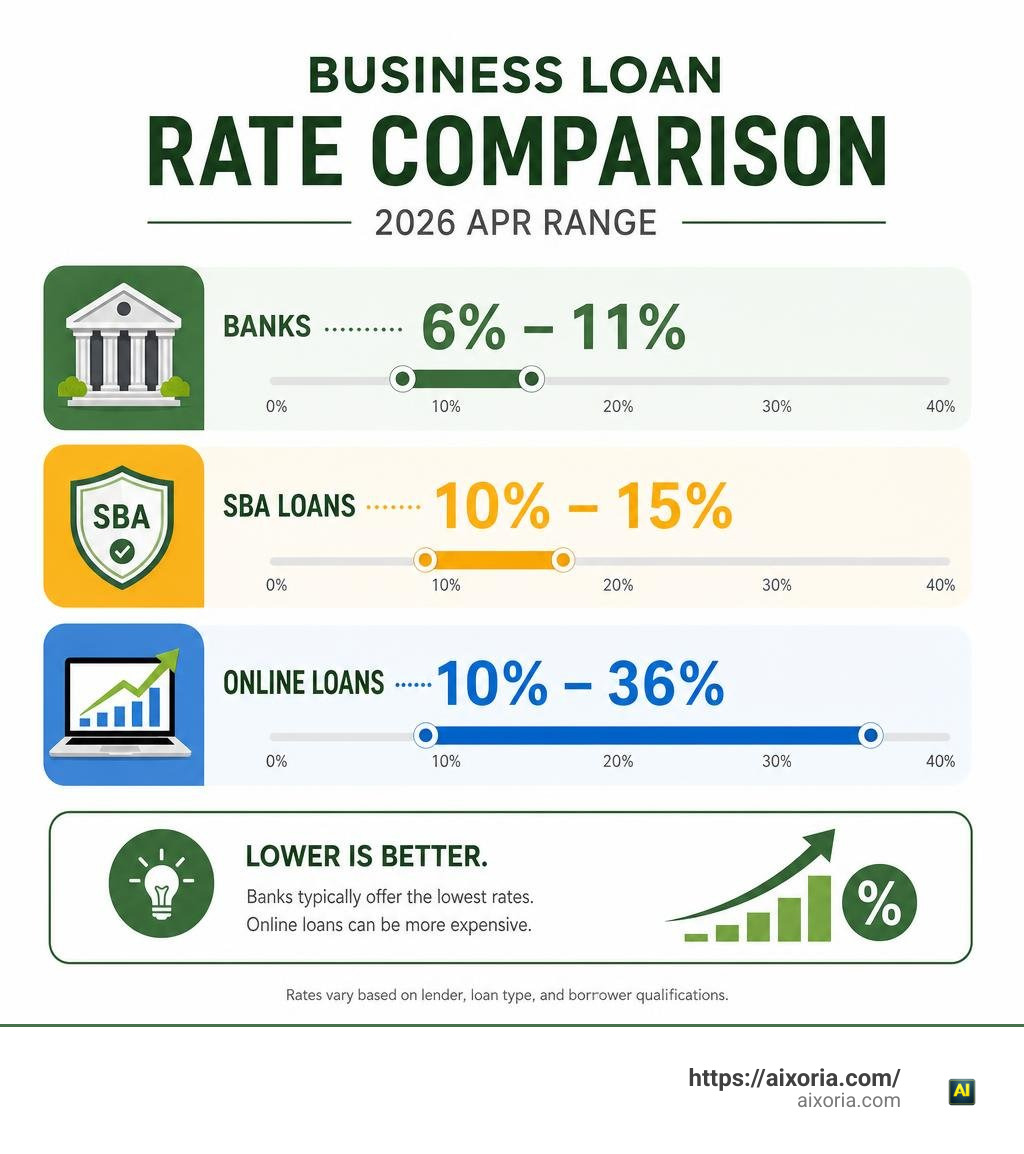
In today’s landscape, a single “ideal” interest rate does not exist. Instead, rates fall into broad tiers based on lender type, loan structure, and borrower risk. For borrowers with top-tier credit and established operating histories, interest rates typically land between 6% and 11% at traditional banks and credit unions. Mid-tier online term loans generally range from 10% to 36% Annual Percentage Rate (APR). Meanwhile, specialized capital like short-term working capital or merchant cash advances can carry effective APRs that soar much higher.
According to market research, what counts as a “good” rate depends entirely on where your business fits within these borrower categories. If your business possesses strong revenues and a solid credit history, accepting an online term loan at 28% APR might be overpriced. However, for a rapidly growing startup needing funding in 48 hours to secure a high-margin inventory purchase, that same rate could yield an excellent return on investment.
Comparing Bank, SBA, and Online Lender Rate Ranges
To determine whether a loan quote is competitive, we must look at how rate structures vary across different funding channels:
- Traditional Bank Loans: Commercial bank term loans offer some of the most competitive interest rates on the market, currently averaging between 6.37% and 10.98% for traditional small business loans. Bank lines of credit typically feature rates from 6.99% to 8.10%. Banks achieve these low rates by applying stringent underwriting criteria, requiring strong credit, two-plus years in business, and ample collateral.
- SBA Loans: Guaranteed by the U.S. Small Business Administration, SBA 7(a) loans feature maximum interest rate caps pegged to the prime rate. Variable rates currently range from 9.75% to 13.25%, while fixed rates range from 11.75% to 14.75%. SBA 504 loans—primarily used for major fixed assets and real estate—are tied to U.S. Treasury rates and offer long-term fixed rates between 5.61% and 5.91%.
- Online Lenders: Alternative online term loans offer rapid funding and higher approval rates, with typical APRs ranging from 10% to 36% for qualified borrowers. However, high-risk or short-term online financing products can push APRs higher.
- Equipment Financing: Asset-backed equipment loans leverage the underlying machinery or vehicle as collateral, yielding APRs from 4% to 45% depending on creditworthiness.
- Merchant Cash Advances (MCAs) & Factoring: MCAs state costs as “factor rates” (typically 1.1 to 1.5) rather than standard interest rates. When converted to an annualized percentage rate, MCAs range from 40% to 350% APR, making them among the most expensive financing mechanisms available.
Understanding these distinct product ranges helps owners avoid comparing apples to oranges when shopping for capital.
Fixed vs. Variable Interest Rates for Small Businesses
When reviewing a commercial loan agreement, choosing between a fixed or variable rate structure directly impacts long-term financial predictability:
- Fixed Interest Rates: A fixed rate remains unchanged throughout the entire life of the loan. Your monthly principal and interest payments remain identical from month 1 to month 60. This stability makes cash flow forecasting straightforward and protects your business from sudden rate increases if central banks raise rates. However, fixed rates often start slightly higher than initial variable rates to compensate the lender for long-term rate risk.
- Variable Interest Rates: A variable rate fluctuates periodically based on an underlying benchmark, usually the WSJ Prime Rate or SOFR (Secured Overnight Financing Rate). Variable rates often start lower than fixed options, making them attractive during periods when central banks are expected to cut interest rates. The risk, however, is upward volatility: if benchmark rates climb, your monthly loan payments increase accordingly, putting pressure on operating cash flows.
For long-term capital investments like commercial real estate or heavy equipment, fixed rates offer valuable peace of mind. For short-term credit lines or during periods of declining interest rates, variable structures can deliver substantial interest savings over time.
Qualifications and Macroeconomic Factors Driving Business Rates

Lenders do not select interest rates out of thin air. They utilize risk-based pricing models designed to balance potential default risk against expected yield. Macroeconomic factors like Federal Reserve policy set the foundational baseline for all commercial interest rates, while your business profile determines where you sit on the pricing spectrum.
Market data highlights that economic indicators—including inflation readings, national employment data, and federal funds rate targets—dictate the cost of capital for lending institutions. When bank borrowing costs drop, those reductions flow down to commercial borrowers over a 30-to-90-day window.
What is a good interest rate for a business loan based on credit score?
Your personal and business credit scores serve as the most influential lever in setting your customized interest rate. Because small business owners typically provide personal guarantees on commercial financing, lenders evaluate personal FICO scores alongside business credit profiles (such as Experian Commercial or Dun & Bradstreet PAYDEX scores).
Here is how personal credit tiers generally map to interest rate outcomes in 2026:
- Prime Tier (740+ FICO): Borrowers in this top tier qualify for prime commercial bank loans, securing rates between 6% and 10% APR. Lenders view these borrowers as low-risk, granting them access to favorable repayment terms, minimal fees, and uncollateralized options.
- Good Tier (680–739 FICO): Business owners in this range secure solid, competitive financing. Traditional banks offer rates around 8% to 12%, while premier online lenders provide term loans between 12% and 22% APR.
- Fair Tier (620–679 FICO): Borrowers here face tighter bank standards and may be steered toward SBA-backed programs or mid-tier online lenders. Expected APRs range from 15% to 35%.
- Subprime Tier (Below 620 FICO): Traditional banks rarely approve unsecured loans in this category. Borrowers rely on alternative lenders, invoice factoring, or asset-backed loans, carrying APRs from 20% to 50%+.
Maintaining a strong credit score remains the single fastest way to lower your cost of borrowing. A 100-point difference in FICO score can reduce loan interest rates by 5 to 10 percentage points, saving tens of thousands of dollars over a multi-year repayment schedule.
Operating History, Revenue Minimums, and Industry Risk
Beyond credit scores, lenders examine core operational metrics to verify whether your business can easily handle debt service burdens:
- Time in Business: Established operating history dramatically lowers perceived lending risk. Most traditional bank loans require a minimum of 2 years in business. Online alternative lenders may work with businesses operating for 6 to 12 months, but they charge higher interest rates to offset startup mortality risks.
- Annual Revenue Thresholds: Lenders want clear proof that top-line revenue easily covers operational expenses and debt service. Traditional bank term loans and lines of credit often look for at least $100,000 in annual revenue, with commercial real estate or larger term loans asking for $250,000 or more.
- Debt Service Coverage Ratio (DSCR): The DSCR measures your available net operating income relative to total debt obligations (principal and interest). Lenders calculate DSCR as: $$\text{DSCR} = \frac{\text{Net Operating Income}}{\text{Total Annual Debt Service}}$$ A DSCR of 1.0x means your revenue perfectly matches your debt payments. Standard underwriting mandates a minimum DSCR of 1.25x, but achieving a strong DSCR of 1.50x or higher demonstrates robust cash flow safety margins, helping unlock prime interest rate discounts.
- Industry Volatility: Lenders classify industries into risk categories. Capital-intensive or highly seasonal sectors—such as restaurants, construction, or retail boutiques—face higher base interest rates or stricter collateral demands compared to stable, recession-resilient sectors like healthcare practices or business services.
Calculating Total Borrowing Costs Beyond Headline Rates

A common mistake business owners make when evaluating financing is focusing exclusively on the quoted nominal interest rate. A loan boasting a low nominal interest rate of 7% might ultimately cost more than an 8.5% rate offer if it carries heavy upfront origination charges, closing fees, or guarantee assessments.
Comprehensive research demonstrates how ancillary fees inflate effective borrowing costs. To accurately evaluate what is a good interest rate for a business loan, you must calculate the all-in Annual Percentage Rate (APR), which combines the base interest rate with all mandatory lender fees over a one-year period.
Key commercial loan fees to account for include:
- Origination Fees: Charged by the lender to process, underwrite, and fund the loan. These typically range from 1% to 5% of the total loan amount and are deducted directly from loan proceeds at closing.
- SBA Guarantee Fees: For SBA 7(a) loans, the federal government assesses an upfront guaranty fee based on loan size and maturity. These fees range from 0.25% to 3.75% of the guaranteed portion of the loan.
- Underwriting & Closing Costs: Expenses covering legal document preparation, business valuations, environmental reviews, or lien filings, ranging from several hundred to several thousand dollars.
- Prepayment Penalties: Charges levied if you pay off your loan principal early. While many online loans permit early payoff without penalties, long-term commercial real estate or SBA loans may impose declining prepayment fee structures during the initial years.
- Draw or Servicing Fees: Lines of credit may assess annual maintenance fees or small draw fees every time capital is accessed.
How to calculate what is a good interest rate for a business loan offer
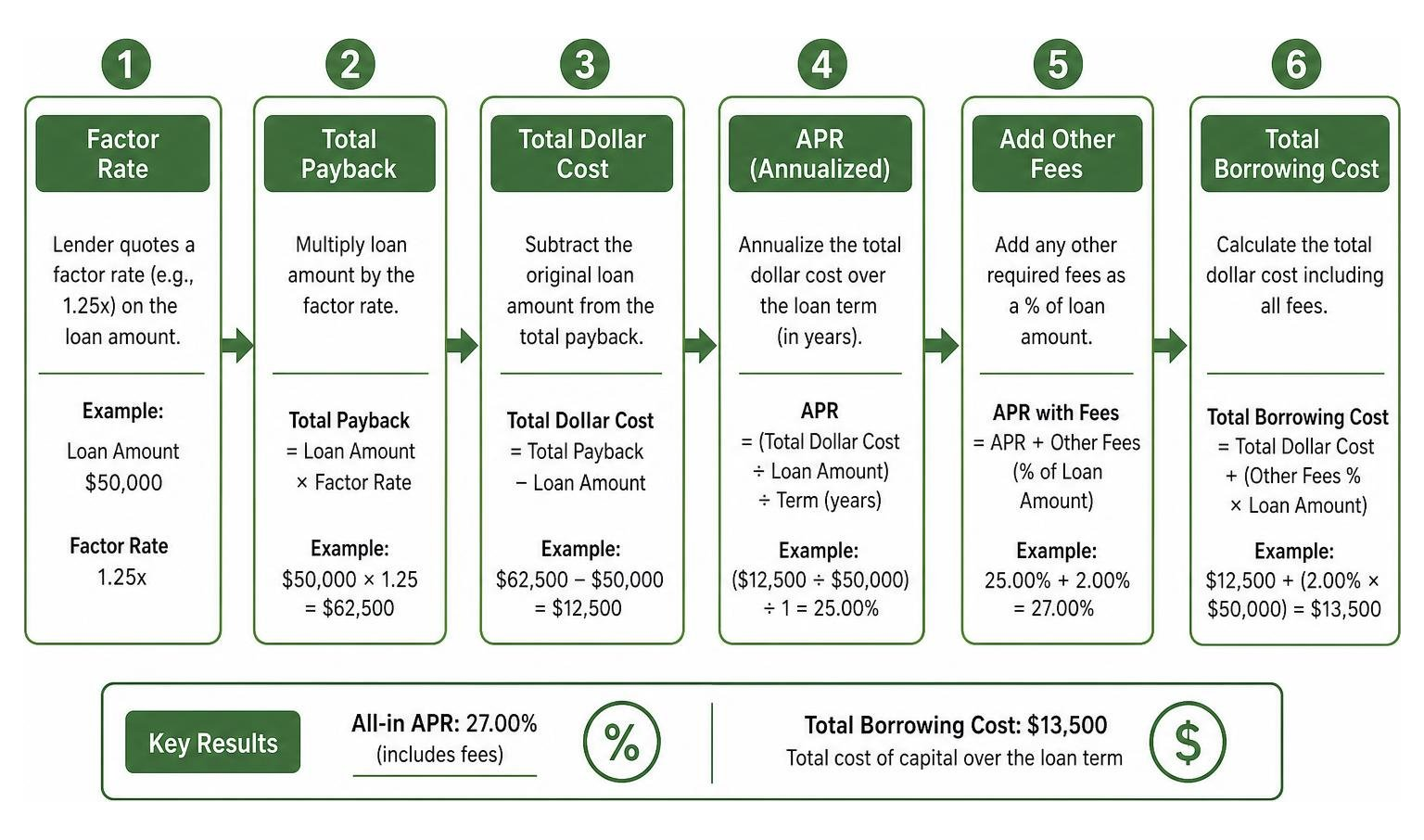
To perform a direct apples-to-apples comparison across different capital offers, you must convert all pricing terms—whether expressed as weekly interest, factor rates, or monthly discount fees—into an all-in APR equivalent and total dollar payback amount.
Converting Factor Rates to APR
Alternative short-term lenders often quote pricing using factor rates (such as 1.25x) instead of annualized percentages. A factor rate is a fixed decimal multiplier applied to the total loan amount.
For example, if you borrow $50,000 at a 1.25 factor rate, your total payback is: $$\$50,000 \times 1.25 = \$62,500$$ You are paying $12,500 in total financing charges regardless of whether you pay off the balance in 6 months or 12 months.
To approximate the equivalent APR on a 12-month loan:
- Subtract 1 from the factor rate ($1.25 – 1 = 0.25$ or 25% total fee).
- Divide by the loan term in years ($0.25 \div 1 \text{ year} = 25\% \text{ simple rate}$).
- Account for annualized compounding and declining balance payments, which often elevates the true effective APR to 40%–50% APR.
Evaluating Real Dollar Interest Paid
Evaluating total dollar costs reveals how loan duration changes overall expenditure. Consider a business taking out a $50,000 term loan over 5 years:
- At a 10% APR, the monthly payment is $1,063, resulting in $13,741 in total interest paid.
- At a 15% APR, the monthly payment rises to $1,190, resulting in $21,370 in total interest paid.
Securing the 10% APR offer over the 15% offer saves the business $7,629 in cash over the 5-year period.
Return on Investment (ROI) Framework
A loan’s rate should be measured against the commercial opportunity it unlocks. If borrowing $100,000 at a 20% APR costs $20,000 in total interest and fees over one year, but enables your business to purchase inventory that yields $70,000 in net gross profit, the net gain to your business is $50,000. In this scenario, what sounds like a higher interest rate proves to be a highly profitable growth decision.
Proven Strategies to Secure Lower Loan Interest Rates
If your initial loan quotes come back higher than expected, you can take concrete, practical steps to strengthen your application and negotiate lower rates:
- Review and Fix Credit Reports: Obtain copies of both personal and business credit reports. Dispute inaccuracies, remove outdated collections, and pay down revolving personal credit card balances below 30% utilization before submitting formal loan applications.
- Pledge Specific Assets as Collateral: Unsecured business loans carry higher default risks, which translates directly to higher interest rates. Offering tangible collateral—such as commercial real estate, heavy equipment, account receivables, or business vehicles—can lower your quoted interest rate by 2 to 4 percentage points.
- Demonstrate High DSCR: Present clean, up-to-date income statements and balance sheets that demonstrate a DSCR of 1.50x or greater. Strong cash flow coverage reassures underwriters that your business can absorb unexpected revenue drops without defaulting.
- Add a Qualified Cosigner: If your business is young or your personal credit score sits in the fair range, adding a partner or co-owner with strong credit (740+ FICO) and verified net worth can help unlock prime rate tiers.
- Shop Multiple Lenders via Soft Credit Pulls: Prequalify with multiple financial institutions—including local credit unions, commercial banks, and online marketplaces—using soft credit inquiries. Shopping around allows you to leverage competing quotes without negatively impacting your credit score.
Frequently Asked Questions About Business Loan Rates
How do Federal Reserve decisions impact variable business loan rates?
The Federal Reserve sets the target federal funds rate, which is the interest rate commercial banks charge each other for overnight loans. When the Fed lowers or raises this target, commercial banks adjust their WSJ Prime Rate accordingly. You can review current policy decisions directly from the Federal Reserve.
Most variable-rate business loans, lines of credit, and SBA 7(a) facilities price directly off the prime rate (for example, Prime + 2.5%). When the Fed changes interest rates, variable-rate commercial loans usually adjust within 30 to 90 days. If benchmark rates decline, your monthly interest charges drop; if benchmark rates rise, your interest costs increase.
How are SBA 7(a) maximum interest rate caps calculated?
The SBA sets strict legal maximums on the interest rates lenders can charge for SBA 7(a) loans. These caps depend on loan size, maturity, and whether the rate is fixed or variable. The U.S. Small Business Administration publishes 7(a) program terms and lender requirements.
For variable-rate 7(a) loans, maximum rates are calculated by taking a standardized Base Rate (the WSJ Prime Rate, 30-day SOFR, or the SBA Peg Rate) and adding a maximum allowable spread based on loan size:
| Loan Amount | Maximum Variable Spread Over Base Rate |
|---|---|
| $50,000 or less | Base Rate + 6.50% |
| $50,001 to $250,000 | Base Rate + 4.50% |
| $250,001 to $350,000 | Base Rate + 3.50% |
| Greater than $350,000 | Base Rate + 3.00% |
For example, with a Prime Base Rate of 6.75%, the maximum variable interest rate for an SBA 7(a) loan exceeding $350,000 is 9.75% (6.75% + 3.00%).
Are small business loan interest payments tax-deductible?
Yes, interest paid on commercial business loans is generally tax-deductible as an ordinary operating expense. Under federal tax rules, interest charges incurred for legitimate business purposes, such as purchasing inventory, buying equipment, or covering operational payroll, can be deducted from your gross taxable income.
Under Section 163(j) of the Internal Revenue Code, larger corporations face business interest expense deduction limits capped at 30% of adjusted taxable income. However, small businesses meeting the gross receipts test (averaging under ~$31 million in annual gross receipts) are exempt from these caps, allowing them to fully deduct 100% of their business loan interest expenses. Always consult a qualified CPA or tax professional to confirm how these tax deductions apply to your specific filing structure.
Conclusion
Understanding what is a good interest rate for a business loan comes down to looking beyond simple advertised percentages. In today’s market, a rate between 6% and 11% APR represents an excellent deal from traditional banks, while 9.75% to 14.75% represents strong value for government-backed SBA loans. For businesses seeking rapid funding or working around credit challenges, online term loans ranging from 12% to 36% APR can serve as effective, flexible solutions when matched with high-margin business opportunities.
Securing the best loan offer requires assessing the complete financial picture:
- Compare total APRs rather than nominal baseline rates.
- Account for all origination, underwriting, and closing fees.
- Verify that monthly payment structures comfortably align with your ongoing operating cash flows.
- Match loan terms to your expected return on investment.
As you optimize your capital strategies and streamline financial workflows, leveraging modern technology can give your team a significant operational advantage. Boost business productivity with AI tools to refine your financial reporting, automate administrative tasks, and keep your business running lean and competitive in 2026.