Why Settling Loans Quickly Can Change Your Financial Future
Scr0ll d0wn to D0VVNL0AD
How to settle loans quickly is one of the most searched personal finance questions — and for good reason. Carrying debt costs you money every single month in interest, and it weighs on your mental health too.
Here is a quick answer to the core question:

The fastest ways to settle loans quickly:
- Pay off in full early — make extra payments, refinance, or use a lump sum to eliminate the balance completely
- Negotiate a settlement — offer a reduced lump sum to the lender in exchange for closing the account, typically after a period of hardship or delinquency
- Consolidate or refinance — combine or restructure debt at a lower rate to pay it down faster
- Use a debt payoff method — apply the avalanche (highest interest first) or snowball (smallest balance first) strategy to clear multiple debts systematically
Important distinction: “Settling” a loan can mean two very different things. You can settle by paying it off completely — or by negotiating a reduced payoff amount with your lender. These two paths have very different consequences for your credit score and finances.
The right path depends entirely on your situation. Are you current on payments and just want to get out of debt faster? Or are you in genuine financial hardship and need to negotiate a reduced balance? This guide covers both.
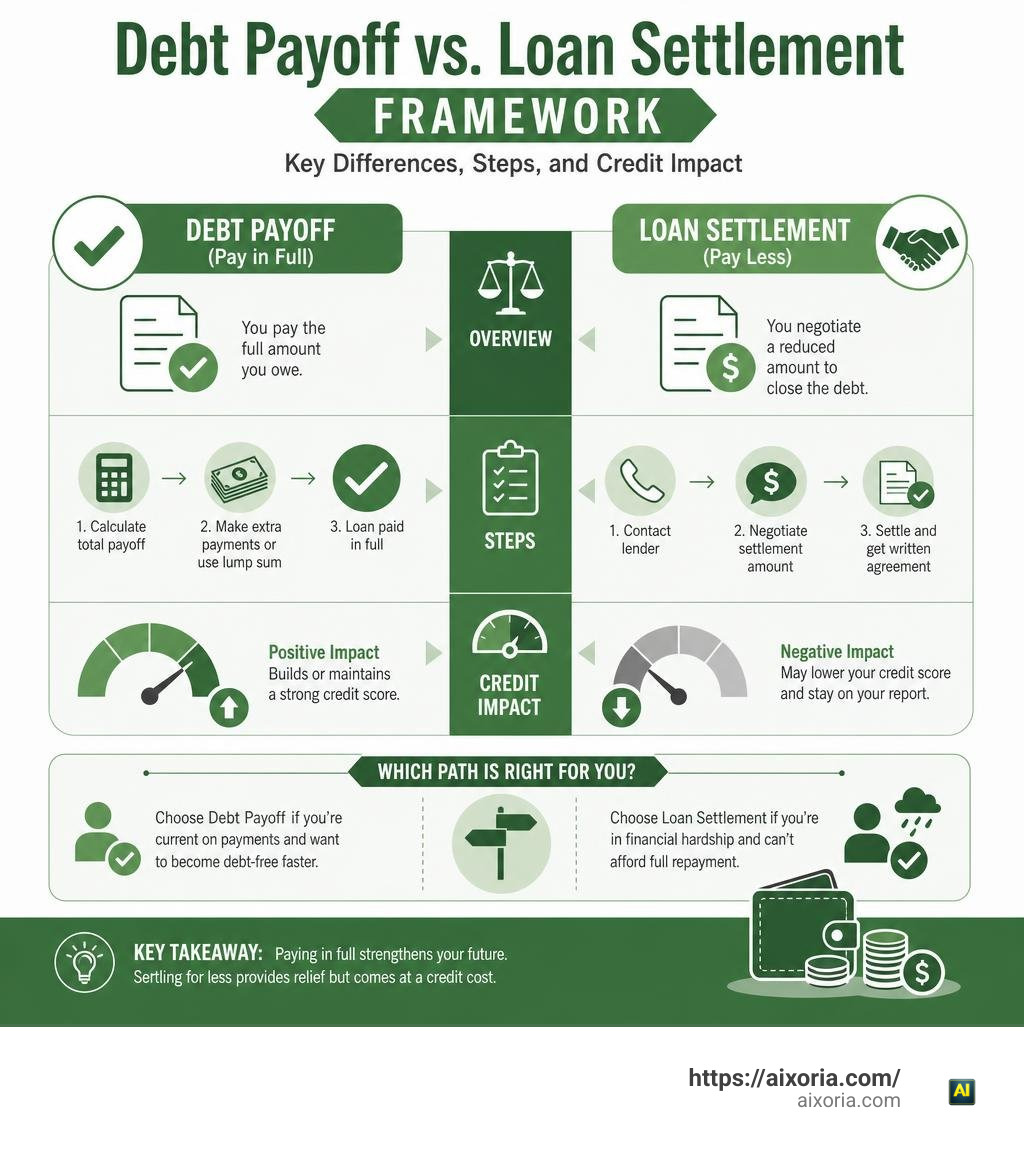
How to Settle Loans Quickly: Settlement vs. Full Payoff
When exploring how to settle loans quickly, we must first clarify the fundamental difference between settling a loan for less than you owe versus paying off a loan in full. While everyday conversation often uses “settling a loan” to mean getting rid of loan debt fast, in the financial industry, these two paths follow completely different mechanisms, legal agreements, and credit reporting rules.
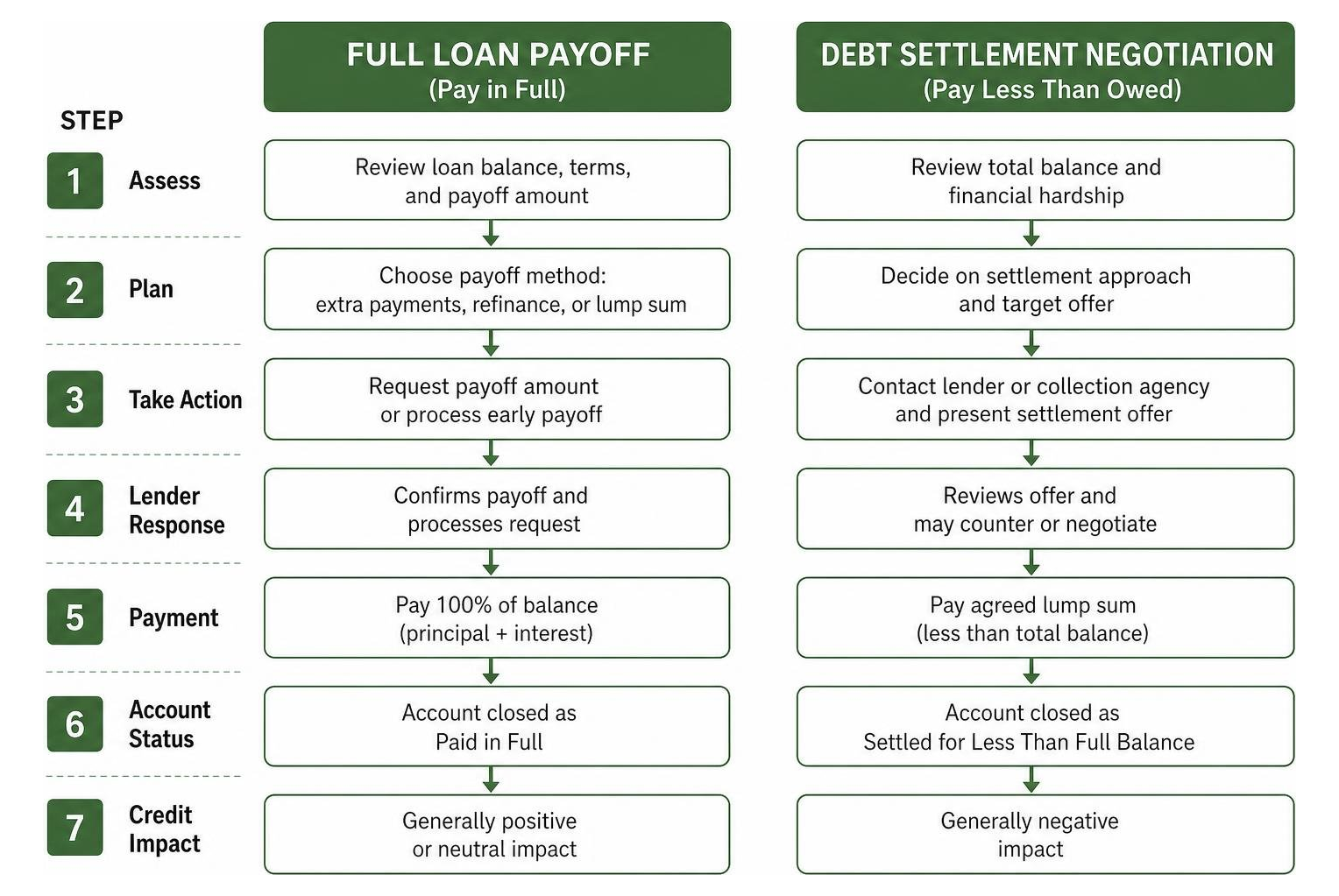
Paying off a loan in full (often referred to as loan closure) means fulfilling 100% of the principal and accrued interest according to your contractual agreement—or even ahead of schedule. When you pay in full, your credit report reflects the status as “Paid in Full” or “Closed – Paid as Agreed.”
In contrast, negotiating a loan settlement involves convincing your lender or a third-party collection agency to accept a lump-sum payment that is lower than your total outstanding balance. In exchange, the lender agrees to forgive the remaining principal and formally release you from the debt contract.
| Parameter | Paying Off in Full | Loan Settlement (Partial Payoff) |
|---|---|---|
| Total Balance Paid | 100% of principal and interest owed | Negotiated fraction (often 30% to 60%) |
| Credit Report Entry | “Paid in Full” / “Closed – Paid as Agreed” | “Settled” / “Paid – Less than Full Balance” |
| Immediate Credit Score Impact | Positive or Neutral (drops utilization, boosts history) | Severe drop (typically 50 to 150 points immediately) |
| Duration on Credit Report | Positive closed account stays up to 10 years | Negative “Settled” status remains for 7 years |
| Tax Liability | None | Potential income tax on forgiven debt over $600 |
| Lender Relationship | Preserves good standing with institution | May trigger 1–3 year institutional blacklist |
Credit Score Impact and Credit Bureau Reporting
Understanding how each route affects your credit score is essential before choosing a path. When you pay off a loan in full, you lower your total debt burden and decrease your overall credit utilization ratio. This demonstrates responsible financial management, protecting or even raising your credit scores over time.
On the other hand, negotiating a debt settlement requires account delinquency in almost every case. Lenders rarely entertain settlement proposals on current accounts. As missed payments accumulate over 30, 60, 90, and 120+ days, your credit score takes successive hits. Once the settlement agreement is completed, the creditor reports the account status as “Settled” or “Paid for less than full balance.”
According to industry data, a formal loan settlement typically drops a credit score by 50 to 150 points immediately upon reporting. Furthermore, that “Settled” mark remains visible on your credit reports for up to seven years from the date of the original delinquency. During this period, mainstream lenders view you as a higher risk. Many financial institutions enforce institutional cooling periods of 1 to 3 years after a settlement, during which automated underwriting systems will automatically decline new credit applications. If you are aiming to maintain an optimal credit rating while accelerating your timeline, review expert guidelines such as Experian Loan Payoff Advice to safeguard your borrowing power.
Tax Consequences and Debt Forgiveness
A hidden cost of negotiating a loan settlement is its tax impact. Under federal tax law, when a financial institution forgives or cancels $600 or more of debt principal, the forgiven amount is generally treated by the IRS as taxable income.
For example, if you owe $15,000 on an unsecured personal loan and successfully negotiate a lump-sum settlement of $6,000, the lender waives the remaining $9,000. Come tax season, the lender will issue an IRS Form 1099-C (Cancellation of Debt) reporting that $9,000 to both you and the government. Unless you qualify for specific tax exemptions—such as proving legal insolvency (where your total liabilities exceeded your total assets immediately prior to the settlement)—that $9,000 must be included in your gross income, potentially triggering a significant tax bill.
Direct Negotiation Strategies with Creditors
If severe financial hardship makes full repayment impossible, negotiating directly with your lenders is far superior to hiring third-party settlement agencies. By eliminating intermediary fees and managing communication yourself, you maintain complete control over your finances and legal protections.

Optimal Timing for Settlement Offers
Timing plays a critical role when requesting a loan settlement. Creditors rarely discuss reduced settlements when an account is current because they expect full payment. Most private lenders and credit card issuers will only entertain settlement proposals after an account has experienced sustained delinquency—typically around 4 to 6 months (120 to 180 days) of non-payment—when the account approaches official default or charge-off status.
Beyond delinquency timing, calendar alignment provides substantial leverage:
- End of Fiscal Quarter: Approaching bank recovery teams during the final week of a fiscal quarter (late March, June, September, or December) aligns your offer with internal targets. Collection managers often face monthly and quarterly quota pressures and are more inclined to accept reasonable settlement discounts (“haircuts”) to boost performance metrics.
- Pre-Charge-off vs. Post-Charge-off: Settling shortly before an account is written off as a bad-debt loss (around 120–150 days delinquent) allows the original creditor to recover cash directly, making them more receptive to reasonable terms. Once charged off, debts are often transferred to external agencies or sold to debt buyers who may accept lower percentage payoffs but carry higher communication friction.
Strategic Negotiation: How to Settle Loans Quickly with Lenders
When entering settlement negotiations, follow a disciplined, businesslike approach:
- Establish a Liquid Lump Sum First: Lenders prioritize immediate liquidity over distant installment promises. Having cash ready—even as low as 30% to 50% of the outstanding balance—gives you immediate leverage.
- Identify the Real Decision Maker: Never negotiate complex terms with front-line call center representatives. Respectfully ask to speak with a supervisor or manager in the hardship, recovery, or loss mitigation department who possesses explicit authority to modify terms.
- Anchor Low with a Realistic Counter: Open negotiations around 30% of the outstanding balance. Expect counter-offers, but maintain a firm ceiling based strictly on what you can afford.
- Secure Everything in Writing Before Paying: Never send money based on a verbal agreement. Demand a formal, signed Settlement Letter detailing that the agreed lump sum constitutes full satisfaction of the debt, explicitly waives any remaining balance, and specifies the exact credit reporting language.
For more tactical approaches on handling creditor discussions, explore these Proven Negotiation Strategies.
Necessary Hardship Documentation
Creditors require concrete evidence that your inability to pay stems from genuine financial hardship rather than deliberate non-compliance. When submitting your settlement proposal, compile a comprehensive hardship package including:
- A concise Hardship Letter detailing the unexpected event (e.g., job loss, medical emergency, divorce, or business failure).
- Proof of Income: Recent pay stubs, tax returns, or unemployment benefit statements confirming reduced earnings.
- Medical Bills or Notices: Formal documentation showing major out-of-pocket medical expenses.
- Asset and Expense Statements: Bank statements showing limited liquid funds and a monthly budget proving your living expenses consume your income.
DIY Negotiation vs. Debt Settlement Companies
Borrowers struggling with debt are often targeted by commercial debt settlement companies promising to erase debt for pennies on the dollar. However, relying on these third-party services involves serious risks and high costs compared to handling negotiations yourself.

Upfront Fees and Legal Risks
Commercial debt settlement agencies typically instruct clients to stop paying creditors directly and instead deposit money into a dedicated savings account. Once a lump sum builds up, the agency attempts negotiations.
This model exposes you to severe financial hazards:
- High Fee Structures: Debt settlement companies usually charge fees ranging from 15% to 20% of the total debt enrolled (or up to 25% of settled amounts). On $30,000 of debt, fees can add $4,500 to $6,000 to your cost.
- FTC Regulations & Scam Warnings: Under Federal Trade Commission (FTC) rules, it is illegal for debt settlement companies to charge upfront fees before settling or reducing at least one debt.
- Lawsuit Exposures: While you hold back payments to build a settlement fund, late fees and penalty interest compound rapidly. Creditors may file debt collection lawsuits, garnish wages, or place liens on property before the settlement company ever negotiates.
- Creditor Refusal: Major financial institutions often refuse to deal with third-party settlement agencies entirely, forcing communication back onto you while fees continue to accrue.
Under the Fair Debt Collection Practices Act (FDCPA), you retain strict rights when dealing with collection agencies, including the right to demand written validation of any debt and to dispute inaccurate balances directly.
Managing Active Credit Accounts During Settlement
A common question is whether you can keep some credit cards active while settling other delinquent debts. While legally permissible to maintain open accounts, card issuers monitor your credit profile continuously through soft credit checks.
When active card issuers detect sudden delinquencies, balance spikes, or settlement notations on other accounts, they frequently take adverse action. This includes unilaterally reducing your credit limits, spiking interest rates to default APRs, or closing accounts outright to limit their own risk exposure.
Accelerating Debt Payoff Without Forgiveness
If you want to clear debt rapidly without damaging your credit score or incurring tax bills, you can use structured repayment strategies to pay off your balance in full ahead of schedule.
Accelerating Repayment: How to Settle Loans Quickly Without Settlement
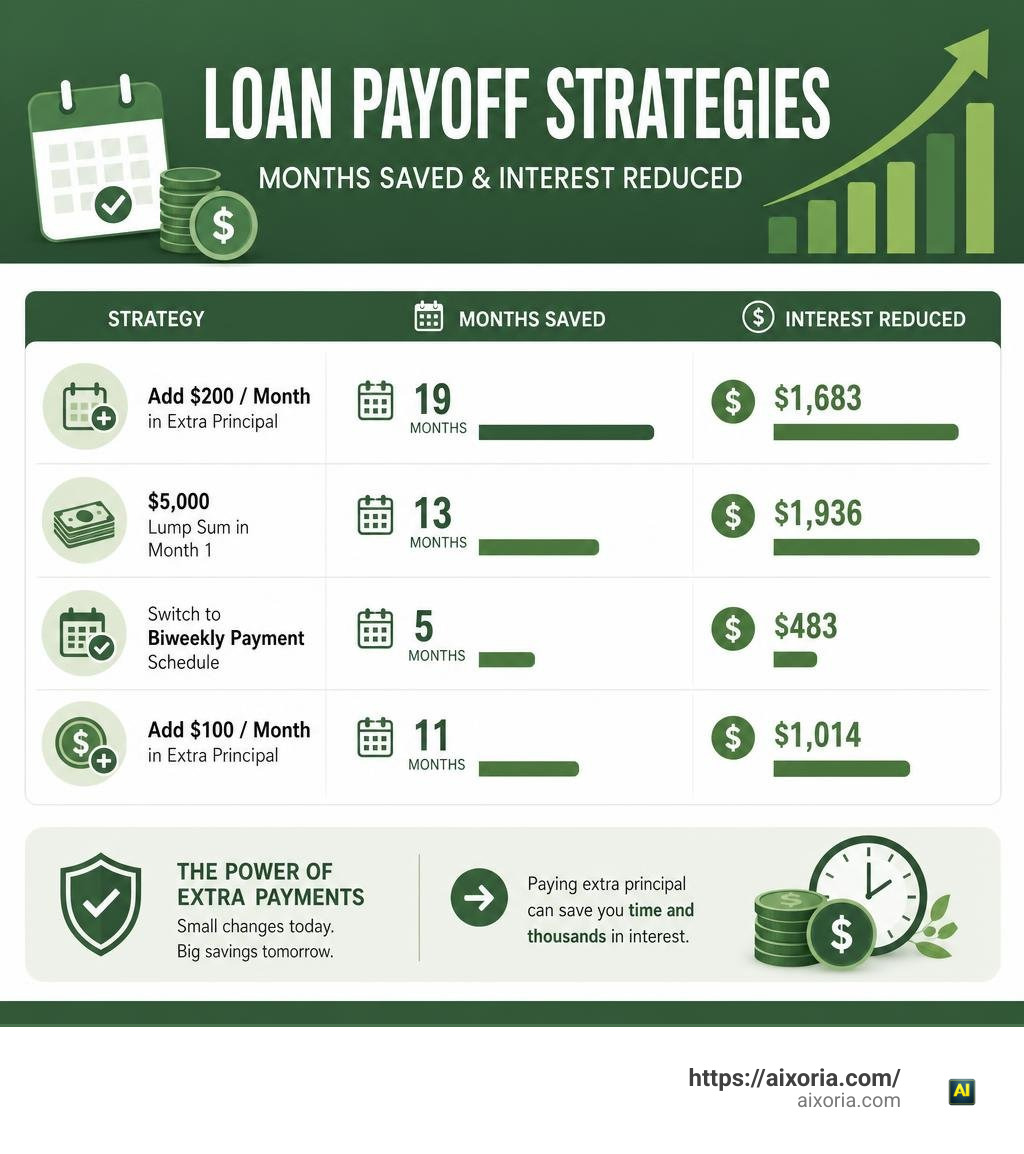
To mathematically prove how extra payments shorten loan lifespans, let’s examine a baseline scenario: a $25,000 personal loan at a 7.5% APR over a 60-month term.
Under standard repayment, the monthly payment is $501, resulting in total interest charges of $5,057 over 5 years. By applying extra principal contributions, you dramatically alter the payoff math:
- Adding $200/Month in Extra Principal: Increasing the monthly payment from $501 to $701 saves 19 months off the term and cuts $1,683 in interest.
- Dropping a $5,000 Lump Sum in Month 1: Applying a $5,000 windfall immediately to the principal balance saves 13 months and eliminates $1,936 in interest because it stops compound interest on that principal for the remaining duration.
- Switching to a Biweekly Payment Schedule: Paying half your monthly payment ($250.50) every two weeks results in 26 half-payments per year—the equivalent of 13 full monthly payments. This extra annual payment saves 5 months and $483 in interest without major lifestyle changes.
- Adding $100/Month in Extra Principal: Consistently adding $100 monthly saves 11 months and $1,014 in interest.
When making extra payments, always verify with your loan servicer that extra funds are applied directly toward the principal balance, rather than marked as “paid ahead” for future monthly due dates. For a full breakdown of payoff options, see the guide on Fastest Ways to Pay Off Any Loan and review these Practical Debt Payoff Tips. Always check your original loan contract first to ensure your lender does not charge prepayment penalty fees.
Refinancing, Lump Sums, and Consolidation Alternatives
Beyond extra monthly payments, restructuring your obligations can significantly reduce costs:
- Loan Refinancing: If your credit score has improved or market interest rates have dropped, refinancing to a lower APR and shorter term yields massive savings. For example, refinancing our baseline $25,000 loan from 7.5% APR to 5.5% APR while shortening the term to 36 months saves 24 months and $2,881 in interest.
- Debt Consolidation Loans: Combining multiple high-interest credit card balances into a single personal loan with a fixed rate simplifies budgeting and lowers total interest expenses.
- Non-Profit Credit Counseling: Agencies certified by the National Foundation for Credit Counseling (NFCC) offer Debt Management Plans (DMPs). DMPs consolidate unsecured payments into a single monthly deposit while counselors negotiate reduced interest rates (often 6% to 10%) without harming your credit report.
- Bankruptcy Options: When liabilities far outstrip income, legal protection under Chapter 7 (asset liquidation for fast debt discharge) or Chapter 13 (a 3- to 5-year court-supervised repayment plan) provides a legal fresh start, halting collection lawsuits instantly.
Frequently Asked Questions About Loan Settlement
What is the difference between settling a loan and paying it off in full?
Paying off a loan in full means paying 100% of the principal and interest owed according to your agreement. It updates your credit report positively as “Paid in Full” or “Closed – Paid as Agreed,” preserving your credit rating.
Settling a loan means negotiating with the lender to accept a smaller lump-sum payment (often 30% to 60% of the total balance) to forgive the remainder. This requires account delinquency, lowers your credit score by 50 to 150 points, leaves a negative “Settled” mark on your credit report for up to seven years, and may create a taxable income event on the forgiven portion.
Can you keep some credit cards active while settling other debts?
Yes, you can legally maintain current credit card accounts while attempting to settle other defaulted debts. However, card issuers regularly monitor your credit profile.
When active lenders observe delinquency notices, debt settlement filings, or steep credit score drops on external accounts, they frequently take preventative adverse action. This includes lowering your available credit limit, raising interest rates to default levels, or closing accounts entirely to eliminate financial exposure.
When is the best time to approach a lender for a loan settlement?
The optimal time to negotiate a settlement directly with a creditor is when the account is between 120 and 180 days delinquent (4 to 6 months unpaid). At this stage, the debt is approaching official charge-off status, making lenders more willing to consider lump-sum settlement offers to recover cash directly.
Additionally, submitting settlement offers during the final week of a fiscal quarter (late March, June, September, or December) aligns with quarterly recovery targets, providing higher negotiation leverage.
Conclusion
Mastering how to settle loans quickly comes down to choosing the right strategy for your personal financial situation. If you are financially stable, accelerating full repayment through biweekly payments, principal additions, or refinancing lets you eliminate debt rapidly while protecting your credit score. If you are experiencing severe hardship, negotiating a direct lump-sum settlement or exploring non-profit credit counseling provides a realistic path toward relief.
Building financial stability requires long-term planning, disciplined budgeting, and staying informed on financial technology. At Aixoria, we help individuals leverage advanced digital tools and insights to navigate complex financial landscapes. Explore our latest strategies and updates at Aixoria AI Updates to take control of your financial future today.