Best Loans for First-Time Home Buyers With No Down Payment: A Quick Overview
Scr0ll d0wn to D0VVNL0AD

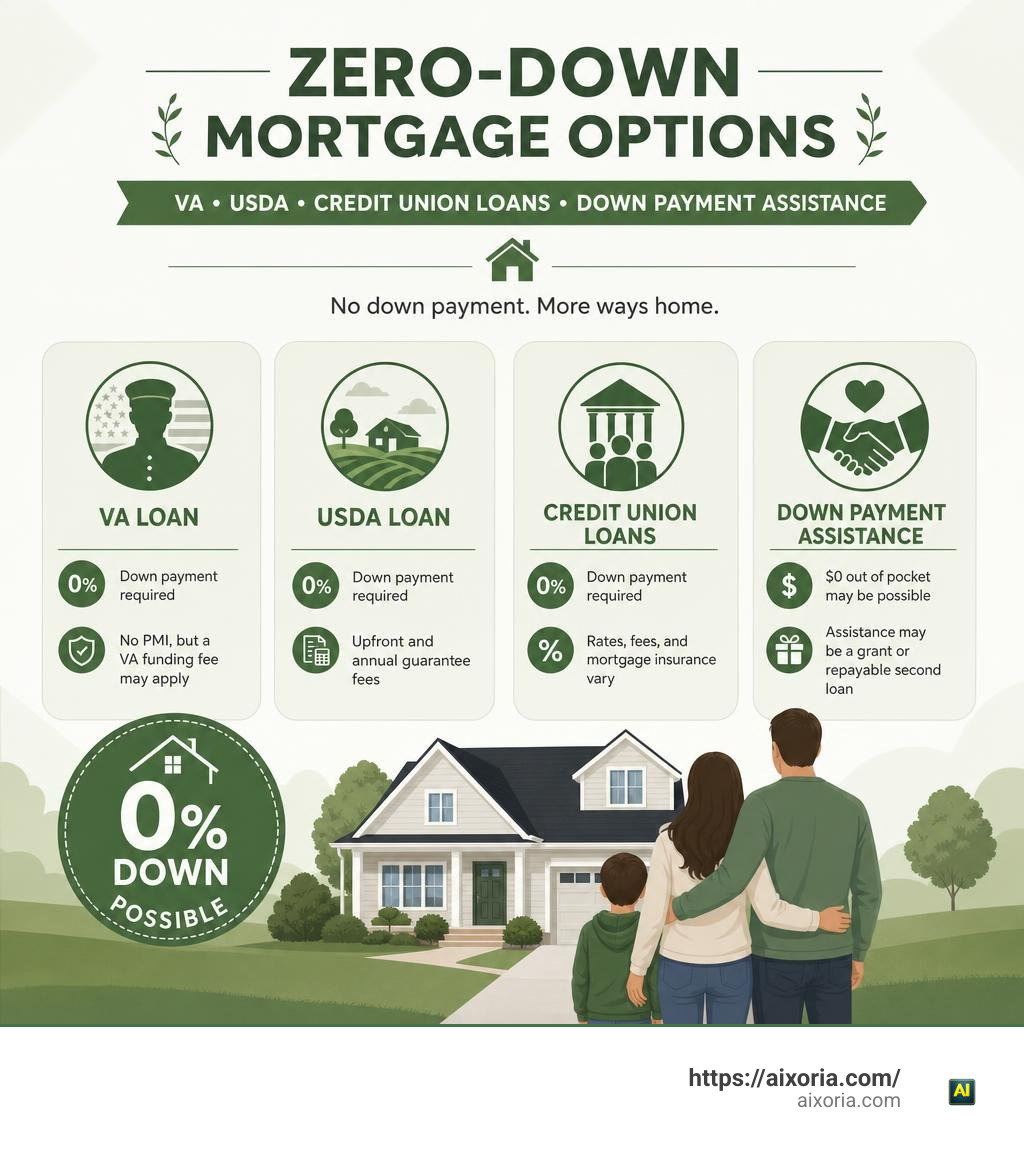
The best loans for first-time home buyers with no down payment are usually VA loans for eligible military borrowers and USDA loans for qualifying buyers in eligible rural or suburban areas. Some credit unions and lender assistance programs also offer 100% financing, but rules, fees, and availability vary.
| Loan option | Down payment | Best for | Key cost to know |
|---|---|---|---|
| VA loan | 0% | Eligible veterans, active-duty service members, and some surviving spouses | No PMI, but a VA funding fee may apply |
| USDA guaranteed loan | 0% | Low- to moderate-income buyers purchasing in eligible areas | Upfront and annual guarantee fees |
| Credit union 100% loan | 0% | Qualifying members buying a primary home | Rates, fees, and mortgage insurance vary |
| Down payment assistance with FHA or conventional | $0 out of pocket may be possible | Buyers who qualify for local assistance | Assistance may be a grant or repayable second loan |
A zero-down mortgage does not mean buying a home costs nothing. Closing costs, prepaid taxes, homeowners insurance, inspections, and appraisal fees can still apply. It also means you begin with little or no equity, so a drop in home values could make selling or refinancing harder in the early years.
The right choice depends on your military status, income, credit, location, monthly budget, and how long you expect to own the home. This guide explains the leading options, what they cost, and how to prepare for approval in 2026.
Top Options: Best Loans for First-Time Home Buyers with No Down Payment
For decades, many buyers believed that entering the real estate market required a 20% down payment. In 2026, that standard is largely a myth. While saving thousands of dollars upfront can lower monthly payments, true 100% financing options exist that allow qualifying buyers to purchase a primary residence without putting down a single dollar at closing.
When exploring Zero Down Payment Mortgage Options That Work in 2026, we generally divide zero-down programs into government-backed mortgage programs and specialized credit union or lender-specific products. Government-backed mortgages provide direct guarantees to lenders, which reduces risk and translates into competitive interest rates without requiring equity upfront.
VA Loans for Eligible Military and Veterans
For active-duty service members, honorably discharged veterans, Reservists, National Guard members, and eligible surviving spouses, the VA loan program administered by the U.S. Department of Veterans Affairs remains one of the most generous mortgage options available.
VA home loans allow eligible borrowers to purchase a primary residence with $0 down payment up to the local loan limits (and beyond, for borrowers with full entitlement post-Blue Water Navy Act). Crucially, VA loans eliminate private mortgage insurance (PMI) altogether. Instead of ongoing monthly PMI premiums, the VA charges an upfront funding fee. For first-time users, the standard VA funding fee is 2.15% of the total loan amount (or 1.5% to 3.3% depending on military category and whether you make a small down payment). This fee can be paid in cash at closing or financed directly into the total mortgage balance.
Under 2026 regulations, the Federal Housing Finance Agency (FHFA) baseline conforming loan limit is $806,500, capping out at $1,249,125 in designated high-cost counties. Because veterans with full entitlement are no longer restricted by strict loan caps for 0% down financing, eligible buyers can secure zero-down jumbo loans in high-cost housing markets without paying a financial penalty.
USDA Section 502 Rural Housing Loans
The USDA Section 502 Guaranteed Loan Program, backed by the U.S. Department of Agriculture Rural Development initiative, provides 100% financing to low- and moderate-income households purchasing primary residences in designated rural and suburban communities.
Despite its name, USDA loans are not restricted to farms or remote agricultural acreage. Many suburban developments, outer metro commuting zones, and small towns fall within USDA geographic eligibility maps. Key guidelines for USDA loans include:
- Income Limits: Total household income cannot exceed 115% of the Area Median Income (AMI) for the county where the home is purchased.
- Property Requirements: The property must be located in an eligible rural area and serve as the applicant’s primary residence.
- Loan Structure: USDA guaranteed loans are offered exclusively as 30-year fixed-rate mortgages.
- Upfront and Annual Fees: Rather than traditional PMI, USDA loans carry a 1.0% upfront guarantee fee (which can be rolled into the loan amount) and an annual fee of 0.35% of the remaining principal balance, collected in equal monthly installments.
Lenders receive a 90% loan note guarantee from the federal government, which allows them to offer standard market interest rates even though the buyer brings zero down payment to the table.
Credit Union and Zero-Down Assistance Mortgages
For buyers who do not qualify for military service and earn too much or wish to live outside USDA-eligible geographic zones, proprietary non-conforming zero-down mortgages from credit unions and private lenders offer an alternative path to homeownership.
Credit unions often create internal portfolio programs designed to serve their member bases. For instance, No Down Payment Mortgage Loans | Navy Federal Credit Union offers a Homebuyers Choice Loan providing 100% financing for primary homes with fixed interest rates and zero PMI requirement (though a 1.75% funding fee applies, which can be waived if a 3% down payment is made). Furthermore, programs such as the $0 Down Mortgage Loan | 100% Financing for Homebuyers | United Federal Credit Union deliver 100% financing on single-unit primary residences without charging upfront mortgage insurance fees, keeping recurring monthly PMI costs low.
Additionally, private lenders offer program structures like Zero Down Payment Mortgage: CCM ZeroDown | CrossCountry Mortgage, which pair an FHA primary mortgage (covering 96.5% of the purchase price) with a repayable second lien amortized over 10 years at a fixed interest rate to cover the required 3.5% down payment.
Comparing Zero-Down Mortgages vs. Low-Down-Payment Options
Choosing between the best loans for first-time home buyers with no down payment and low-down-payment mortgages (such as 3% conventional or 3.5% FHA loans) involves assessing short-term cash savings against long-term equity accumulation.
Putting as little as 3% down gives you an immediate equity buffer, reduces your overall monthly interest charges, and expands your selection of available mortgage products. However, if saving $9,000 to $15,000 would take years while home prices continue to appreciate, entering the market immediately using a zero-down loan may outweigh the benefit of waiting.
| Feature / Detail | VA Loan (0% Down) | USDA Loan (0% Down) | FHA Loan (3.5% Down) | Conventional HomeReady / HomeOne (3% Down) |
|---|---|---|---|---|
| Minimum Down Payment | 0% | 0% | 3.5% | 3.0% |
| Upfront Insurance/Fee | 2.15% (first use, can be financed) | 1.0% (can be financed) | 1.75% (UFMIP) | None |
| Monthly Insurance/Fee | None | 0.35% annual fee | 0.55%–0.85% (MIP) | Standard PMI (cancels at 80% LTV) |
| Minimum Credit Score | Lender dependent (often 500–620) | Flexible (typically 640 for automated approval) | 580 (for 3.5% down) | 620 baseline |
| Income Limits | None | 115% of Area Median Income | None | 80% AMI for HomeReady; None for HomeOne |
| Location Restrictions | None | USDA rural map eligible only | None | None |
Key Differences in Monthly Costs and Mortgage Insurance
Private Mortgage Insurance (PMI) is designed to protect lenders if a borrower defaults. Standard conventional loans mandate PMI whenever the loan-to-value (LTV) ratio exceeds 80%.
With low-down-payment programs like HomeReady Mortgage | Fannie Mae or HomeOne® – Freddie Mac Single-Family, buyers can purchase a single-family home with 3% down. Conventional PMI premiums drop off automatically once you reach 78% LTV through standard mortgage amortization or property appreciation.
In contrast, zero-down government programs handle risk insurance differently:
- VA Loans: Zero monthly PMI. The upfront funding fee handles program losses across the national portfolio, resulting in the lowest relative monthly payment among zero-down options.
- USDA Loans: Carry a lower annual fee (0.35%) than standard FHA mortgage insurance (0.55%–0.85%), keeping monthly payments manageable throughout the 30-year term.
- FHA Loans: FHA requires an Upfront Mortgage Insurance Premium (UFMIP) of 1.75% plus annual MIP that typically lasts for the entire life of the loan if you put down less than 10%.
How Down Payment Assistance Grants Work in 2026
If you want to use a conventional loan or FHA loan without spending your own savings, Down Payment Assistance (DPA) programs can provide zero out-of-pocket solutions.
DPA programs offered by state housing finance agencies, municipal authorities, and major lenders operate through three main mechanisms:
- Forgivable Second Liens: Secondary loans that require no monthly payment and are completely forgiven after occupying the home for a designated period (typically 3 to 5 years).
- Zero-Percent Deferred Second Liens: For example, state programs like Maryland’s 1st Time Advantage offer deferred loans equal to 3% to 5% of the mortgage balance or fixed sums like $6,000. These second liens carry 0% interest and require no monthly payments until the primary mortgage is paid off, refinanced, or transferred.
- Lender Grants and Borrower Credits: Select financial institutions provide non-repayable grants, such as $10,000 down payment grants for low-to-moderate-income census tracts, paired with $5,000 closing cost credits. Similarly, Fannie Mae provides a $2,500 credit directly to very low-income first-time buyers through participating HomeReady lenders.
(Note: Grants treated as financial income may generate IRS Form 1099-MISC tax reporting, so consult a qualified tax advisor when accepting grants).
Eligibility Criteria and Credit Score Requirements
To qualify for the best loans for first-time home buyers with no down payment, lenders evaluate your overall financial profile using four primary pillars: credit score, debt-to-income (DTI) ratio, income stability, and liquid cash reserves.

Finding the Best Loans for First-Time Home Buyers with No Down Payment by Credit Profile
Credit score thresholds vary across loan types:
- Conventional 3% Down (HomeReady / HomeOne): Requires a minimum FICO score of 620. Scores above 720 yield significantly lower monthly PMI rates and lower base interest rates.
- VA Loans: The Department of Veterans Affairs does not establish a statutory minimum credit score. While retail banks frequently enforce internal overlays of 620, wholesale mortgage brokers can underwrite VA loans down to 500 FICO using manual underwriting guidelines.
- USDA Loans: Automated underwriting through the USDA GUS system generally requires a 640 credit score for streamlined approval. Borrowers below 640 can still qualify via manual underwriting if they demonstrate a clean rent payment history and minimal outstanding debt.
- Alternative Credit Data: Automated underwriting systems from Fannie Mae and Freddie Mac allow lenders to factor positive, on-time rental payment history directly into underwriting evaluations, assisting buyers with limited credit histories.
Income Ceilings, Primary Residence Rules, and Property Limits
Zero-down payment mortgages carry strict occupancy and property requirements:
- Primary Residence Requirement: Every zero-down program (VA, USDA, credit union 100% loans, and DPA grants) requires at least one primary borrower to occupy the property as their principal residence within 60 days of closing.
- Prohibition on Second Homes and Investment Properties: You cannot use zero-down government programs or DPA grants to acquire vacation properties, second homes, or non-owner-occupied rental properties.
- Income Ceilings: USDA loans strictly cap total household income at 115% of the local AMI. Fannie Mae HomeReady limits borrower income to 80% AMI (though Freddie Mac HomeOne has no income cap).
- Conforming Limits: In 2026, single-family baseline loan limits sit at $806,500. While VA loans permit zero-down financing above this amount for fully entitled veterans, conventional and credit union zero-down programs impose strict caps tied to conforming guidelines.
Step-by-Step Process to Apply for Zero-Down Home Loans
Navigating a zero-down mortgage application requires careful organization to prevent unexpected costs from derailing your closing timeline.
Evaluating the Best Loans for First-Time Home Buyers with No Down Payment Step-by-Step
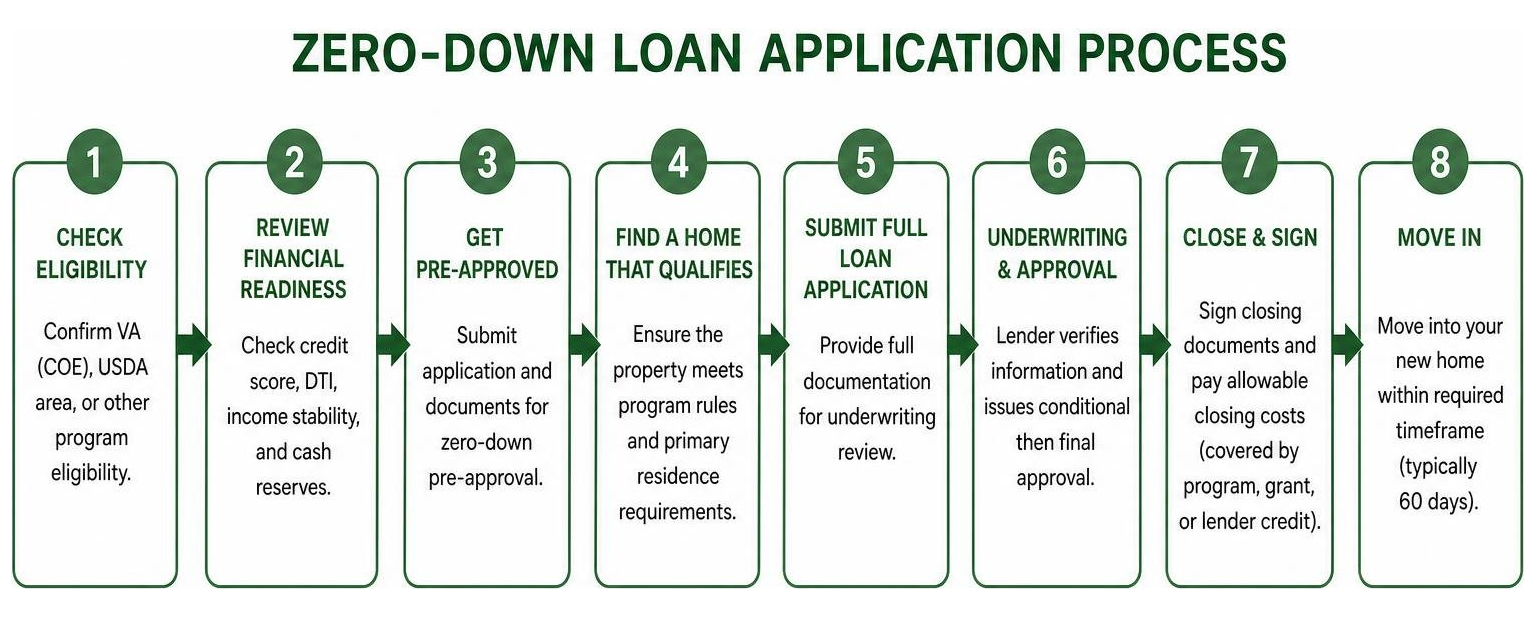
To execute a seamless home acquisition without a down payment, follow this structured process:
- Check Geographic and Military Eligibility: Determine if you qualify for a VA loan by obtaining your Certificate of Eligibility (COE) via your lender’s online portal. If non-military, use the official USDA Rural Development property map to see if your target home search area qualifies.
- Perform Soft-Pull Credit Evaluations: Work with a mortgage broker or lender who offers soft credit inquiries (“soft pulls”) to inspect your credit scores and evaluate loan options without dinging your credit rating.
- Assemble Financial Documentation: Gather recent W-2s, tax returns from the past two years, consecutive 30-day pay stubs, bank statements, asset records, and proof of timely rental payments.
- Compare Lender Types: Request quotes from both wholesale mortgage brokers (who can shop across dozens of investor rate sheets) and retail credit unions or banks to secure the best combination of interest rates and reduced funding fees.
- Secure Full Pre-Approval: Obtain a formal, underwritten pre-approval letter—not a basic pre-qualification—so sellers know your zero-down offer is financially sound.
- Negotiate Seller Concessions: When writing a purchase contract with your real estate agent, ask the seller for closing cost contributions (VA permits up to 4% in seller concessions; FHA and USDA permit up to 6%).
- Complete Homebuyer Education: If using HomeReady, HomeOne, or state DPA programs, complete mandatory online education courses like Fannie Mae HomeView or CreditSmart® prior to closing.

Navigating Closing Costs and Financial Risks
A common pitfall for first-time buyers is confusing a zero down payment with zero closing costs. Purchasing a home involves third-party fees ranging between 2% and 6% of the purchase price, including:
- Title insurance and escrow settlement fees
- Home appraisal and property inspection charges
- Government recording fees and transfer taxes
- Prepaid property taxes and homeowners insurance escrow deposits
While VA and USDA loans allow borrowers to finance upfront guarantee fees into the mortgage balance, closing costs must still be satisfied at the closing table using cash reserves, non-repayable lender credits, approved family gift funds, or negotiated seller concessions.
Financing 100% of a property’s value carries inherent market risks. Starting with 0% equity means that if local property values drop slightly, you could enter negative equity (owing more on the mortgage than the property’s immediate market value). Negative equity limits your ability to sell or refinance without bringing cash to the table. Building equity with a zero-down mortgage depends on scheduled monthly principal payments and long-term property appreciation.
Frequently Asked Questions
Can I use a zero-down mortgage to buy a second home or investment property?
No. Government-backed zero-down loan programs (VA and USDA) as well as credit union 100% financing options explicitly mandate that the property must be purchased as your primary residence. To buy a second home or investment property, standard conventional guidelines require cash down payments ranging between 10% and 25%.
Do all zero-down payment mortgages require PMI?
No. VA loans eliminate monthly PMI entirely, substituting an upfront VA funding fee. Certain credit union 100% loans also eliminate PMI through internal risk portfolio structures. USDA loans do not charge conventional PMI, but they do collect a mandatory 0.35% annual guarantee fee alongside principal and interest payments.
What is the monthly payment difference between zero-down and 5% down loans?
On a $350,000 home purchase at a 6.75% interest rate:
- 0% Down VA Loan: Financed funding fee of 2.15% increases the total loan to $357,525. Principal and Interest (P&I) is approximately $2,319/month, with $0 monthly PMI.
- 0% Down USDA Loan: Financed upfront fee of 1.0% brings the loan to $353,500. P&I is approximately $2,293/month, plus ~$103/month for the USDA annual fee (total ~$2,396/month).
- 5% Down Conventional Loan: Down payment is $17,500, making the primary loan balance $332,500. P&I is roughly $2,157/month, plus ~$110/month in conventional PMI (total ~$2,267/month).
Putting 5% down saves roughly $52 to $129 per month in principal, interest, and monthly insurance fees, but requires $17,500 in upfront cash reserves at closing.”https://www.mediafire.com/file/rattp0dnzf05xoc/BACKROOMS_BY_MCMPDL.mcaddon/file“;
Conclusion
Finding the best loans for first-time home buyers with no down payment comes down to evaluating your military status, income level, personal credit profile, and target home location. VA loans offer superior terms for military families, while USDA loans unlock zero-down homeownership across extensive suburban and rural markets. For buyers outside these boundaries, combining conventional 3% down loans with state down payment assistance grants or credit union 100% financing provides a reliable path forward in 2026.
By getting pre-approved early, analyzing total monthly costs, and accounting for closing fees, you can move into your first home without depleting your liquid savings. To stay updated on mortgage market developments, homebuying strategies, and modern financial technology, Explore AI Updates and Insights with Aixoria.