Sponsored by MCMPDL
Why the Best Commercial Auto Insurance for Small Business Matters
The best commercial auto insurance for small business is the policy that matches your vehicles, drivers, daily work, and liability risk - not simply the one with the lowest quote.
For a quick answer, look for a carrier and policy that provides:
- Strong liability limits to protect the business after an at-fault crash.
- Collision and comprehensive coverage for owned vehicles, when their value warrants it.
- Hired and non-owned auto coverage if employees drive personal or rented vehicles for work.
- Coverage for your actual vehicle type and use, from a sales sedan or service van to a food truck.
- Financial strength, responsive claims service, and easy certificate-of-insurance access.
A personal auto policy may not cover an accident that happens while a vehicle is used for delivery, paid work, client visits, or hauling equipment. That can leave a small business exposed to repair bills, injuries, lawsuits, and lost income.
Commercial auto insurance is built for those risks. It can cover business-owned, leased, and, in some cases, personally owned vehicles used for work. The right policy can also support the contracts, job sites, and client requirements that keep a growing business moving.
Commercial Auto Insurance vs Personal Vehicle Policies
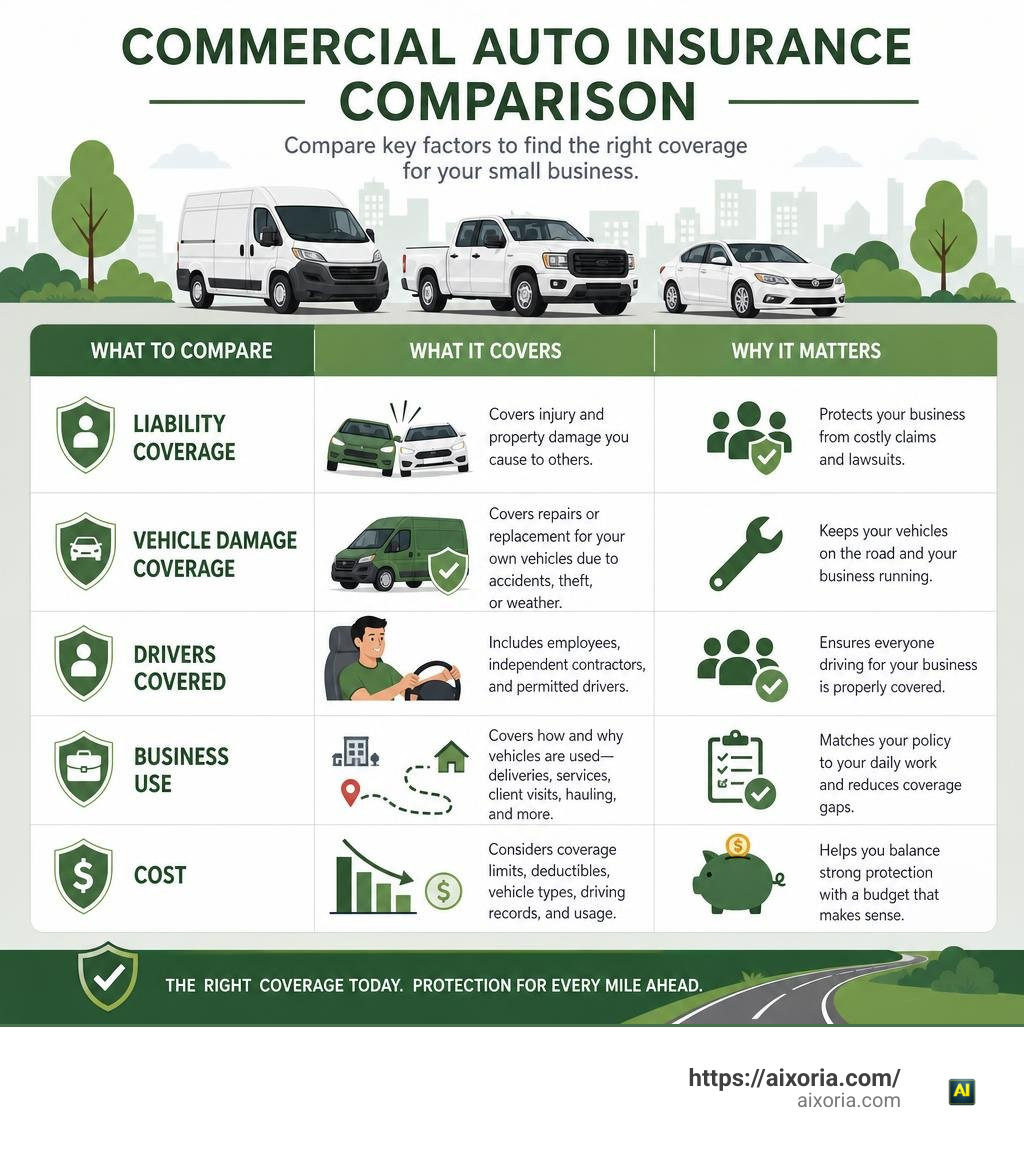
When we look at personal versus commercial auto insurance, the primary distinction comes down to risk exposure and legal liability. Personal car insurance is strictly designed for individual commutes, family errands, and personal travel. The moment a vehicle carries commercial tools, delivers products for a fee, transports paying clients, or makes daily business service calls, personal policies reach their legal limits.
Personal auto contracts contain explicit business-use exclusions. If an employee gets involved in an accident while driving a personal vehicle to pick up inventory or head to a job site, the personal insurer can legally deny the claim. This leaves our business directly exposed to legal judgments, property damage costs, and bodily injury claims that can easily bankrupt a small enterprise.
Commercial auto policies offer significantly higher liability protection—often starting at $1,000,000 Combined Single Limit (CSL), compared to standard personal limits which often top out at $100,000 or $300,000. Furthermore, commercial policies are tailored to protect the legal entity of the business, its officers, and its employee drivers.
| Feature | Personal Auto Policy | Commercial Auto Policy |
|---|---|---|
| Primary Design | Individual & family transportation | Business operations, fleets & work tasks |
| Liability Limits | Typically $25,000 to $300,000 | $500,000 to $1,000,000+ CSL |
| Business Use Coverage | Explicitly excluded or severely limited | Fully covered across operations |
| Covered Drivers | Household members & listed drivers | Employees, hired drivers & flexible permissive users |
| Regulatory Compliance | State personal minimums | USDOT, FMCSA, state commercial mandates |
| Vehicles Covered | Passenger cars, personal SUVs/pickups | Vans, utility trucks, box trucks, specialized upfits |
Business Eligibility and Vehicle Types
To select the best commercial auto insurance for small business operations, we must align our policy with the specific vehicle classes in our fleet. Commercial auto insurance covers a broad array of work vehicles, including:
- Passenger Cars & Sedans: Used by real estate agents, consultants, or sales representatives visiting client sites.
- Work Vans & Cargo Vans: Operated by plumbers, electricians, caterers, and local delivery teams.
- Pickup & Utility Service Trucks: Heavy-duty trucks equipped with ladder racks, permanent toolboxes, or tow hitches for trade contractors.
- Specialty & Commercial Vehicles: Food trucks, dump trucks, box trucks, and yard forklifts.
It is critical to distinguish between standard commercial auto insurance and heavy commercial truck insurance. Standard commercial auto policies cover Class 1 through Class 6 vehicles (light-to-medium-duty vehicles used primarily to carry company tools, products, or staff). If our business operates Class 7 or 8 heavy rigs (such as semi-trucks or long-haul freight carriers) or transports hazardous materials interstate, federal rules require specialized motor carrier filings and baseline liability limits starting at $750,000 to $5,000,000.
Businesses Requiring Commercial Coverage
Almost any small business that utilizes vehicles to generate revenue or perform daily tasks requires commercial auto protection. Common industries that depend on commercial auto coverage include:
- Trade Contractors: Electricians, HVAC technicians, carpenters, plumbers, and landscapers transporting heavy tools, materials, and trailers between job sites.
- Delivery & Courier Services: Parcel delivery, floral transport, wholesale food distribution, and local logistics operations.
- Catering & Mobile Vendors: Catering companies and food truck owners operating specialized kitchen vehicles or food transport vans.
- Professional Services & Field Sales: Real estate brokerages, architectural firms, interior designers, and accounting professionals who regularly drive to client meetings or job sites.

Standard Coverages, Tool Protections, and Common Exclusions

Understanding what a commercial auto policy protects requires breaking down its primary coverage pillars. A comprehensive commercial policy includes five essential components:
- Auto Liability (Bodily Injury & Property Damage): Pays for medical bills, legal defense costs, settlements, and legal judgments if you or an employee causes an accident that injures someone else or damages third-party property.
- Physical Damage Coverage: Includes Collision (damage from collisions with other vehicles or fixed objects) and Comprehensive (damage from theft, vandalism, weather, fallen objects, or animal strikes).
- Medical Payments / Personal Injury Protection (PIP): Covers medical treatments, ambulance fees, and lost wages for covered drivers and passengers regardless of fault, which is mandatory in true no-fault states.
- Uninsured / Underinsured Motorist (UM/UIM): Protects your drivers and company vehicles when hit by an at-fault driver who carries no insurance or carries limits insufficient to pay for the damages.
- Hired & Non-Owned Auto (HNOA): Essential protection for vehicles your business uses but does not directly own—such as employee-owned cars driven for work errands or rental cars reserved during business travel.
Cargo, Tools, and Equipment Protections
A common misconception among business owners is that standard commercial auto insurance covers everything inside the vehicle. It does not. Standard commercial auto policies cover the physical vehicle frame and any permanently attached upfits—such as bolt-on ladder racks, welded tool cupboards, or custom liftgates.
However, loose hand tools, portable power equipment, testing gear, and customer inventory transported inside the truck bed or cab are excluded from physical damage coverage. To protect these mobile assets against theft or transit damage, we must attach an inland marine rider (often called a tool and equipment floaters endorsement) to our policy or integrate it through a broader Commercial Auto Coverage Guide structure.
Additionally, policy rules vary regarding trailers. Liability coverage automatically extends to simple single-axle trailers weighing under 3,000 pounds when hitched to an insured work vehicle. However, multi-axle trailers or heavy utility trailers weighing over 3,000 pounds must be explicitly declared and scheduled on the policy to receive physical damage and liability protection.
Common Commercial Policy Exclusions
Commercial auto insurance policies contain clear boundaries regarding what is and is not covered. Key exclusions to keep in mind include:
- Unattached Loose Tools & Cargo: Stolen power tools, diagnostic equipment, or uninstalled building supplies inside the van (requires inland marine coverage).
- Employee Workplace Injuries: Injuries suffered by employee drivers on the job (covered under Workers' Compensation, not commercial auto).
- Intentional Property Damage or Illegal Acts: Damage caused intentionally by an owner or employee.
- Personal Belongings: Personal laptops, cell phones, or clothing left inside a work vehicle.
- Hauling Goods for Hire (Without Motor Carrier Endorsement): Operating as a fee-for-service freight trucker on a standard light-duty commercial policy.
Commercial Auto Rates, Pricing Factors, and Discount Strategies

When shopping for the best commercial auto insurance for small business, cost is always a pivotal consideration. Nationally, established small businesses operating light-duty vehicles, such as sedans, pickups, or cargo vans, pay an average range of $150 to $270+ per vehicle per month, or $1,800 to $3,500 annually per vehicle.
Pricing structures vary significantly across industries and business types:
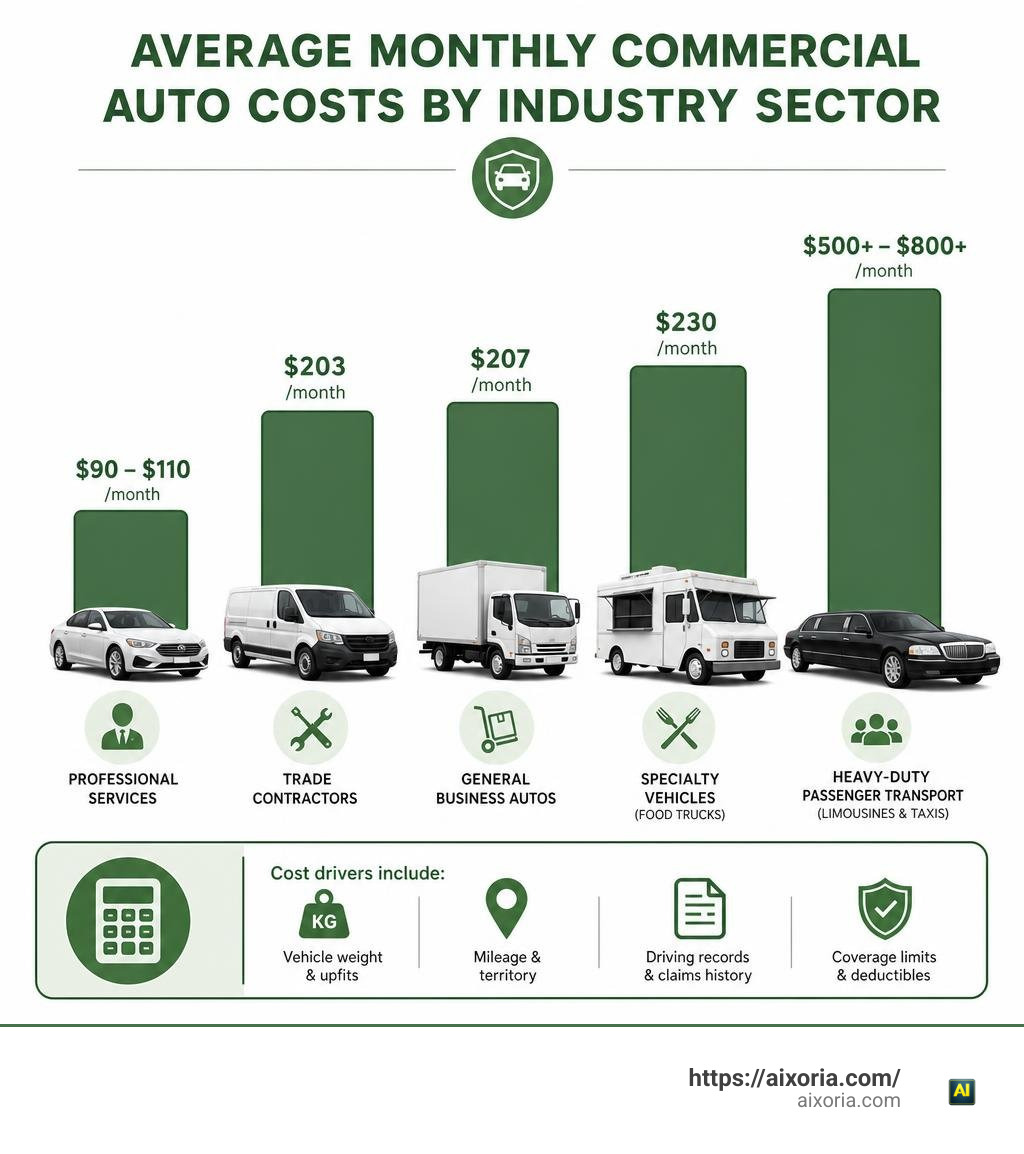
- Low-Risk Professional Services: Business consultants, marketers, and real estate professionals operating passenger sedans pay median premiums around $90 to $110 per month.
- Trade Contractors: Electricians, plumbers, and HVAC professionals operating service vans pay median costs around $203 per month, with averages around $260 per month.
- General Business Autos: Delivery services, caterers, and retail shops pay median costs around $207 per month, with averages around $276 per month.
- Specialty Vehicles: Food trucks average approximately $230 per month, while heavy-duty passenger transport like limousines and taxis can range from $500 to over $800 per month.
Key Factors Influencing Insurance Costs
Insurance underwriters calculate commercial auto premiums by evaluating several distinct variables:
- Vehicle Weight Class & Upfits: Heavier vehicles cause more damage during collisions. A Class 4 box truck incurs higher liability rates than a Class 1 passenger sedan.
- Geographic Location & Operating Radius: Driving in densely populated urban centers with high litigation rates and heavy traffic increases costs compared to operating in rural areas. Regional weather risks, such as hurricane exposure in Florida, also elevate base rates.
- Driver Motor Vehicle Records (MVRs): Driver history is a crucial factor. Accidents, speeding tickets, or DUI convictions on an employee's driving record will directly raise policy premiums.
- ISO Covered-Auto Symbols: Insurance Services Office (ISO) symbols declared on the policy, ranging from Symbol 1 'Any Auto' to Symbol 7 'Specifically Described Autos,' establish exact coverage parameters and affect baseline pricing.
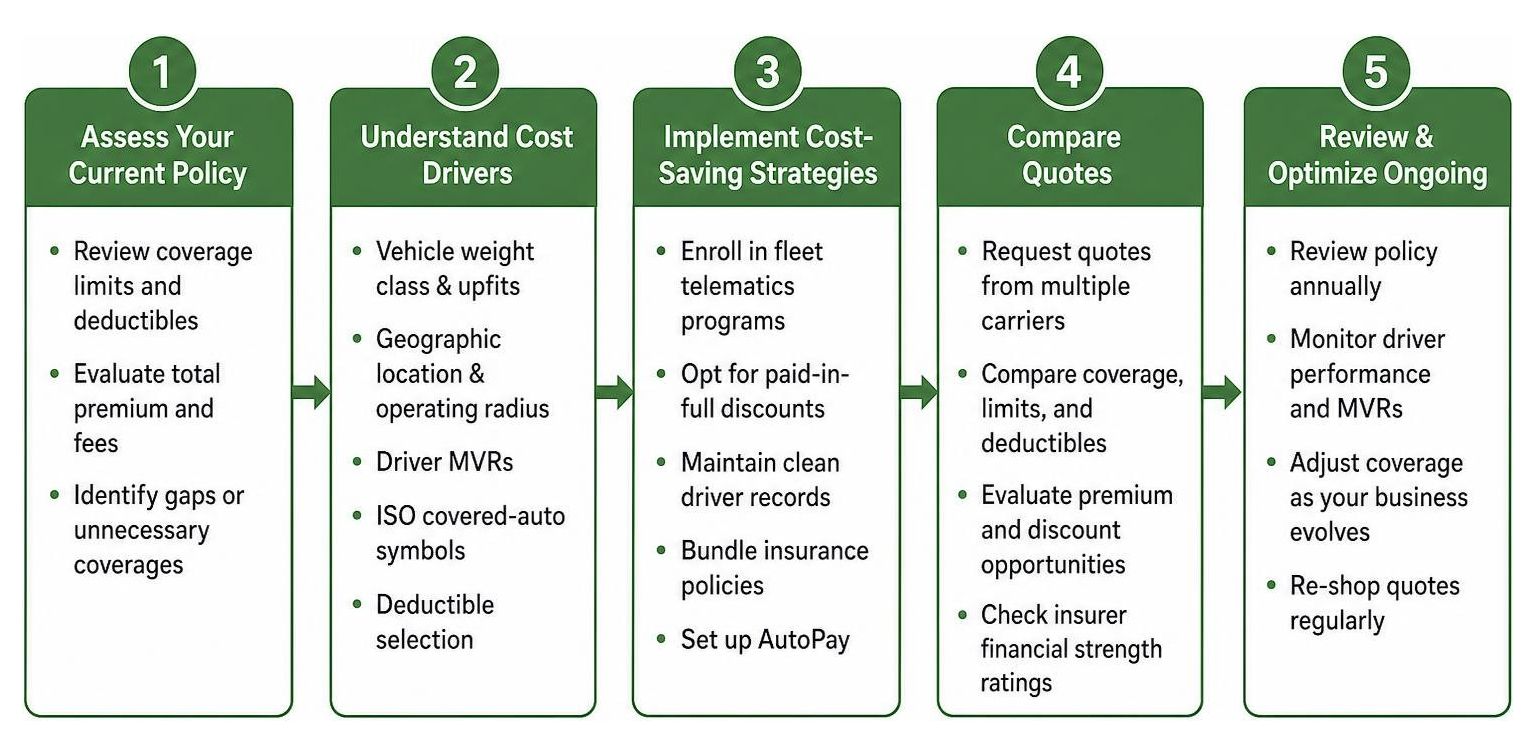
- Deductible Selection: Choosing higher deductibles, such as $1,000 or $2,500 instead of $500, lowers monthly premiums, provided our business maintains adequate cash reserves to handle out-of-pocket expenses during a claim.
Practical Ways to Save on Business Auto Policies
Small businesses can take proactive steps to reduce commercial auto insurance expenses without sacrificing essential protections:
- Enroll in Fleet Telematics Programs: Installing approved telematics devices or using carrier-supported mobile tracking tools can measure driving habits such as sudden braking, cornering speed, handling, and mileage, often helping safe-driving fleets qualify for discounts.
- Opt for Paid-in-Full Discounts: Paying annual premiums upfront eliminates monthly administrative fees and may secure upfront paid-in-full savings.
- Maintain Clean Driver Records: Vetting employee driving histories prior to hiring and conducting annual MVR audits ensures only low-risk drivers operate company vehicles.
- Bundle Insurance Policies: Combining commercial auto coverage with a Business Owner's Policy (BOP), General Liability, or Workers' Compensation under a single carrier can yield substantial multi-policy discounts.
- Set Up AutoPay: Scheduling automatic monthly payments lowers processing surcharges.
Choosing the Best Commercial Auto Insurance for Small Business
To select the best commercial auto insurance for small business, we must evaluate carrier reliability, financial backing, servicing speed, and claims performance rather than relying solely on price.
When assessing insurance carriers, financial strength ratings from independent agencies like AM Best are crucial. Choosing carriers rated "A" (Excellent), "A+" (Superior), or "A++" (Superior) ensures the company has the financial strength to pay out large claims during economic downturns or major loss events.
Speed of service is another critical factor for contractors and service providers. Many client contracts require a Certificate of Insurance (COI) listing specific liability limits and adding the client as an "Additional Insured" before work can begin. Providers offering 24/7 digital portals or mobile apps that issue instant COIs in under 10 minutes prevent costly project delays.
Essential Features of the Best Commercial Auto Insurance for Small Business
When comparing commercial quotes, we should verify that policies include essential feature enhancements:
- Hired and Non-Owned Auto (HNOA) Endorsement: Protects our enterprise whenever employees run business errands in personal cars or drive rental vehicles.
- Specialized Upfit & Equipment Coverage: Ensures ladder racks, custom tool shelving, refrigeration units, and permanent alterations are fully valued in total loss calculations.
- Contractual Liability & Additional Insured Endorsements: Grants the flexibility to adjust policy limits to meet specific commercial contract demands.
- Flexible Fleet Management: Easily add or remove vehicles and drivers as our business grows or adjusts seasonal staff.
Steps to Secure the Best Commercial Auto Insurance for Small Business
Securing optimal commercial auto coverage involves a systematic approach:
- Conduct a Business Fleet Audit: Inventory all company vehicles, personal vehicles used for business tasks, driver names, vehicle Identification Numbers (VINs), upfits, and primary operating radiuses.
- Check Employee Motor Vehicle Records: Pull driver history records for every employee who will operate company vehicles to identify potential risk red flags before getting quotes.
- Determine Necessary Liability Limits: While state laws mandate basic minimums, modern commercial standards recommend carrying at least $1,000,000 CSL liability to protect business assets against catastrophic claims.
- Gather Comparative Quotes: Request quotes from top-tier carriers, comparing coverage symbols, physical damage deductibles, telematics options, and bundling discounts.
- Adjust Endorsements Annually: Review policy terms annually to adjust vehicle valuations, eliminate sold vehicles, and update driver lists.
Frequently Asked Questions About Commercial Auto Insurance
Is commercial auto insurance required by law for small business vehicles?
Yes, commercial auto insurance is required by law in almost every state if a vehicle is registered to a business or driven for commercial purposes. Personal auto insurance policies cannot fulfill state mandatory insurance requirements when vehicles are used for business activities.
State legal minimums typically require basic bodily injury and property damage liability protection (for example, Florida mandates a minimum of $10,000 Personal Injury Protection and $10,000 Property Damage Liability). However, state minimum limits are rarely enough to protect a business from severe accident lawsuits. Carrying a $1,000,000 Combined Single Limit (CSL) policy is the standard commercial best practice to ensure complete asset protection. Furthermore, vehicles operating interstate with a Gross Vehicle Weight Rating (GVWR) exceeding 10,001 pounds must register for a USDOT number and satisfy Federal Motor Carrier Safety Administration (FMCSA) mandatory minimums starting at $750,000.
Are tools and equipment stored inside a business vehicle automatically covered?
No, tools, test instruments, and materials stored inside a commercial vehicle are not automatically covered under a standard commercial auto policy. Commercial auto insurance covers the physical frame of the vehicle and any permanently attached equipment (such as welded tool racks or bolted ladder mounts).
Unattached, loose tools and client inventory in transit are excluded from standard physical damage protection. To safeguard loose tools against theft or accidental loss, you must purchase an inland marine endorsement (equipment floater) added to your General Liability or Commercial Auto policy.
Can commercial auto insurance be bundled with other business policies?
Yes, bundling commercial auto insurance with other core business policies is one of the most effective ways to lower overall insurance expenses. Carriers frequently offer substantial multi-policy discounts when you combine commercial auto coverage with a Business Owner's Policy (BOP), General Liability, or Workers' Compensation.
Bundling simplifies administration by centralizing policy management under a single carrier portal, aligning renewal dates, and eliminating coverage gaps between general liability risks and commercial vehicle activities.
Conclusion
Finding the best commercial auto insurance for small business success requires balancing robust coverage limits, specialized upfit protections, driver safety programs, and competitive premiums. Relying on personal auto insurance for business operations creates severe financial vulnerability that can jeopardize company assets after a single accident.
By assessing driver histories, selecting appropriate coverage symbols, utilizing telematics discounts, and partnering with financially solid carriers, we can establish a resilient auto policy that protects our vehicles, employees, and bottom line. As your operational footprint expands, leveraging modern business tools and automated management systems helps streamline risk tracking, administrative workflows, and overall company efficiency. Explore top AI productivity solutions for business management to optimize your business operations while protecting your assets on the road.
Sponsored by MCMPDL
Click and wait 10 seconds