AI Tools for Farmers in the USA for Crop and Weather Planning
Scr0ll d0wn to D0VVNL0AD
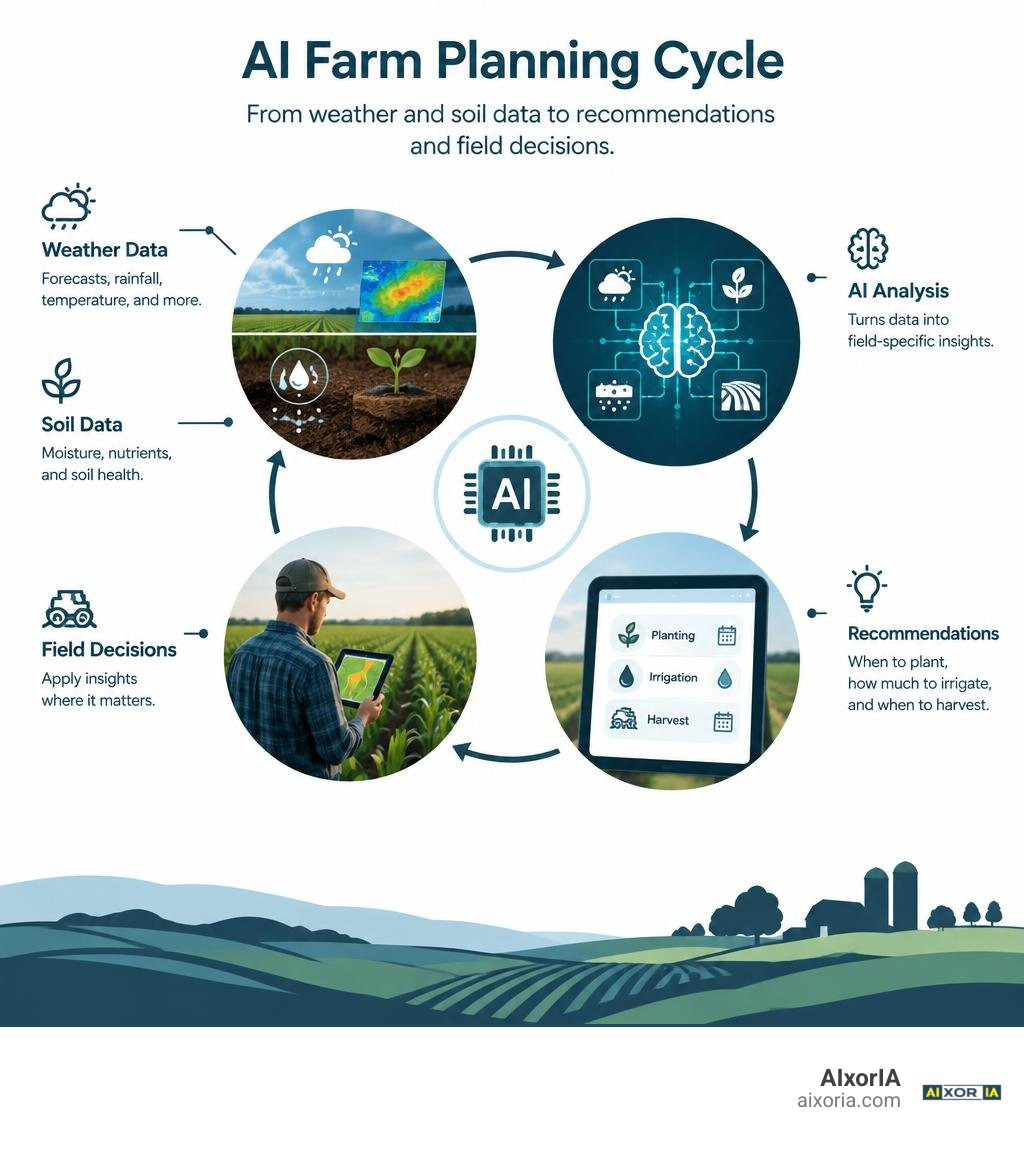
AI tools for farmers in the USA for crop and weather planning turn forecasts, soil readings, and field records into practical choices: when to plant, how much to irrigate, and when to harvest. For a small or mid-size farm, the best place to start is one costly decision. Pair a local weather forecast with soil-moisture data for irrigation, or use past yields and soil conditions to compare planting options.
These tools can help reduce wasted inputs and make weather risks easier to spot. But a forecast is still a forecast. Check recommendations against what you see in the field before acting.
Core Capabilities of AI Tools for Farmers in USA for Crop and Weather Planning
Modern agriculture in the United States requires managing vast streams of data, from hyper-local barometric pressure shifts to shifting soil nutrient profiles across hundreds of acres. Advanced machine learning models now process these variables simultaneously, transforming raw environmental data into precise operational plans.
Rather than relying purely on broad regional weather forecasts that miss localized microclimates, agricultural intelligence platforms leverage deep learning networks trained on decades of atmospheric physics alongside real-time satellite updates. AI-based meteorological engines match or exceed operational physics-based numerical models at a small fraction of the computing expense. This efficiency makes field-level forecasting accessible directly on mobile devices and cab monitors.
These systems routinely ingest high-resolution Sentinel-2 multispectral satellite imagery, which updates roughly every five days at a ten-meter resolution. When combined with ground-level IoT moisture probes and historical climate patterns, machine learning algorithms calculate accurate evapotranspiration rates and soil health indexes. Growers who implement crop management software can connect live weather metrics, NDVI field mapping, and storage monitoring into one operational hub, avoiding fragmented spreadsheets.
Deploying advanced data analysis and visualization platforms allows producers to spot spatial yield trends across distinct field zones, turning unstructured sensor logs into clear, actionable dashboards. Federal research highlighted in studies on advancing farming with cutting-edge technologies underscores that combining low-cost sensors with advanced predictive modeling gives growers the upper hand against climatic uncertainty.
How AI Tools for Farmers in USA for Crop and Weather Planning Transform Irrigation Scheduling
Water management remains one of the largest operating expenses and yield-determining factors for American growers, particularly in arid Western regions and throughout the Midwest Corn Belt during late-summer dry spells. Traditional irrigation often relies on fixed calendar schedules or basic soil probes that fail to account for upcoming atmospheric demand.
AI-powered irrigation models solve this by calculating dynamic Crop Water Stress Index (CWSI) values and reference evapotranspiration (FAO-56 ET0 coefficients) in real time. Machine learning algorithms ingest continuous data feeds from:
- In-field capacitance moisture probes across various root depths
- Near-surface relative humidity and ambient temperature sensors
- Projected solar radiation and wind speed forecasts over the next 72 hours
- Crop canopy temperature captured by thermal imaging sensors
By evaluating this multi-stream data, the software calculates precisely how much water the crop will lose to the atmosphere and consume over the coming days. Instead of flooding or running center pivots uniformly, variable-rate irrigation systems apply water only to zones experiencing physiological moisture deficits. Studies show that AI-assisted smart irrigation schedules reduce on-farm water consumption by 20% to 30% while preserving grape quality in vineyards and protecting test weights in row crops.
Predictive Crop Selection and Planting Window Optimization
Selecting the right hybrid seed and timing the planter pass can define an entire season’s profitability. Planting too early into cold, wet soils risks seed rot and uneven emergence; planting too late cuts into crucial Growing Degree Days (GDD) and exposes flowering stages to mid-summer heatwaves.
Generative AI models and predictive agronomy platforms analyze historical yield data, soil drainage characteristics, and long-range seasonal climate forecasts to rank seed performance under simulated scenarios. By modeling virtual crop rotations, the software evaluates how a corn-after-soybean rotation compares to continuous corn under drought, moderate rain, or high-pest conditions without risking actual capital in the field.
These algorithms compute soil temperature warming trajectories and frost probabilities across 10-to-14-day horizons, identifying narrow, optimal planting windows that maximize emergence uniformity and reduce early-season yield drag.
Integrating AI with On-Farm Hardware, Sensors, and Precision Machinery
Modern agricultural machinery produces an enormous volume of operational telemetry. From seed-metering sensors and downforce actuators to real-time yield monitors, tractors and combines generate millions of data points every pass.
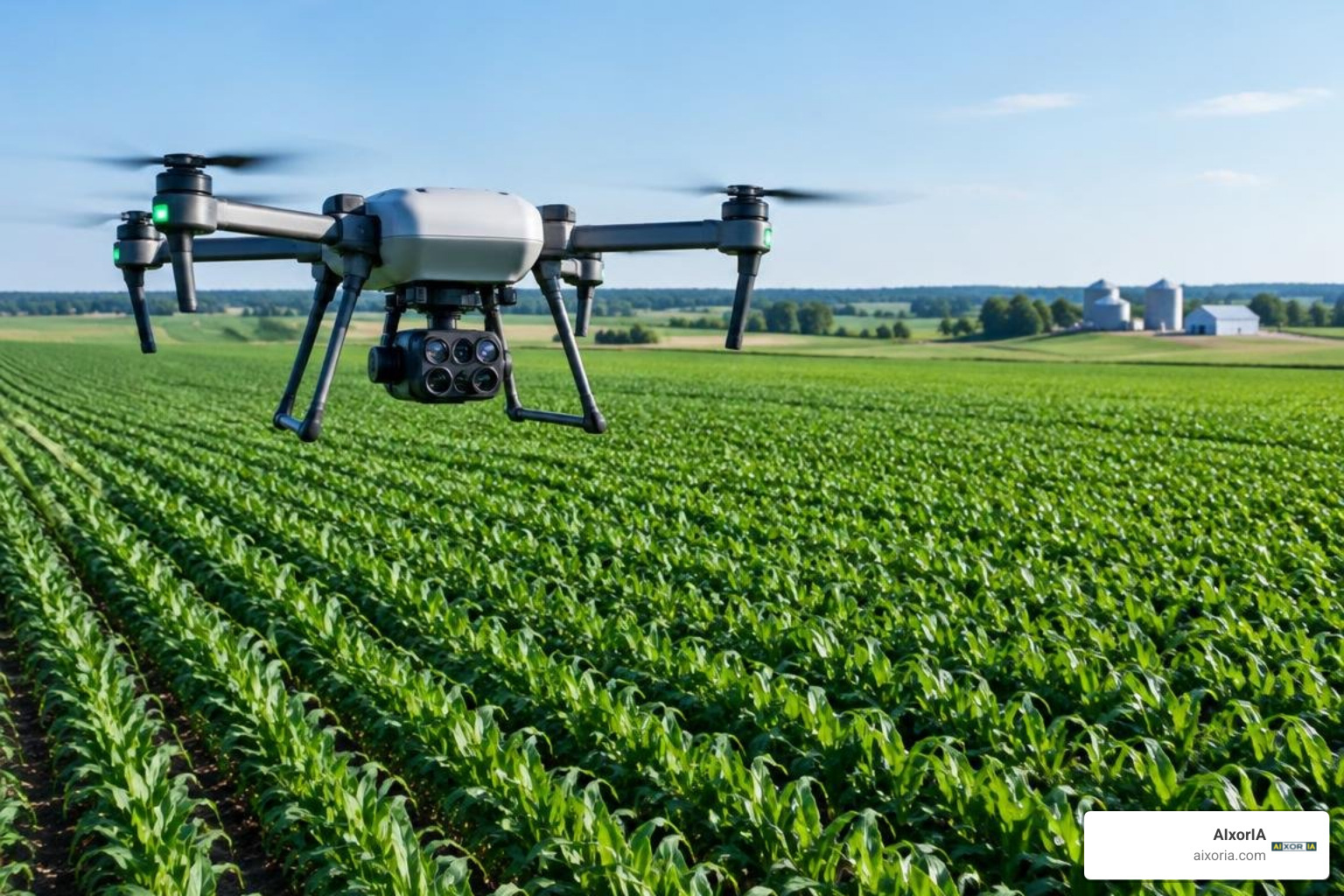
AI bridges the gap between field hardware and decision-making by linking equipment interfaces with cloud analytics. Systems connecting into major equipment telematics networks automatically ingest planting densities, as-applied fertilizer rates, and harvest moisture data.
Applying dedicated AI tools for operational productivity simplifies administrative workflows by turning raw tractor logs into instant field logs, inventory updates, and cost analyses. Modern field command and monitoring platforms consolidate satellite indices, radar-derived precipitation, and equipment files, giving crews clear, synchronized work orders directly on mobile devices.
| Feature / Metric | Traditional Precision Agriculture (1990s–2010s) | AI-Augmented Farming Systems (2026) |
|---|---|---|
| Data Processing | Manual export via USB drives; static spreadsheet analysis | Automated wireless telemetry streaming and real-time cloud parsing |
| Weather Forecasting | Broad regional radar and county-level static forecasts | Microclimate predictive AI modeling with field-level hyper-local updates |
| Scouting & Disease ID | Manual field walking; visual inspection across select rows | Multispectral drone imagery and computer vision diagnosis in under 5 seconds |
| Irrigation Control | Fixed calendar timers or manual soil-probe readings | Automated ET0-based variable-rate prescriptions linked to live weather |
| Application Prescriptions | Uniform field rates or basic grid-sample prescription maps | Real-time computer vision spot-spraying and dynamic nutrient adjustments |
| Interface & Usability | Complex, multi-layered GIS mapping dashboards | Natural-language voice and text assistants providing direct recommendations |
Computer Vision for Real-Time Pest and Disease Detection
Visual scouting across thousands of acres has historically been a significant labor bottleneck. Today, computer vision models deployed on drones, smartphone apps, and smart boom sprayers identify agronomic threats long before they cause widespread economic loss.
When scouting fields, farmers can capture photos of unknown weeds or discolored leaves. Conversational virtual assistants analyze the images against vast agronomic databases, identifying specific weed species or fungal lesions in seconds and recommending targeted chemical treatments.
Multispectral drone flights process Normalized Difference Vegetation Index (NDVI) and red-edge bands to flag localized fungal outbreaks up to three days earlier than standard visual scouting. Smart sprayers equipped with edge-AI cameras detect individual weeds among crop rows, activating targeted nozzles to apply herbicides exclusively to the target plant. This targeted approach reduces chemical application volumes and lowers chemical costs across row-crop operations.
Government Initiatives, Data Governance, and Climate Adaptation
Federal agencies increasingly recognize artificial intelligence as essential to the stability of the American food supply chain. The United States Department of Agriculture (USDA) formalizes this support within its FY 2025–2026 AI Strategy, prioritizing farmer-centered tools that strengthen economic resilience and improve resource efficiency.
Through the Agricultural Research Service (ARS), federal initiatives focus on accelerating genetic gain in staple crops. By applying machine learning models to analyze genomic data alongside field-trial performance, ARS researchers develop oat and grain varieties with enhanced drought resistance, higher nutritional density, and improved disease tolerance.
Concurrently, National Science Foundation (NSF) programs—such as the AI4Ag Testbed and the Internet of Things for Agriculture (IoT4Ag)—support the development of predictive digital plant twins and cost-effective sensor networks designed for real-world farm conditions.
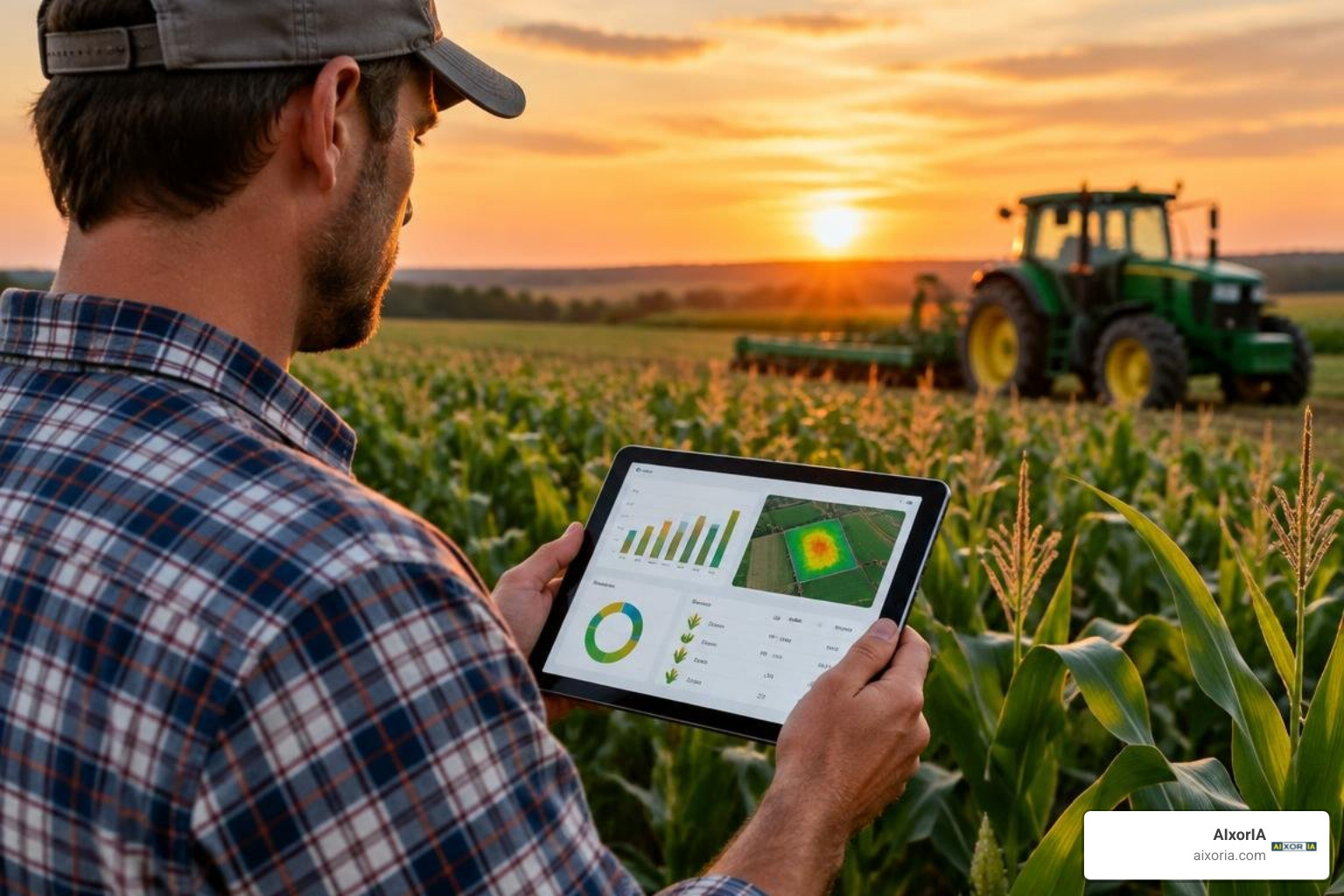
As farms generate increasing amounts of proprietary data, data governance and digital privacy have become top priorities for producers. American growers must maintain clear ownership over their field records, yield maps, and financial books. Leading agricultural platforms now implement bank-level data encryption and append-only historical audit logs.
Modern platforms allow farmers to export data directly to accounting systems like QuickBooks or farm credit lenders while ensuring that third-party vendors cannot monetize private field analytics without explicit consent.
Extreme Weather Mitigation and Space Weather Resilience
Climate volatility presents major risks to modern agricultural production. Unexpected flash droughts, unseasonal freezes, and intense rainfall events can quickly disrupt seasonal farm budgets.
AI-powered meteorological systems help growers mitigate these risks through proactive alerts:
- Frost and Freeze Protection: Real-time canopy sensors and predictive thermal algorithms issue advance alerts, giving fruit and specialty crop growers time to run wind machines or activate frost-protection sprinklers.
- Flash Flood & Drainage Planning: Ingesting radar rainfall data and elevation contours helps identify pooling zones, allowing operators to clear drainage paths or construct field diversions before major storms hit.
- Severe Weather Contingency: Machine learning models track localized storm paths, guiding decisions to speed up harvest windows or secure equipment before high winds or hail cause structural damage.
- Space Weather & GPS Mitigation: Modern precision agriculture depends heavily on Real-Time Kinematic (RTK) GPS for auto-steer navigation. Severe geomagnetic solar storms can disrupt satellite signals, as occurred during notable atmospheric events that led to multi-million-dollar equipment stoppages across the Corn Belt. Predictive space weather monitoring built into farm AI platforms alerts operators to incoming ionospheric disturbances, preventing dangerous implement drift and costly planting errors.
Economic Impact and Cost-Benefit Analysis for American Growers
Adopting AI-driven farm management is fundamentally a financial decision. With high land rents, elevated machinery prices, and variable commodity markets, growers must protect operating margins on every acre.
By evaluating field records and cash bids, grain marketing tools help producers calculate break-even yields, evaluate the return on rented acreage, and identify the most profitable local delivery windows. Instead of juggling multiple disconnected applications, comprehensive software platforms help reduce unnecessary overhead costs.
Utilizing resources from categorized enterprise AI solutions assists farm managers in choosing specialized software for logistics, field recordkeeping, and operational finance. Furthermore, conversational agronomy systems allow Midwest growers to ask practical questions about spray windows, fertilizer rates, and equipment setup in plain language, reducing costly input mistakes.
Evaluating AI Tools for Farmers in USA for Crop and Weather Planning for Small and Medium Farms
Small and medium-sized family farms—frequently operating between 200 and 1,000 acres—face distinct capital constraints compared to massive agricultural enterprises. Fortunately, the shift toward software-as-a-service (SaaS) business models has significantly lowered the financial barrier to entry.
Growers can deploy powerful AI platforms without large capital investments in new machinery. Multi-tier platforms offer entry-level plans starting at modest monthly rates, giving smaller producers access to automated Sentinel-2 field health monitoring and ET0 irrigation schedules without proprietary hardware locks.
For example, on a 500-acre corn operation:
- A conservative 2% yield improvement on 200-bushel-per-acre corn at $4.50/bushel generates $18.00 per acre in additional revenue.
- Optimizing nitrogen timing and spot-spraying weed patches saves an estimated $8.00 per acre in input costs.
- Total gross financial benefit equals $26.00 per acre, or $13,000 across the farm.
- Subtracting an annual software subscription cost of $800 to $1,200 leaves a substantial net return on investment in the very first growing season.
Furthermore, many AI tools operate with offline functionality or lightweight mobile sync modes, ensuring reliable performance even in rural areas with limited broadband access.
Frequently Asked Questions About Farm AI Planning Tools
How do AI weather forecasts outperform traditional meteorological models for agriculture?
Traditional numerical weather prediction models simulate atmospheric dynamics by solving complex fluid thermodynamic equations across large spatial grids. These calculations require immense supercomputing infrastructure, which limits how frequently forecasts can update and often smooths over localized microclimates.
In contrast, agricultural AI weather models use deep neural networks trained on decades of historical weather station data, radar feeds, and satellite observations. Once trained, these models run in seconds on standard servers while matching or exceeding the accuracy of physics-based models.
By integrating localized on-farm weather stations, elevation topographies, and canopy sensors, AI generates reliable, hyper-local forecasts tailored to specific field boundaries, providing accurate precipitation timings and wind-speed windows for spraying.
What are the biggest data privacy concerns when uploading farm records to AI platforms?
The primary concern among growers is data sovereignty—specifically, ensuring that proprietary yield maps, input rates, and financial books are not shared with third-party chemical manufacturers, grain traders, or competing entities. If aggregated yield data were accessible to outside market speculators, it could negatively impact local grain basis pricing and cash contracts.
To address this, modern platforms use bank-level data encryption, append-only historical databases, and transparent terms of service that affirm complete farmer data ownership. Before selecting an AI tool, growers should verify that the software provider does not sell anonymized farm data and allows full data export or deletion at any time.
Can small farms justify the investment in AI crop planning software?
Yes. Small farms often experience the fastest return on investment because their operating margins are particularly sensitive to input waste and crop loss. Because modern AI tools are predominantly software-based and operate on existing smartphones, tablets, and desktop computers, they require minimal upfront capital.
A small farm saving 10% on fertilizer applications or preventing a single fungal outbreak through early satellite and drone detection easily covers the modest annual cost of an entry-level software subscription.
Conclusion
Artificial intelligence in agriculture is not about replacing the farmer’s hard-earned experience or intuition; it is about providing clear, data-driven insights in an increasingly volatile climate. By turning complex weather models, satellite scans, and soil metrics into timely field actions, modern AI planning tools help growers optimize inputs, protect yields, and improve profitability across every acre.
At AIxorIA, we curate practical guides, software walkthroughs, and performance strategies to help modern businesses thrive with artificial intelligence. To discover more ways machine intelligence can streamline your operational workflows and boost productivity, explore our comprehensive collection of curated AI business tools at AIxorIA.
1 thought on “Best AI Tools for Farmers in the USA for Crop Planning”