Why AI Tools Matter in Mechanical Engineering Simulation and Design
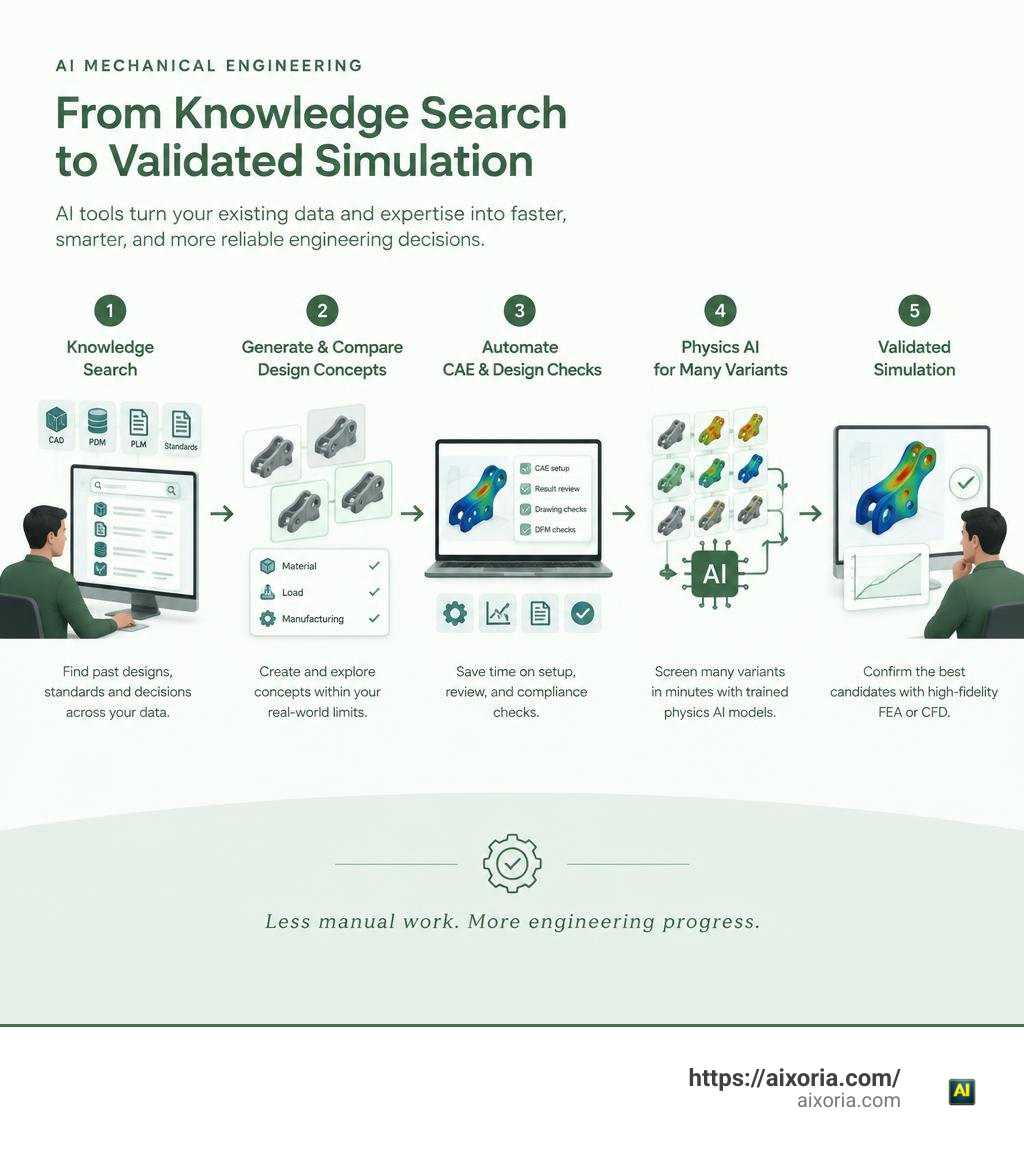
AI tools for mechanical engineering are most useful when they remove repeat work, not when they try to replace engineering judgment. Teams can use them today to:
- Find past designs, standards, and design decisions across CAD, PDM, and PLM records.
- Generate and compare early design concepts within material, load, and manufacturing limits.
- Automate parts of CAE setup, result review, drawing checks, and DFM checks.
- Use trained Physics AI models to screen many design variants in minutes, then confirm the best candidates with high-fidelity FEA or CFD.
This matters because the largest delays are often not in solving the physics. They are in finding the right information, preparing models, setting boundary conditions, and waiting for repeated simulation runs. In a 2026 survey, 87% of engineering leaders said finding information to support one design decision can take hours or days.
AI can reduce those delays, but it is not a shortcut around validation. A surrogate model is fast only within the range of data it has learned from. AI-generated geometry still needs engineering review for loads, tolerances, safety, manufacturability, and standards compliance.
The practical path is to add AI around the CAD, CAE, and PLM tools your team already uses. Start with one bounded workflow, measure the result, keep source data and decisions traceable, and retain human sign-off for production decisions.
Landscape of AI Tools for Mechanical Engineering Practical Applications in Simulation and Design
The mechanical engineering software ecosystem is undergoing a fundamental structural transition. Industry leadership recognizes this shift: 95% of engineering leaders now view AI adoption as essential over the next two years, with nearly half viewing it as critical to business survival. Despite this urgency, only 3% of hardware engineering organizations report achieving deep operational gains from their current implementations.
This performance gap exists because general-purpose language models cannot interpret spatial constraints, geometric dimensioning, or non-linear multi-physics behavior on their own. High-performing engineering teams bridge this divide by deploying specialized intelligence layers across their digital thread. These platforms index proprietary PDM archives, enterprise PLM metadata, and technical industry standards.
By grounding machine learning models in verified engineering records, teams can bypass manual data retrieval and connect their product design pipelines with advanced AI tools for industrial engineering.
Core Categories of AI Tools for Mechanical Engineering Practical Applications in Simulation and Design
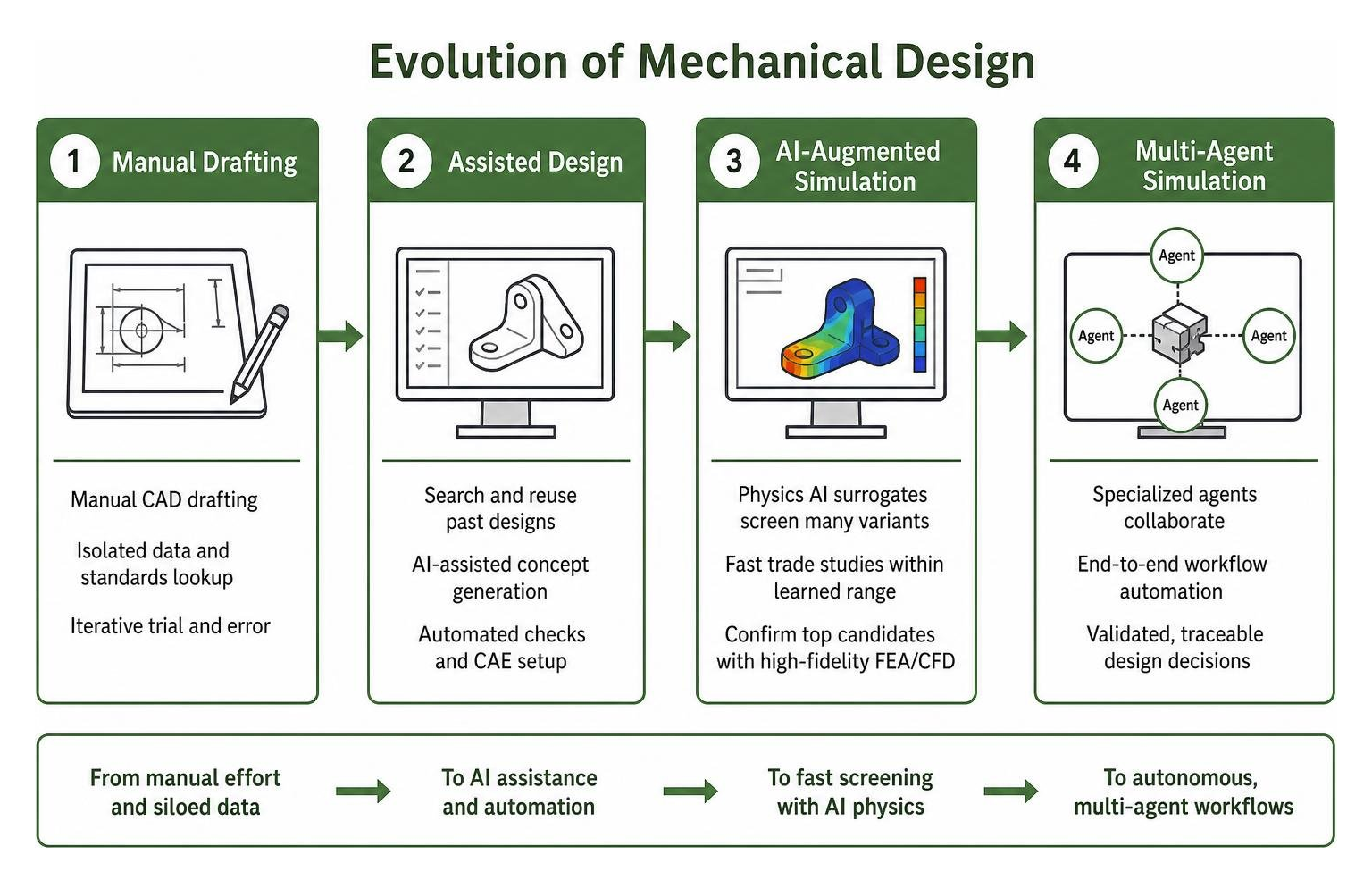
Practical applications of artificial intelligence span the entire product development lifecycle, addressing specific bottlenecks in mechanical design and simulation:
- Engineering Knowledge and Retrieval Engines: Systems trained on historical design justifications, past failure analyses, and internal standards (such as platforms indexed on over 1 million engineering documents) that instantly surface relevant precedents with full source traceability.
- Generative Design and Parametric CAD Generators: Algorithms that synthesize optimized structural topologies from load cases, material envelopes, and manufacturing constraints. General Motors demonstrated this by consolidating an eight-part seat bracket assembly into a single component that is 40% lighter while meeting all durability requirements.
- Physics AI and Neural Surrogate Solvers: Deep learning models that predict mechanical stress distributions, thermal gradients, and pressure drops in milliseconds, bypassing the need for repeated mesh generation.
- Automated Design Verification and DFM Checkers: Vision models and rule engines that validate 3D CAD geometry against GD&T standards (ASME Y14.5atile, ISO 14405) and manufacturability constraints before tooling release.
- Agentic Simulation Orchestrators: Goal-driven AI assistants that interpret design requirements, automate preprocessing routines, coordinate solver execution, and document simulation decisions for auditability.
Understanding the distinctions between these specialized tool classes allows teams to match the right machine learning technology to specific engineering constraints:
| AI Tool Category | Core Underlying Technology | Primary Engineering Bottleneck Solved | Typical Workflow Integration Layer |
|---|---|---|---|
| Engineering Knowledge Search | Retrieval-Augmented Generation (RAG) & LLMs | 87% delay in locating past design decisions and standards | Enterprise PLM / PDM Search Layer |
| Generative CAD & Topology | Density-based topology optimization & generative networks | Blank-page ideation and structural lightweighting | Native CAD Modeling Environment |
| Physics AI Surrogates | Deep neural operators, transformers, and PINNs | Iterative solver computation time during trade studies | CAE Pre/Post-Processing Platforms |
| Design Review & DFM | Computer vision and deterministic rule parsers | Manual drawing review and manufacturability validation | Quality Review Gate |
| Agentic CAE Orchestration | Goal-driven AI assistants with tool-use APIs | Repetitive manual meshing, setup, and solver coordination | Simulation Pipeline / MCP Integration |
Overcoming the Legacy Software Bottleneck in Mechanical Engineering
The primary reason only a small fraction of hardware engineering teams achieve measurable gains is the rigidity of legacy engineering software. Decades-old CAD kernels, siloed on-premises PDM vaults, and proprietary file formats create friction that prevents seamless AI integration.
Modern implementations avoid high-risk migrations by layering AI capabilities non-invasively around existing toolsets. Engineering teams maintain their primary CAD environments while AI assistants access geometry through open REST APIs and middleware connectors. This approach preserves established PLM workflows, drawing associations, and revision histories while enabling AI-driven design exploration, automated rule checking, and simulation acceleration. The key is non-destructive integration that writes validated geometry back to the CAD environment without breaking downstream dependencies or revision control.
Physics AI Surrogates and Neural Solvers vs. Traditional FEA and CFD
Traditional numerical simulation relies on discretizing continuous domain equations into millions of discrete elements or finite volumes. While Finite Element Analysis (FEA) and Computational Fluid Dynamics (CFD) offer unmatched mathematical precision, their computational cost makes large-scale parameter sweeps impractical during conceptual design.
Physics AI surrogates solve this throughput challenge. By training deep neural networks on historical high-fidelity simulation runs, surrogates learn the non-linear mappings between input geometries, boundary conditions, and spatial field outputs.
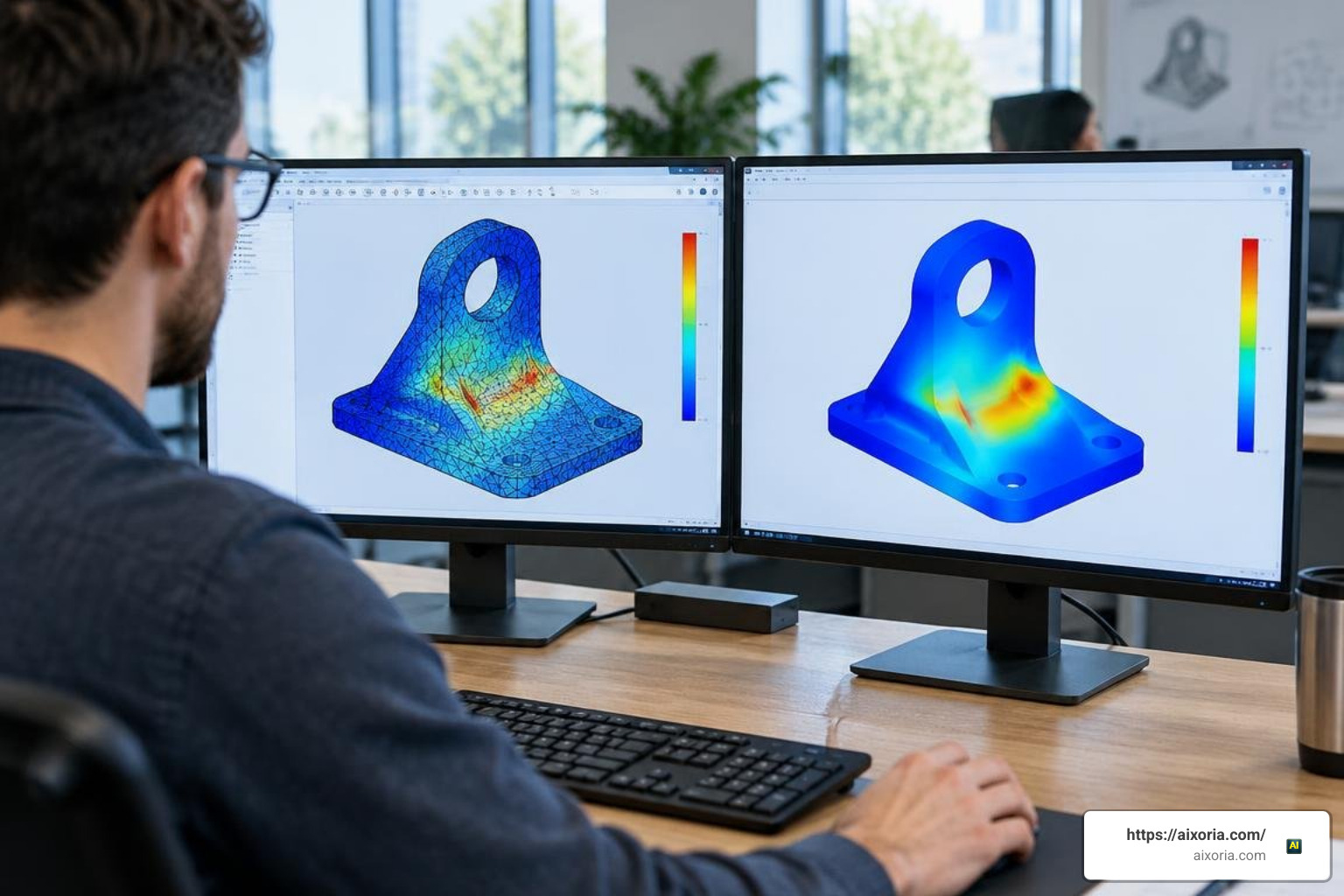
Once trained, these models execute inference in milliseconds. For example, industrial equipment manufacturer Convion (part of HD Hyundai) leveraged cloud-based surrogate modeling to reduce optimization cycles for a complex hydrogen ejector pump from months to under an hour.
Comparing Computational Speed and Engineering Accuracy
Deploying Physics AI effectively requires balancing speed advantages against validation constraints:
| Metric / Parameter | Traditional High-Fidelity FEA / CFD | Physics AI Surrogate Models |
|---|---|---|
| Inference / Solution Speed | Hours to days per iteration | Milliseconds to seconds |
| Preprocessing & Meshing | Manual, highly sensitive to geometric defects | Near-instantaneous direct geometry inference |
| Prediction Accuracy | High (bounded strictly by mesh convergence) | High within training distribution (typically 95-99% of FEA) |
| Out-of-Distribution Behavior | Governed by deterministic physics laws | Unreliable; susceptible to non-physical hallucinations |
| Data Requirements | None (solves boundary value problems directly) | Requires historical dataset (30 to 100+ high-fidelity runs) |
| Uncertainty Quantification | Residual error monitoring and mesh refinement | Statistical confidence scoring per spatial node |
| Optimal Use Phase | Final design sign-off and physical certification | Broad trade-space exploration and concept screening |
Surrogate models do not replace the underlying Navier-Stokes or elasticity solvers; they distill their computational behavior. High-performing platforms feature integrated confidence scoring that alerts the engineer whenever an evaluated geometry falls outside the model’s valid parameter space, indicating when a traditional solver check is required.
Open-Source Frameworks for Physics-Informed Neural Networks
Alongside proprietary enterprise tools, open-source architectures are accelerating the adoption of physics-based machine learning. Frameworks such as Emmi-AI/noether provide modular transformer architectures designed specifically to train surrogate models on external aerodynamics and conjugate heat transfer datasets. Benchmarks on external vehicle aerodynamics demonstrate that transformer-based surrogates scaled across high-performance computing clusters achieve training speedups exceeding 20× compared to legacy baseline models.
Similarly, projects such as FENGSim/FENGSim provide GPU-accelerated numerical simulation SDKs that bridge non-linear solid mechanics and fluid solvers directly with reinforcement learning environments. These frameworks allow engineering teams to train physics-informed neural networks (PINNs) that enforce conservation of mass, momentum, and energy directly within the loss function of the machine learning model.
Practical Workflows: Integrating AI into CAD, CAE, and PLM
Achieving measurable productivity gains requires assembling a reliable, end-to-end digital toolchain. Rather than treating artificial intelligence as an isolated sandbox, modern organizations connect AI assistants directly to the engineering product lifecycle.
Engineers can draft clear system architecture diagrams to map data exchanges between CAD geometry engines, simulation surrogates, and PLM release gates.
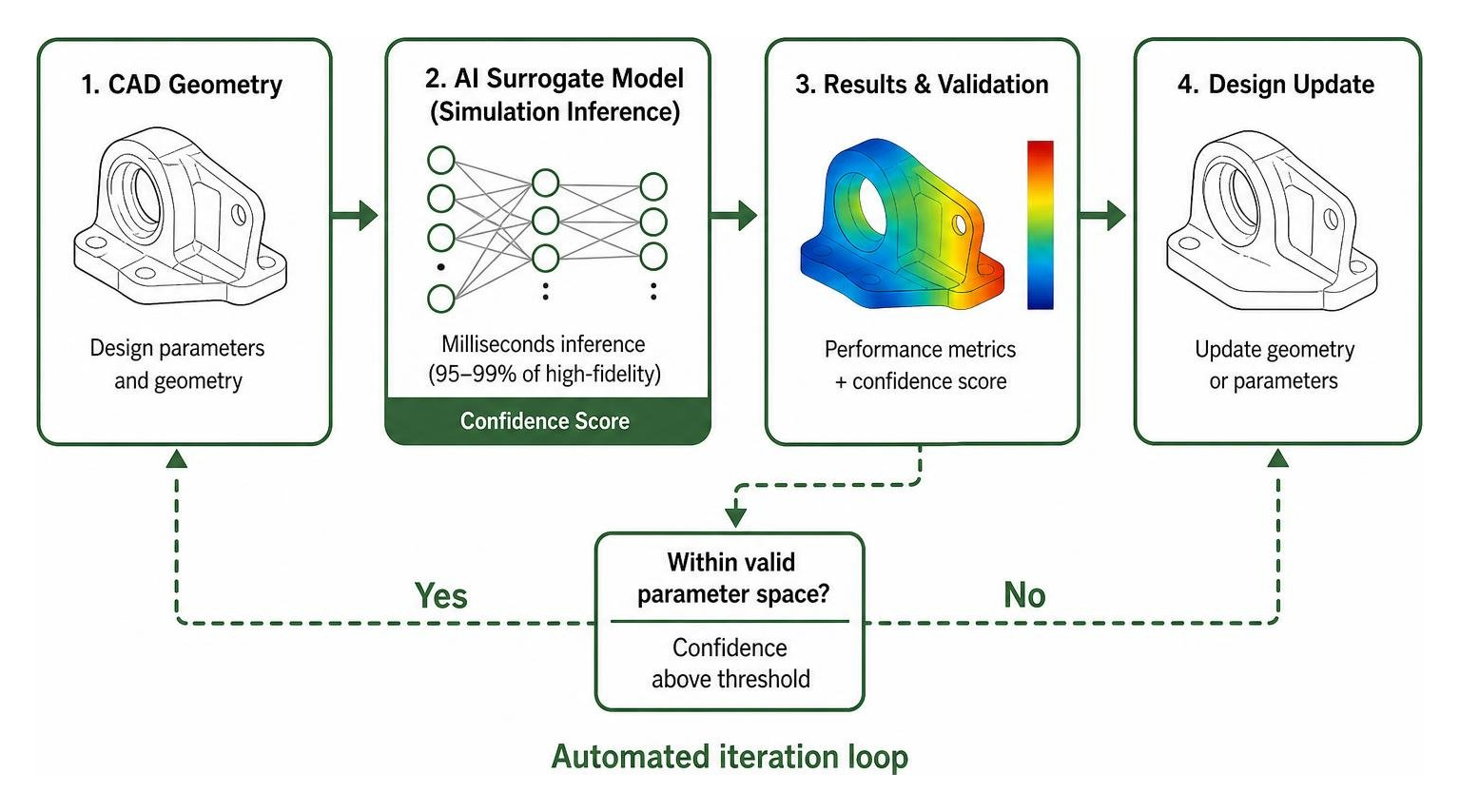
Cloud-native simulation platforms increasingly transform simulation workflows into objective-driven processes, where AI agents interpret natural-language design objectives, configure complex boundary conditions from historical simulation templates, and coordinate solver runs with full auditability.
Step-by-Step Implementation of AI Tools for Mechanical Engineering Practical Applications in Simulation and Design
Teams seeking to deploy AI tools for mechanical engineering practical applications in simulation and design should follow a structured, step-by-step roadmap:
- Curate the Knowledge Foundation: Aggregate and clean proprietary CAD repositories, past simulation archives, and internal design standards. Index this corpus within a secure retrieval-augmented generation (RAG) system to ensure all downstream design queries return fully cited, traceable documentation.
- Isolate High-Frequency Bounded Tasks: Focus initial automation on repetitive, rule-based operations—such as automated GD&T drawing validation, standard fastener selection, or baseline thermal resistance calculations—where success criteria are clearly defined.
- Deploy Physics Surrogates for Parametric Screening: Train neural surrogate models on past simulation runs for key product lines (such as heat sinks, valve manifolds, or structural brackets). Use these surrogates to screen hundreds of design iterations before running full CAE validation.
- Establish Deterministic Verification Gates: Implement deterministic critique engines that automatically check AI-generated geometry against wall-thickness rules, clearance envelopes, and manufacturing constraints.
- Enforce Verification and Validation (V&V-40) Standards: Align surrogate model evaluation protocols with ASME V&V-40 standards for computational modeling, ensuring every automated prediction contains documented confidence bounds prior to sign-off.
Engineering departments preparing entry-level personnel can accelerate this transition by introducing foundational training on AI tools for mechanical engineering students.
Multi-Agent Collaboration and Model Context Protocol
The frontier of mechanical design automation relies on multi-agent systems. Rather than relying on a single monolithic model, multi-agent frameworks use specialized autonomous agents that collaborate across discrete tasks:
- Requirements Agent: Parses Request for Quotation (RFQ) documents, extracts mechanical requirements, and defines the parameter boundaries.
- Geometry Generation Agent: Operates within a parametric CAD environment to generate editable, feature-based geometry. Dedicated CAD/CAE copilots use the open Model Context Protocol (MCP) to turn natural-language functional requirements into verifiable boundary representations (B-reps).
- Simulation Agent: Automatically meshes generated geometry, assigns material properties from curated libraries, applies boundary conditions, and executes linear-static FEA or CFD solvers.
- Review and Compliance Agent: Checks generated stress concentrations against safety factor thresholds and verifies manufacturing feasibility before notifying the lead engineer.
These agents coordinate using standardized MCP client-server protocols, ensuring every parameter modification, mesh strategy, and design iteration is logged in a reproducible audit trail.
Enterprise Governance, Data Security, and Tool Selection Criteria
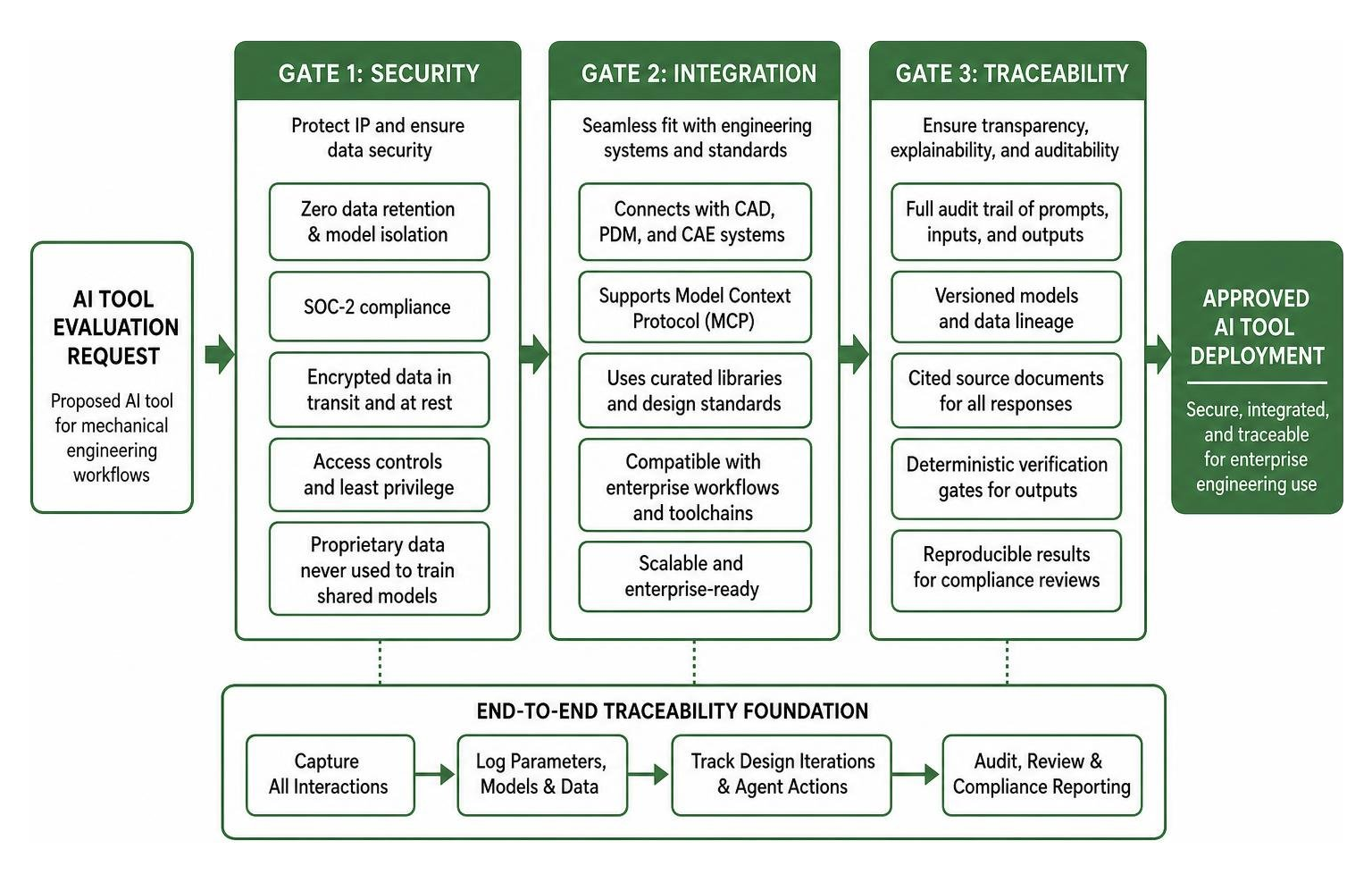
Deploying AI systems across mechanical engineering workflows introduces critical intellectual property (IP) and security considerations. CAD geometry, proprietary finite element meshes, and manufacturing tolerances represent an enterprise’s core competitive advantage. Uncontrolled ingestion of proprietary data into public foundation models creates severe data exposure risks.
Engineering leadership must evaluate tools using enterprise-grade data analysis and visualization tools to benchmark model performance, monitor data security, and track infrastructure costs.
Intellectual Property Protection and SOC-2 Compliance
Before granting any AI application access to internal CAD vaults or PDM repositories, teams must enforce strict data governance requirements:
- Zero Data Retention and Model Isolation: Ensure enterprise vendors sign contractual agreements confirming customer geometry, simulation results, and metadata are never used to train shared foundation models.
- SOC-2 Type II and ISO 27001 Certification: Verify that cloud-based simulation providers adhere to rigorous access control, data encryption (at rest and in transit), and vulnerability management protocols.
- Export Control Compliance: Organizations working on defense, aerospace, or dual-use technologies must verify that AI infrastructure complies with ITAR and EAR regulations, utilizing air-gapped or dedicated sovereign cloud deployments.
- Self-Hosted and On-Premises Options: For highly sensitive intellectual property, prioritize platforms that offer customer-hosted, on-premises, or private cloud deployment footprints (such as desktop-native neural inference engines).
Selection Framework for Deterministic vs. Open-Ended Tasks
Selecting the wrong AI architecture for an engineering task leads to project failure. Generative AI models excel at open-ended conceptual exploration and code generation, but they are inherently probabilistic. For mechanical engineering decisions where failure carries physical and financial risks, probabilistic outputs must be validated by deterministic rules.
When evaluating software vendors, verify that the AI tool provides clear traceability back to underlying CAD parameters, records all intermediate simulation decisions, and enforces mandatory human sign-off gates prior to physical prototyping or manufacturing release.
Frequently Asked Questions
Can AI surrogate models fully replace high-fidelity FEA and CFD solvers?
No. Physics AI surrogates are designed for rapid design space exploration, screening, and sensitivity analysis. They make predictions based on patterns learned from training data, which makes them fast and reliable within a defined design envelope.
However, they cannot extrapolate outside their training domain with the guaranteed physical consistency of numerical solvers. High-fidelity FEA and CFD remain essential for final design verification, structural sign-off, and regulatory certification.
How much simulation data is needed to train a reliable physics AI model?
For modern surrogate platforms evaluating parameterized component variations (such as heat sinks, structural brackets, or aerodynamic ducts), a reliable model typically requires between 30 and 100 high-fidelity simulation runs.
Transfer learning and advanced geometric deep learning architectures continue to reduce this baseline. If the structural topologies vary significantly across the design space, larger datasets and active learning pipelines are recommended to maintain high prediction confidence across the entire operational range.
How do engineers verify the accuracy and traceability of AI-generated designs?
Engineers verify AI outputs by using deterministic verification tools alongside traditional simulation pipelines. Verification includes automated geometric checks for minimum wall thickness and draft angles, tolerance stack-up analysis against ASME Y14.5 standards, and cross-validation of critical stress areas using traditional FEA solvers.
Traceability is maintained by storing every AI-generated configuration, parameter choice, and confidence metric in version-controlled packages (.aieng or PLM records), ensuring any automated decision can be audited.
Conclusion
The role of the mechanical engineer is evolving from manual model configuration to intent-driven system orchestration. As generative CAD tools, neural surrogate solvers, and agentic workflows continue to mature, engineering teams can explore broader design spaces, accelerate simulation cycles, and eliminate routine verification delays.
Success with AI adoption does not require abandoning established CAD and PLM investments. By strategically deploying AI around existing engineering ecosystems—focusing on bounded workflows, enforcing strict data governance, and maintaining rigorous validation standards—engineering organizations can achieve sustained competitive advantages.
To discover modern platforms that can streamline your engineering design and simulation operations, explore the latest curated AI tools to identify the right solutions for your technical workflows.