Compare AI SEO Tools by the Local Search Problem You Need to Solve
Scr0ll d0wn to D0VVNL0AD
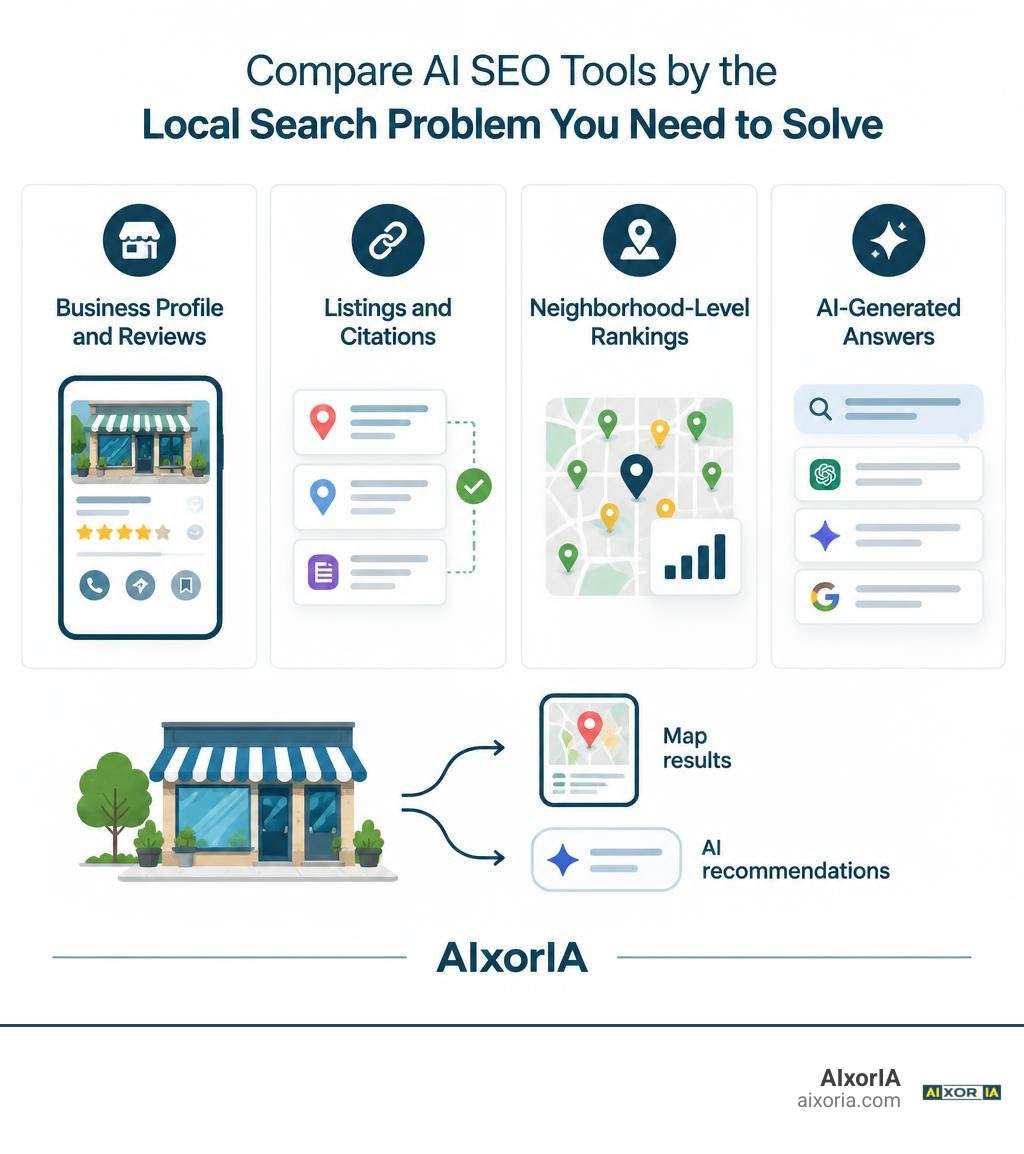
The best AI search engine optimization tools for local businesses depend on what you need to fix:
- Business profile and reviews: Try Localo for guided Google Business Profile tasks.
- Listings and citations: Compare BrightLocal and Yext for finding or correcting business details across directories.
- Neighborhood-level rankings: Use Local Falcon to see how your Google Maps visibility changes across an area.
- AI-generated answers: Look for a tool that checks whether ChatGPT, Perplexity, and Google AI Overviews mention your business for relevant local questions.
In 2026, a customer might find you in a map result or an AI recommendation. Track both, but don’t treat an AI mention as a fixed ranking: answers can change by question and location.
Core Features of AI Search Engine Optimization Tools for Local Businesses
Local search is no longer just about ranking in the traditional local 3-pack. Today, Generative Engine Optimization (GEO) ensures your storefront surfaces directly inside generative models when prospective buyers ask conversational questions like, “Where can I find an eco-friendly dry cleaner open past 7 PM near downtown?”
Understanding how AI search optimization tools increase organic traffic in 2026 requires looking at how modern algorithms extract business entities. Advanced software solutions, such as LocalGenius AI-powered local tools, combine real-time Google Business Profile (GBP) management with automated citation audits and geo-grid tracking.
When evaluating these tools, you should expect four foundational capabilities:
- Autonomous Profile Optimization: Automated audit scores that pinpoint missing categories, services, and profile attributes.
- Real-Time Citation Syncing: Instant synchronization of Name, Address, and Phone number (NAP) data across dozens of online directories.
- Geo-Grid Rank Tracking: High-resolution map scans showing your visibility score street by street.
- AI Answer Engine Grounding: Verification systems that confirm large language models (LLMs) cite your business as a primary local entity.
Selecting AI Search Engine Optimization Tools for Local Businesses on Any Budget
Whether you run a single boutique or manage a regional franchise, tool pricing must align with your operational scale. Entry-level tools typically rely on credit-based systems or flat monthly rates for single profiles, while enterprise tiers provide multi-location dashboards, automated API triggers, and deep competitor gap analysis.
For instance, platforms like AI Search Manager business directory synchronization allow small businesses to manage listings across 35+ directories and access ad-spend forecasting without hiring an agency.
| Feature / Metric | Starter / Budget Tier ($25–$80/mo) | Enterprise / Multi-Location Tier ($150–$500+/mo) |
|---|---|---|
| Location Profiles | 1 to 3 locations | Unlimited / Multi-brand dashboards |
| Citation Syncing | Core directories (Google, Apple, Bing) | 35 to 200+ global and niche directories |
| Geo-Grid Tracking | Basic 5×5 grid, monthly refresh | 13×13+ dynamic radius scans, daily/weekly refresh |
| AI Prompt Monitoring | Google AI Overviews only | Multi-LLM (ChatGPT, Perplexity, Gemini, Copilot) |
| Review Automation | AI reply drafting with manual approval | Autonomous sentiment-based auto-replies and alerts |
| Best For | Single storefronts, solo service providers | Multi-location chains, regional franchises, agencies |
Automated Citation Tracking and Schema Markup Integration
Inconsistent listings confuse both human searchers and AI crawlers. If your phone number varies across local directories, generative search engines lose confidence in your business data. Modern software platforms crawl directory networks automatically, correcting mismatched listings before they harm your entity authority.
Equally vital is structured data. AI models rely on machine-readable code to verify your operating hours, menu items, accepted payment methods, and physical coordinates. Implementing JSON-LD structured data via LocalBusiness schema gives answer engines clear, uncorrupted facts. You can explore platforms designed for structured data and entity tracking in our roundup of the 20 Best AI Search Visibility Tools in 2026.
Evaluating AI Search Visibility and Local Rank Tracking

In generative search, standard numerical rankings are fundamentally obsolete. Because LLM answers are hyper-personalized based on user location, conversational history, and device context, two users standing on opposite street corners may receive completely different recommendations.
Tools like ShiftRanks automated local marketing stack monitor your broader share of voice across multiple platforms. At the same time, we recommend checking out why choose Ziptie AI Search Performance Tool in 2026 a GEO AI visibility deep dive to understand how query intent and generative visibility intersect. Furthermore, following Google’s Guide to Optimizing for Generative AI Features on Search helps ensure your website maintains technical crawling health so search algorithms can retrieve your content seamlessly.
Tracking Brand Mentions Across ChatGPT, Perplexity, and AI Overviews
Modern customers use AI engines as conversational concierge desks. To track how your storefront appears across these platforms, you need dedicated prompt monitoring. These systems query models such as ChatGPT, Perplexity, and Gemini using localized prompts (e.g., “What is the top-rated emergency roofing contractor in West End?”).
Evaluating what are the best AI search monitoring tools in 2026 helps you identify which platforms accurately measure Retrieval-Augmented Generation (RAG) citations. When an LLM generates a response, it pulls data from trusted third-party directories, customer reviews, and your website. If your business is missing from these grounding sources, your share of AI search visibility drops.
Measuring Local Visibility Metrics Beyond Traditional SERPs
To get an accurate picture of your local footprint, move past classic keyword position tracking and focus on these core AI metrics:
- AI Visibility Score: The percentage of relevant prompt variations where your business is explicitly recommended.
- Citation Frequency: How often your domain or GBP URL appears as a clickable source link in AI-generated answers.
- Sentiment Score: The contextual tone (positive, neutral, negative) assigned to your business when summarized by generative models.
- Geo-Radius Coverage: The physical distance from your storefront across which your business maintains top-three answer prominence.
Evaluating which answer engine optimization tools work best for AI visibility enables you to benchmark these metrics against local competitors and identify visibility blind spots.
Local Content Optimization and Reputation Management Workflows

Publishing generic content will not win AI search recommendations. Generative models favor authoritative, non-commodity information that demonstrates real-world experience and clear local expertise.
Using platforms like RankLocal automated review and GBP platform helps you combine review management with localized content updates, keeping your profile active and trustworthy.
How to Implement AI Search Engine Optimization Tools for Local Businesses to Capture ‘Near Me’ Queries
Capturing ‘near me’ and conversational voice queries requires hyper-local landing pages and targeted FAQs. For example, instead of targeting generic terms like “plumber,” modern businesses optimize for conversational phrases such as “emergency pipe repair near North Shore open Sunday.”
Leveraging the best AI tools for enhancing visibility in 2026 allows you to run content gap audits against neighborhood competitors. Furthermore, as outlined in the top 12 AI local SEO tools guide, utilizing bulk landing page generators with distinct localized parameters ensures each service area receives unique, high-value content without running into duplicate-content penalties.
Managing Online Reviews and AI-Generated Brand Summaries
Online reviews have become direct inputs for LLM reasoning engines. When an AI summarizes your business, it parses your recent reviews for recurring themes, staff mentions, and customer sentiment.
- Prompt Response Times: Fast responses signal an active, trustworthy business.
- Sentiment Clustering: Identifying repeated customer feedback (e.g., “fast service” or “long wait times”) helps you address operational issues before they impact your AI reputation.
- Contextual Keyword Replies: Including service and location mentions in your review replies helps reinforce your topical authority.
Learning how AI products can improve brand visibility without large marketing budgets shows how small teams can automate review replies and reputation tracking without spending hours on manual tasks.
Integrating AI SEO Tools with Existing Tech Stacks
Connecting your AI optimization tools to your daily workflow eliminates repetitive manual updates and keeps your digital footprint synchronized.
| Integration Type | Key Platforms Connected | Primary Benefit |
|---|---|---|
| Direct Profile API | Google Business Profile, Apple Business Connect, Bing Places | Real-time hour updates, automated post scheduling, and instant review syncing. |
| CMS & Webhooks | WordPress, Shopify, Webflow | Automatic schema deployment, localized FAQ publishing, and landing page creation. |
| No-Code Automation | Zapier, Make | Sends review alerts to internal communication channels and updates CRM contacts automatically. |
| Analytics Feeds | Google Analytics 4, Search Console | Unifies traditional organic traffic data with AI citation trends in automated monthly reports. |
Frequently Asked Questions About Local AI Search Optimization
What is the difference between traditional local SEO and Generative Engine Optimization (GEO)?
Traditional local SEO focuses on improving rankings within standard search engine results pages (SERPs) and map packs. GEO focuses on optimizing your digital footprint so that conversational AI models (such as ChatGPT, Perplexity, and Google AI Overviews) reference and recommend your business in direct conversational answers.
How quickly can a local business see ranking gains using AI SEO tools?
Most local businesses notice operational improvements—such as review response speed and citation consistency—immediately. Measurable gains in local map pack rankings and AI answer frequency typically emerge within 2 to 4 weeks after correcting listing errors and updating profile completeness.
Is LocalBusiness structured data still required if AI models crawl websites directly?
Yes. While AI models can parse raw text, structured JSON-LD schema removes ambiguity. It explicitly defines your physical address, operating schedule, service catalog, and contact details, ensuring answer engines pull accurate, uncorrupted data.
Conclusion
Local search has entered a new era where conversational AI recommendations sit right alongside traditional map packs. By deploying modern AI tools, local businesses can automate citation management, track neighborhood-level visibility, and optimize their reputation across search engines and AI assistants.
To stay ahead of local competitors and build an efficient, automated growth strategy, explore curated AI marketing resources and guides at AIxorIA and discover how modern AI tools can accelerate your business visibility today.
1 thought on “Best AI SEO Tools for Local Businesses in 2026”