Core Categories: The Best AI Tools for Studying Engineering by Discipline and Task

Engineering curricula move fast. Trying to tackle calculus proofs, circuit analysis, thermodynamics derivations, and coding assignments with a single tool usually leads to frustration. Instead, structuring your setup around specific tasks makes a significant difference. Discovering the right balance among the best AI tools for studying in 2026 allows you to streamline routine calculations, clarify confusing concepts, and organize vast amounts of technical course material.
| Tool Category | Core Strengths | Best Applied To | Key Examples |
|---|---|---|---|
| Symbolic & Computation Engines | Exact analytical math, unit tracking, robust equation solving | Calculus, differential equations, linear algebra, circuit calculations | Computer algebra engines, numerical computation software |
| Conceptual & Coding LLMs | Intuitive explanations, analogies, script debugging, LaTeX formatting | Grasping difficult physics, debugging scripts, drafting lab reports | Conversational AI models, coding assistants |
| STEM-Structured Tutors | Step-by-step frameworks, exam alignment, diagram generation | Statics, beam deflection, thermodynamics, dynamics | Specialized engineering problem solvers, interactive STEM assistants |
| Study & Synthesis Engines | PDF digestion, automatic formula cards, practice quizzes | Lecture review, textbook digestion, exam revision schedules | Spaced repetition note systems, PDF synthesis assistants |

Symbolic Solvers vs Conceptual AI: Best AI Tools for Studying Engineering Calculations
When it comes to pure math, computational engines and large language models serve two distinct purposes. Symbolic calculation systems rely on deterministic algorithms. They excel at multi-step derivations in single-variable and multivariable calculus, fourth-order differential equations for beam deflections, and eigenvalue decompositions in linear algebra. Crucially, these systems track physical units, preventing costly unit conversion errors across mechanical and electrical engineering problem sets.
On the other hand, general-purpose conversational models can sometimes struggle with exact arithmetic or sign conventions on complex multi-loop systems. However, they shine when you need an intuitive conceptual breakdown. If you are struggling to understand what an eigenvalue represents physically in a vibration analysis or why a particular boundary condition applies to a heat transfer equation, conversational AI bridges that gap effortlessly. Combining these approaches with free AI tools for students helps build solid foundational skills without straining your budget.
Subject-Specific AI Solutions: Best AI Tools for Studying Engineering Homework and Mechanics
Standard homework problems often require domain-specific logic that general models miss. In mechanics and structural engineering, drawing a correct Free-Body Diagram (FBD) is vital. Dedicated engineering study platforms provide modules for mechanical engineering problem-solving, walking through statics equilibrium, decomposing force vectors, and applying correct sign conventions for shear and bending moment diagrams.
Similarly, in civil engineering coursework, specialized tools assist with indeterminate beam analysis via moment distribution, soil mechanics effective stress calculations, and code provisions such as ACI 318 for concrete or AISC LRFD for steel design. Purpose-built STEM tutoring frameworks add missing structural methods directly to conversational responses, ensuring that equations, formulas, and diagrams align with rigorous engineering methodology rather than generic summaries.
Lecture Summarization, Spaced Repetition, and Flashcard Platforms
Engineering courses produce hundreds of pages of complex slides, textbook readings, and handwritten derivations. AI study platforms help convert this continuous stream of information into actionable study assets. Automated technical document processors parse dense PDFs, identifying equations, mechanical diagrams, and definitions to generate formula-focused flashcards and quick self-quizzes.
Using modern spaced repetition scheduling—such as the Free Spaced Repetition Scheduler (FSRS) algorithm—these systems prompt you to review specific formulas right before you are likely to forget them. Whether you are memorizing dimensionless numbers in fluid dynamics (Reynolds, Nusselt, Prandtl) or structural design formulas, pairing spaced repetition with AI summaries helps you study smarter with AI assistants throughout the semester.
Visualizing Complex Engineering Physics, Simulations, and Code Debugging
Thermodynamics, Fluid Dynamics, and Electromagnetism Visualization
Visual intuition is essential when dealing with abstract engineering principles. Visualizing thermodynamic power and refrigeration cycles—such as Rankine, Brayton, Otto, and Carnot cycles—requires clear mapping of state points on Temperature-Entropy ($T-s$) and Pressure-Volume ($P-v$) diagrams.
Interactive graphing utilities and modern GPU-accelerated simulation environments let you plot 3D vector fields for electromagnetism (visualizing Maxwell’s equations) and simulate fluid flow lines governed by Navier-Stokes boundary conditions. Seeing how altering a compression ratio changes the enclosed area on a $P-v$ diagram turns abstract formulas into intuitive engineering judgment.
MATLAB Debugging, Python Scripting, and LaTeX Generation
Almost every engineering curriculum requires numerical computing via MATLAB, Python (NumPy/SciPy), or C++. AI coding assistants provide real-time debugging support by pinpointing syntax errors, explaining matrix dimension mismatches, and suggesting vectorized operations to replace slow loops.
Beyond code, AI models streamline the creation of formal lab reports by converting raw equations and data tables into cleanly formatted LaTeX snippets. This makes preparing professional technical documentation with AI tools for academic writing significantly faster and more consistent.
Exam Preparation Strategies for Finals, FE, and GATE

Timed Mock Exams, Formula Sheets, and First-Principles Reasoning
Preparing for major milestones like university finals, the Fundamentals of Engineering (FE) exam, or the GATE exam requires speed, method, and steady conceptual retention. AI tutoring platforms that emphasize first-principles reasoning and the Feynman technique prompt you to explain the physical intuition behind governing equations before running numerical calculations.
Using adaptive question generators, you can create timed mock exam blocks matching official FE or GATE specifications. Diagnostic dashboards pinpoint weak areas—such as transient circuit responses or compressible fluid flow—allowing you to focus revision on high-yield topics.
Structured Exam Writing Frameworks and Multi-Model Fallbacks
For theory-heavy university exams that reward clear methodology and explicit mark-scheme breakdowns, open-source educational frameworks offer specialized learning and “Teach-Back” modes. These frameworks organize technical explanations into clear categories:
- Definition & Governing Laws
- System Construction & Free-Body/Schematic Diagrams
- Working Principle & Stepwise Derivation
- Engineering Applications & Design Constraints
- Advantages, Limitations, and Failure Modes
By incorporating multi-model fallback stacks, modern platforms maintain continuous uptime during high-traffic final exam weeks.
Practical Implementation: Integrating AI into Your Engineering Study Workflow

LMS Integration and Low-Cost Study Stacks for Undergrads
A practical study setup minimizes context switching. Browser extensions and lightweight desktop hotkeys allow you to query formulas or clarify textbook passages directly over your LMS (Canvas, Blackboard, Moodle), PDF readers, or CAD software without disrupting your workflow.
First- and second-year undergraduates can assemble a comprehensive, low-cost study stack:
- Foundational Calculations: Free tiers of symbolic solvers and computational engines
- Concept Breakdown & Coding: General conversational AI models paired with open-source desktop overlays
- Document Organization: Dedicated note-synthesis platforms for slide decks and formula indexing
Verification Techniques, Academic Integrity, and University Honor Codes
While modern AI tools are capable, engineering problem-solving requires rigorous verification. AI tools can misinterpret sign conventions, misidentify boundary conditions, or produce plausible-looking hallucinations for niche empirical formulas.
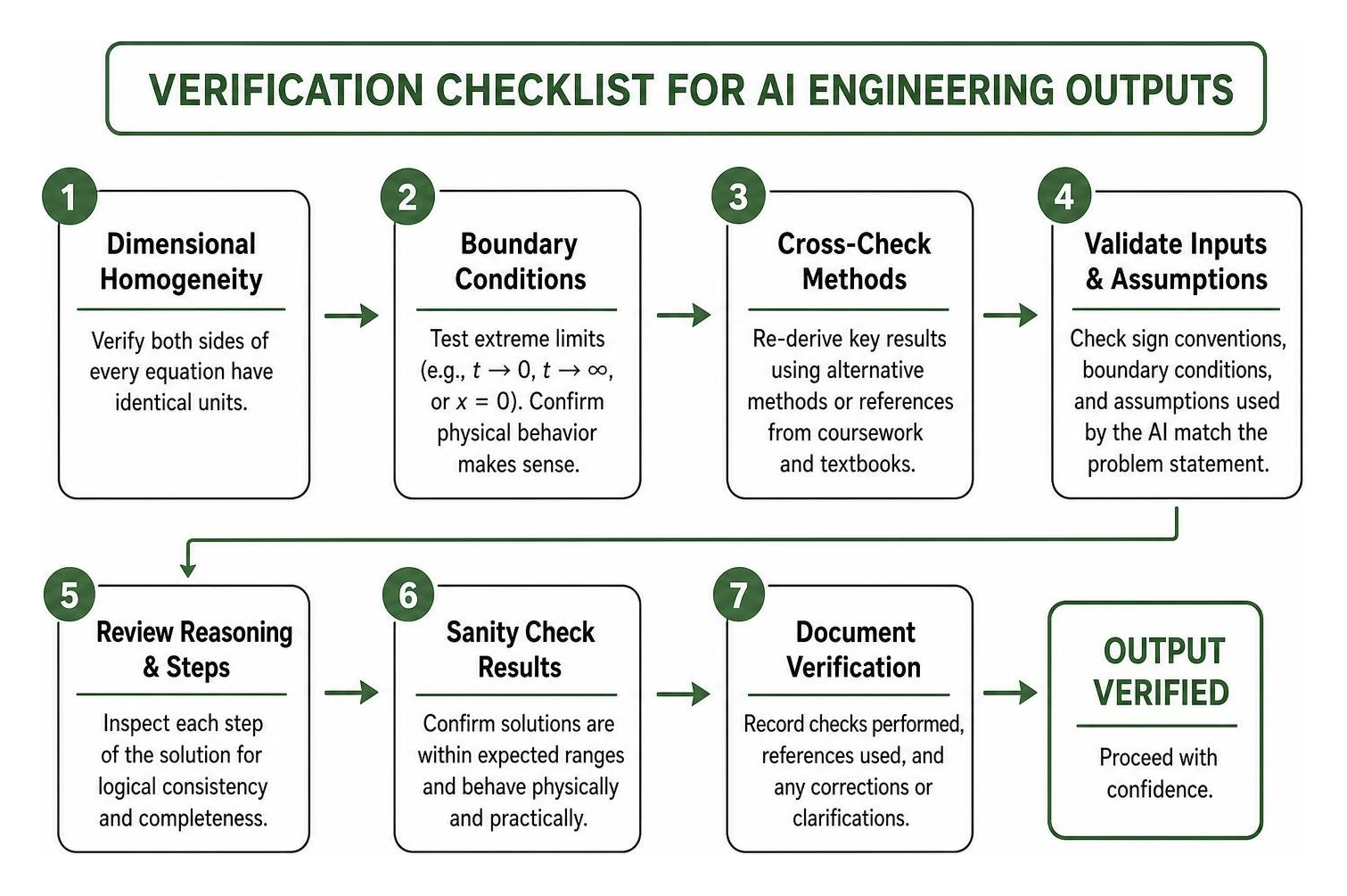
Verification Rules of Thumb:
- Dimensional Homogeneity: Always verify that both sides of an AI-derived equation have identical units.
- Boundary Conditions: Test extreme limits (e.g., $t \to 0$, $t \to \infty$, or $x = 0$) to confirm the physical behavior makes sense.
- Academic Integrity: Use AI tools as personal tutors to master underlying concepts, not as automated shortcuts for graded assignments. When completing literature reviews or background research for senior design projects, cross-reference source materials with dedicated AI research tools for students to ensure proper citation of peer-reviewed engineering papers.
Frequently Asked Questions About Engineering AI Tools
What are the best free AI platforms for first- and second-year engineering courses?
First- and second-year students can rely on a combination of free tiers. Use symbolic solvers (or computational engines via search integrations) for calculus and linear algebra checks, interactive graphing engines for visual graphing, and standard conversational AI interfaces for concept explanations and numerical scripting debugging. Many universities also provide free institutional licenses for specialized software suites.
Can AI tools accurately solve multi-loop circuit analysis and beam deflection problems?
Yes, provided you use the right tool. Pure symbolic solvers and specialized engineering tutors handle Kirchhoff’s voltage and current laws (KVL/KCL), node-voltage systems, and fourth-order beam deflection differential equations reliably. General-purpose chat models can solve them if prompted with clear boundary conditions, but their step-by-step arithmetic and sign conventions should always be checked against manual calculations.
How do AI engineering tutors compare to university office hours?
AI tutors provide instant, 24/7 step breakdowns and allow you to ask unlimited basic questions without pressure. However, they complement rather than replace faculty office hours. Human professors and teaching assistants provide vital mentorship, context on departmental grading standards, career guidance, and deep insight into complex, open-ended design problems that automated software cannot replicate.
Conclusion
Mastering engineering coursework requires consistent problem-solving practice, strong visual intuition, and rigorous analytical thinking. By using symbolic solvers for precise math, specialized AI tutors for engineering mechanics, and structured study platforms for lecture synthesis, you can streamline your weekly workload while deepening your grasp of core principles. Always verify AI outputs against first principles and university course materials. To explore more cutting-edge workflows and tools tailored for modern academic success, visit our Aixoria AI tools hub.