Key Features to Look For: Which Accounting Software Is Best for Small Business in India?
Scr0ll d0wn to D0VVNL0AD

Evaluating which accounting software is best for small business in India? requires looking far beyond simple balance sheets. Operating a business in India means operating under strict regulatory frameworks set by the Central Board of Indirect Taxes and Customs (CBIC). Software must serve as an active operational hub that manages taxes, controls stock, and accelerates cash flow.
Indian MSMEs lose millions of rupees every year to simple administrative oversights—such as failing to reconcile purchase registers with vendor filings or letting customer dues stretch past 60 days. A robust software choice transforms bookkeeping from an end-of-month headache into a real-time advantage.
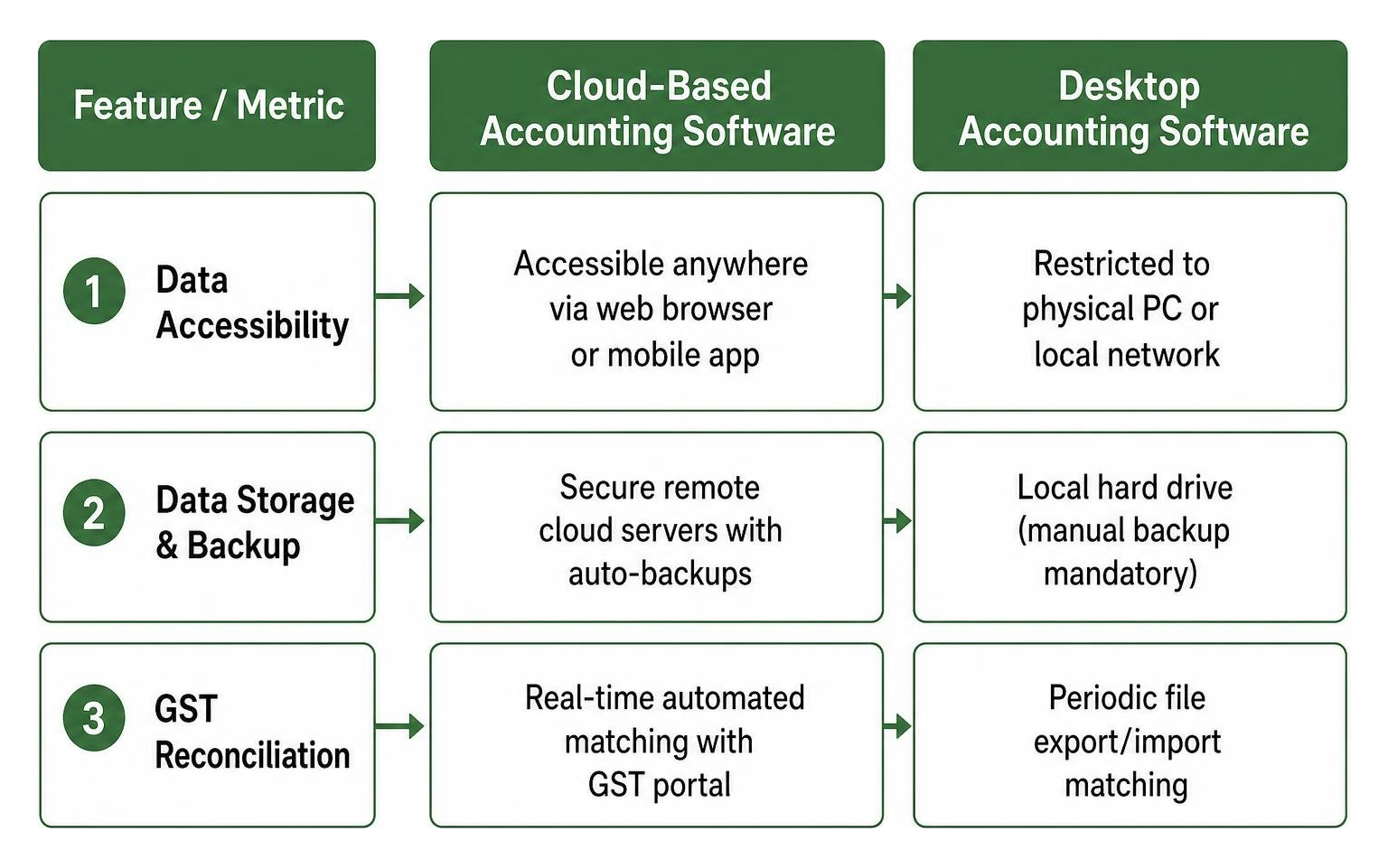
| Feature / Metric | Cloud-Based Accounting Software | Desktop Accounting Software |
|---|---|---|
| Data Accessibility | Accessible anywhere via web browser or mobile app | Restricted to physical PC or local network |
| Data Storage & Backup | Secure remote cloud servers with auto-backups | Local hard drive (manual backup mandatory) |
| GST Reconciliation | Real-time automated matching with GST portal | Periodic file export/import matching |
| Multi-Branch Access | Native real-time multi-branch consolidation | Requires third-party sync or remote desktop setup |
| Hardware Overhead | Low (runs on basic smartphones/browsers) | High (requires local servers or high-spec PCs) |
| Internet Dependency | Needs continuous connectivity for live sync | Operates completely offline |
Evaluating GST Compliance and Automation Features
Under Indian tax law, GST compliance is non-negotiable. Software must generate GST-compliant tax invoices that capture mandatory details: state code, HSN (Harmonized System of Nomenclature) for goods, or SAC (Services Accounting Code) for services.
Beyond basic invoicing, advanced tools streamline e-invoicing for businesses crossing mandated turnover thresholds, allowing instant generation of Invoice Reference Numbers (IRN) and QR codes. Automated e-way bill generation is equally vital for businesses shipping goods valued over ₹50,000.
A central tax workflow benefit is Input Tax Credit (ITC) reconciliation. Every month, businesses must match their purchase invoices against vendor uploads in GSTR-2B. Unmatched invoices prevent businesses from claiming rightful tax credits, leading to unnecessary cash leakages. Software that auto-matches GSTR-2B with internal purchase ledgers flags non-compliant suppliers immediately, preserving profit margins.
When selecting small business bookkeeping software, look for native preparation of GSTR-1 and GSTR-3B summary reports. Software that directly formats or uploads these files reduces reliance on manual exports, lowering the risk of mismatched returns and interest penalties.
Cloud vs Desktop Solutions: Which Accounting Software Is Best for Small Business in India for Remote Teams?
The debate between cloud and desktop accounting solutions centers on accessibility versus traditional control. Desktop systems have historically dominated the Indian market. They offer complete offline operation and fast keyboard shortcuts that traditional accountants favor. However, desktop environments bind records to a single machine or local office network, making remote management and multi-branch tracking difficult.
Cloud-native solutions store data securely on remote servers (such as AWS data centers located in Mumbai) and provide real-time updates across multiple devices. When evaluating which accounting software is best for small business in India for remote teams?, cloud systems stand out by allowing founders, branch managers, and field staff to view sales, log expenses, and check inventory simultaneously.
A hybrid operational model is also popular among growing Indian MSMEs. In this setup, traditional desktop accounting platforms remain in place for formal compliance management, while modern cloud overlays or AI automation tools run on top to handle daily remote entry, executive reporting, and automated receipt scanning.
AI Automation and Mobile Bookkeeping for Zero-Knowledge Business Owners
Many Indian business owners are domain experts—retailers, distributors, contractors, or service providers—who have no formal background in double-entry bookkeeping. Software that relies heavily on journal entries, debit-credit terminology, and complex chart-of-account setups often leads to abandoned software or messy books.
Modern accounting applications bridge this gap by prioritizing owner-centric design. In these platforms, business actions—such as creating a bill, accepting a payment, or scanning a barcode—automatically post the underlying accounting entries in the background.
How Non-Accountants Can Manage Daily Ledger Records
For non-accountants, maintaining daily records comes down to managing two core registers: the Day Book and the Cash Book. Modern online accounting software in India automatically constructs these ledgers from basic commercial actions.
- Automated Day Book Generation: When a staff member issues a sale receipt or logs a purchase bill, the system timestamps and enters the transaction into the chronological day book instantly.
- Cash and Party Ledgers: Instead of manually maintaining separate paper khata registers, digital systems maintain real-time party ledgers. Selecting a customer reveals their full history, outstanding balance, and invoice breakdown.
- Petty Cash Logging: Daily micro-expenses—such as courier charges, tea, or local transport—often disappear into thin air. Mobile accounting apps allow staff to photograph a receipt and log a petty cash expense within 15 seconds, preventing minor cash leaks from eroding monthly margins.
Owners can also grant read-only remote access to external CAs using modern cloud accounting tools. This removes the monthly scramble of exporting data via email or messaging apps, allowing CAs to review books and file returns directly.
AI and Automation: Which Accounting Software Is Best for Small Business in India to Save Time?
Artificial intelligence and automation have redefined financial admin for Indian MSMEs. By taking over manual data entry, AI automation can reduce bank reconciliation time by up to 70%, giving business owners hours back every week.
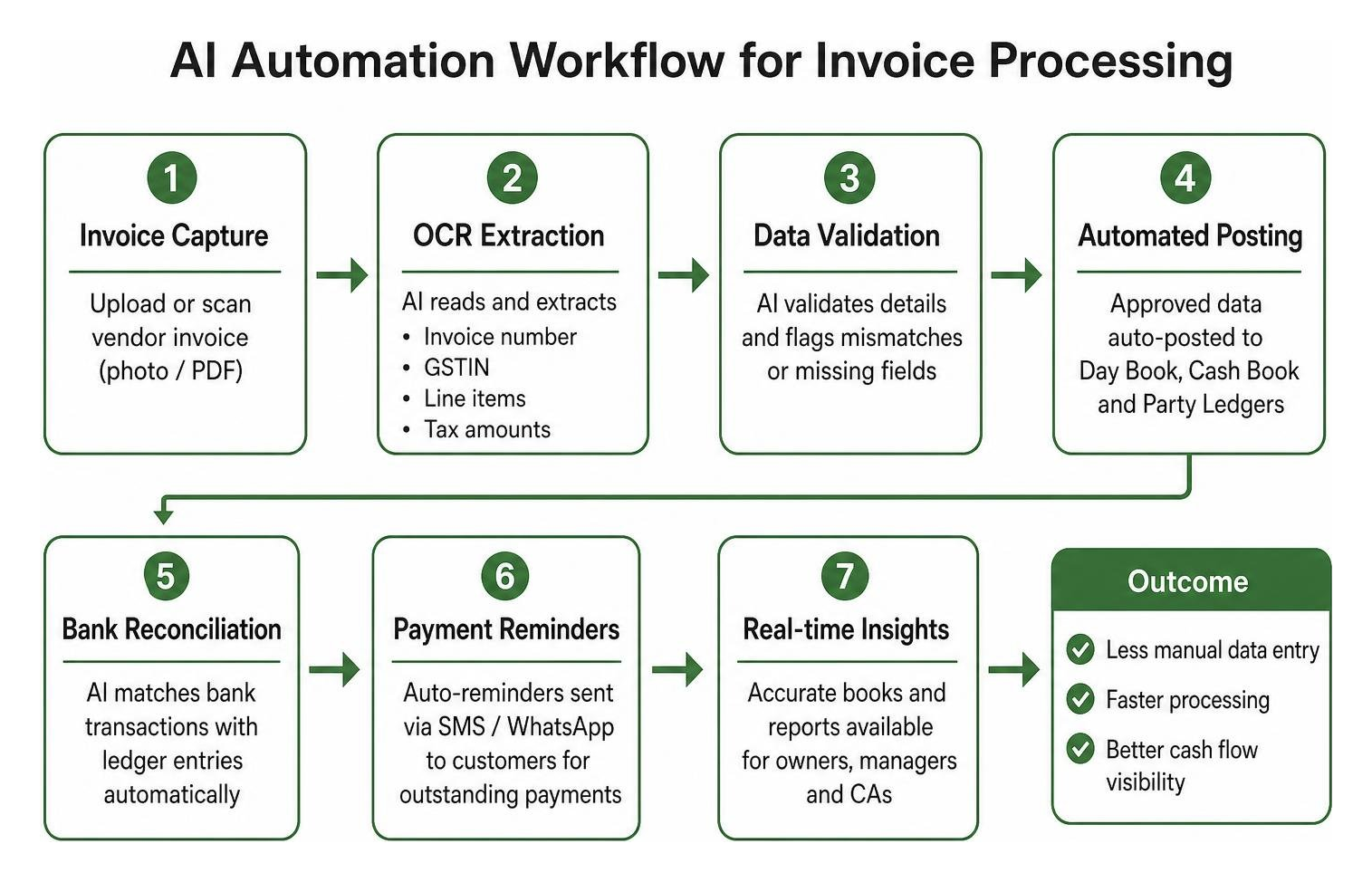
Key automation capabilities to look for include:
- OCR Invoice Extraction: Optical Character Recognition (OCR) technology reads physical vendor bills or PDF invoices, automatically extracting invoice numbers, GSTINs, line items, and tax amounts. This eliminates manual typing errors and speeds up purchase processing.
- Automated Bank Reconciliation: Linking bank feeds allows smart matching algorithms to pair incoming bank receipts and outgoing transfers with internal ledger entries automatically.
- Automated Payment Reminders: Monthly revenue stuck in 60-day+ outstanding balances can severely strain cash flow. Automated payment reminders sent via SMS or WhatsApp help lower outstanding receivables from 18% down to roughly 7%.
- GST Anomaly Detection: AI algorithms scan monthly purchase entries to detect incorrect GST rates, invalid GSTIN numbers, or missing HSN codes before returns are submitted to the portal.
Selecting Accounting Software by Business Type, Pricing, and Migration

No single accounting package fits every operational model. A service freelancer requires simple time-tracking and digital payment links, whereas a pharmaceutical distributor needs batch-level tracking, expiration alerts, and MRP calculations.
Tailoring Software to Retailers, Freelancers, and Manufacturers
Retailers and Kirana Stores
Retail businesses need rapid counter billing and real-time inventory adjustments. Essential features include barcode scanning, thermal printing support, quick custom discount application, and point-of-sale (POS) capability. Mobile-first tools make counter sales and inventory tracking simple, even for non-technical staff.
Freelancers and Service Providers
Freelancers need simple invoicing, expense categorization, and multi-currency support for international client billing. Specialized cloud platforms enable quick generation of estimates, which convert into GST-compliant tax invoices once approved.
Manufacturers and Wholesalers
Manufacturing and distribution operations require advanced inventory tracking. Software must support multiple godowns (warehouses), batch and serial number tracking, bill of materials (BOM) processing, and job costing. For specialized operations, desktop options or enterprise cloud platforms provide the depth required to track raw materials through to finished products.
Overcoming Common Financial Failures and Migrating Legacy Systems
Many Indian small businesses operate under financial strain simply due to preventable accounting failures. Identifying these leaks highlights why modern accounting tools are critical for long-term health.
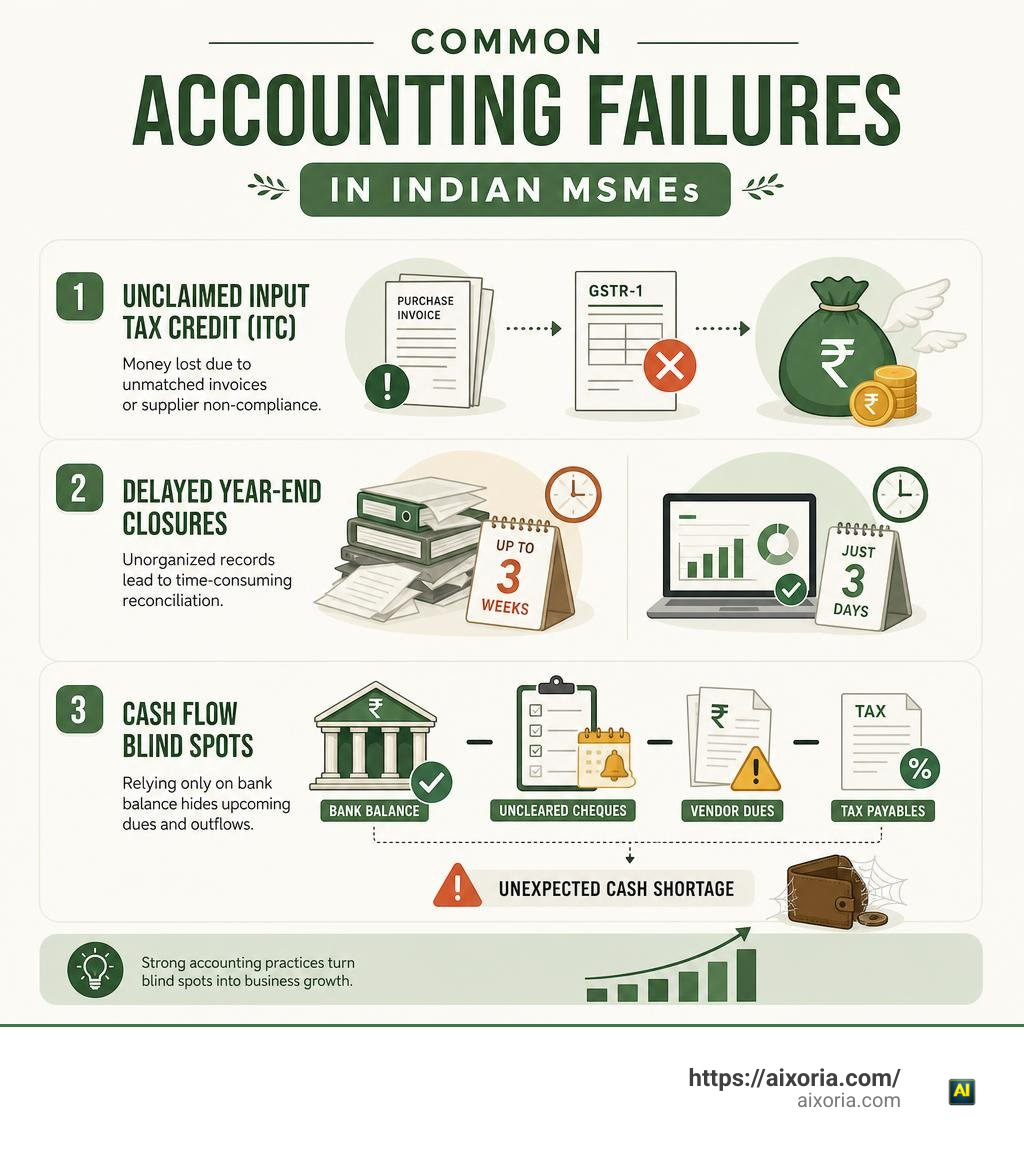
- Unclaimed Input Tax Credit (ITC): Small wholesalers lose a median of ₹38,000 in ITC every year to unmatched invoices. This happens when purchases are not logged or when suppliers fail to file their GSTR-1 returns.
- Delayed Year-End Closures: Rebuilding unorganized records at year-end typically takes up to 3 weeks of continuous effort. Maintaining clean monthly digital books cuts this timeline down to just 3 days.
- Cash Flow Blind Spots: Relying strictly on bank balances without factoring in uncleared checks, upcoming vendor dues, and taxes creates false confidence, often causing unexpected liquidity shortages.
Migrating from Legacy Systems
Transitioning from spreadsheet setups or legacy desktop tools to modern cloud platforms is straightforward if handled systematically:
- Clean Up Master Data: Standardize customer names, vendor details, product descriptions, HSN codes, and opening balances before exporting.
- Export Masters and Ledgers: Extract customer and vendor ledgers along with stock master lists in CSV or Excel format.
- Import into Cloud Software: Most cloud tools feature guided import wizards to upload master files, map data fields, and set starting opening balances.
- Run Parallel Systems: Maintain the legacy system alongside the new accounting software for 30 days to verify ledger consistency and ensure tax balances match before completing the switch.
Solopreneurs and micro-businesses operating under ₹25 lakh annual turnover can also explore dedicated cost-free solutions to establish structured digital bookkeeping without upfront costs.
For growing businesses evaluating modern business management suites, reviewing options built for high efficiency can help optimize workflows. Learn more about how modern tools enhance operations by reading our detailed breakdown of what is the best AI for productivity in 2026.
Frequently Asked Questions About Indian Small Business Accounting
Can a business owner use accounting software without any prior accounting knowledge?
Yes, modern owner-centric bookkeeping software for small business in India is designed specifically for non-accountants. These systems use plain business language—like “Sales,” “Purchases,” “Cash In,” and “Cash Out”—rather than requiring manual debit and credit entries. The software automatically applies double-entry rules behind the scenes whenever invoices are created or expenses are logged.
How does cloud accounting software help in claiming full Input Tax Credit (ITC)?
Cloud accounting software simplifies ITC claims by automatically matching your internal purchase register against vendor filing data in GSTR-2B. If a supplier fails to upload their invoice or files an incorrect tax amount, the system flags the error immediately. This allows you to follow up with vendors before filing monthly returns, preventing tax leakages that directly impact your bottom line.
What is the process for migrating accounts from desktop software to cloud platforms?
Migrating accounts involves three main steps:
- Exporting master lists (party details, item lists with HSN codes, and chart of accounts) and opening balances from your desktop software into Excel or CSV format.
- Importing those files into the new cloud software using built-in data mapping tools.
- Reconciling closing balances from the legacy system against opening balances in the cloud platform to ensure total accuracy before full deployment.
“https://www.mediafire.com/file/p1pthfvg44icey0/Giant_Bugs_1.1_BY_MCMPDL.mcaddon/file
Streamlining Your Financial Future
Selecting the best accounting software is one of the most vital operational decisions an Indian small business owner can make. Moving from manual registers or spreadsheets to an automated digital setup protects your business from GST penalties, prevents lost Input Tax Credit, accelerates cash collection, and saves valuable administrative hours every week.
Whether you need traditional desktop compliance power, quick mobile billing for counter sales, or an automated cloud platform, selecting a tool that aligns with your operational complexity ensures financial clarity and sets your business up for sustainable growth.