Choosing the Best File Management Software for Law Firms
Scr0ll d0wn to D0VVNL0AD

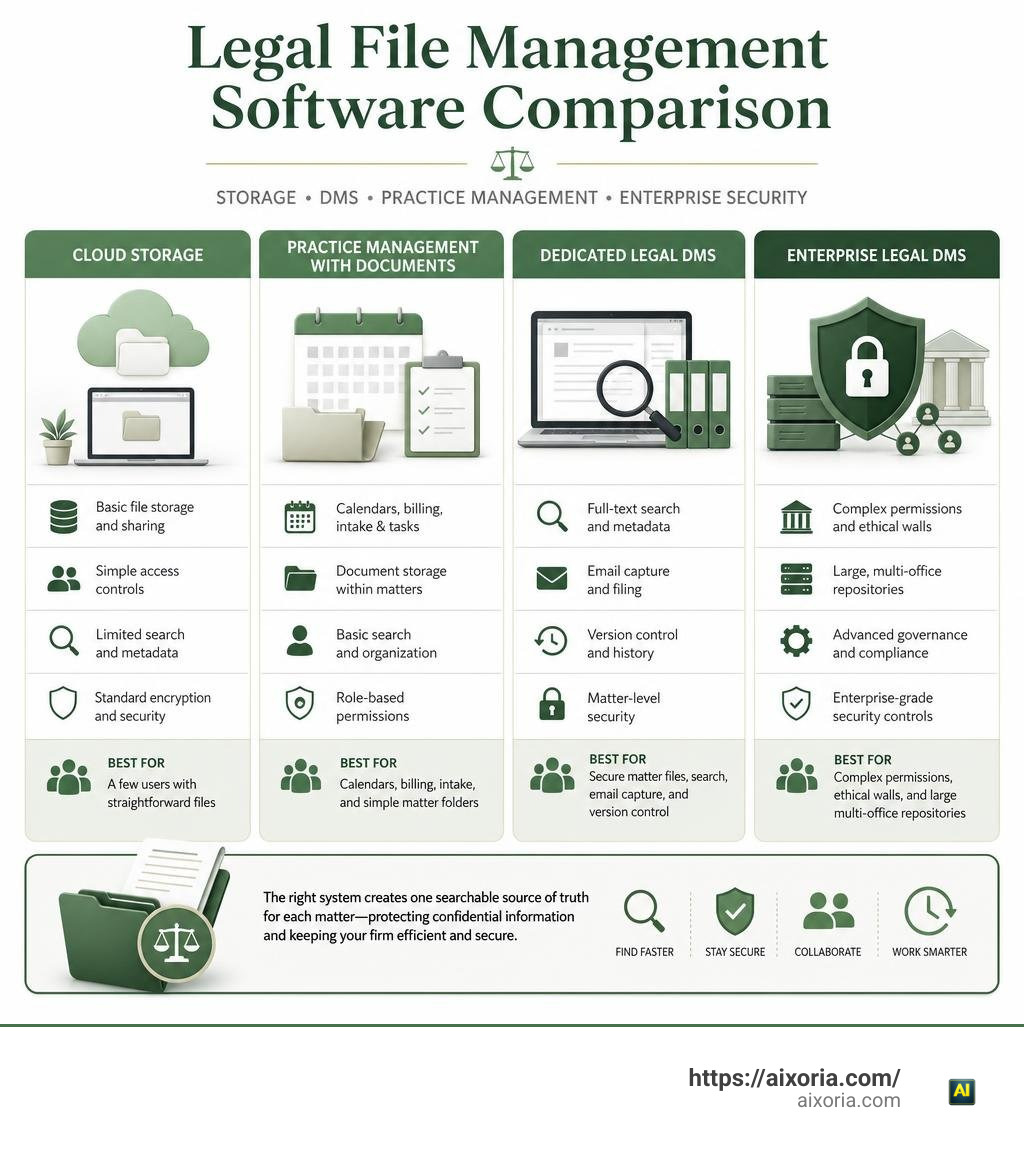
What is the best file management software for law firms? The best choice depends on your firm’s size and workflow, but most firms that need strong search, email filing, version history, and matter-level security should choose a dedicated legal document management system (DMS), rather than generic cloud storage or basic file tools inside practice management software.
| Firm need | Best-fit software type |
|---|---|
| Calendars, billing, intake, and simple matter folders | Practice management software with document storage |
| Secure matter files, full-text search, email capture, and version control | Dedicated legal DMS |
| Complex permissions, ethical walls, and large multi-office repositories | Enterprise legal DMS |
| A few users with straightforward files | Cloud storage with disciplined naming and access policies |
Legal files rarely stay simple. A matter can produce drafts, signed agreements, scanned evidence, court filings, and long email threads. When those records live across inboxes, desktops, shared drives, and disconnected folders, finding the right version becomes slow and risky.
The right system creates one searchable source of truth for each matter. It should help lawyers and staff locate documents quickly, protect confidential information, and keep everyone working from the current file.
This guide compares the leading approaches, explains when a firm needs more than basic cloud storage or a network drive, and covers the security, AI, cost, and migration questions that should shape a buying decision.
What is the Best File Management Software for Law Firms?
When answering what is the best file management software for law firms?, we must first clarify that legal practices have unique file handling requirements. Unlike general businesses that store static files in basic client directories, law firms deal with high document volumes, strict confidentiality mandates, chain-of-custody tracking, and constant version edits.
Modern law firms typically choose between three main architectures for managing digital files:
- Dedicated Legal Document Management Systems (DMS): Specialized platforms engineered specifically for legal work product, email archiving, document profiling, and matter-centric organization.
- Practice Management Suites with Built-In Document Storage: All-in-one software suites that handle front-office tasks like intake, time-tracking, billing, and calendaring alongside baseline document uploads.
- General-Purpose Cloud Storage or Shared Network Drives: Generic storage environments like consumer cloud drives or local
S:drive network shares paired with manual folder hierarchies.
| Feature / Capability | Dedicated Legal DMS | Practice Management Built-in Storage | Generic Cloud / Network Shares |
|---|---|---|---|
| Primary Focus | Deep file versioning, email archiving, and search | Billing, calendaring, contacts, and client intake | Basic file storage and folder sharing |
| Email Integration | Direct Outlook/Mail capture linked to matters | Basic file attachments or email logging | Manual drag-and-drop or inbox saving |
| Optical Character Recognition (OCR) | Automatic background OCR on all uploads | Manual or limited preview OCR | None or separate standalone tool needed |
| Version Control | Automatic check-in/out with 100% version retention | Overwrite protection or basic file uploads | Filename-based (“v1finalrev.docx”) |
| Ethical Walls & Granular Security | Advanced permission locks per matter/user | Basic user role permissions | Folder-level permissions only |
Dedicated Document Systems vs Practice Management Tools
A common source of confusion for law firm managers is deciding whether a dedicated DMS is necessary when their practice management software already includes document attachment features.
Practice management platforms excel at matter administration. They unify client contact details, court dates, trust accounting, eSignatures, and invoicing in a single dashboard. Many law firms report significant productivity gains from practice management tools, such as capturing an average of 3+ billable hours per day and reclaiming over 500 hours annually in administrative overhead.
However, the file storage inside practice management suites is often a secondary module. It acts primarily as a digital filing cabinet for finalized attachments. Where it struggles is managing active draft iterations, background indexing, and high-volume email correspondence.
A dedicated legal DMS provides a deep matter-centric architecture. Instead of treating documents as disconnected attachments, a DMS enforces document profiling—attaching critical metadata such as document type, author, practice group, sub-matter, and privilege status to every single record. When an attorney works on a complex brief, a dedicated DMS handles background checks, locks the document during editing to prevent conflicting copies, tracks every draft alteration indefinitely, and saves email correspondence natively within the matter repository.
When Law Firms Outgrow Basic Cloud Storage
Many boutique law firms and solo practices start out using generic cloud drives or a shared local network drive. In the early stages with one or two fee earners, this setup feels affordable and familiar.
However, firms quickly reach a tipping point where generic file servers create operational bottlenecks and severe malpractice liabilities. A firm has outgrown basic cloud storage when it experiences the following pain points:
- Version Confusion: Staff frequently work on outdated drafts, leading to embarrassing filing errors like submitting
Motion_Summary_Judgment_FINAL_v3_comments.docxto court. - Search Failures: Attorneys waste 3 to 5 hours per week hunting for misplaced documents or trying to guess exact filenames across localized desktop folders.
- Email Isolation: Critical client correspondence stays trapped in individual lawyer inboxes rather than being accessible to the broader legal team working on the matter.
- Unsearchable Scans: Image-only PDF scans from opposing counsel or court reporters sit unindexed because generic drives lack automated Optical Character Recognition (OCR).
- Security Risks: Shared folders lack audit trails, ethical wall controls, or granular permissions necessary to enforce conflict-of-interest walls between practice groups.
Essential Features of Legal Document Management Systems
To ensure long-term operational efficiency, a modern legal document management platform must include core features designed around legal workflows.
The essential capabilities every legal DMS should deliver include:
- Matter-Centric Organization: Every file, note, scanned exhibit, and email automatically tags to a central client matter record.
- Full-Text & Metadata Search: The ability to search not just filenames, but the internal text of every Word document, email thread, spreadsheet, and scanned image file across the entire firm repository.
- Automatic Background OCR: Optical Character Recognition automatically converts image-only PDFs and faxed documents into fully searchable, selectable text upon upload.
- Native Outlook Email Management: One-click or automated email filing add-ins that allow lawyers to log incoming and outgoing client correspondence straight from Outlook into the corresponding case file.
- Check-In / Check-Out Version Control: Prevents two team members from editing the same file simultaneously, saving every edit iteration indefinitely while maintaining a single, permanent document link or ID.
Evaluating Features: What is the Best File Management Software for Law Firms?
When evaluating platforms, firms must look beyond basic file uploads and scrutinize how easily daily operations flow through desktop tools.
For example, email integration is a primary differentiator. Over 60% of a matter’s official record consists of email correspondence and attachments. Standard practice management software often forces users to manually save emails to a local desktop and re-upload them to a browser window. In contrast, advanced platforms provide native Outlook add-ins that suggest relevant client matters automatically based on email addresses, allowing single-click filing without leaving Microsoft Office.
Furthermore, pre-processing and file naming habits directly impact long-term retrieval speed. Implementing tools like legal document management solutions for pre-upload document renaming ensures that scanned exhibits and discovery disclosures follow structured naming conventions before entering the firm’s primary repository.
Mac vs Windows Support and Cross-Platform Usability
Historically, legal software was engineered almost exclusively for Windows desktop environments running local SQL servers. However, modern law firms increasingly operate on hybrid operating systems, combining Windows workstations, Apple MacBooks, iPads, and mobile smartphones.
When choosing software in 2026, firm managers must verify cross-platform parity:
- Web-Native Cloud Applications: Browser-based platforms deliver full functionality regardless of whether an attorney logs in from macOS, Windows, or Linux.
- Native Mac Desktop Integration: If your firm uses Macs, ensure the DMS provides native Mac Finder integrations and native Microsoft Office for Mac add-ins, rather than requiring virtualization software like Parallels.
- Mobile Access: Dedicated iOS and Android applications let lawyers review, edit, lock, and share work-in-progress documents directly from courtrooms or client meetings.
Security, Compliance, and Ethical Considerations for Law Firms
Law firms are high-value targets for cybersecurity threats because they host concentrated confidential business secrets, intellectual property, corporate financial data, and personally identifiable information (PII). A data breach can lead to severe reputational damage, ethical sanctions, and bar association disciplinary actions.

When selecting a file management system, the software architecture must comply with stringent security standards:
- Encryption Standards: All document data must be protected using bank-grade AES-256 encryption at rest (while stored on servers) and TLS 1.3 encryption in transit (while moving between devices and the cloud).
- Security Certifications: Top-tier vendors hold audited SOC 2 Type II certifications and ISO 27001 compliance, verifying that physical and cloud data centers maintain rigorous operational security controls.
- Redundant Cloud Infrastructure: Platforms hosted on enterprise cloud environments (such as Microsoft Azure or Amazon Web Services) maintain 99.999% historical uptime and multi-region backup redundancy to prevent loss of work product.
Access Controls and Data Privacy Regulations
Legal ethics rules dictate that confidential client records must be protected not only from external cyber threats, but also from unauthorized internal access.
Key compliance capabilities include:
- Ethical Walls and Granular Permissions: Law firms handling conflicting parties or high-profile litigation require ethical walls—system controls that restrict file access exclusively to assigned matter team members, preventing unauthorized colleagues from viewing restricted case materials.
- Audit Trails: Detailed activity logging that tracks every document interaction, recording exactly who viewed, edited, downloaded, exported, or deleted a file, alongside precise timestamps.
- Global Data Privacy Compliance: For law firms operating across international borders or managing European client data, full alignment with regional privacy mandates such as GDPR and local data protection regulations is essential. Implementing verified document management compliance frameworks ensures that client files adhere to strict data sovereignty, access controls, and retention schedules.
AI-Powered Automation and Modern Document Search
Artificial intelligence has shifted legal document management from static document storage to intelligent knowledge work. In 2026, leading platforms embed AI capabilities directly into document repositories, enabling lawyers to analyze massive case files in a fraction of the time.
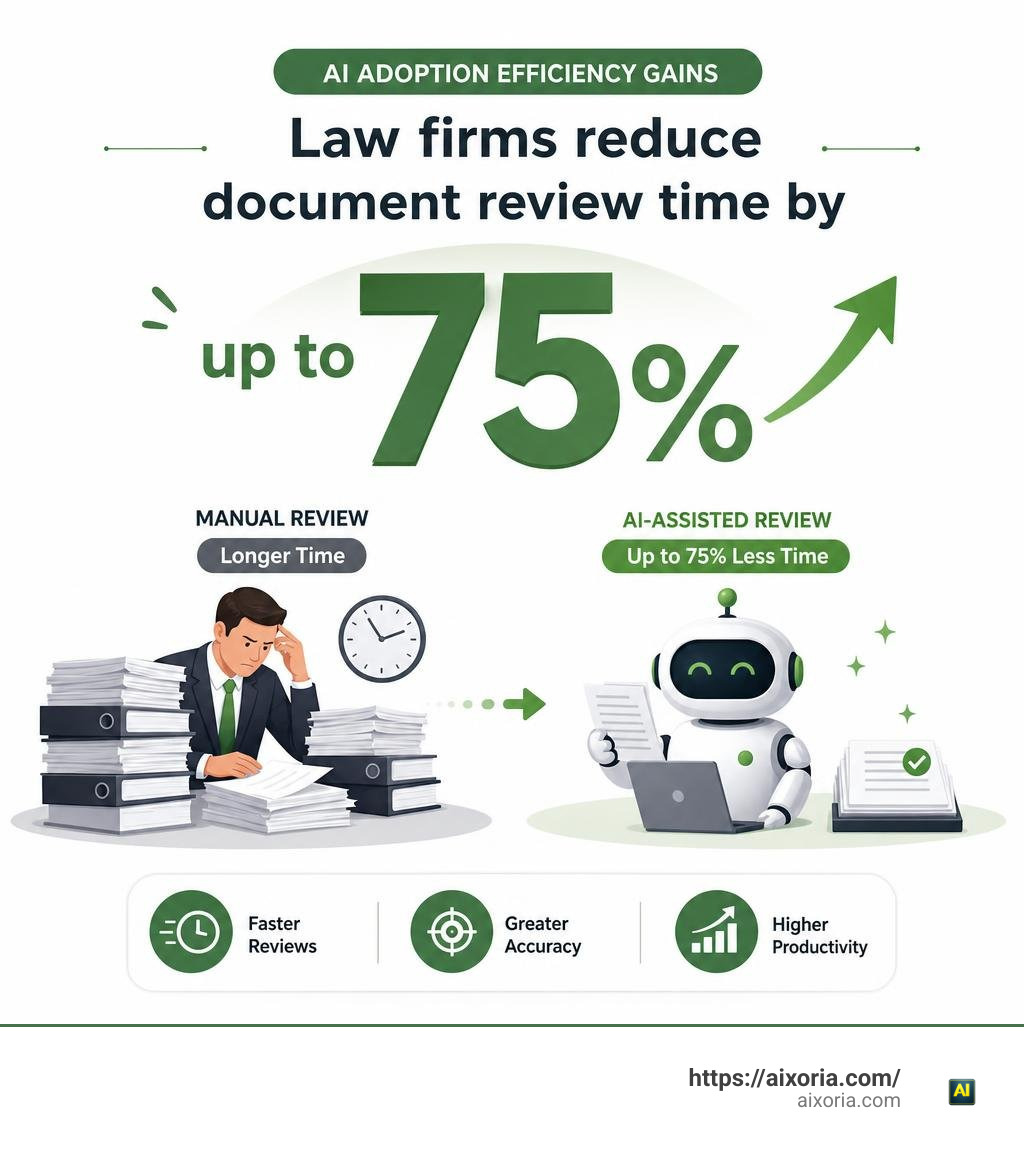
Key AI applications in legal file management include:
- Semantic and Natural Language Search: Instead of relying on exact keyword matching, AI search understands conceptual meaning. An attorney can search for “agreements regarding commercial tenant liability” and retrieve relevant indemnity clauses even if the specific word “liability” does not appear in the title.
- Automated Summarization: AI summarization tools can instantly digest a 50-page deposition transcript, contract, or court ruling, returning concise executive summaries and bullet points of key obligations.
- Data Extraction (AI Fields): AI engines scan incoming legal contracts and automatically extract critical metadata—such as execution dates, governing law, termination clauses, and payment terms—pre-populating matter records without manual data entry.
Smart Search and Automated Indexing Tools
Traditional search tools fail when documents are improperly named or when scanned images lack text layers. Automated background indexing solves this by continually crawling local PCs, network drives, email archives, and cloud repositories.
By leveraging background harvesting and fuzzy search algorithms, attorneys can locate obscure client work product even if they misspell party names or search using partial phrases. Combined with automated OCR, smart search engines turn every incoming fax, scanned exhibit, and email attachment into an instantly accessible institutional knowledge base.
Implementation, Migration, and Total Cost of Ownership
Transitioning a law firm to a new legal document management platform requires careful financial evaluation and planning.
Licensing and Pricing Structure
Legal DMS software is typically billed under two main structures:
- Per-User Monthly Subscriptions: Ranging from $40 to $89+ per user/month, commonly seen in enterprise cloud platforms.
- Flat Base Monthly Pricing: Platforms starting at flat rate tiers (e.g., $395/month covering baseline user groups up to designated thresholds), offering predictable operational costs for boutique and growing law firms.
Firms must also factor in initial setup fees, storage expansion tiers, and whether onboarding is handled directly by the software vendor or outsourced to third-party resellers and IT consultants. Direct vendor onboarding often reduces implementation friction and provides ongoing technical support directly from the platform developers.
Choosing by Firm Size: What is the Best File Management Software for Law Firms?
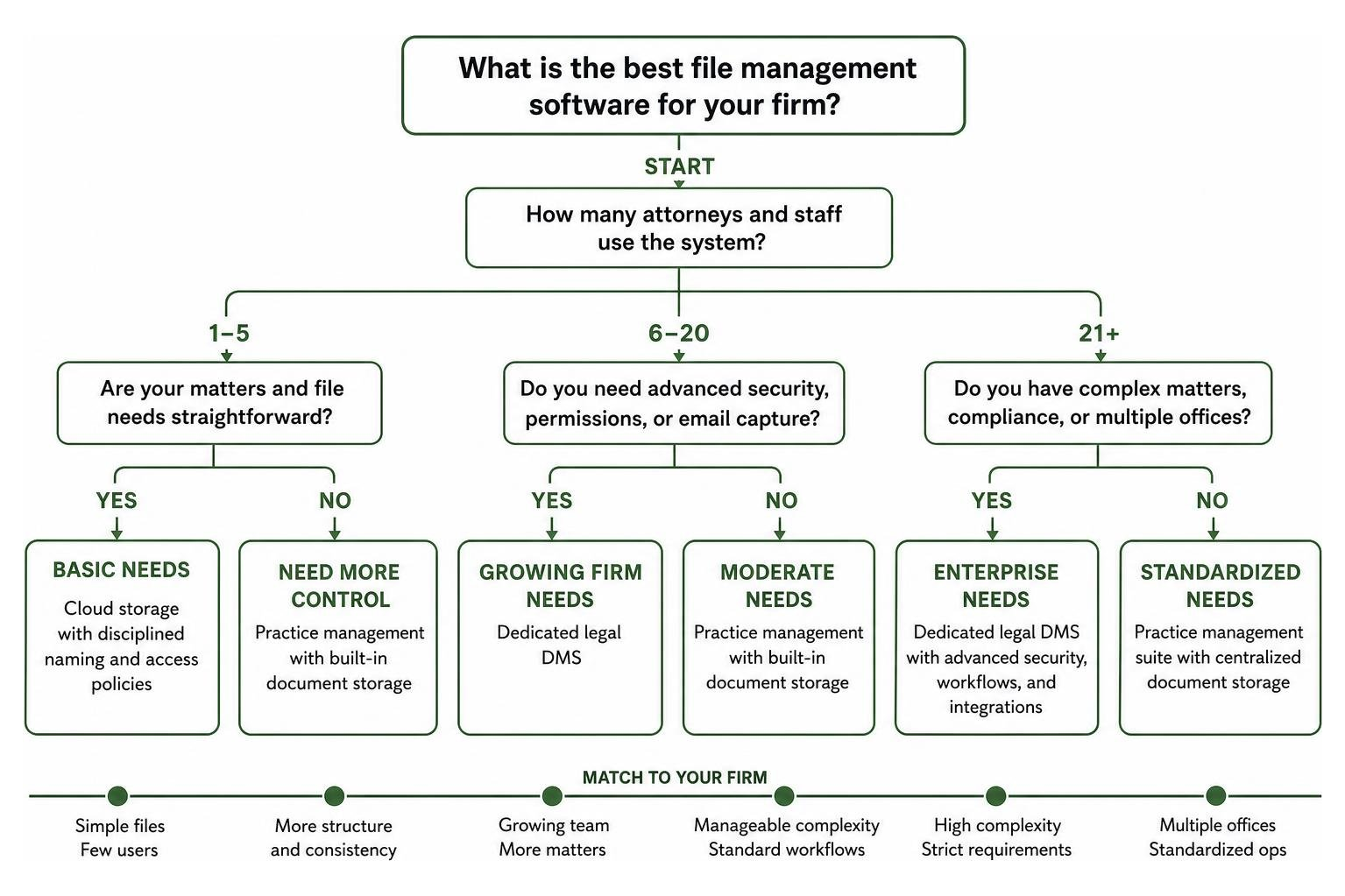
Firm size is often the primary deciding factor when determining what is the best file management software for law firms?:
- Solo Practitioners & Micro-Firms (1–4 Users): All-in-one practice management software paired with cloud file renaming tools is often sufficient. Storage needs are straightforward, and administrative simplicity outweighs the need for complex ethical walls.
- Mid-Market Law Firms (5–75 Users): Dedicated cloud-native legal DMS platforms offer the ideal balance. They provide deep Outlook email integration, automated background OCR, 100% permanent versioning, and matter-centric security without requiring dedicated IT engineering teams.
- Large Enterprise Firms (75+ Users & Global Practices): Enterprise DMS engines are standard among AmLaw 100 and Global 100 law firms. These systems support massive cross-office repositories, complex multi-jurisdictional compliance mandates, custom API integrations, and advanced governance controls.
Moving off legacy on-premise servers or sunsetted software (such as legacy document management installations or raw network shared drives) requires a structured data audit. The migration process involves auditing existing folder trees, mapping metadata fields, running background delta syncs, and conducting staff onboarding to ensure zero loss of billable time during cutover.
Frequently Asked Questions
What is the difference between practice management and document management?
Practice management software handles business operations across a law firm, including client intake, calendaring, time tracking, trust accounting, and billing. Document management software (DMS) specializes deeply in file work product, providing matter-centric storage, version control, automatic background OCR, deep Outlook email capture, and robust metadata search.
How do law firms maintain security when moving files to the cloud?
Law firms maintain cloud security by selecting software providers that enforce bank-grade AES-256 encryption at rest and in transit, hold third-party audited SOC 2 Type II certifications, support multi-factor authentication (MFA), and allow administrators to configure role-based access permissions and ethical walls.
How long does it take to migrate legacy server files to a cloud DMS?
Migration timelines depend on total data volume, internet bandwidth, and file structure complexity. Small to mid-sized firms migrating from local network drives or legacy on-premise servers typically complete data extraction, mapping, delta staging, and staff onboarding within 2 to 6 weeks with zero disruption to active casework.
https://www.mediafire.com/file/cj9lf9v9mz9sowi/Hide_and_Seek_BY_MCMPDL.mctemplate/file
Conclusion
Finding what is the best file management software for law firms? comes down to aligning technology with how your attorneys and support staff actually work. While generic cloud drives and basic practice management attachments work for simple documents, growing legal practices require a matter-centric system built for legal work product.
By adopting a dedicated legal DMS or pairing robust management tools with advanced search, automatic OCR, and email capture, your firm can eliminate duplicate draft errors, safeguard confidential client data, and drastically reduce time spent hunting for lost files.
As digital transformation continues to reshape the legal industry, leveraging modern software tools allows legal teams to streamline administrative overhead and stay focused on delivering exceptional client service. Discover the best AI for productivity in 2026 to learn how our cutting-edge AI automation solutions can transform your organization’s daily workflows.