What Is a Typical Interest Rate for a Small Business Loan in 2026?

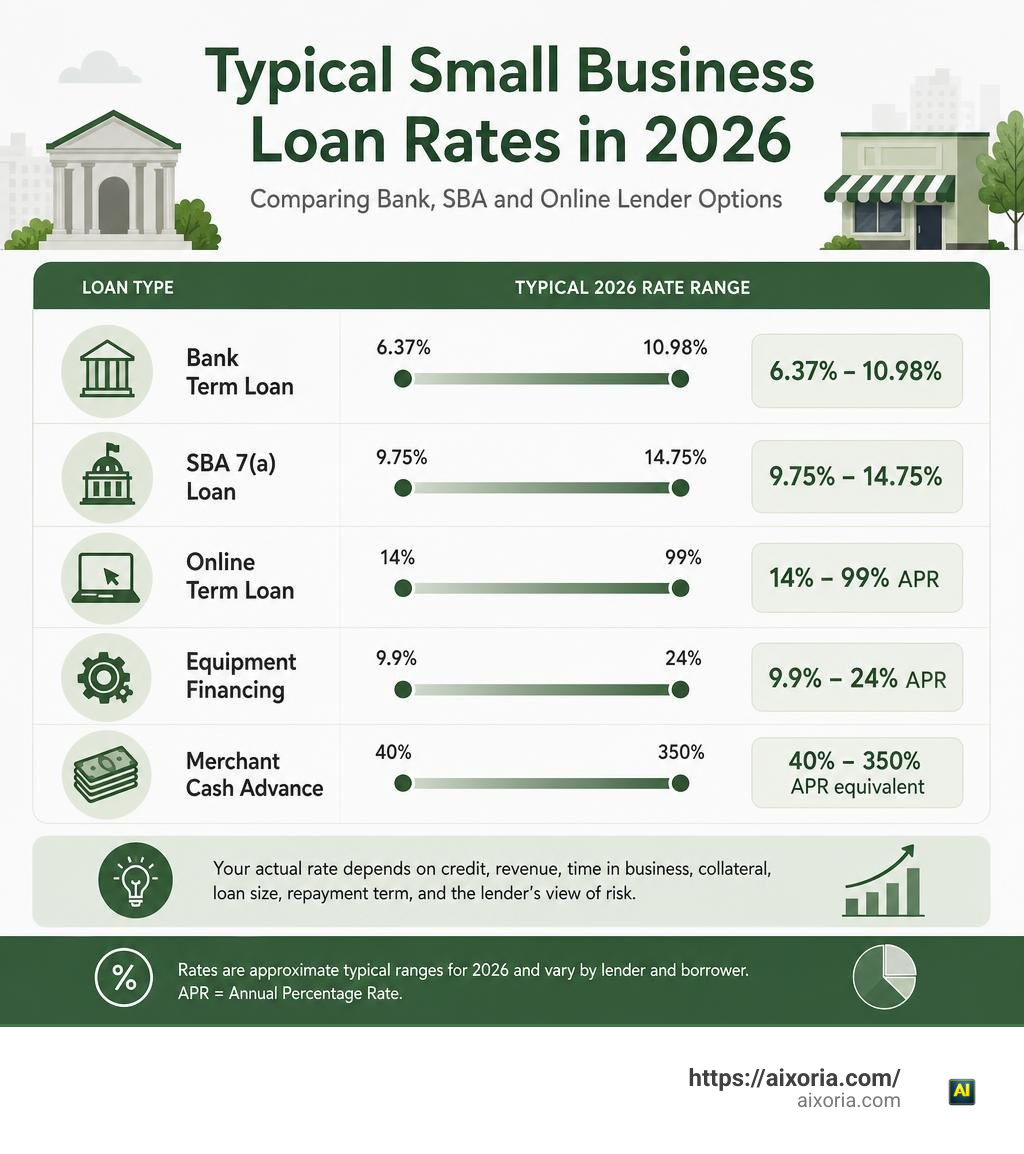
What is a typical interest rate for a small business loan? In 2026, strong borrowers may find bank loans around 6.37% to 10.98%, while SBA 7(a) loans generally fall between 9.75% and 14.75% depending on whether the rate is variable or fixed. Online term loans often cost more, with APRs commonly ranging from 14% to 99%.
| Loan type | Typical 2026 rate range |
|---|---|
| Bank term loan | 6.37% to 10.98% |
| SBA 7(a) loan | 9.75% to 14.75% |
| Online term loan | 14% to 99% APR |
| Equipment financing | 9.9% to 24% APR |
| Merchant cash advance | 40% to 350% APR equivalent |
There is no single average that fits every business. Your actual offer depends on credit, revenue, time in business, collateral, loan size, repayment term, and the lender’s view of risk.
The headline rate matters, but it is not the whole story. Fees, repayment frequency, and whether a lender quotes APR or a factor rate can change the real cost by a lot. For business leaders evaluating financing alongside operational investments, rate comparison also supports better capital allocation: the lower your borrowing cost, the more room you preserve for productivity tools, automation, hiring, and growth initiatives.
This guide explains how to compare offers clearly before your business takes on new debt, with a practical focus on making financing decisions that support long-term operational efficiency.
What Is a Typical Interest Rate for a Small Business Loan Across Lenders?
When we look at the borrowing landscape in 2026, understanding what is a typical interest rate for a small business loan requires looking closely at who is issuing the capital. Different financial institutions operate under distinct regulatory frameworks, funding costs, and risk tolerances. According to current market benchmarks, interest rates span from single-digit bank offers all the way to high double-digit online products.
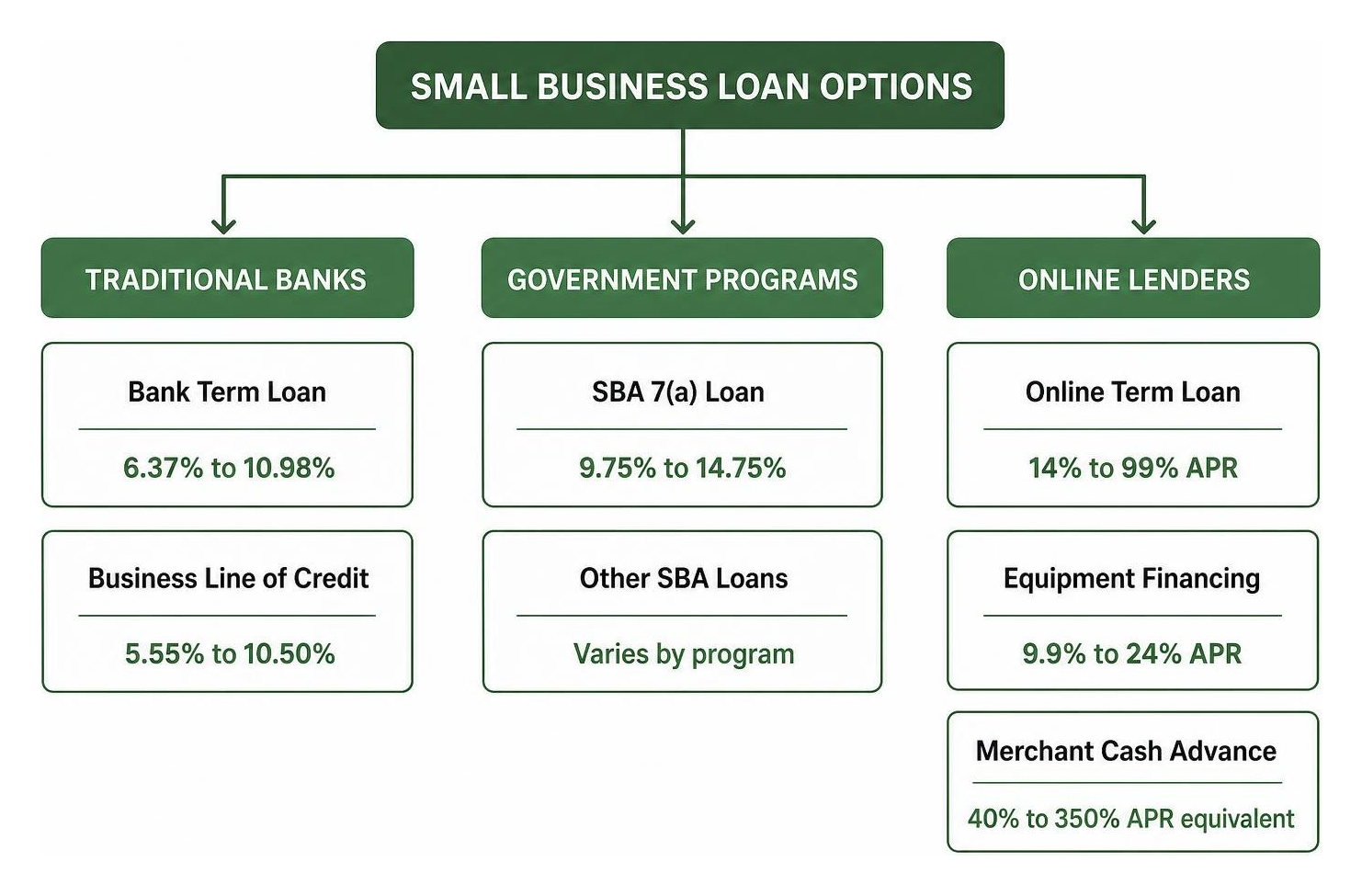
Where your business lands on this spectrum depends primarily on where you choose to apply and how your business profile matches up with lender requirements. Recent industry insights indicate that credit tier classification remains the single most influential factor in determining whether a borrower qualifies for prime rates or higher-cost alternative capital.
Bank Term Loans and Business Lines of Credit
Traditional commercial banks offer some of the most competitive pricing in the market today. For small enterprises with established track records, strong revenue streams, and solid credit profiles, conventional bank term loans generally range between 5.35% and 11.00% for fixed rates and 5.55% to 10.50% for variable rates. Recent Federal Reserve survey data shows average bank small-business loan interest rates starting around 6.37% to 10.98%.
For business lines of credit issued by commercial banks, average interest rates hover between 6.99% and 8.10% (or roughly 8.5% to 14% APR on drawn balances for strong files). Bank loans price off benchmark indices like the U.S. Prime Rate (which stood around 6.75% entering 2026). Because traditional banks hold rigorous underwriting criteria, including a minimum of two years in business and personal credit scores above 700, they maintain the lowest default risk—and pass those savings along as lower interest costs.
Online Term Loans and Alternative Financing
Fintech platforms and online alternative lenders cater to businesses that need rapid funding, have shorter operational histories, or carry lower credit scores. Because online lenders accept higher risk and deploy automated underwriting models capable of funding in as little as 24 to 48 hours, their pricing reflects that premium.
Online term loan APRs generally span from 14% to 99% (with average online term loans for clean mid-tier files settling between 18% and 35% APR). Online business lines of credit typically carry APRs ranging from 7.8% to 36% (and up to 60%+ for higher-risk files). Alternative short-term products, such as merchant cash advances (MCAs) and revenue-based financing, often rely on factor rates rather than standard annual rates, yielding effective APR equivalents anywhere from 25% up to 350%.
SBA 7(a), CDC/504, and Microloan Rates
Loans backed by the U.S. Small Business Administration (SBA) offer a middle ground: bank-level interest rates paired with flexible qualification requirements, made possible by federal guarantees.
The SBA sets maximum allowable rate caps that partner lenders can charge. For standard SBA 7(a) loans, interest rates are tied directly to the prime rate plus an SBA-regulated spread:
- Variable SBA 7(a) rates range from 9.75% to 13.25% (calculated as Prime + 2.25% to 4.75%).
- Fixed SBA 7(a) rates range between 11.75% and 14.75%.
- Under the SBA Working Capital Pilot (WCP) and standard 7(a) caps, smaller loans ($50,000 or less) allow maximum spreads up to Base Rate + 6.5%, whereas larger loans over $350,000 are capped at Base Rate + 3.0%.
CDC/504 loans, designed for long-term fixed-asset investments like commercial real estate or heavy machinery, offer even lower fixed pricing. CDC/504 rates are pegged to 10-year and 20-year U.S. Treasury yields plus program fees, typically delivering long-term fixed rates around 5.65% to 5.82%.
SBA Microloans provide up to $50,000 through non-profit community-based intermediaries. Microloan interest rates are negotiated between the non-profit lender and the entrepreneur, generally falling between 6% and 13% with maximum terms of six years.
Key Factors That Determine Your Small Business Loan Interest Rate
Lenders do not select interest rates at random. When asking what is a typical interest rate for a small business loan, we must evaluate how financial risk modeling works behind the scenes. Lenders calculate your specific rate by assessing the likelihood that your company will make all scheduled debt payments on time.
Standard underwriting guidelines assign a risk tier to your application based on credit history, cash flow safety margins, and asset coverage.

Credit Score Tiers and Financial Metrics
Your personal and business credit scores serve as the foundation of your interest rate offer. Because small business owners frequently guarantee commercial debt, personal credit history remains a top evaluation metric.
- Prime Tier (FICO 740+): Qualifies for top-tier bank loans starting around 6.37% to 10% APR and optimal SBA spreads.
- Mid-Tier (FICO 680 – 739): Qualifies for standard bank financing, competitive SBA loans (10.5%–13.5%), and low-end online term loans (14%–25% APR).
- Subprime Tier (FICO 620 – 679): Mostly routed toward online term loans (22%–45% APR) or equipment financing backed by physical collateral.
- Deep Subprime (FICO below 620): Qualifies primarily for high-cost alternative financing, revenue-based advances, or merchant cash advances carrying effective APRs of 40% to 100%+.
Beyond credit scores, lenders evaluate key operational safety metrics:
- Debt Service Coverage Ratio (DSCR): Lenders divide your Net Operating Income by your total annual debt obligations. A DSCR of 1.25x is the standard benchmark, but achieving a DSCR of 1.50x or higher signals strong cash cushions that help lower your interest rate.
- Annual Revenue and Bank Deposit Consistency: Lenders prefer to see stable cash flow. Maintaining 12+ deposit days per month and consistent average daily balances reduces perceived risk, sometimes lowering rate quotes by a full tier.
- Time in Business: Companies with at least two years of operating history unlocked conventional bank access. Businesses operating for under 12 months are considered higher risk and pay higher starting rates.
Loan Term Length, Collateral, and Loan Amount
The physical structure of your loan influences interest rate pricing:
- Loan Term Length: Longer repayment terms (such as 10 to 25 years for SBA real estate financing) lower monthly payments but increase total interest exposure over time. Shorter terms (6 to 24 months) carry higher monthly obligations, though lenders may offer lower cumulative interest costs on short exposures.
- Collateral: Pledging physical assets—such as commercial real estate, vehicles, or specialized machinery—reduces lender loss given default. Equipment financing, for instance, yields lower interest rates (9.9% to 24% APR) than unsecured working capital loans because the asset secures the debt.
- Loan Amount: Larger loans ($350,000+) incur lower administrative overhead per dollar lent, leading lenders and regulatory bodies like the SBA to cap rate spreads lower than on small $25,000 micro-transfers.
Fixed vs Variable Rates: Understanding What Is a Typical Interest Rate for a Small Business Loan
When selecting debt, small business owners must choose between fixed and variable interest rate structures:
| Feature | Fixed Interest Rate | Variable Interest Rate |
|---|---|---|
| Rate Behavior | Locks in place for the full term | Fluctuates periodically with market indices |
| Index Benchmark | Fixed percentage agreed at closing | Tied to Prime Rate, SOFR, or Treasury yields |
| Budget Predictability | High; monthly payment never changes | Lower; payments adjust when rates move |
| Initial Rate Level | Slightly higher starting rate | Slightly lower starting rate initially |
| Best Used For | Long-term expansion, equipment, real estate | Short-term credit lines, bridge financing |
Selecting between the two comes down to cash flow predictability versus overall interest rate trends. If you anticipate market interest rates falling, a variable rate allows your interest expense to decline automatically without refinancing fees. Conversely, if your business requires precise cash flow budgeting, fixed rates remove uncertainty.
APR, Factor Rates, and Hidden Fees: Calculating the True Cost of Capital
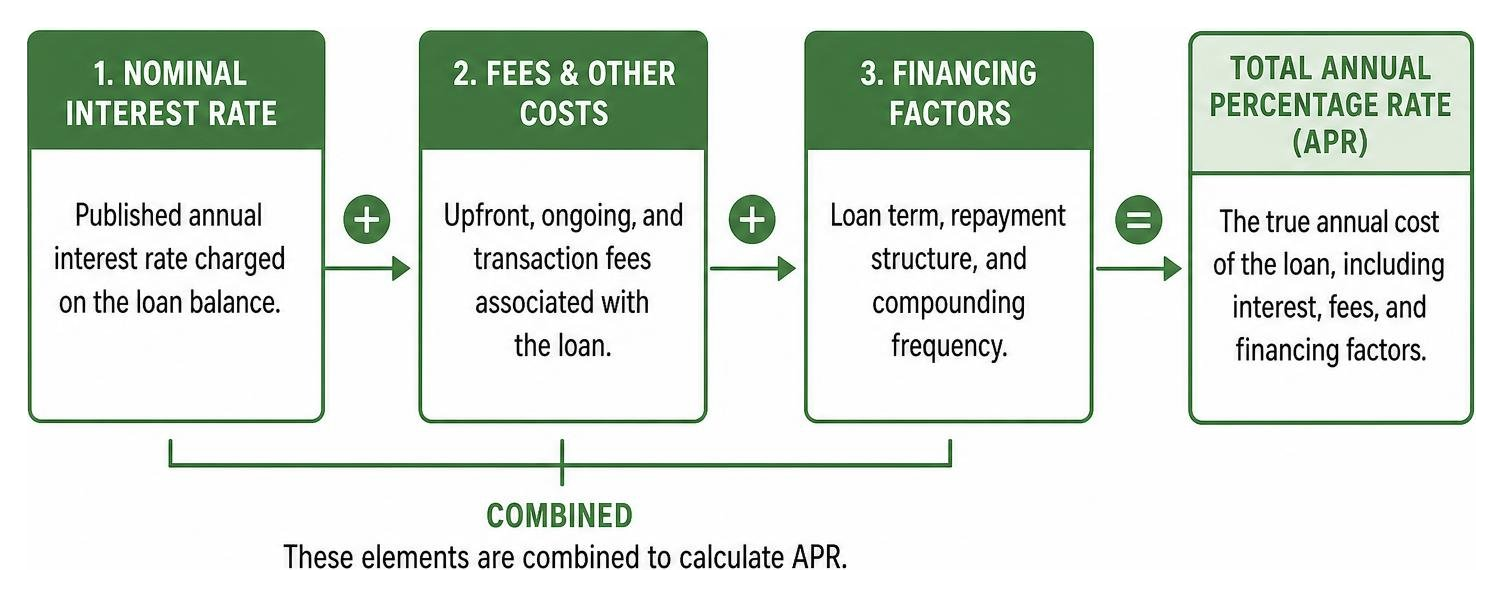
A common trap for business owners comparing loan quotes is focusing exclusively on the headline interest rate. The real cost of capital includes fees, repayment structures, and how interest is calculated over time. Converting all financing quotes into an Annual Percentage Rate (APR) is the single best way to evaluate offers on an equal footing.
Demystifying Interest Rate vs APR vs Factor Rates
To avoid paying more than expected, we must distinguish between standard interest terms and alternative financing formulas:
- Nominal Interest Rate: The percentage charged on the remaining principal balance over time. It does not include upfront loan fees.
- Annual Percentage Rate (APR): The true annual cost of borrowing. APR combines the nominal interest rate plus all mandatory upfront fees (origination, processing, underwriting) amortized over the loan term.
- Factor Rates: Common in short-term working capital and merchant cash advances, factor rates are expressed as a flat decimal multiplier (e.g., 1.15 to 1.45) applied to the total borrowed amount upfront.
Unlike APR, factor rates do not amortize over time. If you borrow $50,000 at a 1.25 factor rate, you agree to repay $62,500 ($50,000 × 1.25) regardless of how quickly you pay it off. Early payoff rarely reduces the fee total.
| Cost Metric | Simple Interest / Nominal | Annual Percentage Rate (APR) | Factor Rate (MCA) |
|---|---|---|---|
| Pricing Expression | Annual percentage (e.g., 8%) | Annual percentage (e.g., 11.5%) | Fixed decimal multiplier (e.g., 1.30) |
| Fee Inclusion | Excludes mandatory fees | Includes interest + all fees | Flat cost added to initial principal |
| Early Payoff Benefit | Reduces total interest paid | Reduces total interest paid | None (total cost fixed upfront) |
| Typical Range | 6% to 15% | 7% to 99% | 1.10 to 1.50 (25% to 100%+ APR equivalent) |
Additional Business Loan Fees Beyond Nominal Rates
When calculating your total cost of debt, make sure to review the fine print for these common financing fees:
- Origination Fees: Charged upfront by lenders to process and underwrite the loan, ranging from 1% to 10% of total principal (often deducted directly from proceeds).
- SBA Guarantee Fees: For SBA 7(a) loans, the federal government charges a guarantee fee ranging from 0.25% to 3.75% depending on loan size and maturity.
- Closing and Underwriting Costs: Commercial real estate loans and heavy term loans may incur appraisal fees, title search fees, attorney costs, and environmental audit charges.
- Draw Fees & Maintenance Charges: Lines of credit may include monthly maintenance fees, annual renewal charges, or a 1% to 2% fee every time you draw funds.
- Prepayment Penalties: Some long-term loans charge a fee if you pay off the principal early, protecting the lender’s expected interest yield.
How to Qualify for the Lowest Interest Rates on Small Business Loans
Securing competitive rates requires advance preparation and financial optimization. Proactive preparation directly opens access to lower interest rate tiers.

Strategies to Lower Your Borrowing Costs
To positions your company for lower rate offers, focus on these five steps before submitting formal applications:
- Clean Up Personal and Business Credit: Request official credit reports from Experian, Equifax, and TransUnion. Dispute reporting errors, lower personal credit card utilization below 30%, and address any outstanding liens or late payments.
- Strengthen Cash Flow Ratios: Pay down existing short-term debt to boost your Debt Service Coverage Ratio (DSCR) above 1.25x. Lenders favor businesses with strong profit margins and clean debt profiles.
- Build Average Daily Bank Balances: Maintain steady daily deposits and avoid overdrafts. Consistent daily balances demonstrate liquidity, reassuring underwriters during risk evaluations.
- Pledge Specific Assets as Collateral: If seeking lower rates, consider secured financing options like equipment or real estate loans. Pledging business assets lowers lender risk, helping unlock lower interest rates even if credit scores are mid-tier.
- Shop Multiple Lenders via Soft Credit Pulls: Seek pre-qualification with multiple bank and online lenders using soft credit inquiries. Soft pulls allow you to compare customized APR estimates without lowering your credit scores.
Market Shifts and What Is a Typical Interest Rate for a Small Business Loan Today
Macroeconomic conditions heavily influence business borrowing costs. When the Federal Reserve adjusts the federal funds rate to manage inflation, commercial banks update their prime lending rates within 30 days.
Following Federal Reserve rate adjustments, market interest rates shifted across commercial lending sectors. Recent market snapshots indicate that alternative term rates compressed slightly, with non-bank pricing easing while traditional commercial banks tightened credit standards.
For small business owners holding high-cost variable debt originated during peak-rate periods, evaluating refinancing opportunities can generate significant interest savings. Refinancing an older online term loan or line of credit into a lower-rate SBA 7(a) or conventional bank loan can yield savings of $3,000 to $15,000 per $100,000 financed annually.
Frequently Asked Questions About Business Loan Interest Rates
What is considered a good interest rate on a small business loan in 2026?
In 2026, a “good” interest rate depends on loan type, loan term, and borrower profile:
- Under 10% APR is excellent, generally reserved for prime borrowers (740+ credit) securing traditional bank or CDC/504 loans.
- 10% to 14% APR is competitive for SBA 7(a) loans, equipment loans, and premier commercial credit lines.
- 14% to 22% APR is a reasonable rate for fast online term loans serving mid-tier credit profiles.
- Above 25% APR is typical for high-risk, short-term working capital or subprime alternative products.
Are small business loan interest payments tax deductible?
Yes, interest payments on business loans are generally tax-deductible as ordinary business expenses. Under Section 163(j) of the Internal Revenue Code, small businesses with average annual gross receipts below the statutory threshold (approximately $31 million) are exempt from interest deduction limits, allowing full deduction of ordinary business interest expenses. Always consult a qualified CPA to confirm your tax situation.
How do SBA loan guarantees affect interest rates?
The SBA does not lend money directly to small businesses. Instead, it guarantees up to 75% to 85% of the loan amount issued by participating banks. This federal guarantee reduces lender risk in default scenarios, enabling partner banks to offer lower interest rates, capped margins, and longer repayment terms than non-guaranteed commercial loans.
Conclusion
Navigating business loan interest rates requires looking beyond headline numbers to evaluate total borrowing costs. While bank loans (6.37%-10.98%) and SBA options (9.75%-14.75%) deliver low pricing for qualified applicants, online alternatives offer speed at higher APRs.
To secure the lowest available borrowing costs, focus on improving personal and business credit scores, maintaining strong cash flow ratios, comparing all-in APRs, and selecting financing options tailored to your operational needs. A disciplined financing decision helps ensure that borrowed capital supports measurable improvements in revenue, cash flow, and efficiency rather than simply adding debt service pressure.
As you optimize your business capital and financial strategy, managing overall operations efficiently becomes paramount. Beyond financing, business growth requires maximizing organizational efficiency. Exploring tools like the best AI productivity solutions for modern businesses can help automate financial workflows, streamline cash flow tracking, and ensure your capital delivers maximum return on investment.