Which Bank Is Best for a Personal Loan With Low Interest?

Finding the right financial institution requires looking beyond headline figures. When evaluating which bank is best for a personal loan with low interest?, the answer largely depends on your existing banking relationships, credit score, and financial goals. To compare your options across top lenders, it is essential to evaluate loan limits, terms, and starting APRs across major institutions.
Major traditional financial institutions often offer some of the most competitive starting interest rates in the market, but their eligibility requirements are often strict:
- Large national banks: Some established banks offer fixed rates starting around 6.74% APR for existing customers who set up automatic payments from an eligible account. Qualified borrowers may access loan amounts ranging from $3,000 to $100,000 with flexible terms from 12 to 84 months, often with zero origination or prepayment fees.
- Regional banks: Some regional institutions feature rates starting as low as 5.99% APR, including an autopay discount for eligible borrowers.
- East Coast-focused banks: Certain branch-based lenders feature fixed rates starting around 7.99% APR on loans between $2,000 and $50,000, with zero origination fees or prepayment penalties and terms commonly ranging from 36 to 60 months in supported states.
- Relationship-based banks: Some banks tailor personal loan rates by credit tier, loan size, and relationship status. Existing customers may qualify for higher borrowing limits and longer repayment terms than non-customers.
- Existing-customer loan programs: Certain financial institutions offer APRs below 20% for eligible existing customers, with autopay discounts that may reach 0.50%.
Which Bank Is Best for a Personal Loan With Low Interest for Excellent Credit?
For applicants holding a FICO score of 740 or higher, online bank lending divisions and major national lenders can stand out as strong choices. Some highly qualified borrowers may find rates starting as low as 6.74% APR when enrolling in automatic payments and taking out loans from $5,000 up to $100,000.
A key feature to look for is a rate-match or rate-beat program, where a lender promises to beat a competing approved unsecured loan interest rate by a small margin, provided the competing offer meets identical terms and conditions. Borrowers with excellent credit, five or more years of credit history, steady income, and liquid assets are typically best positioned to secure low fixed rates with minimal fees.
Which Bank Is Best for a Personal Loan With Low Interest for Debt Consolidation?
Consolidating high-interest revolving credit cards into a single fixed monthly payment is one of the most effective ways to lower total borrowing costs. With average credit card interest rates exceeding 21%, securing a personal loan under 10% APR can result in substantial savings.
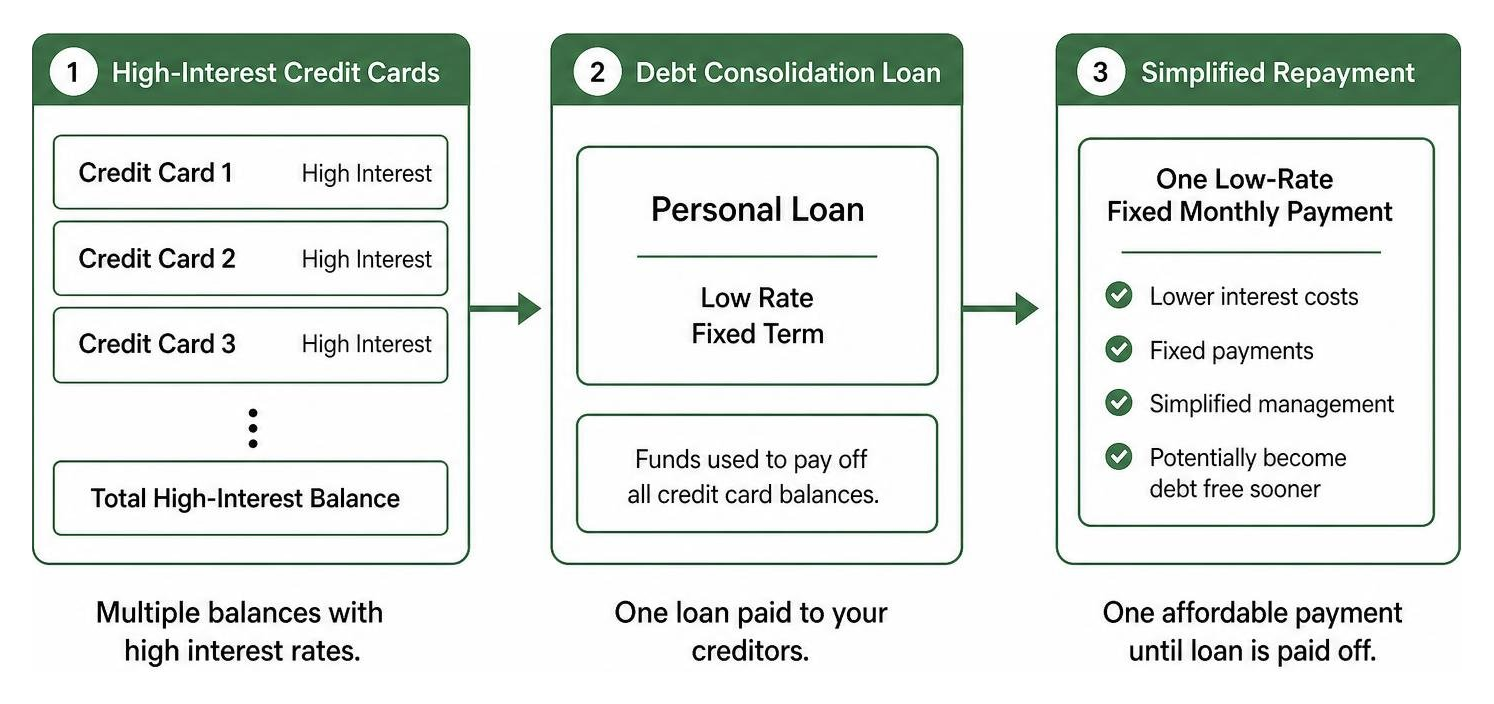
For debt consolidation, prioritize lenders that offer direct creditor pay options. Direct pay allows the lender to disburse loan funds directly to your credit card issuers, preventing the temptation to spend the money elsewhere while immediately lowering your credit utilization ratio.
For example, consolidating $10,000 in credit card debt at 22.15% APR into a 24-month personal loan at 11.86% APR can cut total interest expenses nearly in half, saving over $1,100 over two years.
Comparing Banks, Credit Unions, and Online Lenders

When shopping for fixed-rate funding, comparing traditional brick-and-mortar institutions against credit unions and online lenders is essential.
| Feature | Major Traditional Banks | Credit Unions | Specialized Online Lenders |
|---|---|---|---|
| Lowest Starting APRs | 5.99% – 6.74% | 6.99% – 8.74% | 5.74% – 7.24% |
| Relationship Discounts | 0.25% – 0.50% | Varies by membership tier | Rare |
| Customer Eligibility | Often restricted to existing customers | Requires union membership | Open to general public |
| Funding Speed | 1 to 4 business days | 2 to 5 business days | As fast as 24 hours |
| Origination Fees | Usually $0 | Usually $0 | 0% to 10%+ |
Rate Discounts and Customer Relationship Perks
Setting up automatic payment deductions from a checking or savings account is the easiest way to trim interest charges. Most major financial institutions reward existing account holders with rate reductions:
- 0.25% APR Discount: Common among banks and online lenders that reward borrowers for enrolling in automatic payments.
- 0.50% APR Discount: Available through some relationship-based loan programs and online lending platforms for eligible applicants.
Beyond autopay discounts, maintaining a primary checking account or higher deposit balances with a financial institution can unlock higher borrowing limits, sometimes up to $50,000 or $100,000, and longer repayment terms up to 84 months.
Fee Structures and Funding Speed
When assessing loan expenses, always compare the Annual Percentage Rate (APR) rather than the base interest rate alone, as the APR reflects upfront fees.
- Fee Structures: Many top traditional banks charge zero origination fees, zero late fees, and zero prepayment penalties. Conversely, some online marketplace lenders charge origination fees ranging from 1% to 10%, which are deducted directly from loan proceeds.
- Funding Timeline: Electronic disbursement typically takes 1 to 4 business days following final approval. However, some lenders offer same-day funding if applications are finalized before early afternoon cutoff times, such as 2:30 PM ET for certain wire transfers.
How Credit Scores Impact Personal Loan Interest Rates
Your credit score is the single most influential factor in determining your final APR offer. Financial institutions use credit tiers to calculate risk and price their loan products accordingly.
Data representative of 36-month unsecured personal loan market averages.
Market analysis reveals that a borrower with an exceptional credit score taking out a $15,000 loan over 36 months can save upwards of $650 to $1,100 in overall interest compared to a borrower in a lower credit tier. For detailed breakdown calculations on interest savings, see How Much Could You Save With a Low APR Personal Loan?.
Securing Low APRs with Fair or Bad Credit
If your credit score falls into the fair or poor ranges (below 670), securing a single-digit APR from a major bank can be challenging. However, several strategies can help lower borrowing costs:
- Apply with a Creditworthy Co-Signer: Adding a co-signer or co-borrower with an excellent credit profile (740+) and stable income drastically reduces lender risk, unlocking lower interest rate tiers.
- Opt for a Secured Loan: Placing an asset—such as a savings account, certificate of deposit (CD), or vehicle—up as collateral reduces risk for the bank, resulting in significantly lower rates than uncollateralized options.
- Prequalify via Soft Credit Checks: Always prequalify with multiple lenders before submitting formal paperwork. Soft credit inquiries allow you to preview estimated APRs without impacting your credit score.
- Lower Credit Utilization First: Paying down revolving card balances right before your monthly billing statement closes can instantly boost your credit score prior to submitting a loan application.
How to Qualify for the Lowest Bank Personal Loan Rates in 2026
To position yourself for the lowest advertised personal loan rates, follow this step-by-step qualification roadmap:
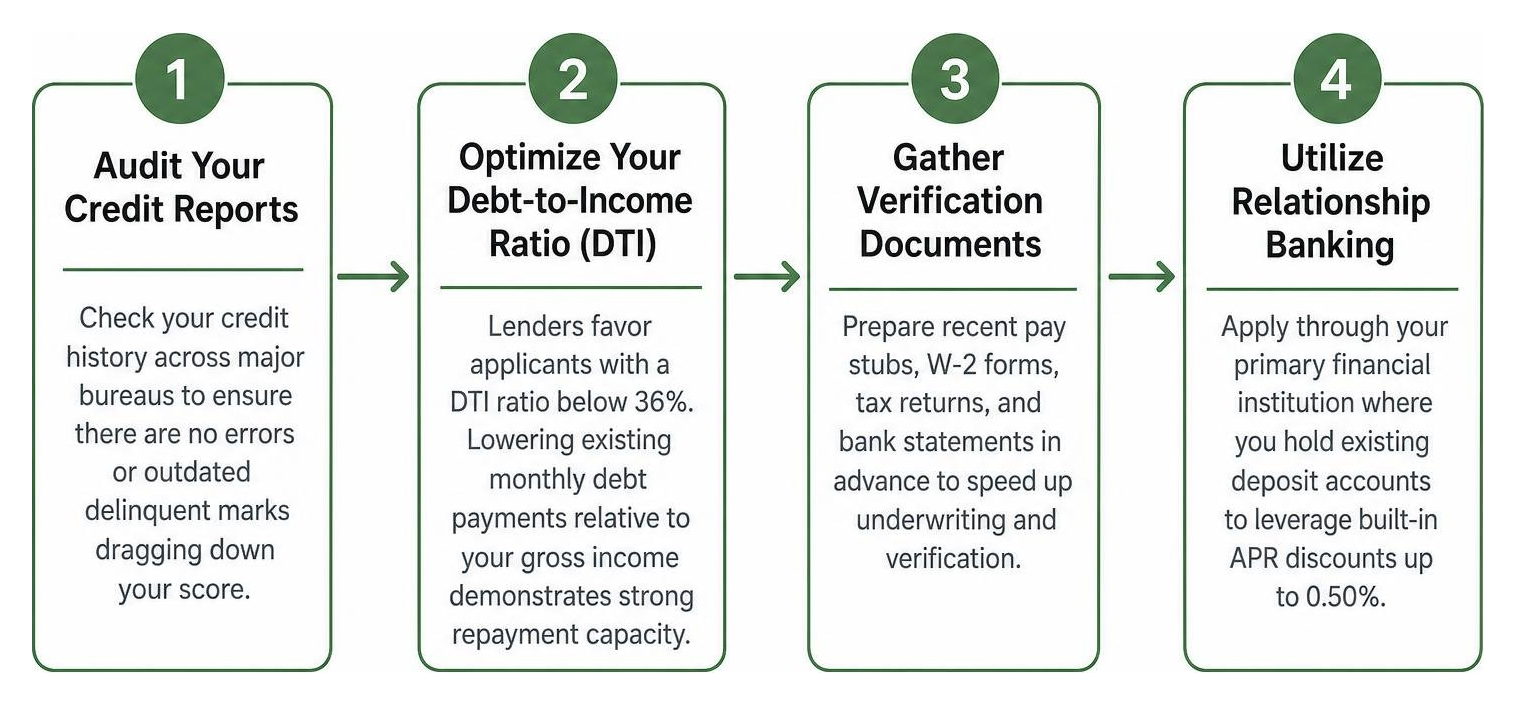
- Audit Your Credit Reports: Check your credit history across major bureaus to ensure there are no errors or outdated delinquent marks dragging down your score.
- Optimize Your Debt-to-Income Ratio (DTI): Lenders favor applicants with a DTI ratio below 36%. Lowering existing monthly debt payments relative to your gross income demonstrates strong repayment capacity.
- Gather Verification Documents: Prepare recent pay stubs, W-2 forms, tax returns, and bank statements in advance to speed up underwriting and verification.
- Utilize Relationship Banking: Apply through your primary financial institution where you hold existing deposit accounts to leverage built-in APR discounts up to 0.50%.
Choosing the Right Repayment Term and Loan Amount
Selecting your loan term involves balancing your monthly budget against overall interest expense:
- Shorter Terms (24 to 36 Months): Feature higher monthly installment payments, but carry significantly lower interest rates and lower total interest paid over the life of the loan.
- Longer Terms (60 to 84 Months): Provide smaller, more manageable monthly payments, but incur higher fixed APRs and accumulate substantially higher cumulative interest expenses.
Always borrow the exact amount required rather than accepting maximum approved limits to avoid paying unnecessary interest over time.
Frequently Asked Questions About Low-Interest Bank Loans
What is considered a good interest rate on a bank personal loan in 2026?
An APR below 10% is generally considered a good interest rate for an unsecured personal loan in 2026. Top-tier applicants with credit scores above 740 can qualify for rates between 5.99% and 8.00%, whereas average personal loan rates across all credit tiers sit slightly above 12%.
How fast can I get funds after my personal loan is approved?
Funding timelines vary by institution. Many major banks deposit electronic funds within 1 to 3 business days via ACH direct deposit. Certain lenders offer same-day funding for approved applications completed prior to early afternoon cutoff times.
Does checking my personal loan interest rate affect my credit score?
Initial prequalification uses a soft credit check, which does not impact your credit score. A hard credit inquiry, which may temporarily dip your score by a few points, only occurs when you formally accept a loan offer and complete the full application.
Conclusion
When determining which bank is best for a personal loan with low interest?, major banks, credit unions, and online lending platforms can all offer competitive fixed APRs, with the lowest advertised rates sometimes starting below 7% for highly qualified borrowers. To maximize your savings, shop around using soft-check prequalifications, enroll in automated payment discounts, and keep your repayment terms as short as comfortably possible.
Managing your personal finances and researching loan terms requires organization and time. Using modern tools like AI productivity tools in 2026 can help streamline your financial research, automate budget tracking, and simplify complex decision-making processes.