Essential Coverage Types: Business Insurance for Self Employed in California for Small Business
Scr0ll d0wn to D0VVNL0AD

For self-employed Californians building lean, tech-enabled businesses, insurance is part of the same operational foundation as productivity systems, client workflows, and financial tracking. Aixoria readers often use AI tools to work faster, automate admin, and serve more clients with fewer resources; the right coverage helps protect that progress from lawsuits, contract requirements, data-related disruptions, and unexpected property losses.
Navigating the landscape of business insurance for self employed in california for small business operations starts with understanding your specific exposures. Single-person operations do not need blanket, blanket-coverage plans designed for massive corporations; rather, you need targeted protections that address your day-to-day work environment, client interactions, digital tools, and business assets.
When searching for California Business Insurance , most independent contractors, freelancers, consultants, creators, and sole proprietors begin by evaluating two primary foundational safeguards: general liability and professional liability insurance.
General Liability vs Professional Liability Coverage
While both coverages protect your business against claims, they cover fundamentally different types of risks. The diagram below illustrates how third-party physical risks differ from service-based professional risks:
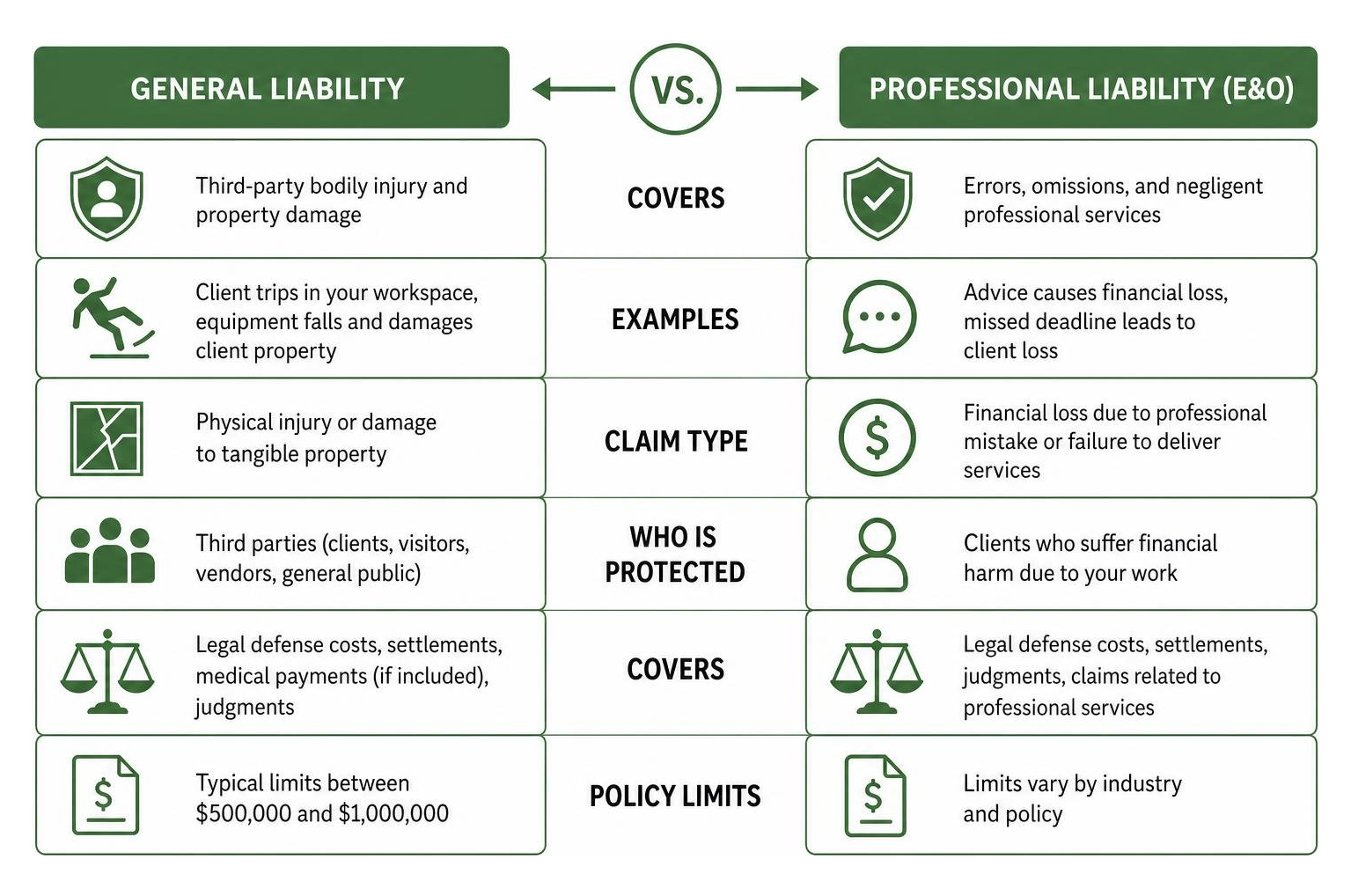
General liability insurance handles third-party physical claims. If a client visits your workspace and trips over an extension cord, or if you accidentally drop a heavy piece of equipment on a customer’s hardwood floor while working on-site, general liability steps in. It covers bodily injury, third-party property damage, and associated legal defense costs. On average, small business owners in California pay around $42 per month for standard general liability coverage, with typical policy limits ranging between $500,000 and $1,000,000.
Professional liability insurance, often called Errors and Omissions (E&O), protects against non-physical, service-related claims. If a client claims your consulting advice led to a severe revenue drop, an automation workflow was implemented incorrectly, or an administrative oversight caused them a major financial delay, professional liability handles the legal fees, court defense costs, and potential settlements. In California, average professional liability premiums hover around $94 per month, depending heavily on your specific industry.
| Coverage Feature | General Liability | Professional Liability (E&O) |
|---|---|---|
| Primary Exposure | Physical injuries & property damage | Financial loss from advice or service errors |
| Typical Trigger | Slip-and-fall, accidental property harm | Breach of contract, missed deadlines, typos |
| Legal Costs Covered | Defense costs for third-party injury claims | Defense costs for professional negligence claims |
| Commonly Required By | Commercial landlords, event venues | Enterprise clients, government agencies |
Business Owner’s Policy Bundles and Home-Based Coverage
For self-employed individuals who need physical property protection alongside general liability, buying separate policies can quickly become expensive. A California Business Owners Policy (BOP) | Property + GL Bundled combines general liability, commercial property coverage, and business interruption insurance into a single package. Purchasing a BOP typically saves sole proprietors 30% to 50% compared to buying these coverages individually.
A common pitfall for home-based solopreneurs is assuming that personal homeowners or renters insurance protects their business assets. Standard home policies explicitly exclude business-related liabilities and usually cap business personal property claims at a low limit, often around $2,500. If high-value equipment, inventory, client files, or business devices used for AI-assisted workflows are damaged or stolen from your home workspace, a standard homeowners policy will likely reject the claim. Adding a commercial endorsement or securing a BOP ensures both your physical property and business continuity are fully backed.
California Business Insurance Mandates and Legal Requirements

While California offers freedom to entrepreneurs, state regulations enforce strict compliance rules around specific operational activities. For solo consultants, AI-enabled service providers, independent creatives, and local tradespeople alike, operating legally means understanding where voluntary coverage ends and state-mandated protection begins.
California Workers’ Compensation Rules for Solo Operators
Under California law, any business with one or more employees, even part-time or seasonal staff, must carry workers’ compensation insurance. Average state premiums run around $63 per month, but rates vary based on total company payroll and job risk classifications.
For single-person LLCs, S-Corporations, or sole proprietorships without any employees, workers’ compensation is generally optional. However, key statutory exceptions exist:
- Licensed Construction Contractors: Under the California Contractors State License Board (CSLB), trade contractors in specific classifications, such as HVAC, concrete, plumbing, or carpentry, are legally required to carry workers’ compensation insurance or file an approved certification, even if they operate completely alone with zero employees.
- Commercial Leases and Client Contracts: General contractors and commercial landlords often require solo subcontractors to hold active workers’ compensation policies before stepping onto a job site or signing a lease. Larger business clients may also request proof of coverage from consultants, automation specialists, and other independent vendors before work begins.
To verify your specific industry requirements, you can review current state guidelines on California Business Insurance, General Liability Insurance | TechInsurance .
Operating Without Business Insurance for Self Employed in California for Small Business Risk Analysis
Operating without adequate coverage carries severe financial consequences. Personal auto policies will not pay for collisions occurring during commercial tasks, personal home policies exclude business slip-and-falls, and personal health insurance excludes workplace injuries.
Without commercial policies, you become personally liable for:
- Out-of-pocket legal defense fees when faced with client lawsuits or third-party injury claims.
- Court judgments, medical bills, and property repair costs that directly threaten personal savings and home equity.
- Loss of client contracts, as most enterprise clients and commercial partners require a Certificate of Insurance (COI) prior to issuing payments.
- License suspensions or state fines if operating without legally mandated coverage lines like mandatory commercial auto liability or CSLB-mandated workers’ compensation.
For modern solo businesses that rely on software, automation, and repeatable client delivery systems, insurance also supports credibility. A clear COI can help prove that your one-person business is structured professionally enough to work with larger organizations.
Cost Factors and Tax Deductions for Sole Proprietors

Managing overhead is essential when running a single-person business. Understanding how insurance carriers calculate risk, and how the IRS treats eligible business expenses, helps keep premiums manageable while supporting a more resilient operating system.
Finding Affordable Business Insurance for Self Employed in California for Small Business Owners
Insurance providers determine your commercial premiums using key operational factors:
- Industry Risk Rating: High-risk physical trades, like roofing or tree trimming, face higher liability rates than low-risk digital services, like copywriting, web design, virtual assistance, or AI workflow consulting.
- Location and Exposure: Operating in densely populated urban centers or areas prone to natural hazards increases property and liability premiums.
- Annual Revenue and Coverage Limits: Higher gross revenue and higher policy limits, such as $1 million vs. $2 million thresholds, directly impact annual costs.
- Claims History: Maintaining a clean claims record over several years earns valuable carrier discounts.
To keep costs low, shop independent digital brokers to compare active carrier quotes side by side. Flexible providers allow you to scale limits up or down depending on your current client contract demands. Keeping organized records of contracts, invoices, claims history, and equipment purchases can also make quote comparisons easier, especially for self-employed owners who already use AI-assisted productivity tools to manage admin work.
Tax Deductions for Commercial Premiums and Health Coverage
One major financial advantage for self-employed individuals is that commercial insurance premiums are generally 100% tax-deductible as necessary business expenses.
When filing your federal tax return, write off your commercial policies, such as general liability, professional liability, BOP, commercial auto, and cyber risk, on Schedule C (Form 1040). Furthermore, eligible sole proprietors can deduct qualifying personal health insurance premiums for themselves, their spouse, and dependents directly on Schedule 1 as an adjustment to income. This self-employed health insurance deduction reduces your overall adjusted gross income (AGI), softening your total tax burden while keeping you protected.
For California freelancers and small business owners, the practical takeaway is simple: treat insurance as part of your operating budget, not just a compliance expense. When your tools, taxes, contracts, and coverage are organized together, you can make faster decisions about pricing, client risk, and long-term profitability.
Navigating Health Insurance and State Disability Options
Beyond commercial property and liability protection, self-employed Californians must secure their personal health and income continuity. This is especially important for one-person businesses where the owner is also the strategist, producer, salesperson, and operator behind every client deliverable.
Covered California and Health Insurance Marketplace
Sole proprietors in California obtain health insurance through Covered California, the state’s official ACA health exchange. Unlike corporate employees with fixed W-2 income statements, self-employed individuals base their health plan subsidies on projected net income (gross business revenue minus allowable business expenses) for the upcoming coverage year.
Subsidies, known as Advance Premium Tax Credits (APTC), reduce monthly health insurance premiums across standardized ACA metal tiers (Bronze, Silver, Gold, Platinum). Because income fluctuates for freelancers, it is vital to update your Covered California account mid-year if net earnings rise or fall significantly. Updating your profile prevents unexpected tax repayments or missing out on lower premiums during tax season.
For solo operators using AI tools to expand capacity, projected income may change quickly as new clients, retainers, or digital services are added. Reviewing health insurance estimates alongside quarterly financial planning helps prevent surprises.
Disability Insurance Elective Coverage (DIEC)
Because self-employed individuals do not pay mandatory State Disability Insurance (SDI) payroll taxes, an unexpected injury or illness can disrupt personal earnings. The California Employment Development Department (EDD) addresses this gap through Disability Insurance Elective Coverage.
Enrolling in the DIEC program provides voluntary access to two vital state-backed benefits:
- Disability Insurance (DI): Provides partial wage replacement if you are unable to work due to a non-work-related illness, injury, or pregnancy.
- Paid Family Leave (PFL): Offers financial relief when taking time off to care for a seriously ill family member or bond with a new child.
Enrolling in DIEC gives independent contractors an affordable, state-backed safety net that protects individual cash flow during unexpected personal medical emergencies.
Frequently Asked Questions About California Business Insurance
Does personal homeowners insurance cover a home-based business in California?
No. Standard California homeowners policies generally exclude business liability and impose strict sub-limits, frequently $2,500 or less, on business personal property. If a client trips inside your home office or commercial gear is stolen from your garage, a standard homeowners policy will typically deny the claim. You must purchase a commercial endorsement, standalone general liability, or a Business Owner’s Policy (BOP) to ensure full coverage.
This matters for digital solopreneurs as much as it does for local service providers. Laptops, cameras, monitors, work phones, inventory, and other tools used to run AI-assisted or online operations may need commercial protection.
Is commercial auto insurance required if I use my personal vehicle for work?
If you use your personal car to transport tools, carry job inventory, deliver products, or transport clients, personal auto insurance policies will likely exclude accidents that occur during those activities. California law mandates business vehicle coverage limits of at least $30,000 for bodily injury per person, $60,000 for bodily injury per accident, and $15,000 for property damage (30/60/15). If you drive a personal car for occasional business errands, adding Hired and Non-Owned Auto (HNOA) coverage to your business policy fills critical liability gaps.
Can I deduct business insurance premiums on my California state tax return?
Yes. Commercial insurance premiums, including general liability, professional liability, commercial auto, and property coverage, are fully deductible on Schedule C as ordinary business expenses. Additionally, self-employed individuals may deduct qualified personal health insurance premiums on their tax returns, reducing both federal and California state tax obligations.
For better year-end records, keep policy documents, receipts, renewal notices, and client COI requests organized with the rest of your business finance records.
Conclusion
Securing business insurance for self employed in california for small business success comes down to assessing your real operational risks and buying policies that address them directly. By securing foundational general liability or professional liability policies, taking advantage of bundled Business Owner’s Policies, staying compliant with state mandates, and leveraging state health and disability programs, you protect both your personal assets and professional reputation.”https://www.mediafire.com/file/nvle5y36cezp1xq/Zoo_Builder_BY_MCMPDL%25E2%2580%25A2COM.mcaddon/file“;
For California solopreneurs, insurance works best when it is treated as part of a broader productivity and risk-management system. The same disciplined approach used to select AI tools, organize client work, track finances, and automate routine tasks should also guide how you choose coverage, maintain policy documents, and respond to client contract requirements.
As your client roster grows, evaluating modern operational tools helps maintain long-term momentum. Discover how cutting-edge tools elevate your day-to-day business operations by exploring what is the best AI for productivity. Smart protection paired with efficient management ensures your California business stays resilient and ready for long-term growth.