Health Insurance for Self Employed in California: The Quick Answer
Scr0ll d0wn to D0VVNL0AD

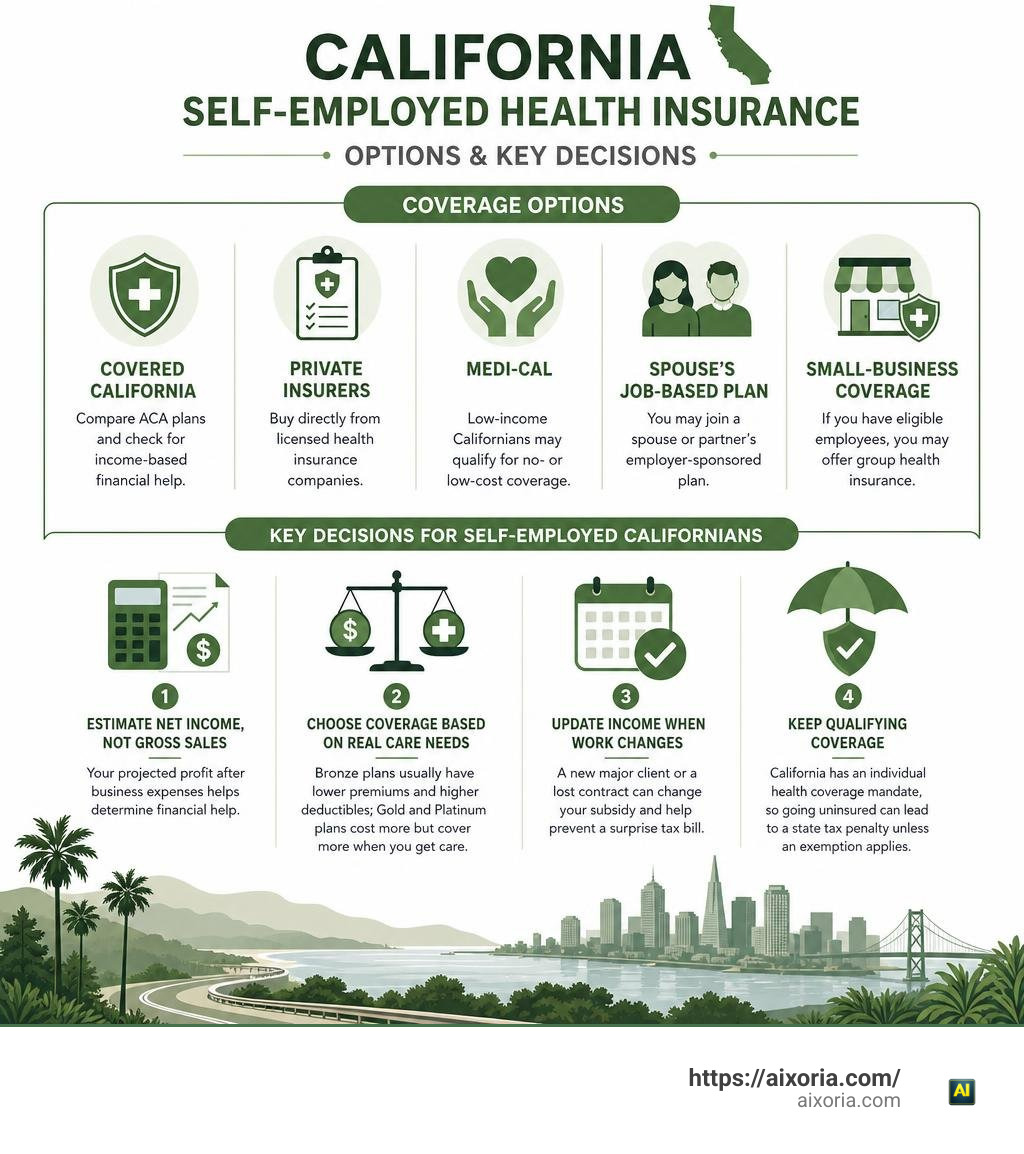
Health insurance for self employed in california is available through Covered California, private insurers, Medi-Cal, a spouse’s job-based plan, or small-business coverage if you have eligible employees.
For most freelancers, independent contractors, gig workers, and solo business owners, the best first stop is Covered California. It lets you compare ACA-compliant plans, check for income-based financial help, and apply for Medi-Cal if a low-income business year makes you eligible.
- Estimate net income, not gross sales. Your projected profit after business expenses helps determine financial help.
- Choose coverage based on real care needs. Bronze plans usually have lower premiums and higher deductibles; Gold and Platinum plans generally cost more each month but cover more when you get care.
- Update income when work changes. A new major client or a lost contract can change your subsidy and help prevent a surprise tax bill.
- Keep qualifying coverage. California has an individual health coverage mandate, so going uninsured can lead to a state tax penalty unless an exemption applies.
Self-employment offers freedom, but it also means you are often your own benefits department. That matters: more than one in four subsidized Covered California enrollees are self-employed. For many people, coverage is not just a medical decision. It is tied to uneven income, tax planning, and the ability to keep building a business without risking a major medical bill.
This guide explains the options, the 2026 subsidy changes, tax deductions, HSAs, Medi-Cal, and the practical choices that matter when your income does not look the same every month.
Coverage Options for Health Insurance for Self Employed in California

When we trade a traditional W-2 job for the freedom of running our own business in California, we leave behind human resources departments and ready-made benefits packages. Nationally, self-employed individuals represent approximately 10% of the labor force. Since the Affordable Care Act (ACA) marketplaces launched, the national uninsured rate among self-employed workers fell dramatically from 27.3% in 2013 down to 16.4% in 2022. In California alone, roughly 28% of subsidized marketplace enrollees—over 426,000 individuals—are freelancers, gig workers, and independent entrepreneurs.
Finding the right health insurance for self employed in california comes down to understanding which avenue fits your business setup, medical usage, and household budget. Here are the primary pathways available to us:
- Covered California (Individual Marketplace): The state-run portal where solo freelancers and independent contractors purchase individual policies, often backed by state and federal premium subsidies.
- Private Off-Exchange Plans: Individual coverage purchased directly from insurance carriers or through brokers outside the official state marketplace.
- Medi-Cal: California’s Medicaid program, which offers comprehensive, zero- or low-cost health coverage to residents whose net earnings drop during low-income business years.
- Covered California for Small Business (CCSB): Group health coverage for business owners who employ at least one non-family W-2 worker.
- Specialized Multi-Employer Plans: Industry-specific group health benefit plans tailored for niche freelance sectors.
Covered California vs. Private Insurance
A common question we hear from freelancers is whether to buy through Covered California or shop on the private market.
All plans sold on Covered California and standard private individual plans are fully ACA-compliant. They guarantee coverage regardless of pre-existing conditions and cover the ten Essential Health Benefits, including preventive screenings, prescription drugs, emergency services, mental health care, and maternity care.
The main difference lies in financial assistance and plan availability:
- On-Exchange (Covered California): This is the only place where you can claim Advance Premium Tax Credits (APTC) and Cost-Sharing Reductions (CSR). If your household income falls within eligible subsidy brackets, purchasing on-exchange reduces your monthly premium.
- Off-Exchange (Private Market): Private plans offer identical essential protections, but you pay the full sticker price with no federal or state subsidies. Private plans can sometimes be beneficial if you do not qualify for financial aid and want access to specific regional networks or niche carrier benefit packages not listed on the exchange.
Specialty and Industry Coverage Options
If your business structure includes non-family employees, your options expand beyond individual coverage. Once you hire even one full-time equivalent W-2 employee who is not a co-owner or family member, you transition from individual marketplace eligibility to small-group coverage. Covered California for Small Business (CCSB) and private small-group plans allow you to offer employee benefits while taking advantage of small business health care tax credits.
For freelancers in specific creative fields, specialized industry programs offer tailored benefits. For instance, commercial production freelancers may access the Producers’ Health Benefit Plan, a multi-employer plan designed to provide employer-subsidized health coverage based on cumulative days worked or total industry earnings across participating employers.
All individual and small-group health plans operating in the state must comply with strict statutory standards, including the California Department of Insurance filing standards for individual, small group, and exchange products.
How to Calculate Income and Claim 2026 Subsidies
Getting the most out of health insurance for self employed in california requires understanding how subsidies work. Unlike W-2 employees who receive a predictable pay stub, self-employed workers must estimate their forward-looking income for the upcoming coverage year.
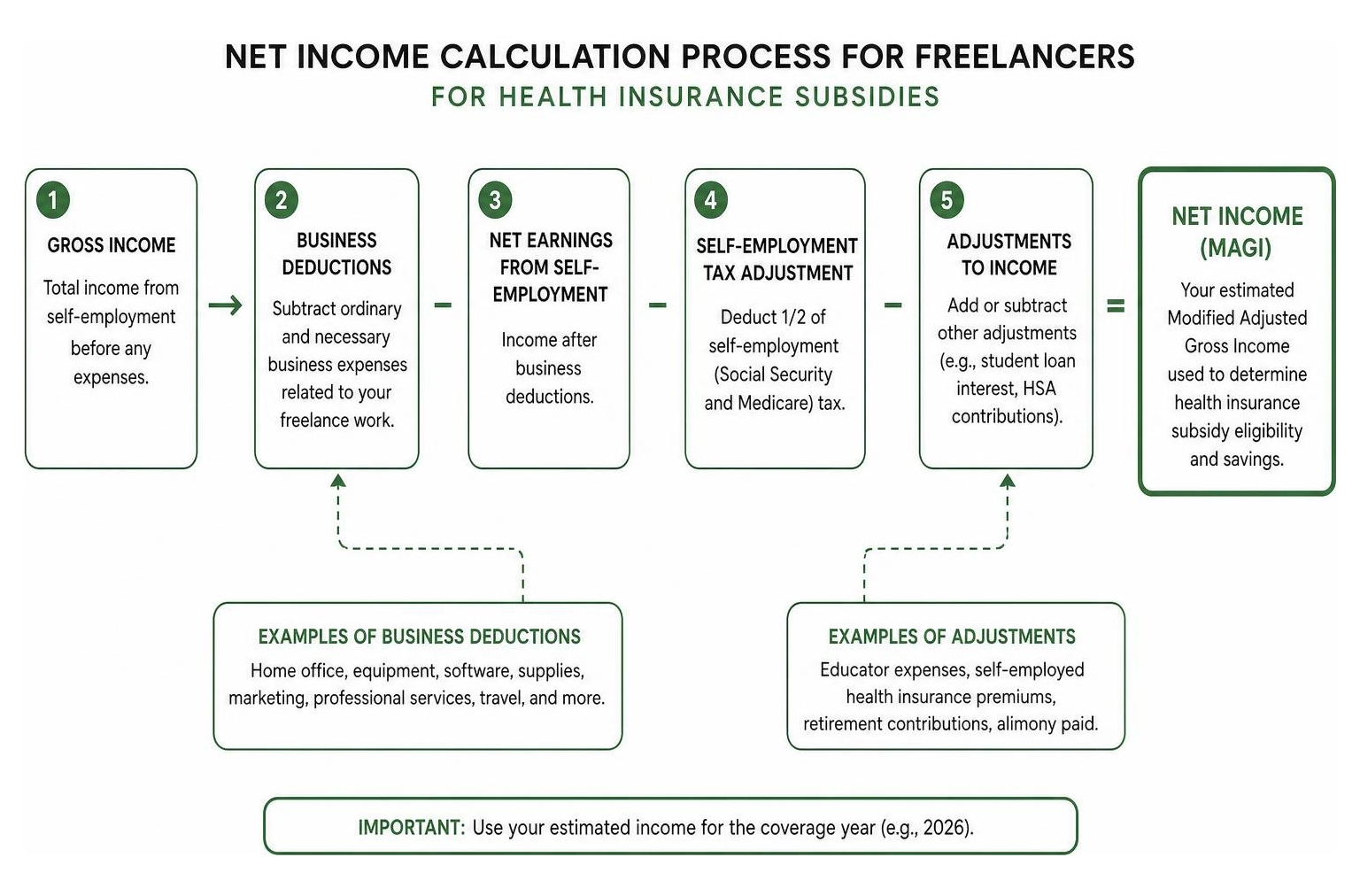
Financial help on Covered California is calculated using your estimated Modified Adjusted Gross Income (MAGI) for the calendar year you will be covered—not your prior year’s tax return.
Calculating Net Income for Health Insurance for Self Employed in California
To calculate your MAGI correctly, start with your projected gross business revenue and subtract allowable business deductions. For sole proprietors reporting on IRS Schedule C, your starting baseline is your net profit (Line 31 of Schedule C), not your gross receipts.
Here is the basic formula we use to calculate projected net self-employment income:
- Gross Business Revenue: Total incoming payments from clients, invoice collections, and platform sales.
- Minus Allowable Schedule C Expenses: Advertising, office supplies, software subscriptions, professional services, platform fees, home office deductions, business travel, and vehicle mileage (deducted at standard federal rates).
- Minus Adjustments to Income: Deductions such as the self-employed health insurance deduction, half of your self-employment tax (SE tax), and tax-deferred retirement contributions made to a Solo 401(k) or SEP-IRA.
Maximizing legitimate business deductions and contributing to tax-deferred retirement accounts directly lowers your overall MAGI. This dual strategy lowers your income tax burden while simultaneously qualifying you for higher monthly health insurance subsidies.
2026 Subsidy Rules and Expiring Credits
Understanding the 2026 financial help environment is crucial for budgeting. In prior years, federal legislation provided Enhanced Premium Tax Credits that expanded financial help to middle-income earners and capped premium spending. With those enhanced credits expiring, baseline ACA rules dictate subsidy availability in 2026.
According to Covered California subsidy research, 90% of self-employed Covered California members earn less than 400% of the federal poverty level ($58,320 per year for an individual based on 2024 baseline calculations). Middle-income self-employed individuals earning above 400% FPL face a potential “subsidy cliff,” where full retail premiums could account for a significantly higher portion of their annual earnings without enhanced subsidies.
To help evaluate your options, the table below outlines the core differences across Covered California’s metal plan tiers:
| Plan Metal Tier | Average Monthly Premium | Actuarial Value (Plan Pays) | Member Pays (Deductible/Co-pays) | Ideal For |
|---|---|---|---|---|
| Bronze | Lowest | 60% | High out-of-pocket costs & deductibles | Healthy individuals seeking protection against catastrophic costs |
| Silver | Moderate | 70% (Up to 94% with CSRs) | Balanced copays and manageable deductibles | Frequent care seekers earning under 250% FPL (CSR eligible) |
| Gold | High | 80% | Low deductibles and predictable copays | Individuals with chronic health conditions or ongoing specialist needs |
| Platinum | Highest | 90% | Minimal out-of-pocket costs, zero deductible | High healthcare users who want maximum cost predictability |
Navigating Medi-Cal for Low-Income Business Years
Freelance revenue flows in cycles. A slow year, lost contracts, or startup investments can temporarily push your net business profit down. If your estimated annual household MAGI falls below 138% of the federal poverty level (approximately $20,783 for a single individual in 2026), Covered California automatically routes your application to Medi-Cal.
Medi-Cal provides comprehensive health coverage with no monthly premiums and minimal out-of-pocket costs. Landing on Medi-Cal during a low-revenue year is not a setback; it serves as a vital safety net that keeps you protected without draining your working capital. When your business rebounds and revenue increases, you simply update your application to transition back to a subsidized Covered California marketplace plan.
Choosing Plan Metal Tiers and HSA Strategies in 2026

Selecting the right plan metal tier depends on balancing monthly premium costs against out-of-pocket medical expenses.
- Bronze Plans (60% Actuarial Value): These plans feature the lowest monthly premiums but higher deductibles. They protect your business assets against catastrophic medical events while keeping fixed monthly expenses low.
- Silver Plans (70% Actuarial Value): Silver plans are the sweet spot for many self-employed individuals. If your household income qualifies for Cost-Sharing Reductions (CSR) (available to those earning under 250% FPL), enrolling in an enhanced Silver plan automatically lowers your deductible, copays, and maximum out-of-pocket limits to match Gold or Platinum levels.
- Gold (80%) and Platinum (90%) Plans: These tiers carry higher monthly premiums but offer low or zero deductibles and minimal copays. They suit those who require regular medical care, prescription drugs, or ongoing specialist visits.
Maximizing Health Savings Accounts (HSAs) with Health Insurance for Self Employed in California
Combining a High-Deductible Health Plan (HDHP) with a Health Savings Account (HSA) is one of the most effective strategies for self-employed workers. Starting in 2026, Covered California Bronze and minimum coverage plans qualify as HSA-compatible high-deductible health plans.
HSAs offer a powerful triple tax advantage for business owners:
- Tax-Deductible Contributions: Money deposited into your HSA reduces your taxable income dollar-for-dollar on your federal and state tax filings.
- Tax-Free Growth: Capital gains, interest, and investment growth inside your HSA account accumulate completely tax-free.
- Tax-Free Withdrawals: Withdrawals used for qualified medical expenses—including dental, vision, prescription drugs, and copays—are never taxed.
For 2026, single individuals can contribute up to $4,300 per year to an HSA, while family coverage allows contributions up to $8,550 (with an additional $1,000 catch-up contribution available for individuals aged 55 and older). Unused funds roll over indefinitely from year to year, allowing your HSA to function as an additional long-term investment vehicle for healthcare in retirement.
Tax Deductions, Regulations, and California Mandate Penalties
One major financial advantage of buying health insurance for self employed in california is the ability to write off premium costs. Eligible self-employed individuals can claim 100% of their paid medical, dental, and vision insurance premiums as an above-the-line deduction on Schedule 1 of IRS Form 1040.
Key rules for claiming the self-employed health insurance deduction include:
- Net Profit Requirement: Your total deduction cannot exceed the net earned profit of the business under which the coverage is established.
- Employer Coverage Exclusion: You cannot claim the deduction for any month in which you were eligible to participate in an employer-sponsored health plan offered by your employer or your spouse’s employer.
- IRS Form 7206: Taxpayers must complete IRS Form 7206 (which replaced the old Publication 535 worksheet) to calculate the self-employed health insurance deduction accurately.
- Interaction with APTC: Premiums paid using Advance Premium Tax Credits must be reconciled on IRS Form 8962 using information provided on your end-of-year IRS Form 1095-A. Only the actual out-of-pocket premium portion paid after applying subsidies qualifies for the Schedule 1 tax deduction.
The California State Individual Mandate
In California, health insurance is required by law. The state enforces an individual health care mandate managed by the Franchise Tax Board (FTB).
If you go without qualifying minimum essential coverage during the tax year, you may face a state tax penalty when filing your California tax return. The standard penalty is calculated as either a flat fee per uninsured household member (at least $900 per adult and $450 per dependent child) or 2.5% of your annual household income above the state tax filing threshold, whichever amount is greater. Maintaining continuous coverage protects both your health and your business balance sheet.
Frequently Asked Questions About California Freelancer Health Coverage
What happens if my self-employment income changes during the coverage year?
When your earnings fluctuate, you should report any significant income shift to Covered California within 30 days. If your net income increases unexpectedly and you do not update your profile, you may receive more Advance Premium Tax Credit (APTC) than you are entitled to, which will require repayment when filing your federal tax return. Conversely, if your net business profit declines, updating your application right away increases your monthly subsidy or qualifies you for cost-sharing reductions to keep monthly premiums manageable.
Can I deduct my health insurance premiums if my spouse has employer-sponsored coverage?
You cannot claim the self-employed health insurance tax deduction on Schedule 1 for any month you were eligible to join a spouse’s employer-sponsored health plan, even if you chose not to enroll. Additionally, for Covered California marketplace subsidies, spouse job-based coverage is evaluated under the 2026 affordability test. Employer coverage is deemed affordable if the employee’s required contribution for individual or family coverage does not exceed 9.96% of household income. If the job-based coverage is affordable under this threshold, your household is generally ineligible for marketplace premium tax credits.
Is short-term health insurance a valid option for self-employed Californians?
Short-term health plans are not a recommended alternative for California freelancers. Under California state law, standard short-term medical plans are strictly regulated and restricted because they do not provide minimum essential coverage, routinely exclude pre-existing conditions, and do not cover essential health benefits. Furthermore, carrying short-term coverage leaves you exposed to California’s Franchise Tax Board individual mandate tax penalty. Sticking with an ACA-compliant marketplace or private plan ensures full legal compliance and broad clinical coverage.
Conclusion
Navigating health insurance for self employed in california does not have to be overwhelming. By accurately calculating your projected net self-employment income, leveraging tax deductions on IRS Form 7206, and pairing high-deductible Bronze plans with Health Savings Accounts, you can secure affordable health coverage that protects both your physical well-being and your financial independence.”https://www.mediafire.com/file/wjhrd6lekcphk99/Huggy_Friends_BY_MCMPDL%25E2%2580%25A2COM.mcaddon/file“;
Make it a habit to review your projected business profits quarterly, update your marketplace account whenever client contracts shift, and maintain continuous coverage to stay compliant with state mandates. Taking control of your benefits strategy ensures that your independent career remains sustainable for years to come.
For more insights on optimizing modern workflows, leverage emerging technology, and growing your business, explore the latest guides on AI Updates at Aixoria.
I feel that is one of the most important information for me.
And i’m happy studying your article. But should commentary on few basic issues, The website style is perfect,
the articles is actually excellent : D. Excellent process, cheers