
Scr0ll d0wn to D0VVNL0AD
Health insurance for sole proprietorship in California usually means buying an individual or family ACA plan through Covered California or directly from an insurer. A sole proprietor with no non-family W-2 employees generally cannot enroll in a small-group plan.
Here is the fast version:
| Your situation | Usual coverage path |
|---|---|
| You work alone or only with a spouse or family members | Individual or family plan through Covered California |
| Your income qualifies | Covered California premium tax credits, and possibly lower out-of-pocket costs on a Silver plan |
| You hire at least one eligible non-family W-2 employee | Small-group coverage may become an option |
| You work in a qualifying freelance industry | An industry-specific benefit plan may be available |
| Your income changes | Update Covered California promptly to reduce the chance of repaying financial help at tax time |
For many California solopreneurs, the best starting point is an ACA-compliant individual plan. It covers essential health benefits, cannot deny coverage for pre-existing conditions, and may cost far less after financial assistance. Covered California reports that 4 in 5 enrollees receive some form of financial help.
Health coverage also has a tax angle. Eligible sole proprietors may deduct up to 100% of qualifying medical, dental, and vision premiums through the federal self-employed health insurance deduction, subject to income and eligibility rules.
Going without coverage is risky for both your health and your business finances. California also has an individual mandate, which can create a state tax penalty for residents who do not maintain qualifying coverage and do not qualify for an exemption.
This guide explains the practical choices, subsidy rules, tax treatment, enrollment deadlines, and what changes when your one-person business hires its first employee.
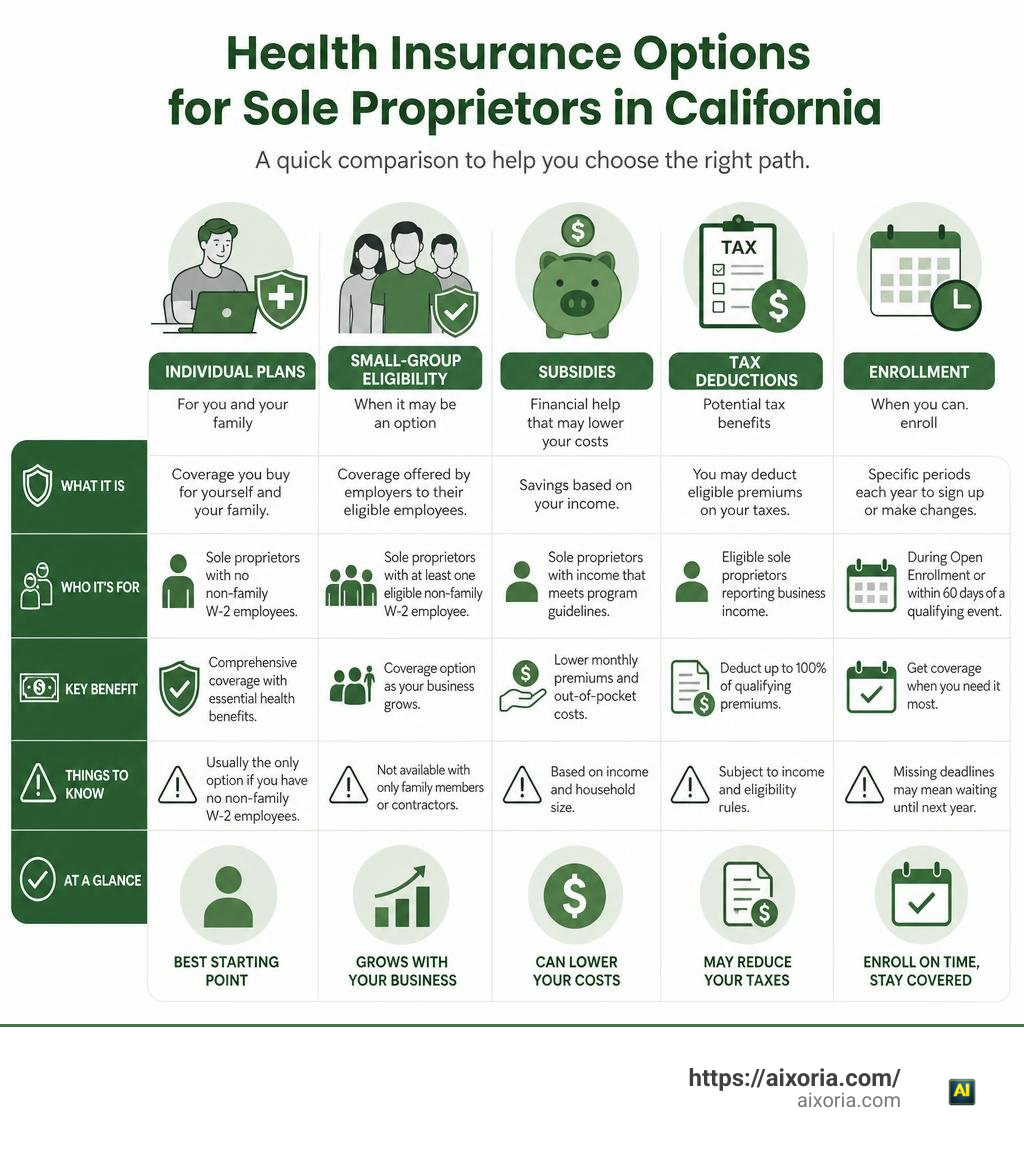
Core Coverage Options for Health Insurance for Sole Proprietorship in California

When running a business of one in California, securing high-quality, affordable healthcare can feel like solving a puzzle with moving pieces. Approximately one in four self-employed workers currently lacks health insurance, often because navigating private markets and government exchanges seems overwhelming. However, understanding how health insurance for sole proprietorship in California works gives you total control over both your physical wellness and financial security.
Evaluating Health Insurance for Sole Proprietorship in California vs Group Coverage
A common point of confusion for solopreneurs is whether they can buy a small-group health plan to get better corporate rates or broader doctor networks. Under federal ERISA rules and California Small Group Eligibility Rules, the answer depends strictly on your payroll structure:
- The Common-Law Employee Requirement: To qualify for a small-group plan in California (which covers businesses with 1 to 100 employees), your business must employ at least one bona fide, non-spouse W-2 common-law employee.
- Spouse and Family Exclusions: Under ERISA Section 3(5) and state rules, business owners, their spouses, and direct family members do not count as common-law employees for the purpose of establishing small-group eligibility.
- 1099 Independent Contractors: Independent contractors do not count toward W-2 employee headcounts, no matter how many hours they work for your business.
If you operate as a single-member LLC or a sole proprietor with zero W-2 staff, you are classified as an individual buyer. The good news? ACA-compliant individual plans offered in California provide robust protections, including guaranteed coverage regardless of pre-existing medical conditions and mandatory coverage for 10 essential health benefits.
Individual Market Plans and Covered California Basics
For single-operator sole proprietors, Covered California serves as the state’s official health insurance marketplace. Choosing a plan through Covered California offers access to major insurance carriers, full ACA protections, and substantial government subsidies to reduce monthly premiums.
Because marketplace plans use your estimated household Modified Adjusted Gross Income (MAGI) rather than business revenue to determine financial aid, many solopreneurs find that high-quality individual coverage is surprisingly affordable.
Covered California Subsidies, Metal Tiers, and Income Reporting
Understanding how plans are structured and how monthly savings are calculated helps you select the optimal plan for your medical needs and budget.
| Metal Tier | Average Plan Pays | You Pay | Best Suited For |
|---|---|---|---|
| Bronze | 60% | 40% | Solopreneurs who want low monthly premiums and catastrophic protection |
| Silver | 70% (Up to 94% with CSR) | 30% | Those qualifying for Cost-Sharing Reductions or wanting balanced costs |
| Gold | 80% | 20% | Individuals with predictable prescription or specialist needs |
| Platinum | 90% | 10% | Frequent healthcare users seeking low deductibles and minimal copays |
Understanding Metal Tiers and Cost-Sharing Reductions
All plans on Covered California are categorized into four standardized “metal tiers” based on how costs are split between you and the insurer:
- Bronze Tier: Features the lowest monthly premiums but the highest deductibles and out-of-pocket costs. It serves as an excellent safety net against unexpected hospital stays, which can average $30,000 for a three-day visit.
- Silver Tier: Strikes a balance between monthly premiums and out-of-pocket care costs. Most importantly, Silver plans are the only tier eligible for Cost-Sharing Reductions (CSRs). If your income falls within specific state guidelines, a Enhanced Silver plan lowers your deductible, copays, and coinsurance to Platinum-like levels at a Silver price.
- Gold & Platinum Tiers: Higher monthly premiums offset by low or zero deductibles and minimal copays. Ideal for those who anticipate regular specialist visits or brand-name prescriptions.
Estimating Net Income and Handling Mid-Year Income Changes
Unlike traditional W-2 employees with steady paychecks, sole proprietors experience fluctuating monthly revenue. Covered California calculates your Advance Premium Tax Credit (APTC) based on your projected annual net self-employment income (Schedule C Line 31) for the current tax year, not the previous year’s taxes.
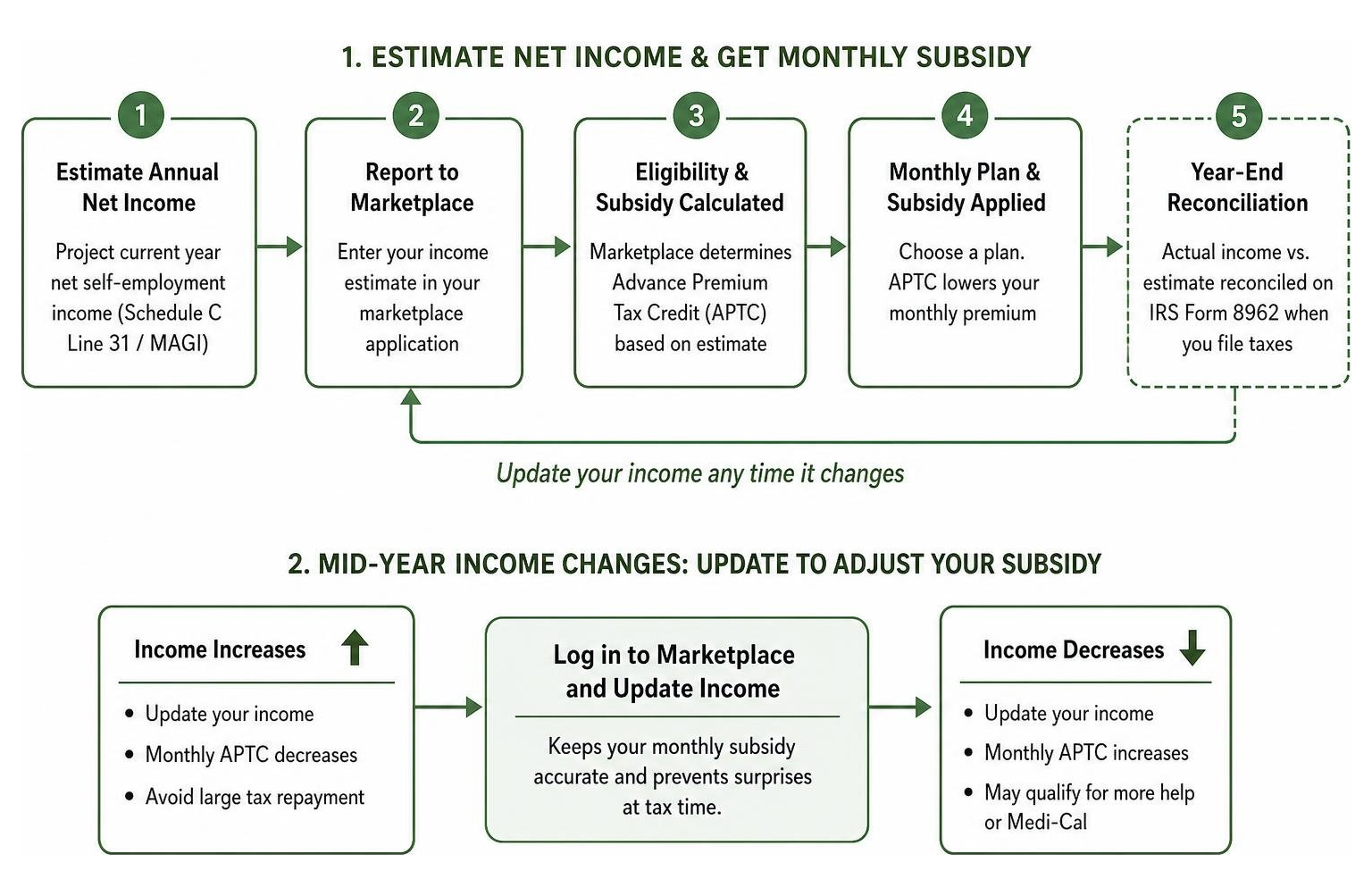
If your business income changes significantly mid-year, you must log into Covered California and update your income projection immediately.
- If your income increases: Updating your profile lowers your monthly APTC subsidy, preventing a painful tax repayment when filing IRS Form 8962 at year-end.
- If your income decreases: Updating your profile increases your monthly financial help or moves you into Medi-Cal, lowering your monthly expense right away.
Small Group Transition, SHOP Rules, and ICHRA Tax Benefits
As your sole proprietorship grows and you bring on board your first non-family team member, your health insurance options expand significantly.
Hiring Your First Employee and SHOP Employer Rules
Once you hire at least one non-spouse W-2 employee who works full-time (or full-time equivalent), your business qualifies for Covered California for Small Business (SHOP) or private small-group insurance.
When offering group coverage under the California Participation Requirements Code, sole employers must follow strict legal standards:
- Employer Contribution Minimum: You must contribute at least 50% of the lowest-cost employee-only medical premium offered.
- Participation Thresholds: For small businesses with 2 or 3 eligible employees, 100% enrollment is required (excluding valid waivers). For groups with 4 or more eligible employees, at least 70% must participate.
- Decision Window & Documentation: Employees must be given 30 calendar days to accept or decline coverage. Signed waiver forms for declining staff must be retained at your primary business site for at least one year.
Navigating Health Insurance for Sole Proprietorship in California Tax Deductions
One of the largest financial perks of self-employment is the self-employed health insurance deduction governed by IRC Section 162(l).
Sole proprietors can deduct 100% of premiums paid for medical, dental, and qualified long-term care insurance for themselves, their spouse, and dependents. This is an “above-the-line” deduction taken on Schedule 1 of Form 1040, directly reducing your taxable gross income without requiring you to itemize deductions.
However, note these essential tax limits:
- The deduction cannot exceed your net self-employment profit (Schedule C net income).
- You cannot claim the deduction for any month you were eligible to participate in a subsidized health plan maintained by your spouse’s employer.
- While it reduces federal and state income tax, IRC Section 162(l) does not reduce self-employment (FICA) tax.
For solopreneurs considering incorporating or using Health Reimbursement Arrangements (HRAs) like an Individual Coverage HRA (ICHRA), reviewing a comprehensive Tier List Breakdown for Business Health Coverage can help you optimize tax structures across S-Corp, C-Corp, and sole proprietorship models.
Alternatives, Freelancer Plans, and Enrollment Deadlines
Beyond standard exchange plans, certain California sole proprietors can access industry-specific coverage networks or alternative group arrangements.
Specialized Plans for Freelancers and Alternative Collectives
If you work as an independent contractor or freelancer in creative industries, you may qualify for tailored benefit funds:
- Producers’ Health Benefit Plan (PHBP): Designed specifically for commercial production freelancers in California, the California Freelancers — Producers’ Health Benefit Plan offers major medical coverage. To qualify, freelancers must work at least 80 days (minimum 8 hours/day) per year or earn $45,000 annually through participating commercial employers. PHBP allows workers to bank up to 40 unused days and offers “Bridge Coverage” payments to maintain year-round insurance.
- Alternative Solopreneur Collectives: Organizations like Solo Health Collective Plans provide self-funded captive frameworks using large PPO practitioner networks (such as PHCS), giving solopreneurs options with customized deductibles and broad nationwide doctor access.
Note on Short-Term Plans: Traditional short-term health insurance plans that bypass pre-existing condition rules face severe restrictions and bans in California, making ACA-compliant plans the primary secure legal path.
Open Enrollment, Special Enrollment, and California Mandate Penalties
To stay compliant with California Insurance Code Regulations, sole proprietors must secure coverage during designated signup windows:
- Open Enrollment Period: Runs annually from November 1 through January 15 in California.
- Special Enrollment Periods (SEP): Triggered by Qualifying Life Events (QLEs) such as loss of job-based coverage, marriage, divorce, birth or adoption of a child, or moving to a new county.
California Individual Mandate Penalty: California enforces a state requirement to maintain qualifying health insurance. Going uninsured can result in state tax penalties collected by the Franchise Tax Board (FTB)—often reaching $900 per adult and $450 per dependent child or 2.5% of household income, whichever is greater.
Frequently Asked Questions
Can a sole proprietor with no employees join Covered California for Small Business?
No. To qualify for Covered California for Small Business (CCSB), California law requires your business to employ at least one non-spouse W-2 common-law employee. Sole proprietors without staff must enroll through individual and family Covered California plans.
How much of my health insurance premiums can I deduct as a sole proprietor in CA?
Under IRC Section 162(l), eligible sole proprietors can deduct up to 100% of health, dental, and vision insurance premiums paid for themselves, their spouse, and dependents. The deduction is limited to your net self-employment earnings shown on Schedule C.
What happens if my income changes mid-year while receiving Covered California subsidies?
You should report income changes to Covered California within 30 days. If your income goes up and you do not update your account, you may have to repay excess Advance Premium Tax Credits when filing federal taxes using IRS Form 8962.
Conclusion
Securing reliable health insurance for sole proprietorship in California is an essential strategy for protecting both your personal well-being and your growing business venture. By choosing an ACA-compliant individual plan through Covered California, maximizing your Schedule 1 tax deductions, and keeping your reported earnings updated, you can secure outstanding health benefits while avoiding costly state tax penalties.https://www.mediafire.com/file/c1m68d3p98509da/Boss_Dimensions_BY_MCMPDL%25E2%2580%25A2COM.mctemplate/file“;
As your business grows and your operational needs evolve, keeping up with modern digital tools and AI integrations can streamline your daily administrative workflows, freeing up valuable time to focus on business growth. Explore cutting-edge operational insights and strategies at Aixoria AI Updates to elevate your sole proprietorship today.