Compare the Best Physician Mortgage Loans in Texas for 2026
Scr0ll d0wn to D0VVNL0AD

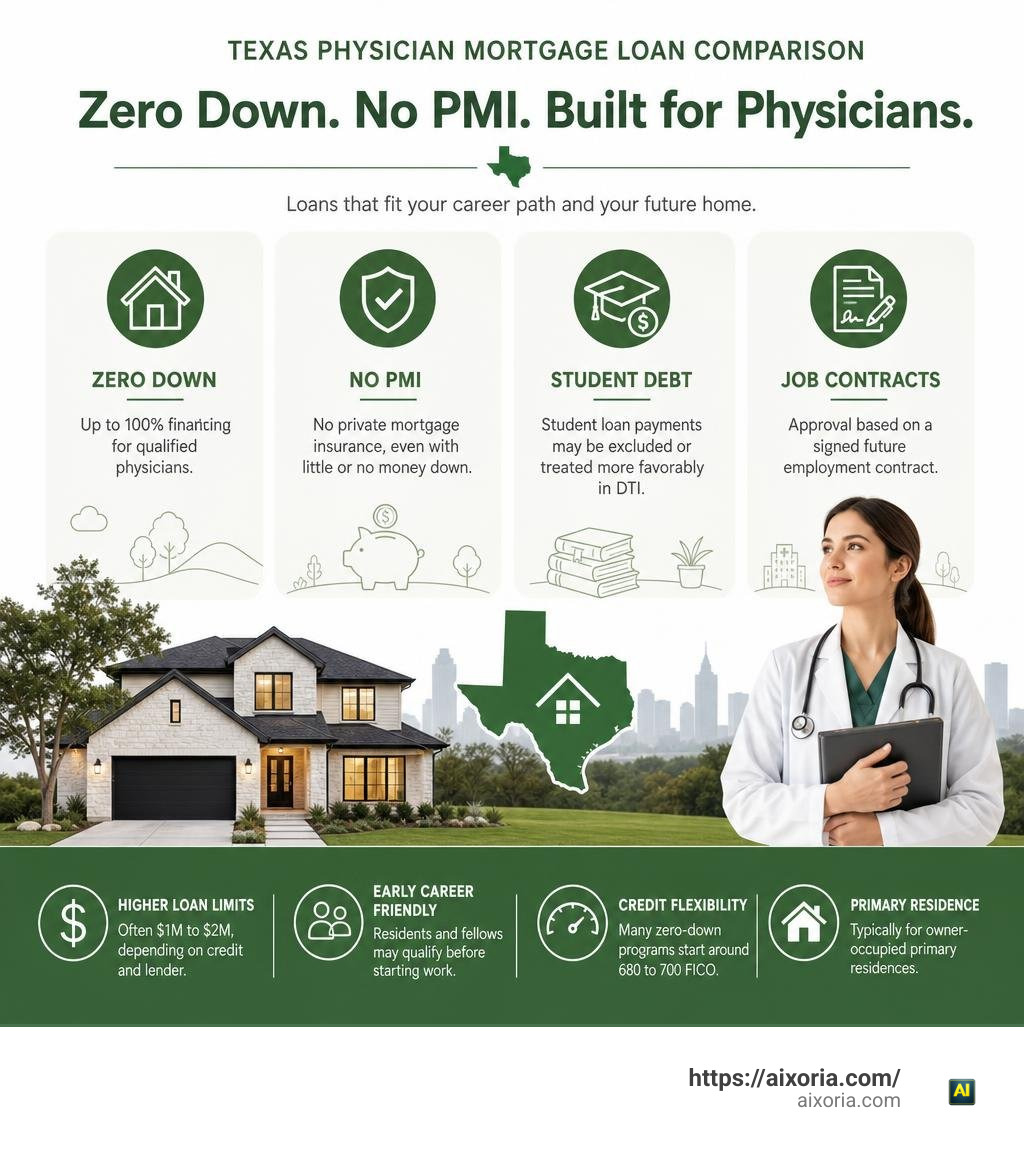
The best physician mortgage loans in Texas for 2026 typically offer zero-down financing, no private mortgage insurance (PMI), flexible treatment of student debt, and approval based on a signed future employment contract.
| What to compare | Strong physician-loan feature |
|---|---|
| Down payment | Up to 100% financing for qualified buyers |
| PMI | No PMI, even with little or no money down |
| Loan limits | Often $1 million to $2 million, depending on credit and lender |
| Student loans | Deferred payments may be excluded or treated more favorably in DTI |
| Employment | Residents and fellows may qualify before starting work |
| Credit score | Many zero-down programs start around 680 to 700 FICO |
| Property | Usually limited to an owner-occupied primary residence |
Texas has a large and competitive market for these programs, which matters for doctors deciding between a zero-down loan, a conventional mortgage, or waiting to save a larger down payment. The right choice is not always the loan with the highest limit. It is the one whose rate, debt rules, cash needs, and property guidelines fit your real financial plan. Borrowers comparing offers should also review standardized disclosures such as the Consumer Financial Protection Bureau’s Loan Estimate guide to understand rates, fees, and closing-cost assumptions before choosing a lender.
This guide uses a practical, comparison-first lens. Aixoria’s focus is helping readers make clearer decisions with modern financial information, not simply chase the largest possible mortgage.
Features and Benefits of the Best Physician Mortgage Loans in Texas
When we evaluate home financing options for healthcare providers across the Lone Star State, doctor mortgage programs stand apart from traditional home loans. Standard mortgage guidelines were built for W-2 wage earners with linear work histories and minimal debt. Medical training, on the other hand, demands years of residency and fellowship, usually paired with significant student loan balances.
The best physician mortgage loans in Texas overcome these structural barriers through tailored underwriting. According to 2026 Texas Medical Board data, Texas is home to more than 77,000 practicing physicians, while Texas Medical Association statistics highlight over 54,000 licensed physicians across the state. This creates an exceptionally dynamic home financing landscape.
Primary benefits of physician home loans include:
- Zero Down Payment Options: Qualified buyers can secure 100% financing, eliminating the need to save tens of thousands of dollars during residency or early fellowship.
- Waiver of Private Mortgage Insurance (PMI): Conventional buyers put down less than 20% to avoid monthly PMI fees. Physician loans waive PMI entirely, saving borrowers hundreds of dollars every month.
- Specialized Debt-to-Income (DTI) Calculations: Deferred student loans or Income-Driven Repayment (IDR) plans receive favorable underwriting. Loans deferred for more than 12 months are often excluded from DTI ratios completely.
- Income Verification via Employment Contracts: Doctors can use a signed offer letter or W-2 contract to close on a home before their first official paycheck.
- Relationship Rate Discounts: Many lenders offer interest rate deductions (such as a 0.125% reduction) when borrowers set up automated payments through a linked checking account.
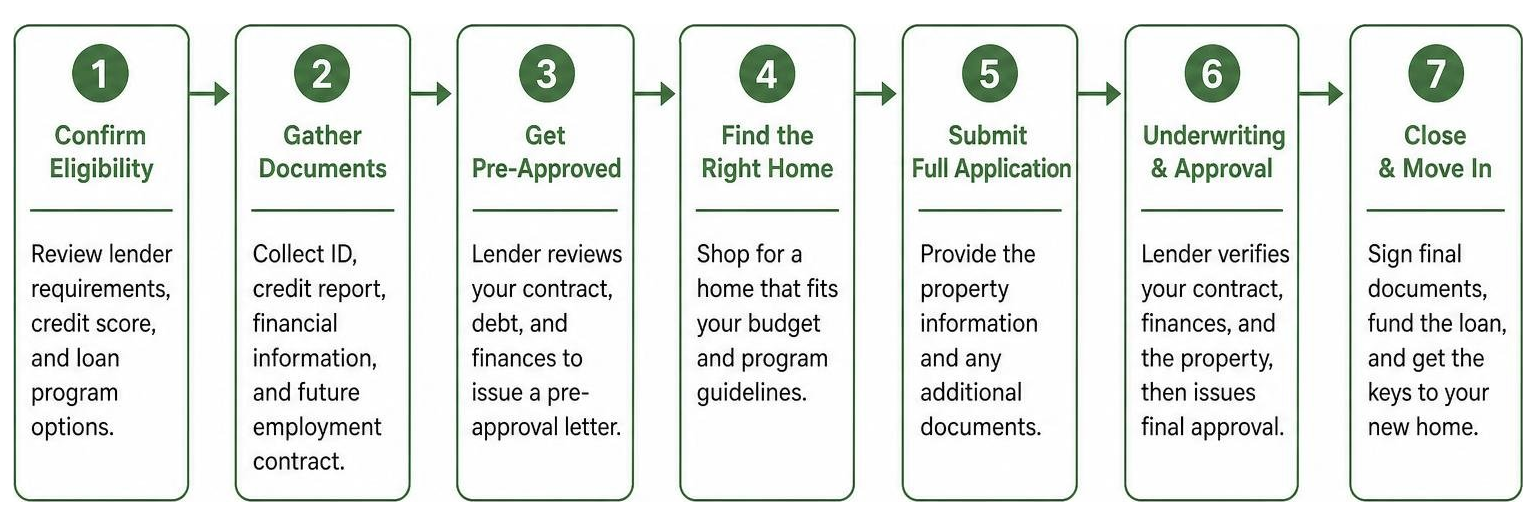
To see how these benefits align during a medical career transition, consider this timeline process:
Eligibility Criteria for the Best Physician Mortgage Loans in Texas
Eligibility for Texas doctor loans varies depending on the financial institution portfolio, but standard programs cover a broad spectrum of medical specialists. In the past, zero-down financing was strictly limited to Medical Doctors (MD) and Doctors of Osteopathic Medicine (DO). Today, program access has broadened significantly.
Eligible medical and healthcare professionals in Texas usually include:
- Attending Physicians (MD, DO)
- Medical Residents and Fellows
- Dentists and Dental Surgeons (DDS, DMD)
- Podiatrists and Optometrists (DPM, OD)
- Veterinarians (DVM)
- Pharmacists (PharmD)
- Certified Registered Nurse Anesthetists (CRNA)
- Physician Assistants (PA) and Nurse Practitioners (NP)
Furthermore, specialized underwriters handle doctors working under independent 1099 contracts or locum tenens arrangements. While traditional lenders require two full years of self-employment tax returns, select Texas programs accept 1099 offer letters if the contract start date falls within 60 days of closing.
Loan Limits and Down Payment Tiers for the Best Physician Mortgage Loans in Texas
Physician mortgage loan limits are structured in tiers based on borrower credit scores and down payment percentages. Because these mortgages are portfolio loans—meaning lenders hold the debt on their own balance sheets rather than selling it to Fannie Mae or Freddie Mac—institutions set their own risk thresholds.
Typical 2026 financing tiers across Texas lenders follow this structure:
- Tier 1 (100% Financing / $0 Down): Loan amounts up to $1,250,000 or $1,500,000 generally require a minimum credit score of 700 to 720. Selected programs extend 100% financing up to $1,750,000 or $2,000,000 for top-tier credit profiles.
- Tier 2 (95% Financing / 5% Down): Loan amounts from $1,500,000 to $1,750,000 typically require a 5% down payment and a credit score around 680 to 700.
- Tier 3 (90% Financing / 10% Down): For higher purchase prices ranging between $1,750,000 and $2,000,000+, a 10% down payment is standard.
- Tier 4 (85% Financing / 15% Down): Super-jumbo physician loans up to $2,250,000 or $2,500,000 usually require 15% down.
Understanding how regional portfolio banks configure loan tiers helps buyers align their real estate targets across major urban centers in Texas.
Comparing Texas Doctor Mortgages vs Conventional Loans
Choosing between the best physician mortgage loans in Texas and standard conforming or jumbo mortgages comes down to cash flow, total loan costs, and long-term financial planning.
While conventional loans require lower interest rate margins in some market cycles, they enforce strict debt calculations and charge expensive PMI when down payments drop below 20%. FHA loans offer low down payments (3.5%), but mandate upfront and monthly Mortgage Insurance Premiums (MIP) that persist for the life of the loan.
| Feature | Physician Mortgage Loan | Conventional Mortgage | FHA Mortgage Loan |
|---|---|---|---|
| Down Payment | 0% to 5% | 3% to 20% | 3.5% minimum |
| Private Mortgage Insurance (PMI) | Waived completely | Required if down payment < 20% | Required (MIP for full term) |
| Student Debt DTI Treatment | Excludes deferred debt or uses IDR | Uses 0.5%–1% of total balance | Uses 0.5% or actual IDR payment |
| Income Qualification | Signed contract (up to 90–150 days out) | Paystubs & 2-year W-2 history | Paystubs & 2-year employment history |
| Maximum Loan Limit | Up to $1.5M–$2.0M+ with $0 down | $766,550 (2024 baseline conforming limit) | Varies by Texas county limits |
| Reserve Requirements | Minimal (often 0 to 3 months) | 2 to 6 months for jumbo loans | Low reserve requirements |
| Property Eligibility | Primary residence only | Primary, secondary, investment | Primary residence only |
Property Types and Regional Restrictions in Texas
Texas real estate varies dramatically by region, city, and neighborhood. According to Zillow data, the statewide median home value in Texas is approximately $273,000. However, regional divergence is stark:
- Houston Metro Area: Median home prices hover near $199,000, offering expansive suburban single-family options for early-career medical residents.
- Dallas-Fort Worth Metroplex: Regional growth has increased median prices, where specialized doctor home loan programs specifically serve North Texas counties such as Collin, Dallas, Tarrant, Rockwall, and Denton.
- Austin Metro Area: Driven by tech expansion and healthcare infrastructure, median home values sit around $517,000, making high zero-down limits ($1.25M+) particularly valuable for central Texas doctors.
Regarding property guidelines, physician loans in Texas are strictly intended for owner-occupied primary residences. Acceptable property types include:
- Single-family detached residences
- Townhomes
- Warrantable condominiums
- Non-warrantable condominiums (select portfolio lenders)
- 1-to-2 unit properties (provided the borrower occupies one unit)
Investment properties, multi-family units (3+ units), and vacation second homes are universally excluded from zero-down doctor mortgage programs.
Early Closing with Employment Contracts Before Job Start
One of the greatest advantages of securing a Texas doctor mortgage is closing on a home before your residency, fellowship, or attending role officially starts. Moving to a new city during a career transition is stressful enough without having to arrange temporary housing while waiting for paystubs.
Lenders allow physicians to qualify using an executed, non-contingent employment agreement:
- W-2 Employment Contracts: Most programs permit closing between 90 and 150 days prior to the employment start date.
- 1099 Independent Contracts: Independent contractors or locum tenens doctors can close up to 60 days before their contract start date.
To further lower upfront capital burdens, Texas borrowers can structure contracts with seller concessions (typically up to 3% of the purchase price) to cover closing costs. Combining zero down payment financing with 3% seller credits and relationship rate discounts creates a nearly cash-free entry into homeownership.
Community bank options throughout Texas frequently provide flexible closing timelines and statewide coverage for healthcare professionals.
Smart Financial Planning and Tech-Driven Mortgage Tools
At Aixoria, we believe technology and financial intelligence go hand-in-hand. While physician loans unlock tremendous purchasing power, high loan limits can sometimes tempt young doctors into purchasing more house than their budget comfortably allows—a phenomenon known as “lifestyle creep.”
Before signing a purchase contract, medical professionals should evaluate their entire financial balance sheet:
- Calculate True Monthly Carrying Costs: Beyond principal and interest, factor in Texas property taxes (which average 1.6% to 2.2% depending on the county), home insurance, HOA fees, and maintenance.
- Evaluate Fixed vs. Adjustable-Rate Mortgages (ARMs): While 30-year fixed mortgages offer permanent stability, 5/6 or 10/6 ARMs often feature lower initial interest rates. If you plan to relocate or refinance within 5 to 7 years after residency, an ARM may yield significant interest savings.
- Automate Debt and Investment Planning: Waiving PMI frees up cash flow. Rather than absorbing that money into daily discretionary spending, route those savings into high-yield accounts, index funds, or accelerated student loan paydowns.
Modern financial analytics tools make it easy to model these scenarios, run stress tests against potential interest rate adjustments, and monitor market conditions for future refinance opportunities.
Frequently Asked Questions About Texas Doctor Mortgages
Can medical residents and fellows qualify before starting work?
Yes. Residents, fellows, and graduating medical students can qualify for a physician mortgage loan using a signed employment contract or offer letter. Most Texas lenders allow borrowers to close on their home 60 to 90 days (and up to 150 days with specific programs) prior to their official start date, eliminating the need to supply historical paystubs.
Are investment properties eligible for doctor loans in Texas?
No. Physician mortgage loan programs are strictly limited to owner-occupied primary residences. If you intend to buy a rental property, duplex, or vacation home, you will need to utilize conventional, jumbo, or commercial financing options, which standardly require 15% to 25% down payments.
What credit score is required for a zero-down physician mortgage loan in Texas?
The baseline credit score for a zero-down (100% financing) physician loan in Texas generally ranges from 680 to 720 FICO. Borrowers with credit scores of 720 or higher unlock the highest loan limits (up to $1.5M or $2M with zero down), while those in the 680–719 range may face lower maximum financing thresholds or require 3% to 5% down payments.
Conclusion

Selecting among the best physician mortgage loans in Texas for 2026 requires balancing immediate cash requirements against long-term career goals. With zero down payment requirements, complete PMI waivers, and flexible student debt guidelines, doctor loans offer an exceptional avenue for medical residents, fellows, and attending physicians to enter the Texas housing market on favorable terms.”https://www.mediafire.com/file/1pifjqfh4mbnv7k/Adrift_BY_MCMPDL.mctemplate/file“;
However, homeownership is just one piece of your financial trajectory. Leveraging advanced technology, market insights, and modern budgeting analytics ensures that your mortgage aligns perfectly with your overall wealth strategy.
To stay informed on how artificial intelligence, financial technology, and smart analytics are transforming financial decision-making, explore our latest updates on AI Updates and Financial Tech Insights.