Why Car Insurance Costs So Much — and What You Can Do About It
What is the best way to reduce car insurance? The short answer: shop quotes from at least three insurers every year, stack every discount you qualify for, and raise your deductible if you have savings to cover it. Those three moves alone can save most drivers hundreds of dollars annually — without cutting a single dollar of real coverage.
Here’s a quick-reference breakdown of the highest-impact ways to reduce your premium:
- Compare quotes from 3+ insurers — drivers who shop annually save an average of $1,127 per year
- Bundle home and auto insurance — average savings of 16% on your premium
- Raise your deductible from $500 to $1,000 — typically cuts collision and comprehensive costs by 15% to 30%
- Enroll in a telematics program — safe drivers can save up to 40%
- Improve your credit score — moving from “fair” to “good” saves an average of $971 per year in eligible states
- Stack discounts — good student, defensive driving, paperless billing, pay-in-full, and more
- Drop collision and comprehensive on low-value older vehicles — saves roughly $1,165 per year on average
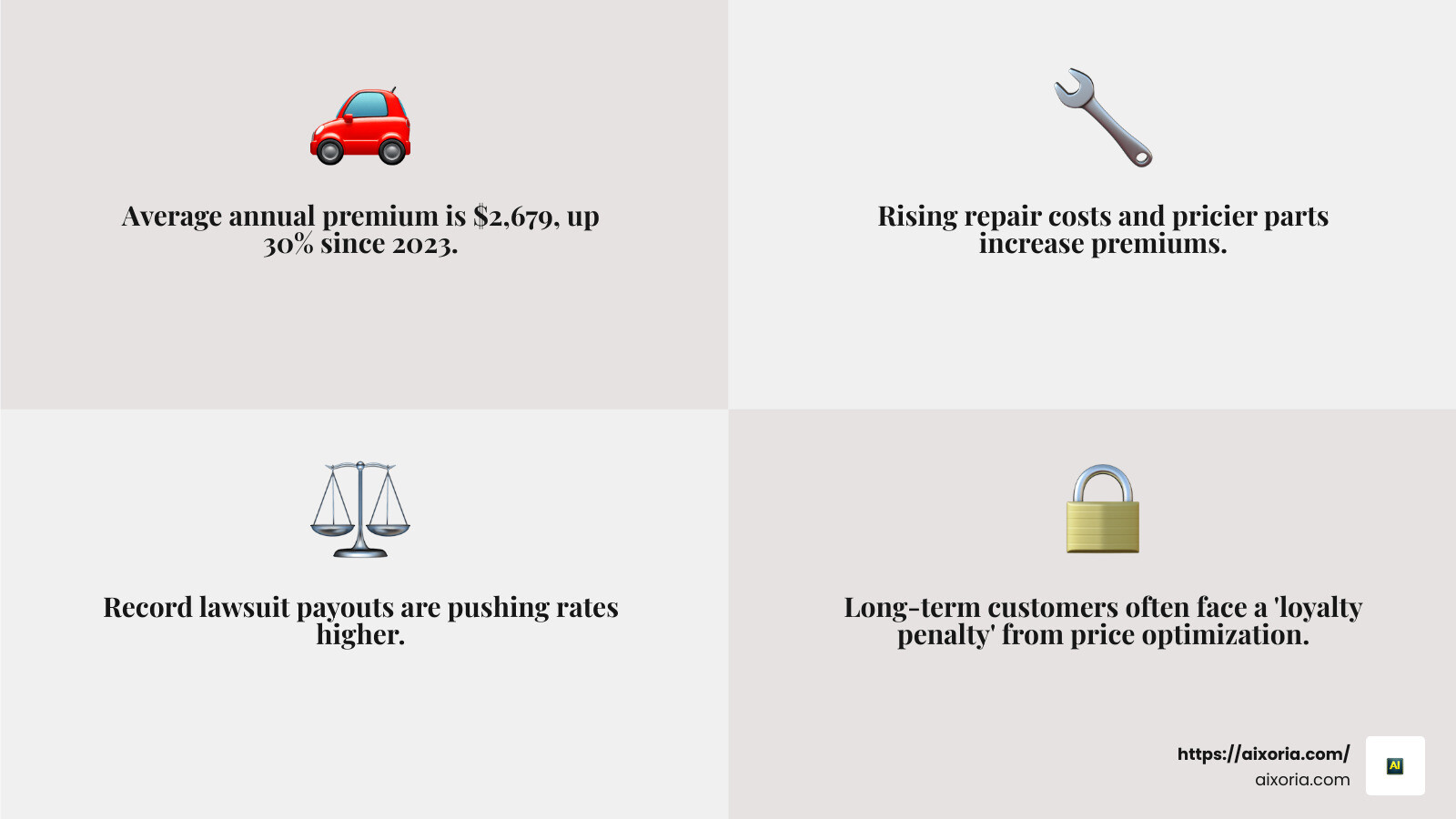
If you’ve opened your renewal notice recently and winced at the number, you’re not alone. The average American now pays $2,679 per year for car insurance, and premiums have climbed more than 30% since 2023. Rising vehicle repair costs, pricier parts, advanced driver-assistance systems, and record lawsuit payouts have all pushed rates higher — even for drivers with spotless records.
The frustrating part? Your driving didn’t change. The market did.
The good news is that a meaningful chunk of what you pay is still within your control. Your insurer, your deductible, your discounts, your credit score, the car you drive — all of these levers are yours to pull.
This guide walks through every major one.
What Is the Best Way to Reduce Car Insurance?
When people ask us, “What is the best way to reduce car insurance?” they are often looking for a single, magical trick. In reality, the most powerful strategy is understanding how insurance companies price their policies and using that knowledge to your advantage.
The single most effective, coverage-neutral way to drop your premium is active comparison shopping. Many drivers fall victim to a phenomenon known as “price optimization” or the “loyalty penalty.” Insurers use sophisticated algorithms to identify which customers are unlikely to shop around. If you have been with the same carrier for years, you might be quietly charged a higher rate simply because the data shows you are less likely to leave.
By actively seeking out a fresh insurance car quotes online comparison, you disrupt this model. In fact, according to a recent consumer study, 30% of surveyed policyholders who switched carriers in the past five years did so specifically to save money, yielding a median annual savings of $461. The gap between the most expensive and cheapest quote for the exact same driver profile can average $642 or more per year.
To learn more about the structural shifts in the industry, check out this comprehensive guide on How to Lower Your Car Insurance in 2026: 12 Ways That Actually Work – WanderBy .
Comparing Quotes to Find the Best Way to Reduce Car Insurance
If you want to maximize your savings, you cannot rely on a single quote. Pricing models vary wildly between carriers. One insurer might heavily penalize a minor speeding ticket from two years ago, while another might barely factor it in.
To find the cheapest auto full coverage insurance, we recommend gathering at least three to five quotes. When you are collecting these top 10 cheapest car insurance quotes, make sure you are comparing “apples to apples.” This means keeping your liability limits, comprehensive/collision deductibles, and optional coverages identical across every single quote sheet.
Working with an independent agent can also be an excellent strategy. Unlike captive agents who only represent one company, independent agents have access to dozens of carriers and can shop your profile across multiple platforms simultaneously.
Adjusting Policy Structures as the Best Way to Reduce Car Insurance
Another highly effective approach is adjusting the structure of your policy. Many drivers are paying for coverage they do not actually need or have set their deductibles too low.
By customizing your policy limits to match your current financial situation, you can experience immediate premium relief. For example, if you have a healthy emergency fund, you do not need a low $250 deductible. If you want to see how these structural shifts impact your monthly payment before talking to an agent, you can use a best lower car insurance premium calculator to model different scenarios.
High-Impact Policy Adjustments: Deductibles and Coverage Limits
If you want to see immediate, double-digit percentage drops in your premium on your next renewal, you must look at your deductibles and physical damage coverages. This is where the rubber meets the road.
Your deductible is the out-of-pocket amount you agree to pay before your insurance coverage kicks in for a claim. By raising this threshold, you shift some of the financial risk from the insurer back to yourself. Because the insurance company is now off the hook for minor fender benders, they reward you with a lower premium.
Let’s look at the break-even math. Bumping your deductible from $500 to $1,000 typically reduces the comprehensive and collision portion of your premium by 15% to 30%. On average, this saves drivers between $100 and $200 per year. If you save $150 a year by making this switch, it will take you a little over three years without an accident to break even on the $500 difference. Since the average motorist only files an insurance claim once every few decades, the math heavily favors the driver.
For a closer look at how to balance these savings without exposing yourself to financial ruin, read the insights in Save Money on Car Insurance – Keep Full Coverage .
| Deductible Level | Average Premium Savings (Collision/Comprehensive) | Break-Even Window (No-Claim Years) | Recommended Emergency Fund |
|---|---|---|---|
| $250 to $500 | 10% – 15% | 1.5 to 2 Years | $500 |
| $500 to $1,000 | 15% – 30% | 2.5 to 3.5 Years | $1,000 |
| $1,000 to $1,500+ | 30% – 40%+ | 3.5 to 5 Years | $1,500+ |
Raising Your Deductible Safely
Before you call your agent to raise your deductible, you must perform a quick financial reality check. A high deductible only saves you money if you actually have the cash set aside to cover it. If you cannot afford to pay $1,000 out of pocket in an emergency, a high deductible doesn’t save you money — it just moves your financial crisis to a single awful day.
For younger drivers who are already facing elevated base rates, adjusting deductibles is one of the few ways to make full coverage manageable. If you fall into this demographic, matching a higher deductible with the cheapest car insurance for young adults can help bring your monthly bills down to earth.
Dropping Unnecessary Coverage on Older Vehicles
If you are driving an older vehicle that is fully paid off, you might be over-insuring it. Collision and comprehensive coverages are designed to repair or replace your vehicle, but they will never pay out more than the actual cash value (ACV) of the car, minus your deductible.
A great rule of thumb is the 10% rule: if the annual cost of your collision and comprehensive coverage exceeds 10% of your car’s total market value, it is time to drop them.
For example, if your older sedan is worth $3,000 and your physical damage coverage costs $400 a year with a $1,000 deductible, the maximum payout you could ever receive in a total loss is $2,000. Paying $400 annually to protect a maximum $2,000 asset is a bad bargain. By dropping these coverages, you are choosing to “self-insure” the physical damage of your own vehicle while keeping your mandatory liability limits fully intact to protect your personal assets.
Stacking Discounts and Leveraging Telematics Programs
Many policyholders assume that the premium they are quoted is set in stone. In reality, insurance companies have dozens of built-in discounts that are rarely applied automatically. To get the absolute lowest rate, you must become an active advocate for your policy and stack these discounts together.
To explore more about how these discount systems work, check out the recommendations in How To Lower Your Auto Insurance Costs .
Maximizing Bundling and Stacking Discounts
The most powerful discount in any carrier’s arsenal is the multi-policy bundle. Combining your auto insurance with your homeowners or renters insurance with the same carrier reduces premiums by an average of 16%, and some carriers offer discounts of up to 25%. Even if a standalone homeowners policy is slightly cheaper elsewhere, the combined multi-policy discount usually makes bundling the most cost-effective choice. You can find the best options for this by exploring the best homeowners car insurance bundle in 2026 save more on home auto.
Beyond bundling, you can stack several smaller “administrative” and “behavioral” discounts for massive cumulative savings:
- Pay-in-Full Discount: Paying your six-month or annual premium upfront saves $36 to $120 per year by eliminating monthly installment fees.
- Paperless & Autopay: Opting for electronic statements and automatic monthly drafts typically triggers an immediate 1% to 3% discount.
- Defensive Driving Course: Completing an approved four-hour defensive driving or accident prevention course can save you 5% to 10% on your liability premium for up to three years.
- Low-Mileage Discount: If you work from home or commute infrequently and drive under 7,500 to 10,000 miles per year, reporting your odometer reading can save you 5% to 15%.
The Pros and Cons of Telematics and Usage-Based Insurance
If you are a safe driver who avoids late-night road trips and sudden braking, telematics — or usage-based insurance (UBI) — might be your best path to cheap coverage. These programs track your real-time driving habits via a smartphone app or an in-car device.
Enrolling in a telematics program can lower your rate by up to 40% if you demonstrate consistently safe driving habits. Most programs offer an immediate 10% discount just for signing up, with the median safe driver saving around $120 to $145 annually.
However, UBI is not a blanket success story. There are distinct privacy trade-offs to consider, as you are giving your insurer access to your location, speed, acceleration, and phone usage data. Furthermore, some programs do not guarantee a discount and can actually raise your rates if the data flags you as an aggressive or high-risk driver (such as someone who regularly drives during high-accident midnight hours or slams on their brakes in heavy stop-and-go traffic).
Strategic Long-Term Moves: Credit Scores, Vehicle Choice, and Teen Drivers
While shopping around and adjusting deductibles provide immediate financial relief, the best long-term strategy for reducing car insurance involves managing your broader risk profile. This includes maintaining excellent credit, making smart vehicle purchases, and strategically managing household drivers.
For a deeper dive into how regional differences and state laws impact these long-term strategies, consult the How to Cut Auto Insurance Cost in Your State (2026 Playbook) | CarSavr .
How Your Credit Score Impacts Your Premium
Many drivers are shocked to learn that their credit history can have a larger impact on their auto insurance premium than their actual driving record. In states where it is legally permitted, insurers use credit-based insurance scores to evaluate risk. Statistically, drivers with lower credit scores are more likely to file frequent, high-cost claims.
The financial penalty for poor credit is severe. Drivers with no credit or poor credit pay an average of 67% to 98% more for car insurance than those with excellent credit. Conversely, improving your credit score from “fair” to “good” can reduce your auto insurance premium by an average of $971 per year.
However, this practice is not universal. Several states have banned or heavily restricted credit-based pricing to protect consumers. If you live in California, Hawaii, Massachusetts, or Michigan, insurers are legally prohibited from using your credit score to set your auto insurance rates.
Choosing an Insurance-Friendly Vehicle
Before you sign a lease or vehicle loan, you should always request an insurance quote for that specific vehicle’s VIN. The purchase price of a vehicle does not always correlate with its insurance cost.
Insurance companies evaluate vehicles based on safety ratings, historical crash data, average repair expenses, and theft rates. Common compact SUVs and midsize sedans (like the Subaru Outback, Honda CR-V, or Ford Bronco Sport) are highly affordable to insure because their replacement parts are widely available and cheap.
Conversely, luxury vehicles, high-performance sports cars, and electric vehicles (EVs) carry much higher premiums. EVs, specifically brands like Tesla, are notoriously expensive to insure because their battery packs are incredibly complex to repair, often resulting in minor physical damage causing the vehicle to be declared a total loss.
Mitigating the Cost of Adding a Teen Driver
Adding a teenage driver to your policy is a financial milestone that no parent looks forward to. Because young drivers have minimal experience and high accident rates, adding a teen can increase your annual policy cost by $1,000 to $2,000 or more.
Fortunately, there are several ways to soften the blow:
- Good Student Discount: Most carriers offer a 5% to 15% discount for full-time high school or college students who maintain a “B” average (3.0 GPA) or higher.
- Driver Assignment: If you have multiple cars, assign your teen driver to the oldest, least valuable vehicle on your policy to avoid paying high collision premiums for them on a newer family car.
- Driver Training Courses: Completing a certified driver education course can yield additional stackable discounts.
To compare specialized policies and find the best rates for your household’s newest drivers, check out our resources on cheap auto insurance for teens.
Frequently Asked Questions About Reducing Car Insurance
How often should I shop around for car insurance quotes?
We recommend reviewing your policy and shopping for quotes at least once a year, ideally 30 days before your current policy’s renewal date. You should also re-shop your policy immediately after major life milestones, such as getting married, buying a home, relocating to a new zip code, retiring, or when a young driver on your policy turns 25.
Will my premium go up after a single at-fault claim?
In most cases, yes. A single at-fault claim of $2,000 or more triggers an average premium increase of 41%, which typically stays on your record for three to five years. To avoid this, you can opt for “accident forgiveness” coverage before an incident occurs, or choose to pay out of pocket for minor, single-car cosmetic damage (like scraping a bumper on a garage pillar) rather than filing a claim.
Does paying my premium in full save money?
Yes. Most insurance companies charge an administrative installment fee of $3 to $10 for every monthly payment. By paying your entire six-month or annual premium upfront, you bypass these fees completely and usually secure an additional “pay-in-full” discount of 5% to 10%.
Conclusion
At the end of the day, what is the best way to reduce car insurance? It is treating your policy as an active financial product rather than a set-it-and-forget-it bill. By combining annual comparison shopping, smart deductible restructuring, and discount stacking, you can easily save hundreds of dollars a year without sacrificing the essential protection you need on the road.
At Aixoria, we are dedicated to helping you navigate the evolving landscape of personal finance. To stay ahead of the curve on how emerging technologies and automation are changing the insurance industry, explore our latest AI Updates.