Why Finding the Cheapest Auto Full Coverage Insurance Could Save You Thousands
If you’re shopping for the cheapest auto full coverage insurance, here’s what you need to know right now:
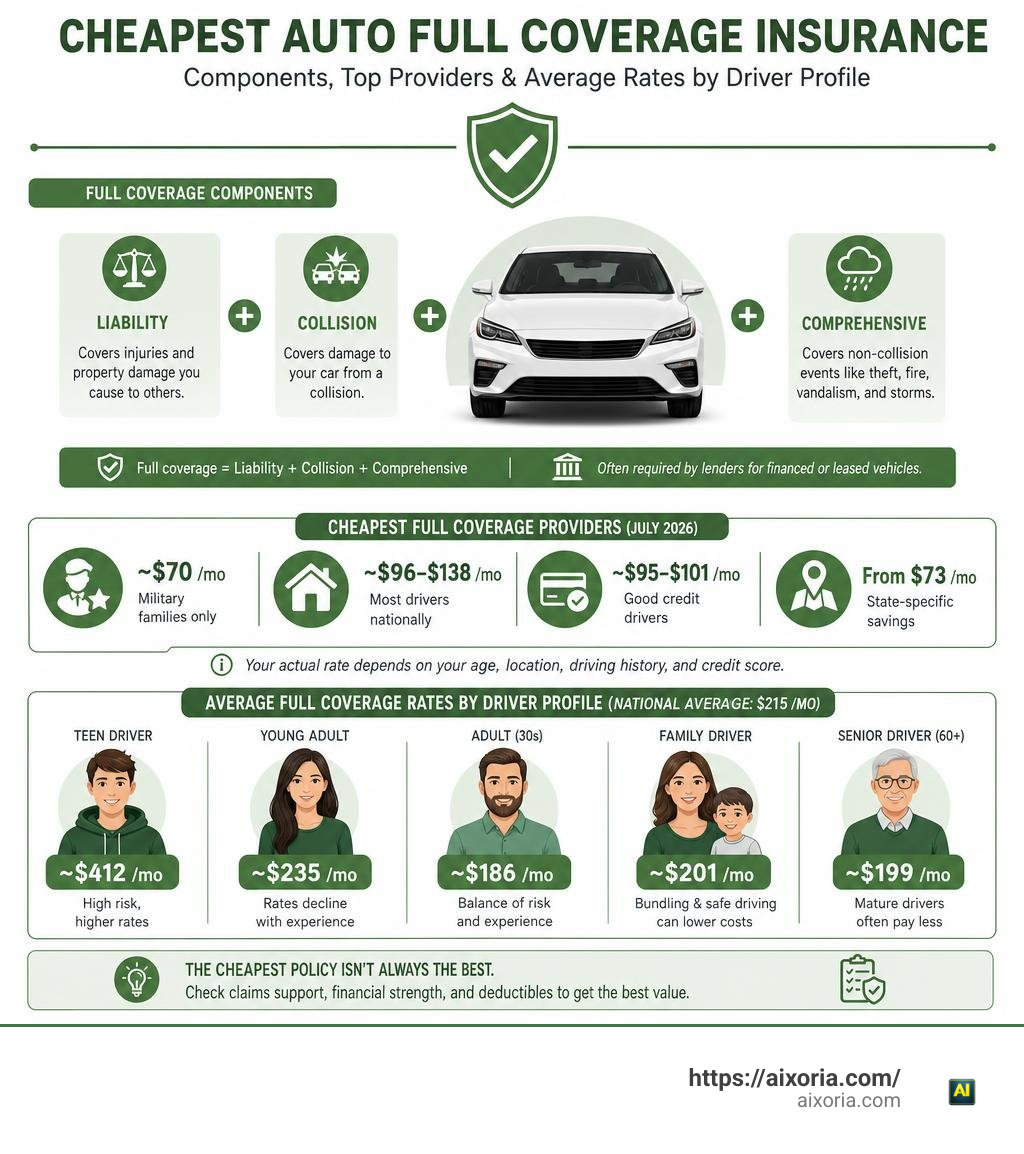
Cheapest full coverage car insurance companies (July 2026):
| Provider | Avg. Monthly Rate | Best For |
|---|---|---|
| USAA | ~$70/mo | Military families only |
| Travelers | ~$96–$138/mo | Most drivers nationally |
| GEICO | ~$95–$101/mo | Good credit drivers |
| Regional insurers | From $73/mo | State-specific savings |
Note: Your actual rate depends on your age, location, driving history, and credit score.
Full coverage isn’t a single product. It’s a combination of liability, collision, and comprehensive coverage — and it’s often required by lenders if you finance or lease your car.
The national average for full coverage runs about $215 per month ($2,575 per year). But the cheapest providers come in well below that — sometimes 31% lower or more.
Here’s the catch: the cheapest policy isn’t always the best one. Poor claims support, shaky financial ratings, or hidden high deductibles can cost you far more than you saved on premiums.
This checklist walks you through exactly how to compare your options, avoid the common traps, and find a policy that’s genuinely affordable and reliable.
What is Full Coverage Car Insurance?
When we talk about the cheapest auto full coverage insurance, we have to clear up a common myth: “full coverage” is not an official insurance policy type that covers every single scenario under the sun. Instead, it is an industry shorthand for a policy that bundles state-mandated liability insurance with physical damage protection for your own vehicle.
Without full coverage, you are essentially driving with liability-only insurance. While liability-only is the absolute cheapest option on paper, it leaves you completely exposed. If you cause an accident, liability insurance pays for the other driver’s medical bills and car repairs, but you will have to pay out of pocket to fix your own car.
To understand how the overall premium is calculated, it helps to review How Much Does Full Coverage Car Insurance Cost? | MoneyGeek to see how the pricing dynamically scales with the specific protection tiers you choose.
Liability, Collision, and Comprehensive Explained
A standard full coverage policy consists of three core pillars:
- Liability Coverage: This is the legally required foundation of your policy. It includes bodily injury liability (to pay for medical bills of people you injure) and property damage liability (to pay for things you damage, like another car, a mailbox, or a guardrail).
- Collision Coverage: This pays to repair or replace your vehicle if you are involved in an accident, regardless of who is at fault. Whether you hit another car, scrape a concrete pillar in a parking garage, or roll your vehicle on an icy road, collision coverage protects your wallet.
- Comprehensive Coverage: Often called “other-than-collision” coverage, this handles damage caused by factors outside your control. This includes theft, vandalism, fire, explosions, falling tree limbs, loose bricks, windshield cracks, and collisions with animals (such as hitting a deer). It even covers bizarre scenarios, like a rogue squirrel gnawing through your car’s wiring.
Optional Add-ons and Lender Requirements
While liability, collision, and comprehensive make up the standard full coverage package, lenders and leasing companies typically mandate them to protect their financial assets. If you have an active car loan or lease, your contract will legally require you to maintain full coverage until the vehicle is fully paid off.
Beyond the basics, you can customize your policy with optional add-ons:
- Gap Insurance: If your financed car is totaled, standard insurance only pays out the actual cash value of the vehicle. If you owe more on your loan than the car is worth, gap insurance covers the difference.
- Roadside Assistance: Helps you out of a jam if you get a flat tire, need a tow, or lock your keys in the car.
- Rental Reimbursement: For an extra $2 to $5 a month, this covers the cost of a rental vehicle while your car is in the shop after a covered accident.
How to Find the Cheapest Auto Full Coverage Insurance
Finding a policy that fits your budget requires structured comparison shopping. You shouldn’t simply buy the first policy you see advertised on television.

By taking a systematic approach to your market research, you can uncover massive price disparities. To make sure you are getting a highly competitive rate, we recommend checking out the Cheapest Full-Coverage Car Insurance (2026) guide to see how national averages are trending this year.
National vs. Regional Providers for the Cheapest Auto Full Coverage Insurance
One of the biggest secrets to unlocking the cheapest auto full coverage insurance is looking beyond the household-name national brands. While major national carriers like Travelers and GEICO offer highly competitive rates (with Travelers averaging $96 to $138 per month for many drivers), regional insurers often quietly undercut them.
In fact, smaller regional companies such as Union Mutual, Hastings Insurance, and Rural Mutual offer localized rates that start as low as $73 per month in specific states. Furthermore, specialty insurers like Foremost offer average full coverage policies at around $146 per month, according to a comprehensive review of over 600,000 real-world quotes. To see how these regional players stack up against national giants in your specific ZIP code, you can use the interactive database at Compare Cheap Full Coverage Car Insurance in July 2026 – Jerry.
Comparing Quotes and Coverage Limits
When comparing quotes, you must compare apples to apples. This means requesting the exact same policy limits and deductibles from every insurer.
A common industry baseline for a robust full coverage policy is the 100/300/100 limit structure:
- $100,000 of bodily injury liability per person.
- $300,000 of bodily injury liability per accident.
- $100,000 of property damage liability.
Surprisingly, a higher liability limit policy with a larger deductible can sometimes be more affordable than a low-limit policy with a low deductible. In 22 states, a 100/300/100 policy with a $1,000 deductible actually costs less than a 50/100/50 policy with a $500 deductible from the same carrier. To research these structural pricing quirks, we suggest reviewing Cheap Full Coverage Auto Insurance for 2026 – NerdWallet.
Key Factors That Determine Your Premium
Underwriting is the process insurance companies use to assess how risky you are to insure. Every carrier uses a proprietary algorithm, which is why quotes for the exact same driver can vary by thousands of dollars.
To keep a pulse on national trends, you can refer to the Average Cost of Car Insurance in the US for 2026 data study, which notes that the national average for full coverage sits at $2,926 annually ($244 per month).
The table below highlights how much average rates can shift based on your risk profile:
| Driver Profile | Impact on Premium | National Average Trend |
|---|---|---|
| Clean Record & Good Credit | Baseline | ~$2,114 / year |
| One Speeding Ticket | Moderate Increase | ~$2,544 / year |
| One DUI Violation | Severe Surcharge | ~$2,925 / year (+$1,294) |
| Poor Credit Score | High Surcharge | ~$2,940 / year (70% increase) |
| Young Driver (Under 25) | Extreme Risk Surcharge | ~$3,878 / year ($323/mo) |
Driving History and Credit Scores
Your driving history is the most direct reflection of your risk on the road. A single moving violation, such as a speeding ticket or an at-fault fender-bender, can transition you into a higher-risk tier for three to five years. Serious violations like a DUI can cause your annual premium to skyrocket by over $1,200.
Your credit score is another massive factor in most states. Statistically, insurers have found that drivers with lower credit scores are more likely to file claims. As a result, drivers with poor credit pay an average of 70% more per year for full coverage than those with good credit.
However, if you live in California, Hawaii, Massachusetts, or Michigan, you are in luck: these states have legally banned insurance companies from using credit history to determine auto insurance rates.
Age, Location, and Vehicle Type
Demographics and geography play heavy roles in your final quote:
- Age: Teenagers and young adults under 25 face the highest rates because of their lack of driving experience. Rates generally decline steadily as you age, bottoming out in your 60s, before ticking slightly upward again in your mid-70s.
- Location: Where you live determines your exposure to traffic density, vandalism, and extreme weather. For example, a driver in rural Vermont might pay an average of $75 per month for full coverage, while an identical driver in storm-prone Louisiana or congested Maryland could pay over $247 to $352 per month.
- Vehicle Type: High-end sports cars and luxury sedans cost much more to repair or replace. Insuring a high-performance BMW M4 can cost nearly double the premium of a reliable, standard family vehicle like a Subaru Legacy.
Actionable Checklist to Lower Your Insurance Costs
If your premium is too high, you don’t have to accept it. There are several highly effective, actionable strategies you can deploy right now to drive down your costs.
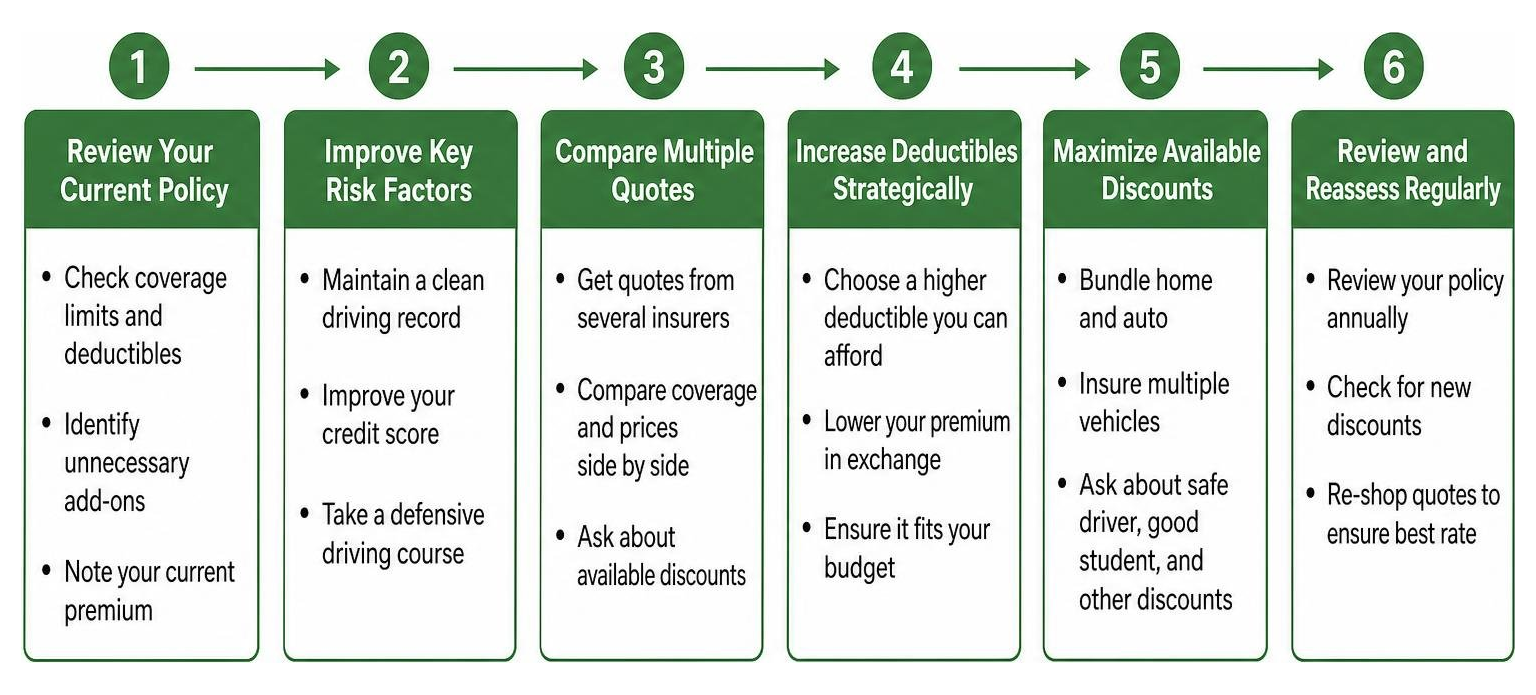
To explore these savings methods in depth, read the comprehensive analysis at Cheapest Full Coverage Car Insurance (From $96 a Month).
Raising Deductibles Strategically
Your deductible is the amount of money you agree to pay out of pocket before your insurance coverage kicks in to pay for damages.
By raising your comprehensive and collision deductibles from $500 to $1,000, you reduce the financial risk to the insurer. Nationally, this simple adjustment saves drivers an average of 12% on their policy (about $193 per year). Just make sure you keep that $1,000 set aside in an emergency fund so you aren’t caught off guard if you ever need to file a claim.
Maximizing Discounts and Telematics Programs
Always ask your insurance agent to apply every single discount you qualify for. Common discounts include:
- Policy Bundling: Combining your auto insurance with your home, renters, condo, or boat insurance can unlock massive multi-policy discounts. For example, bundling home and auto with major carriers can save you up to 12.7% or over $950 annually.
- Safe Driver & Good Student Discounts: Maintaining a clean driving record can save you up to 20% over time. Additionally, full-time students under age 25 with a GPA of 3.0 (B average) or higher can save up to 15% on their premiums.
- Telematics (Usage-Based Insurance): Programs like RightTrack or DriveEasy track your actual driving habits (braking, acceleration, and mileage) via a mobile app or plug-in device. If you are a safe, low-mileage driver, you can earn discounts of up to 30% or more. Just be aware that some programs reserve the right to raise your rates if they detect highly risky driving habits.
Frequently Asked Questions About Cheap Auto Insurance
What is the average cost of the cheapest auto full coverage insurance?
While the national average for standard full coverage is roughly $215 to $244 per month, drivers who shop around and qualify for maximum discounts can find rates with top-tier carriers like Travelers or GEICO starting between $95 and $138 per month.
Is the cheapest policy always the best choice?
Not necessarily. Genuinely cheap insurance from a fly-by-night carrier often comes with significant trade-offs, such as agonizingly slow claims processing, poor customer service, or high hidden deductibles. We recommend checking a company’s financial stability rating via AM Best (an A or A+ rating is excellent) to ensure they have the financial strength to pay out major claims.
How does poor credit affect my insurance rates?
In states where credit-based insurance scoring is legal, poor credit can increase your premium by 70% or more, adding an average of $1,343 to your annual bill. Improving your credit score over time is one of the most effective ways to lower your long-term auto insurance costs.
Conclusion
Finding the cheapest auto full coverage insurance doesn’t mean you have to settle for subpar protection. By understanding the components of full coverage, comparing national and regional carriers, adjusting your deductibles, and capitalizing on smart discounts, you can secure reliable coverage that fits your budget.
As you optimize your personal finances and explore the latest in smart technology, stay ahead of the curve by visiting Aixoria AI Updates for valuable insights into how cutting-edge technology is transforming everyday financial planning.
4 thoughts on “Cheapest Auto Full Coverage Insurance in 2026: Compare Top Low-Cost Providers”