Why the Most Reliable ETL Tools for Enterprise Data Matter More Than Ever
Scr0ll d0wn to D0VVNL0AD
The most reliable ETL tools for enterprise data are the ones that move, clean, and deliver your data without breaking — even at massive scale. Here’s a quick answer if that’s what you need:
Top reliable ETL tools for enterprise data (2026):
| Tool | Best For | Key Strength |
|---|---|---|
| Azure Data Factory | Cloud & hybrid pipelines | 90+ connectors, SSIS migration |
| Pentaho Data Integration | Complex orchestration | Low-code, multi-cloud support |
| Archon ETL | Legacy migration | Metadata-driven, governed movement |
| Informatica PowerCenter | Large enterprise | Data governance at scale |
| Apache Airflow | Custom orchestration | Open-source, highly flexible |
| Fivetran | Automated ingestion | Managed, low-maintenance |
| CONNX | Mainframe-to-cloud | 150+ database adapters |
Data is growing fast. Very fast. By the end of 2025, the world’s total data volume was projected to hit 181 zettabytes — a number too large to picture. For enterprises, this isn’t just a statistic. It’s a daily operational challenge.
ETL tools — software that Extracts data from sources, Transforms it into usable formats, and Loads it into a destination like a data warehouse — are the backbone of every data-driven organization. Without them, teams spend weeks on manual data wrangling instead of making decisions.
The global ETL software market reflects this urgency. It’s valued at $10.24 billion in 2026 and is projected to reach $21.25 billion by 2031, growing at nearly 16% per year.
But not all ETL tools are built the same. For enterprises running mission-critical pipelines, reliability isn’t a nice-to-have. It’s everything. A failed pipeline can mean bad reports, compliance violations, or decisions made on stale data.
This guide cuts through the noise and shows you exactly which tools hold up under real enterprise pressure — and why.
Key Criteria for the Most Reliable ETL Tools for Enterprise Data
When we evaluate reliability at the enterprise level, we look far beyond simple uptime percentages. True reliability means a system can handle data spikes, trace errors automatically, and secure sensitive information without slowing down your operations.
For modern enterprises, a reliable pipeline must offer:
- High Uptime and Fault Tolerance: Automated retries and failovers ensure that temporary network drops do not ruin overnight batch loads.
- Proactive Monitoring and Alerting: Real-time dashboards must alert data engineers before a delayed pipeline impacts downstream business intelligence dashboards.
- Seamless Scalability: The tool must handle gigabytes or petabytes of data with equal efficiency.
If you are looking to connect these pipelines directly to your centralized analytics repositories, check out our deep dive on the Best ETL Tools in Data Warehouse in 2026.
Why Data Integrity Defines the Most Reliable ETL Tools for Enterprise Data
At its core, data integration is about trust. If your business intelligence tools display inaccurate revenue figures because of a silent pipeline failure, the tool has failed.
The most reliable platforms enforce data integrity using three core pillars:
- Checksum Validation: Every single data load is verified by matching source and destination checksums to ensure zero data loss during transmission.
- Referential Integrity: Preserving parent-child relationships between tables (for example, ensuring an order record is never loaded without its corresponding customer record).
- Metadata-Driven Ingestion: Capturing source schema metadata dynamically so the platform can adapt to minor source changes without failing.

Security and Compliance Standards at Scale
For global enterprises, moving data means adhering to strict regulatory standards. A pipeline is only as reliable as its security protocols.
When evaluating enterprise tools, we prioritize:
- AES-256 Encryption: Mandatory for data both at rest and in transit.
- Compliance Certifications: Platforms should hold SOC 2 Type II, GDPR, and ISO 27001 certifications.
- Role-Based Access Control (RBAC): Granular access permissions integrated with enterprise Single Sign-On (SSO) systems to ensure only authorized users can modify critical pipelines.
Top Enterprise ETL Platforms and Their Reliability Profiles
To help you make the right choice, we have analyzed the leading enterprise ETL solutions across different deployment models.
| Platform | Deployment Model | Primary Strength | Ideal Use Case |
|---|---|---|---|
| Azure Data Factory | Cloud-Native / Hybrid | Serverless scalability, SSIS migration | Microsoft-centric enterprise ecosystems |
| Archon ETL | Cloud / On-Premises | Governed migration, metadata-driven | Legacy decommissioning & archive migration |
| Pentaho Data Integration | Hybrid / Containerized | Low-code orchestration, GenAI readiness | Multi-cloud and hybrid environments |
| CONNX | Hybrid / On-Premises | Mainframe virtualization & replication | Legacy system integration (VSAM, DB2) |
Modern Cloud-Native and Hybrid Orchestration
Cloud-native solutions have redefined data integration by offering serverless computing power that scales on demand. A standout in this category is Microsoft’s Azure Data Factory Integration.
Azure Data Factory simplifies hybrid data integration at scale. It offers more than 90 built-in connectors and delivers up to 5 Gbps throughput. For organizations migrating traditional SQL Server Integration Services (SSIS) packages to the cloud, it is highly cost-effective; organizations can gain up to 88% cost savings with Azure Hybrid Benefit when migrating SSIS to Azure Data Factory.
If your architecture relies heavily on cloud environments, explore our guide on the 9 Best Data Integration Tools for Cloud Services in 2026.
Metadata-Driven and Automated Migration Engines
When enterprises undergo massive migrations or legacy system decommissioning, standard ETL tools often struggle with referential integrity. This is where specialized, governed movement platforms excel.
Using Archon ETL Automation, organizations can automate complex ingestions while maintaining strict compliance. Archon ETL captures source metadata, maps dependencies dynamically, and validates every load through checksum and count matching. This automated parallelism allows customers to typically achieve up to 80% faster execution and significant cost reductions in their ETL operations.
For a broader look at how these automation features impact enterprise-wide architectures, read our review of the Most Reliable ETL Tools for Enterprise Data in 2026.
Codeless Orchestration and Mainframe Integration
Many enterprises still rely on legacy mainframes while simultaneously building modern cloud applications. Bridging this gap requires tools that blend old-world stability with new-world agility.
- Pentaho Data Integration: This platform provides a drag-and-drop, low-code environment that simplifies hybrid data estates. It supports containerized deployments (using Docker and Kubernetes) and runs on Java 21 for long-term platform stability. Pentaho users report an average of 80% savings in data operations costs and a 55% reduction in the time data scientists spend finding and evaluating data.
- CONNX Data Integration: If your business runs on legacy databases like VSAM, Adabas, or IMS, CONNX provides over 150 database adapters. It is widely recognized as one of the fastest ways to stream mainframe data directly into modern streaming platforms like Kafka or cloud warehouses like Snowflake.
Architectural Evolution: ELT, AI, and Lakehouses
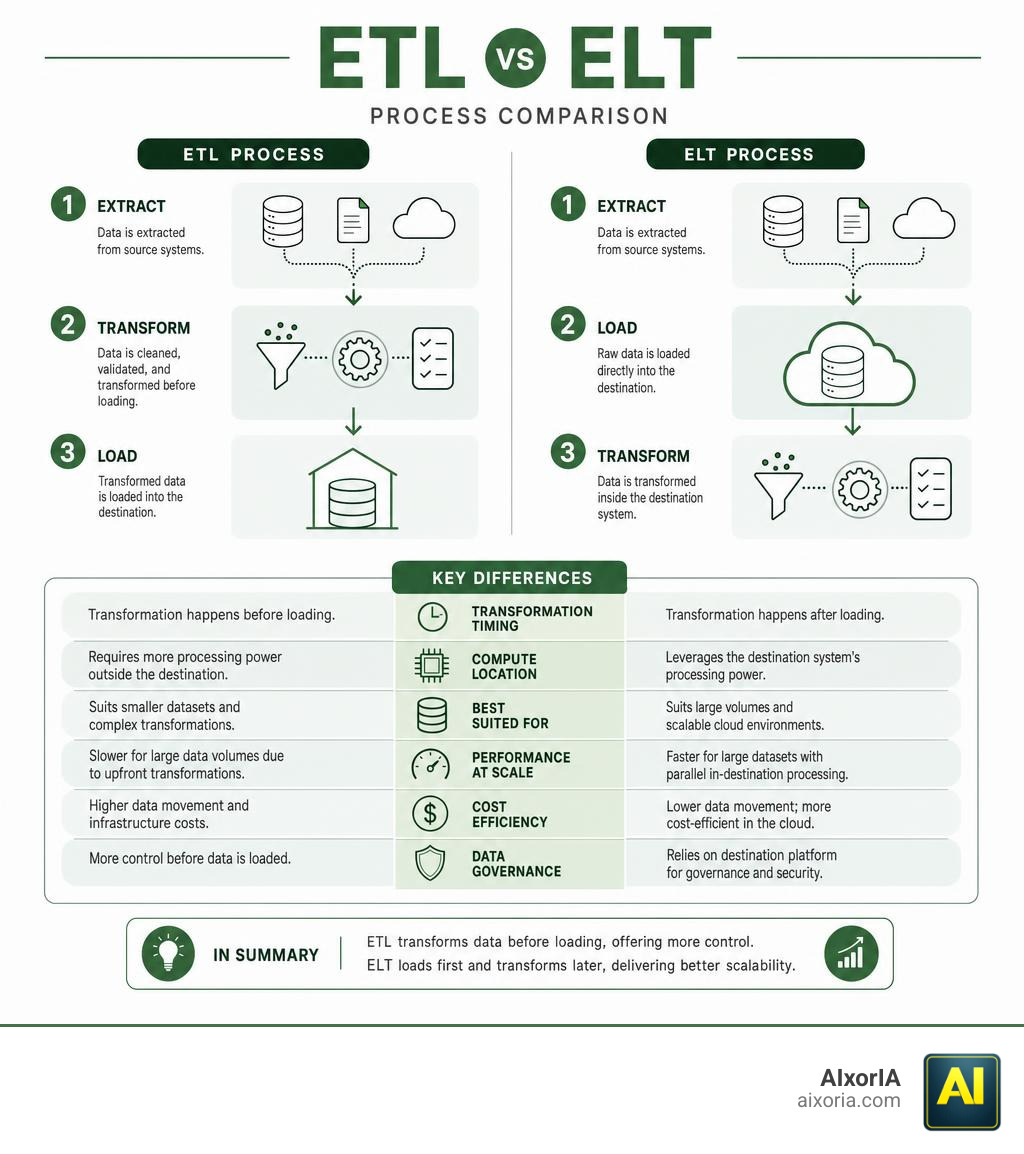
The traditional ETL model is shifting. Today, many enterprises leverage ELT (Extract, Load, Transform), loading raw data directly into powerful cloud data warehouses or data lakehouses before executing transformations using SQL or Python.
Furthermore, AI-driven automation has become a core feature of modern data engineering. AI tools now assist with automated schema mapping, anomaly detection, and query optimization, making pipelines significantly more self-healing.

To see how machine learning is reshaping data pipelines, check out our curated list of the Best AI Tools for Data Integration in 2026.
Evaluating the Most Reliable ETL Tools for Enterprise Data in Hybrid Environments
In complex, hybrid environments, moving data physically is not always practical due to latency, bandwidth, or compliance constraints.
In these scenarios, data virtualization and intelligent orchestration environments like Scaylor Orchestrate prove invaluable. Scaylor Orchestrate uses a “Tribal Knowledge Layer” to understand business context, allowing automated entity resolution (matching records across platforms like SAP and Salesforce) with up to 97.3% confidence.
For organizations leveraging modern lakehouse structures, we highly recommend reading about The 8 Best ETL Tools for Databricks in 2026.
Frequently Asked Questions about Enterprise ETL Reliability
What is the difference between ETL and ELT in terms of reliability?
In traditional ETL, data is transformed in-memory on an external server before being loaded. If the transformation server fails, the target warehouse remains untouched, isolating the error. In ELT, raw data is loaded directly into the target warehouse, and the warehouse’s compute engine handles the transformation. ELT is highly reliable for large volumes because it eliminates intermediate transfer steps, though it requires robust warehouse-native governance to prevent raw data “swamps.”
How do modern ETL tools handle legacy mainframe data?
Modern tools use specialized database adapters (such as those provided by CONNX) to access legacy systems like DB2, VSAM, and mainframe environments. They virtualize the data or replicate it in real time, streaming changed data directly into modern message brokers like Apache Kafka without placing heavy operational loads on the mainframe.
Are there reliable no-code ETL options for enterprise teams?
Yes. Platforms like Azure Data Factory and Pentaho Data Integration offer visual, drag-and-drop pipeline designers that allow non-developers to build production-grade workflows. These visual data flows compile into optimized code behind the scenes, ensuring enterprise-level performance.
To explore these options further, read our guide on the Best No-Code ETL Tools in 2026 or check out the Best Free ETL Tools for Developers in 2026 if your team prefers code-first solutions.
Conclusion
Selecting the right data integration platform is a foundational decision for your enterprise. Whether you need cloud-native scale, governed legacy migration, or real-time hybrid orchestration, prioritizing data integrity, security, and automated monitoring will protect your business from pipeline failures.
At AIxorIA, we specialize in helping businesses navigate these complex technical choices. We provide custom AI solutions, tool training workshops, hands-on tutorials, and comprehensive performance audits to ensure your data pipelines run smoothly and cost-effectively. With our commitment to clear language, affordable services, and fast support, we help you eliminate complexity.
Ready to explore your options further? Take a look at our comprehensive comparison of the 20 Best ETL Tools for Data Integration to find the perfect fit for your architecture.