Online Retail Is Booming — But Only If You Pick the Right Platform

The best eCommerce website building platforms for online stores in 2026 are not all created equal — and picking the wrong one can cost you real money and time.
More than a fifth of all retail sales now happen online. Mobile devices drive over 60% of that traffic. If your store isn’t fast, mobile-friendly, and easy to manage, you’re leaving sales on the table.
Here’s a quick answer to help you choose:
| Platform | Best For | Starting Price |
|---|---|---|
| Shopify | Most small businesses, physical products, scaling | $39/month |
| Wix | Beginners, design flexibility, all-in-one tools | $29/month |
| Square | In-person + online sellers, free starting option | Free (fees apply) |
| BigCommerce | High-volume sellers, no transaction fees | $39/month |
| WooCommerce | WordPress users, full control, tech-comfortable | Free + hosting |
| Ecwid | Adding a store to an existing site | From $5/month |
So which one is right for you? That depends on your budget, technical comfort, and how fast you want to grow.
The good news: today’s platforms are more beginner-friendly than ever. No coding required. AI tools write your product descriptions. Templates get you 70% of the way there in minutes.
But the wrong choice still hurts. Transaction fees add up. Some platforms lock you into ecosystems. Others lack the marketing tools you need to actually get found.
This guide breaks it all down clearly — features, pricing, AI tools, and which platform fits which type of business.
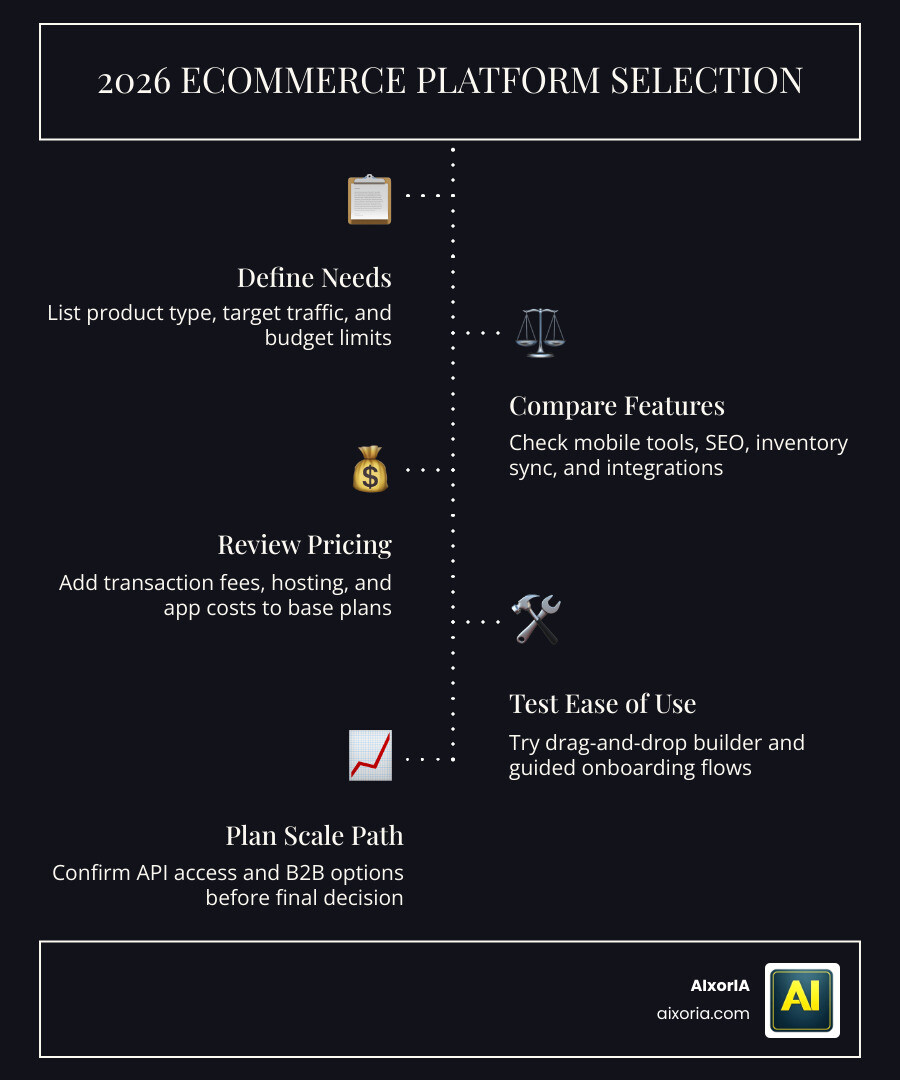
Essential Features of the Best eCommerce Website Building Platforms for Online Stores
When we look for the best eCommerce website building platforms for online stores, we aren’t just looking for a pretty digital storefront. We are looking for a powerhouse that handles the “boring” stuff so you can focus on selling. In 2026, the baseline for a great platform has shifted. It is no longer just about having a “buy” button; it is about having a cohesive ecosystem.

The most important feature is ease of use. Most of us aren’t computer scientists, and we shouldn’t have to be. Modern platforms like the Shopify eCommerce Website Builder use intuitive drag-and-drop interfaces that let you move sections around like LEGO blocks.
Beyond the editor, you need:
- Mobile Responsiveness: Since mobile devices account for over 60% of traffic, your site must look perfect on a smartphone.
- Built-in SEO Tools: If customers can’t find you on Google, you don’t exist. The best platforms now automate meta tags and sitemaps.
- Multichannel Selling: You should be able to sell on your site, Instagram, TikTok, and Amazon from one single dashboard.
- Inventory Management: Real-time syncing is vital to prevent selling items that are out of stock.
For a deeper dive into the specific contenders this year, check out our list of The 7 Best Ecommerce Website Building Platforms for Online Stores in 2026.
Evaluating the Best eCommerce Website Building Platforms for Online Stores for Beginners
If you are just starting, the “perfect” setup is worthless if it takes six months to launch. Beginners should prioritize platforms with guided onboarding.
For example, Square is a fantastic entry point. Research shows that sellers who added a website to their existing Square setup saw an average 38% increase in revenue. It connects your in-person sales directly to your online inventory.
Another beginner favorite is Wix. Their AI-powered eCommerce builder can literally build a site for you based on a short conversation. Platforms like Fourthwall are also gaining traction for their extreme simplicity, often handling complex tasks like sales tax compliance automatically, which is a massive headache for new sellers.
Scaling with the Best eCommerce Website Building Platforms for Online Stores in 2026
What happens when you go from 10 orders a day to 10,000? That is where scalability comes in. You need a platform that won’t crash during a Black Friday surge. Some high-end platforms can now support up to 750 simultaneous transactions per second.
For true enterprise-level needs, Adobe Commerce offers a composable, API-first architecture. This means you can add custom features or integrate complex B2B workflows without breaking the core store. It is built for multi-brand, multi-country operations that require millions of SKUs and advanced security like AI-powered threat detection.
Top Platform Comparisons: From Shopify to Wix in 2026
Choosing between the giants often comes down to the “vibe” of the tools and the specific revenue-boosting features they offer.
| Feature | Shopify | Wix | Square | BigCommerce |
|---|---|---|---|---|
| AI Content | Shopify Magic | Wix AI Text/Image | Basic AI | AI Assistant |
| SEO Strength | High | Very High (24% rev boost) | Moderate | High |
| App Store | 13,000+ Apps | 500+ Apps | Focused Integrations | 1,000+ Apps |
| Best For | Physical Products | Creative Control | Brick & Mortar | Large Catalogs |
Shopify remains the king of the ecosystem with over 13,000 apps to extend your store’s power. Whether you need a specific shipping carrier or a niche loyalty program, there’s an app for it. You can explore how to maximize this with the Top AI Tools for Shopify in 2026.
Wix, on the other hand, has leaned heavily into SEO and marketing. Stores using Wix SEO tools see a 24% increase in monthly revenue on average. Their platform is less about “apps” and more about having everything built-in from the start.
Design and Customization Options
We’ve moved past the era of “cookie-cutter” templates. In 2026, the best eCommerce website building platforms for online stores offer “vibe-coding” and hybrid builders. This allows you to start with a professional design but tweak it at a pixel level without touching a line of CSS.

Wix and Squarespace lead the pack here. Wix uses a “first-of-its-kind” hybrid builder that combines the speed of AI generation with the freedom of a drag-and-drop editor. This ensures your brand identity isn’t lost in a generic layout.
Marketing and Customer Engagement Tools
Building the store is only half the battle; you have to keep people coming back. The statistics from 2025 and 2026 are clear on what works:
- Automated Emails: Wix stores using automated emails see 45% higher revenues.
- Gift Cards: Implementing gift cards can lead to a 65% increase in average order value.
- Social Integration: Sites using advanced social tools generate 6X more revenue from social media activity.
To see which automated tools are currently leading the market, take a look at our guide on the Best AI Tools for Ecommerce in 2026.
The Impact of AI on Modern eCommerce Building
AI is no longer a buzzword; it’s the engine under the hood. In 2026, the best eCommerce website building platforms for online stores use AI to handle everything from the mundane to the highly strategic.
Platforms like Unizap use AI engines to help B2C and B2B stores launch in minutes. Meanwhile, giants like Adobe and Shopify use AI for Personalized Recommendations. There are now over 13 different types of AI-powered recommendations (like “frequently bought together” or “trending in your area”) that can significantly boost your conversion rates.
If you’re looking to squeeze every drop of profit from your traffic, you’ll want to read about Top AI Tools for Optimizing Checkout & Upsells.
Automating Operations and Analytics
The real magic of AI happens in the backend. We are seeing platforms automate:
- Inventory Syncing: Predicting when you’ll run out of stock based on sales trends.
- Tax Automation: Calculating VAT or local sales tax based on the customer’s exact GPS location.
- ROAS Reporting: AI tools can now tell you exactly which ad campaign is making money and which is wasting it.
For those focused on data, check out the Best AI Tools for Ecommerce ROAS Reporting in 2026 to simplify your analytics.
Pricing, Transaction Fees, and Total Cost of Ownership
Don’t let a “Free” plan fool you. The total cost of ownership (TCO) includes your monthly subscription, domain costs, and—most importantly—transaction fees.
Most platforms charge a standard 2.9% + $0.30 per transaction. However, some (like Shopify) charge an extra fee if you don’t use their proprietary payment gateway. Others, like BigCommerce, have no transaction fees but will force you to upgrade your plan once you hit a certain sales volume (e.g., $50,000/year).
Platforms like SiteGround Ecommerce offer a different path, providing a beginner-friendly environment with 14-day free trials and bundled hosting. This can be a great way to avoid the “plugin hunting” that often drives up the price of platforms like WooCommerce.
Frequently Asked Questions about eCommerce Platforms
What is the best eCommerce platform for small businesses in 2026?
For most small businesses, Shopify is the top choice due to its massive app ecosystem and ease of use. However, if you are a creative who wants total design freedom, Wix is a very close second.
How much does it cost to build an online store?
If you do it yourself using a builder, expect to pay between $30 and $150 per month for the platform. If you hire a professional developer, costs can range from $1,000 to $10,000+ depending on the complexity.
Can I build an eCommerce website without coding skills?
Absolutely. In 2026, coding is optional. Drag-and-drop editors and AI website builders have made it possible for anyone to launch a professional-grade store in a single afternoon.
Conclusion
Choosing from the best eCommerce website building platforms for online stores is a strategic decision that sets the ceiling for your growth. Whether you need the massive scalability of Adobe, the design-first approach of Wix, or the all-in-one simplicity of Shopify, the right tool is out there for your specific budget and goals.
At AIxorIA, we specialize in helping businesses navigate these technical waters. From custom AI solutions that automate your operations to performance audits that ensure your store is running at peak efficiency, we provide the simple language help and fast support you need to succeed.
Ready to take the next step in your eCommerce journey? Explore More info about AI tools for business in 2026 to see how autonomous agents and smart ROI formulas can transform your store into a high-performance sales machine.