Cited answers in AI tools are responses that include verifiable sources—such as articles, journals, databases, or websites—for each claim made in the response.
This system is powered by Retrieval-Augmented Generation (RAG), where an AI model first retrieves relevant external information and then generates a summarized answer while attaching references to the original sources.
The goal is simple: combine AI reasoning with factual transparency so users can quickly verify information without manually checking dozens of search results.
Why “Cited Answers” Became Important in Modern AI
Early AI chatbots often produced confident but incorrect responses. These errors—commonly called AI hallucinations—happened because models relied only on training data rather than real-time sources.
Modern AI systems solved this problem by introducing source-backed responses.
Instead of guessing, the AI now:
- Searches reliable data sources.
- Extracts relevant information.
- Generates a contextual summary.
- Attaches citations so users can verify the claim.
Tools like Perplexity AI and Google Gemini use this approach to deliver answers that are both informative and traceable.
How Cited Answers Actually Work (The RAG Process)
At the technical level, cited answers rely on Retrieval-Augmented Generation (RAG).
RAG combines two systems:
- Information Retrieval Engine – finds relevant documents
- Generative AI Model – summarizes and explains them
Step-by-Step Process
Step 1: Query Understanding
The AI analyzes the user’s question and identifies key intent.
Step 2: Data Retrieval
The system searches external sources such as:
- websites
- research papers
- knowledge bases
- indexed databases
Step 3: Context Filtering
Relevant sections from the retrieved documents are extracted.
Step 4: Answer Generation
The AI generates a coherent response using the filtered context.
Step 5: Citation Attachment
Sources used in the response are added as inline references or links.
This pipeline ensures that the final answer is not purely generated content but evidence-supported information.
Measuring Citation Reliability in AI Systems
Simply attaching sources does not guarantee accuracy.
Modern AI systems evaluate the quality and relevance of citations.
One theoretical metric used to understand this reliability is the Citation Accuracy Score.
C_a = \frac{\sum (\text{Source Authority} \times \text{Contextual Match})}{\text{Total Citations Generated}}
What This Means
- Source Authority – credibility of the source (research journal vs random blog)
- Contextual Match – how closely the source matches the user query
- Total Citations Generated – number of sources referenced in the answer
A higher score indicates stronger evidence backing the AI’s claims.
When citation reliability is high, the probability of hallucinated content becomes extremely low.
AI Cited Answers vs Traditional Search Engines
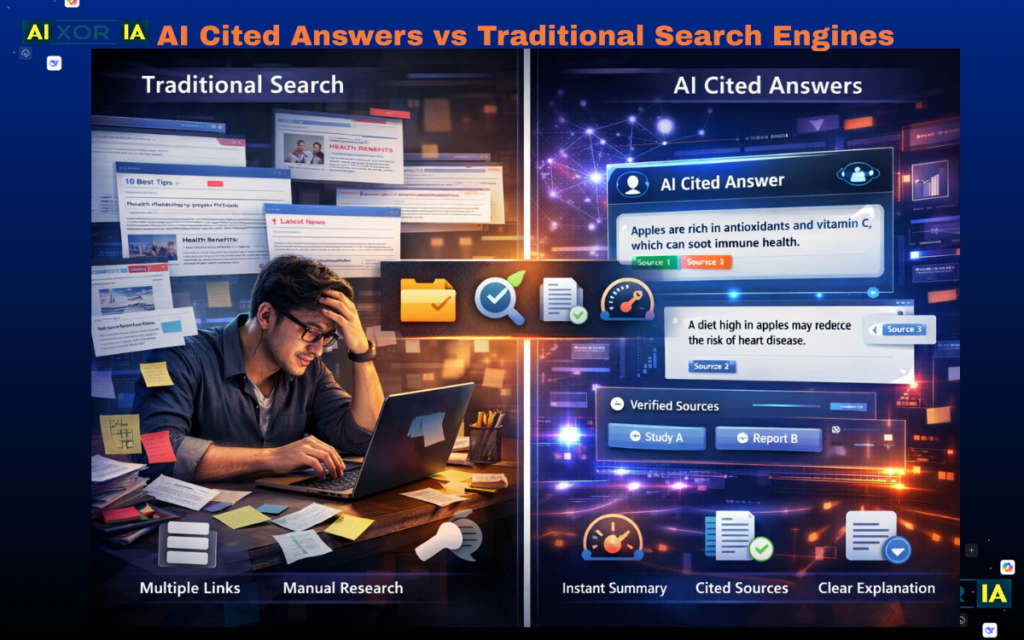
One of the biggest differences between modern AI tools and traditional search engines is how information is delivered.
| Feature | Traditional Search (Google) | Cited AI Answers |
|---|---|---|
| Efficiency | User must open multiple links | AI summarizes information instantly |
| Verification | Requires reading full pages | Sources appear directly beside claims |
| Context | Information scattered across pages | Single coherent explanation |
| Speed | Manual research required | Synthesized research within seconds |
Traditional search gives links.
AI cited answers give knowledge with references.
This is why many researchers now use AI tools for initial information discovery before deep research.
Real AI Tools That Provide Cited Answers
Perplexity AI
Perplexity AI is one of the earliest platforms designed specifically for AI-powered search with citations.

Unlike traditional chatbots, Perplexity focuses heavily on evidence-backed responses.
When a user asks a question, the platform retrieves sources from:
- academic journals
- major news sites
- scientific databases
- verified blogs
Each statement in the response is connected to numbered references that link to the original source.
Real Experience Using Perplexity
While testing Perplexity for research queries, the biggest advantage was its transparent citation system. For example, when searching for information about AI marketing trends, the tool generated a structured answer with references from industry reports and research articles. Clicking the citation immediately opened the source page, which made verification extremely fast. Compared to traditional searching, the workflow felt more like reading a mini research report rather than browsing search results.
Because of this approach, Perplexity is often used by:
- students
- journalists
- researchers
- analysts
who need fast but verifiable information.
Google Gemini
Google Gemini integrates AI reasoning with Google’s massive search index.
Instead of simply generating text, Gemini often references Google Search results and knowledge sources to support its responses.
This allows the AI to combine:
- real-time web data
- structured knowledge graphs
- contextual AI reasoning
Real Experience Using Gemini
When testing Gemini for technical questions, the system frequently referenced content from authoritative websites and documentation pages. For example, asking about AI model architectures produced an explanation that cited developer documentation and educational resources. The major strength of Gemini is its connection to Google’s search infrastructure, which means the citations often come from high-authority domains and well-indexed pages. However, compared to specialized AI search tools, the citations sometimes lean more toward web articles rather than academic research papers.
Gemini works best when users want AI explanations combined with familiar search-engine sources.
Why Cited Answers Improve Trust in AI
The presence of sources changes how users interact with AI responses.
Instead of asking “Is this correct?”, users can simply check the source.
This improves:
Transparency
Readers know exactly where the information came from.
Research Efficiency
Instead of scanning ten pages, users get a summarized explanation.
Learning Depth
Users can start with the AI summary and then explore the original research.
Limitations of Cited AI Answers
Even with citations, AI systems are not perfect.
Some potential issues include:
Low-quality sources
If the AI retrieves unreliable content, the citation itself may not be trustworthy.
Context distortion
A model might summarize a source incorrectly.
Citation mismatch
Sometimes the citation is related but does not fully support the claim.
Because of this, experts still recommend checking the original source when accuracy matters.
The Future of Cited Answers in AI Search
AI search is moving toward a model where information and verification happen simultaneously.
Instead of separate steps like:
- Search
- Click links
- Read sources
- Summarize information
AI tools are combining all four into a single process.
This transformation is gradually turning AI systems into knowledge synthesizers rather than simple information generators.
In the future, cited answers may become the standard interface for online research, where every statement produced by an AI model is automatically backed by a traceable source.
Conclusion
Cited answers represent one of the most important improvements in modern AI systems. By combining generative models with real-time information retrieval, these tools produce responses that are not only informative but also verifiable.
Through technologies like Retrieval-Augmented Generation, AI platforms can search external sources, interpret relevant context, and generate explanations while attaching references to the original information.
This approach bridges the gap between AI creativity and factual accuracy, allowing users to explore complex topics faster while maintaining confidence in the reliability of the information they receive.