A Practical Comparison of AI Visibility Platforms for Modern Search
Quick Answer
Ziptie.ai differs from traditional SEO tools by tracking Generative Engine Optimization (GEO) metrics such as brand mentions, citations, and sentiment inside AI platforms like ChatGPT, Perplexity, and Google AI Overviews. Traditional SEO tools focus mainly on keyword rankings and organic traffic, while newer AI search tools measure how often your brand appears in AI-generated answers.
The Shift From Traditional SEO to AI Search Visibility
For more than two decades, search optimization meant ranking inside the classic “10 blue links” on Google.
But the rise of generative AI search experiences has changed how information is delivered.
Instead of simply listing links, AI systems now:
- Generate complete answers
- Cite multiple sources
- Mention brands directly
- Summarize information from across the web
This fundamentally changes what “visibility” means.
In many cases, users never click a website because the AI response already answers their question.
For marketers and content creators, the key question becomes:
Is your brand included in the AI-generated answer?
That’s the problem a new category of tools is trying to solve.
One of the most interesting platforms in this emerging category is Ziptie.ai.
But how does it compare with other AI search monitoring tools?
To answer that, we need to understand how AI visibility metrics work.
READ MORE – Why Choose Ziptie AI Search Performance Tool?
Understanding AI Visibility Metrics
Traditional SEO measures things like:
- Keyword rankings
- Click-through rate
- Organic traffic
- Backlinks
AI search environments introduce a different metric: presence within generated answers.
One way to measure this is through Generative Share of Voice (gSOV).
Generative Share of Voice (gSOV):gSOV=Total Industry Queries AnalyzedBrand Mentions in AI Answers×Sentiment Weight
This metric evaluates how frequently a brand appears within AI responses across multiple queries.
Instead of focusing on ranking positions, it measures AI-level influence and citation frequency.
Platforms like Ziptie.ai and other AI visibility tools rely heavily on variations of this model.
What Is Ziptie.ai?
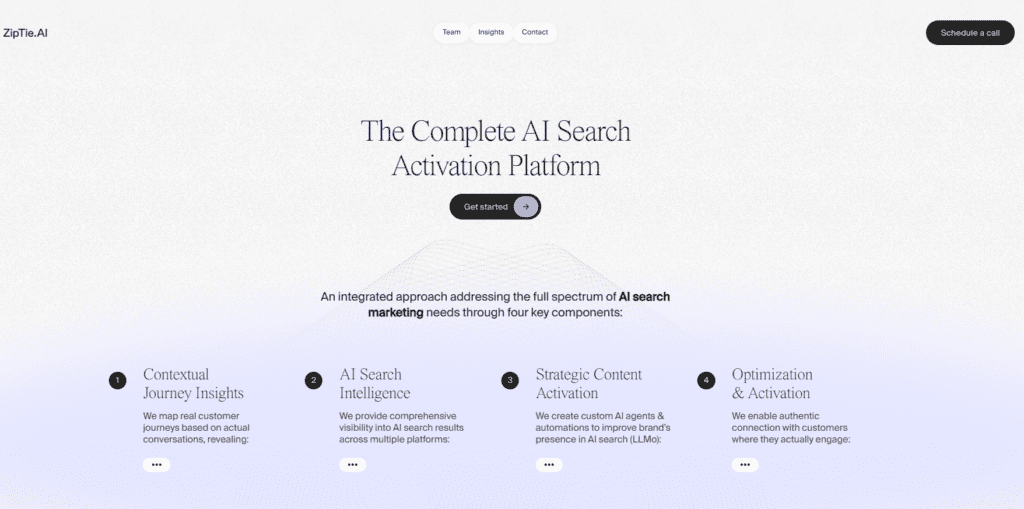
Ziptie.ai is a monitoring platform designed specifically for AI-generated search ecosystems.
Rather than tracking keyword rankings, it tracks how AI systems mention and cite your brand.
The platform analyzes responses across multiple AI search environments including:
- Chat-based assistants
- AI answer engines
- AI search summaries
It then records:
- Whether your brand is mentioned
- Whether your domain is cited
- Sentiment context
- Which competitors appear in the same answer
This approach helps marketers understand their true visibility inside generative search responses.
Core Features of Ziptie.ai
1. AI Answer Monitoring
Ziptie continuously queries AI platforms and records how answers change over time.
Each query produces a record showing:
- The full AI response
- Mentions of brands
- Source citations
- Competitive visibility
This gives teams a historical record of how AI answers evolve.
2. Citation Tracking
Unlike traditional SEO tools, Ziptie focuses heavily on citations.
When AI models reference sources, Ziptie logs:
- Domain names cited
- Frequency of citation
- Query context
This allows teams to identify which content types AI models trust most.
3. Sentiment Detection
Mentions alone do not always equal positive exposure.
Ziptie analyzes surrounding language to determine whether the brand mention is:
- Positive
- Neutral
- Negative
This helps companies detect reputation risks inside AI answers.
4. Competitive AI Visibility
Ziptie also shows which competitors appear most frequently in the same query set.
For example, if five competitors appear more frequently in AI responses than your brand, that becomes a strategic content opportunity.
Real-World Experience Using Ziptie.ai
In my own testing workflow, Ziptie was particularly useful for tracking long-tail industry questions.
Instead of analyzing just keywords, I ran queries such as:
- “Best AI search monitoring tools”
- “How to measure AI visibility for brands”
The platform returned structured data showing:
- Which companies were cited
- Which domains were used as sources
- How answers differed between AI engines
One surprising insight was that AI systems often cite smaller niche blogs rather than large authority websites, especially when those blogs provide structured explanations or technical breakdowns.
That insight alone can influence content strategy.
READ MORE – What Is the Ziptie AI Search Performance Tool?
Comparing Ziptie.ai With Other AI Search Tools
Several other platforms are beginning to compete in the AI search analytics space.
The most notable ones include:
- BrightEdge Generative Parser
- SE Ranking AI Tracker
- AnswerEngine
Each of these tools approaches AI search monitoring differently.
Feature Comparison Matrix
| Feature | Ziptie.ai | Traditional SEO Tools | BrightEdge Generative Parser |
|---|---|---|---|
| Primary Focus | AI Answer Visibility | Keyword Rankings | Enterprise AI & SEO |
| Tracks AI platforms | Yes | No | Yes |
| Citation tracking | Yes | No | Yes |
| Brand mention monitoring | Yes | No | Yes |
| Keyword tracking | Limited | Yes | Yes |
| Best for | Agencies & marketers | Bloggers & SEOs | Enterprise companies |
Ziptie.ai vs BrightEdge Generative Parser
BrightEdge Generative Parser is part of the enterprise SEO platform BrightEdge.
It focuses on analyzing how generative AI results appear inside search engines.
Key Differences
Ziptie.ai
- Built specifically for AI answer monitoring
- Simpler dashboard
- Focus on brand mentions and citations
BrightEdge Generative Parser
- Integrated into a full enterprise SEO platform
- Advanced keyword datasets
- Large enterprise data infrastructure
My Experience Testing BrightEdge
BrightEdge tools are extremely powerful but also designed for large marketing teams with large budgets.
During testing, the data depth was impressive, but the interface felt more like a traditional SEO analytics suite with AI features added later.
Ziptie, in contrast, felt more focused on AI answer behavior itself.
Ziptie.ai vs SE Ranking AI Tracker
SE Ranking AI Tracker approaches AI search tracking differently.
Instead of analyzing entire AI responses, it focuses on how AI results influence keyword rankings.
Key Differences
Ziptie.ai
- Tracks AI answer text
- Measures citations
- Records brand mentions
SE Ranking AI Tracker
- Tracks keyword impact from AI search
- Focuses more on ranking volatility
- Integrated with SEO campaigns
My Experience Testing SE Ranking
SE Ranking works well when teams want AI insights integrated with traditional SEO campaigns.
However, it does not analyze AI responses as deeply as dedicated tools like Ziptie.
Ziptie.ai vs AnswerEngine
AnswerEngine focuses on optimizing content specifically for AI question answering systems.
It tracks:
- Question-based queries
- AI-generated summaries
- Knowledge panel influence
Key Differences
Ziptie.ai
- Brand monitoring across AI responses
- Citation analysis
- Sentiment insights
AnswerEngine
- Focus on question-answer optimization
- Content structure recommendations
- AI answer probability scoring
Real Experience Testing AnswerEngine
AnswerEngine is particularly useful for publishers creating FAQ-style or knowledge-base content.
However, it lacks the deeper competitive brand visibility analysis that Ziptie offers.
Where Ziptie.ai Excels
After testing multiple AI search analytics tools, Ziptie performs particularly well in three areas.
1. AI Response Transparency
Seeing the full AI answer history provides context that simple metrics cannot.
2. Brand Visibility Monitoring
Most SEO tools focus on keywords rather than brand mentions inside AI responses.
3. Competitive AI Landscape Analysis
Ziptie makes it easier to see which brands dominate AI responses in a specific industry.
Limitations of Ziptie.ai
Despite its strengths, Ziptie also has limitations.
Limited SEO Infrastructure
It does not replace platforms used for:
- Backlink analysis
- Technical SEO audits
- Site health monitoring
Smaller Data Index
Enterprise platforms often maintain larger keyword databases.
Ziptie instead focuses on query-level AI answer tracking.
READ MORE – What are the Best AI Search Monitoring Tools in 2026
How Marketers Should Use AI Search Tools Today
The smartest strategy is combining traditional SEO tools with AI visibility platforms.
A typical workflow might look like this:
- Keyword research using traditional SEO tools
- Content creation optimized for search intent
- AI visibility monitoring using platforms like Ziptie
- Content updates based on AI citation behavior
This hybrid strategy ensures content performs in both traditional search and AI-generated responses.
The Future of AI Search Monitoring
AI search technology is still evolving rapidly.
Within the next few years, we can expect:
- More AI-generated answers
- Fewer traditional search clicks
- Greater importance of brand citations
- New metrics beyond rankings
Tools that analyze AI answer visibility will become essential for marketers.
Ziptie.ai and similar platforms represent the early stage of this transformation.
Final Thoughts
Search optimization is entering a new phase.
Instead of competing only for rankings, brands must now compete for visibility inside AI-generated answers.
Platforms like Ziptie.ai, BrightEdge Generative Parser, SE Ranking AI Tracker, and AnswerEngine represent different approaches to measuring this new type of search presence.
Each tool serves a slightly different purpose.
But together they reveal an important truth:
The future of SEO is no longer just about rankings — it’s about influence inside AI knowledge systems.
Understanding that shift today can give marketers a powerful advantage in tomorrow’s search landscape.