Why Finding the Best Debt Payoff Method Changes Everything

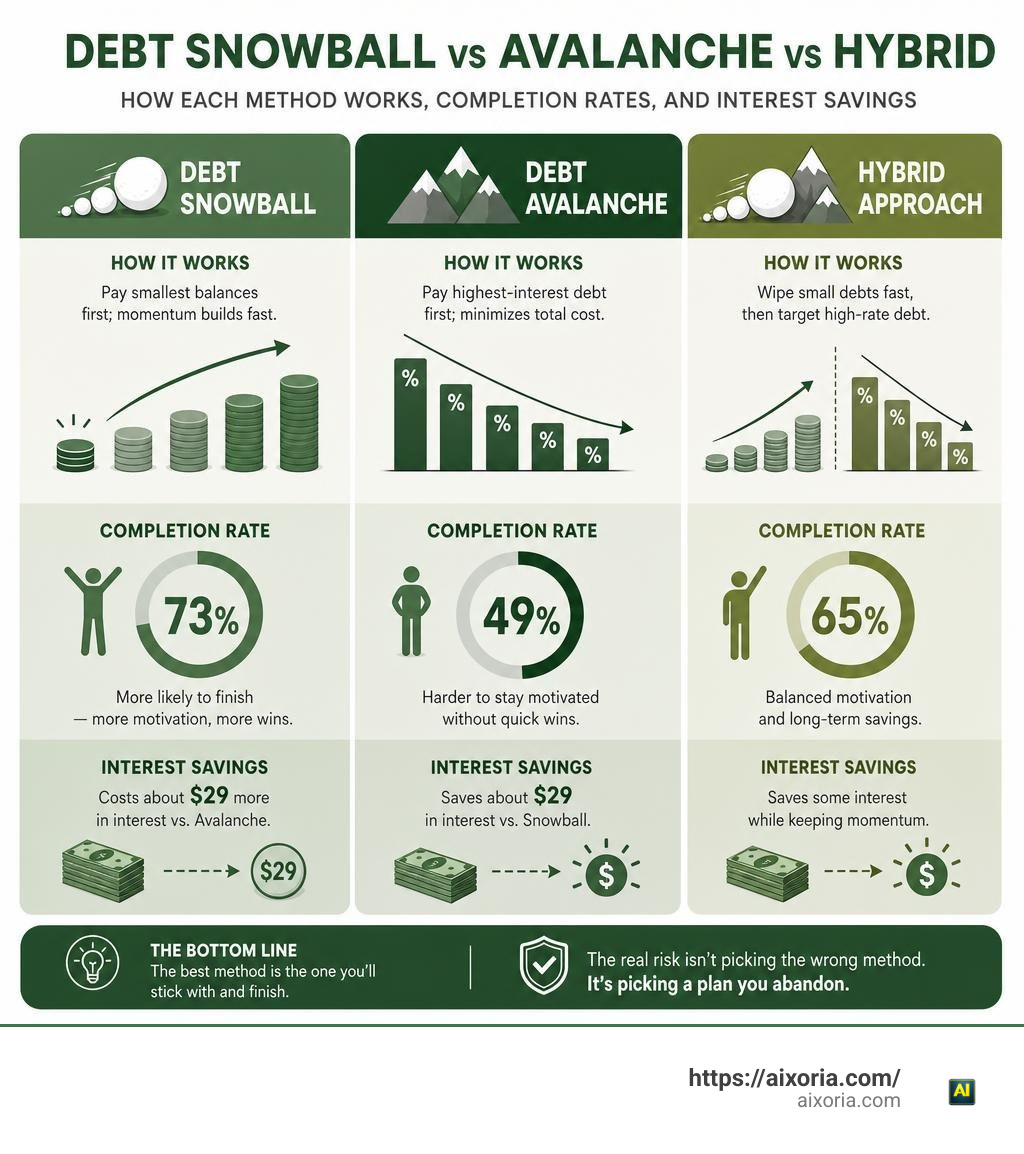
What is the best debt payoff method? The honest answer: it depends on your personality and debt profile. But here’s a quick guide to match you to the right strategy:
| Your Priority | Best Method | Why It Works |
|---|---|---|
| Stay motivated, get quick wins | Debt Snowball | Pay smallest balances first; momentum builds fast |
| Save the most on interest | Debt Avalanche | Pay highest-rate debt first; minimizes total cost |
| Balance both math and motivation | Hybrid Approach | Wipe small debts fast, then target high-rate debt |
| Simplify multiple debts | Debt Consolidation | One payment, potentially lower rate |
The two most popular methods are the snowball and the avalanche. Each has real advantages — and real drawbacks.
Here’s what the data actually shows:
- The snowball method achieves a 73% completion rate
- The avalanche method achieves only a 49% completion rate
- Yet the avalanche method can save hundreds — sometimes thousands — in interest
- For a typical mix of credit card, auto, and student loan debt, choosing snowball over avalanche costs roughly $29 in extra interest over the full payoff
That last number surprises most people. The gap between “mathematically perfect” and “actually works” is often smaller than a dinner out.
The real risk isn’t picking the wrong method. It’s picking a plan you abandon.
Understanding the Core Frameworks: Snowball vs. Avalanche
When we look closely at personal finance, almost every repayment framework builds upon two foundational systems: the debt snowball and the debt avalanche. Both require you to make required minimum monthly payments on every single debt account to protect your credit standing. However, they differ fundamentally in where you direct your extra cash flow.
| Feature | Debt Snowball Method | Debt Avalanche Method |
|---|---|---|
| Primary Focus | Smallest balance first | Highest interest rate (APR) first |
| Main Advantage | Fast psychological wins and momentum | Maximum mathematical interest savings |
| Main Disadvantage | May pay slightly more interest overall | Progress can feel slow on large balances |
| Best Suited For | Anyone needing motivation and visible progress | Analytical individuals focused on pure math |
| Completion Rate | ~73% completion | ~49% completion |
To execute either system, you begin by creating a simple four-column inventory of your current liabilities: creditor name, total balance owed, interest rate (APR), and required minimum monthly payment.
Under the debt snowball, you organize this list strictly from the smallest balance to the largest balance, completely ignoring interest rates. You allocate every extra dollar in your budget to the account at the top of the list. Once that smallest balance drops to zero, you take its entire payment amount—both the minimum and your extra contribution—and roll it into the monthly budget for the next smallest debt. Like a rolling snowball, your target payment grows larger with every account you eliminate.
Under the debt avalanche, you sort your list from the highest interest rate to the lowest interest rate, regardless of account balances. You funnel all surplus cash toward the debt charging you the steepest annual percentage rate—often a revolving credit card charging upwards of 22% to 28% APR. Once that high-rate card is paid in full, you redirect the entire payment amount to the account with the next highest rate.
What Is the Best Debt Payoff Method for Psychological Motivation?
If you struggle with feeling overwhelmed by multiple monthly bills, the snowball method is widely regarded as the most effective choice. By knocking out a small $300 store card or a $500 medical bill within the first couple of months, you immediately reduce your total count of open obligations.
This rapid elimination produces what behavioral scientists call a “cognitive dividend.” According to research published in the Proceedings of the National Academy of Sciences (PNAS), completely closing out a debt account improves cognitive functioning by approximately one-quarter of a standard deviation and reduces the likelihood of experiencing financial anxiety by 11%. When you wipe out a line of credit, your brain registers a clear victory, liberating mental bandwidth previously consumed by tracking due dates and payment thresholds.
Furthermore, studies on consumer behavior show that picking up these quick wins creates emotional momentum. Research on debt completion rates highlights that borrowers using momentum-based strategies complete their plans at significantly higher rates than those following strict spreadsheets. Seeing zero balances on your monthly statements provides concrete proof that your sacrifices are working, reinforcing positive habits before fatigue sets in.
What Is the Best Debt Payoff Method for Maximum Interest Savings?
From a purely mathematical standpoint, interest is a penalty you pay for borrowing time. Therefore, targeting your highest APR accounts first via the avalanche method minimizes the total dollar amount lost to interest over your repayment journey.
Consider a scenario where you carry a $2,400 store credit card balance at 28.99% APR alongside a $6,000 personal loan at 10% APR. If you put extra money toward the personal loan simply because its balance is lower, the credit card at 28.99% continues to compound rapidly. Every month that high-rate balance remains untouched, nearly 2.4% of its balance goes straight into non-recoverable interest charges.
By prioritizing the 28.99% credit card first, you immediately halt aggressive compound interest. In high-debt scenarios—such as carrying tens of thousands in revolving credit card debt across multiple accounts—the avalanche strategy can save you thousands of dollars and shave several months off your timeline compared to minimum payments alone. For anyone who feels deeply motivated by numbers, spreadsheets, and financial efficiency, the avalanche method provides the optimal path forward.
Evaluating the Contenders: What Is the Best Debt Payoff Method for Your Situation?
To determine what is the best debt payoff method? for your household, you must look beyond theory and evaluate your specific debt profile.

The ideal approach depends heavily on two core factors:
- The spread between your interest rates: If your debts range from a 4% auto loan to a 29% credit card, rate spread matters immensely. But if all your accounts carry similar rates between 18% and 22%, interest prioritization offers negligible mathematical benefit.
- Your account count and total balance size: Carrying seven different small balances creates mental fatigue. Carrying two large loans requires a long-term endurance plan.
As detailed in an insightful analysis of debt repayment order, strict financial orthodoxy often fails because it assumes human beings act like unfeeling calculators. In practice, choosing a repayment order that ignores human psychology frequently leads to burnout.
The Hybrid Playbook: Blending Math and Psychology
Fortunately, you do not have to choose between pure math and pure psychology. A growing consensus among personal finance experts favors a hybrid approach that captures early emotional wins without leaving massive interest savings on the table.
A comprehensive study on math versus behavior in debt strategies demonstrates that flexible frameworks keep households engaged far longer than rigid systems. You can implement a simple hybrid strategy by following three rules:
- The Sub-$500 Rule: Eliminate any small account with a balance under $500 immediately within your first 30 to 60 days, regardless of its interest rate. Clearing these tiny balances eliminates mental clutter at a negligible mathematical cost.
- The 60-Day Quick Win Window: If your next-smallest debt can be fully cleared within 60 days using your extra monthly budget, pay it off next to build momentum.
- The 20%+ APR Emergency Threshold: Treat any credit card or loan with an interest rate above 20% APR as an active financial emergency. Once you have cleared sub-$500 clutter, pivot directly to the avalanche method to attack accounts charging over 20% APR before turning your attention to moderate-interest debts (such as auto loans or student loans under 8% APR).
Behavioral Science and Real-World Completion Rates
Why does behavioral science weigh so heavily in this debate? Because the most expensive debt payoff plan is the one you abandon halfway through.
When researchers tracked real-world debt repayment attempts, the behavioral numbers revealed a striking pattern:
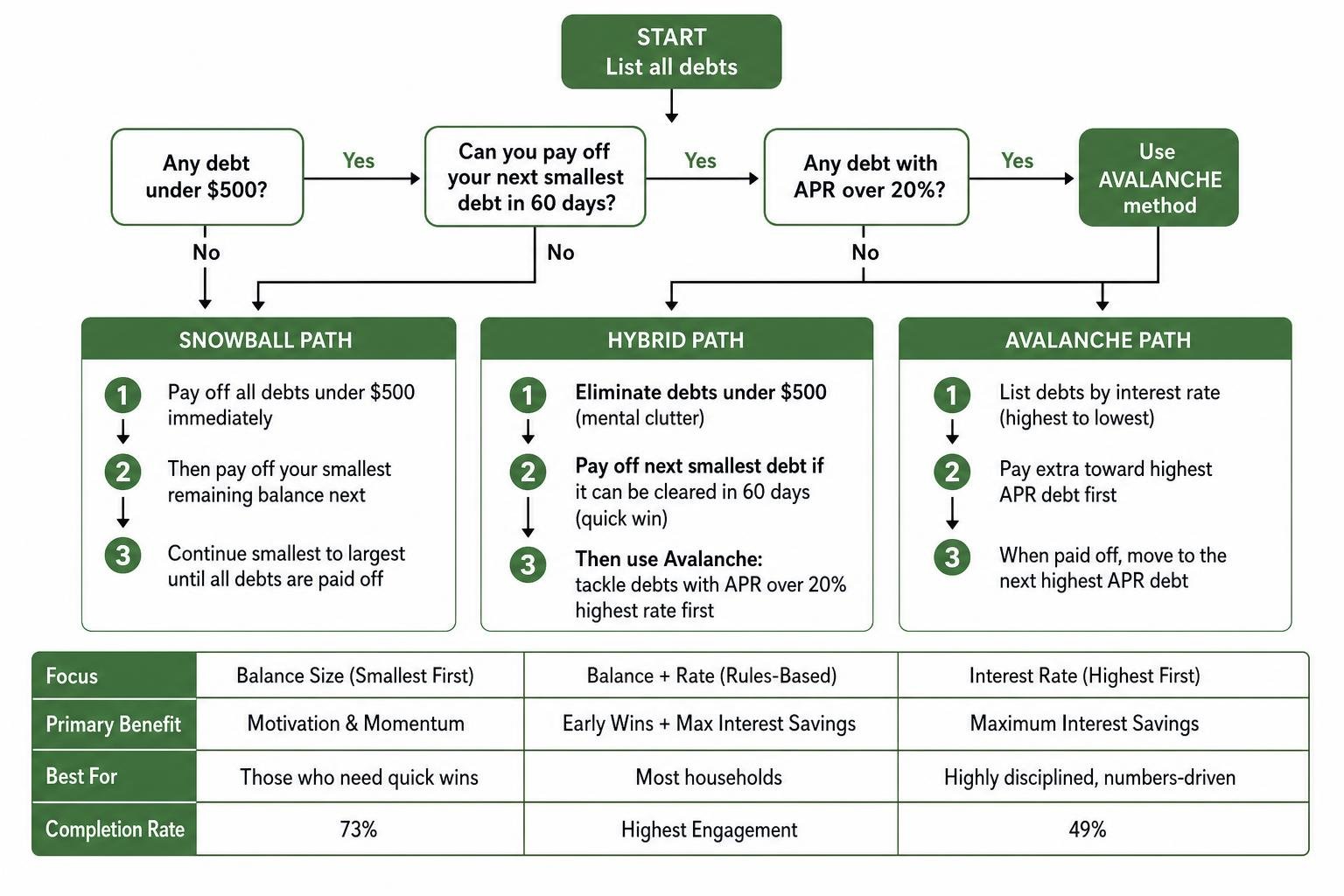
- 73% Completion Rate for Snowball: Borrowers who prioritized small balances cleared all their target non-mortgage debts at nearly three-quarters completion.
- 49% Completion Rate for Avalanche: Fewer than half of those using pure interest-rate prioritization finished their plans.
- 23% Higher Abandonment Rate: Participants using pure avalanche math were 23% more likely to drop out within the first six months.
When you target a massive $20,000 credit card balance at 24% APR while ignoring a tiny $600 store account at 15% APR, you may spend 14 straight months making heavy payments without seeing a single account hit zero. That lack of visible progress creates emotional fatigue, causing many people to conclude that their efforts are useless. The hybrid model solves this by providing immediate positive reinforcement before asking you to run a long-term mathematical marathon.
Essential Prerequisites: Budgeting, Emergency Funds, and Investing
Before launching an aggressive debt paydown strategy, you need a stable foundation. Accelerating debt payments without setting up basic safeguards is like driving a car at full speed without a spare tire—a single unexpected bump can derail your entire journey.
Building a Monthly Payoff Budget
To pay down debt faster, you must create a reliable cash flow surplus each month. That starts with a thorough, realistic monthly budget.
- Conduct an Expense Audit: Download your last 90 days of bank and credit card statements. Categorize every dollar spent into essential fixed expenses (housing, utilities, basic groceries) and discretionary variable expenses (dining out, entertainment, shopping).
- Audit Recurring Subscriptions: Studies indicate the average American household spends over $200 per month on forgotten or underutilized recurring subscriptions and streaming services. Cancel unused memberships to free up instant cash flow.
- Execute a 90-Day Debt Sprint: Commit to a temporary 90-day period where you aggressively trim non-essential spending. Redirect every saved dollar directly toward your designated target debt.
- Leverage Bi-Weekly Payment Schedules: If you are paid bi-weekly, consider splitting your standard monthly debt payment in half and submitting it every two weeks. Because there are 52 weeks in a year, this results in 26 half-payments—the exact equivalent of making 13 full monthly payments per year. That single extra annual payment accelerates principal reduction without straining your weekly lifestyle.
Prioritizing Debt vs. Savings and Investments
A common mistake is throwing every spare cent at debt while keeping zero cash in savings. When an inevitable emergency occurs—such as a car repair or medical bill—you are forced to use high-interest credit cards once again, undoing months of hard work.
Here is how to sequence your financial priorities:
- Step 1: Build a Starter Emergency Fund: Secure a cash cushion of $1,000 to $2,000 in a accessible high-yield savings account before adding an extra penny to debt principal. This buffer protects you from taking on new debt during minor setbacks.
- Step 2: Capture Your Full Employer 401(k) Match: If your employer offers a matching contribution (e.g., matching 100% up to 4% of your salary), make sure you contribute enough to collect the entire match. An employer match represents an instant 100% return on your money—far outpacing the interest saved on high-rate credit cards.
- Step 3: Attack High-Interest Debt (Above 8% APR): Direct all remaining cash flow surplus toward paying off debts with interest rates exceeding 8% APR. Paying off a 22% credit card yields a guaranteed, risk-free return of 22%.
- Step 4: Balance Low-Interest Debt with Long-Term Investing: Once high-interest accounts are cleared, compare low-interest loans (such as a 4% mortgage or 5% student loan) against potential investment returns. Historical stock market returns average around 7% to 10% annually over long periods. In many cases, maintaining standard minimum payments on low-cost debt while increasing long-term retirement contributions produces greater net wealth over time.
Consolidation Options and Mistakes to Avoid
While choosing between snowball, avalanche, or hybrid strategies gives you a clear path, you may also want to explore debt consolidation to streamline your accounts or lower your baseline interest rates.
When Debt Consolidation Makes Sense
Debt consolidation involves merging multiple high-interest debts into a single manageable loan with one fixed monthly payment—ideally at a lower annual percentage rate.
- 0% APR Balance Transfer Credit Cards: If you have good to excellent credit (typically a FICO score of 690 or higher), you may qualify for a balance transfer card offering a 0% introductory APR for 12 to 21 months. Transferring high-interest credit card balances allows 100% of your monthly payment to reduce the principal balance. Just factor in the upfront balance transfer fee (usually 3% to 5%) and ensure you can pay off the entire balance before the promotional period ends.
- Personal Consolidation Loans: Taking out an unsecured personal loan with a fixed interest rate (often ranging from 8% to 12% for qualified borrowers) to pay off multiple 25% credit cards immediately reduces your interest burden and establishes a clear end date.
- Credit Score Benefits: Paying off revolving credit cards with a personal installment loan lowers your overall credit utilization ratio—which makes up roughly 30% of your FICO score—often providing an immediate boost to your credit profile.
However, debt consolidation carries a major warning: the relapse trap. National economic data reveals that 65% of people who consolidate credit card debt accumulate new card debt within 18 months. Consolidation changes your loan structure, but it does not automatically change spending habits. If you clear your credit card balances with a loan but continue using those cards for unbudgeted expenses, you risk doubling your overall debt load.
Critical Pitfalls That Sabotage Debt Payoff
As you implement your repayment plan, keep an eye out for these common missteps:
- Making Only Minimum Payments: Minimum payments are designed by card issuers to keep you in debt for as long as possible. For example, paying only the minimum on a $6,300 balance at 22.76% APR can take over 18 years to pay off and cost over $9,800 in interest alone.
- Closing Credit Accounts Prematurely: After paying off a credit card, your initial instinct may be to close the account immediately. However, closing an old card reduces your total available credit, which increases your overall credit utilization ratio and shortens your average credit history—both of which can lower your credit score. Instead, keep the account open with a zero balance, or set up one small recurring charge (like a utility bill) with automated monthly payoffs.
- Failing to Negotiate Interest Rates: Many cardholders do not realize that APRs are often negotiable. Industry surveys reveal that 56% of cardholders who contacted their credit card issuers to request a lower APR received one—yet only 25% of cardholders had ever tried asking. A simple, polite phone call explaining your history of on-time payments can secure a rate reduction of several percentage points, saving you money instantly.
Frequently Asked Questions About Debt Repayment
Should I save or pay off debt first?
You should always build a basic starter emergency fund of $1,000 to $2,000 before aggressively accelerating debt payoff. Having this cash buffer ensures that when an unexpected bill arrives, you do not have to rely on credit cards. Once your starter fund is in place and you have captured any available employer 401(k) match, funnel your extra cash flow into eliminating high-interest debt (APRs above 8%). After clearing high-interest balances, you can rebuild your emergency fund to cover 3 to 6 months of living expenses.
How does paying off debt affect credit scores?
Paying off debt generally improves your credit score over time, primarily by reducing your credit utilization ratio (the percentage of available credit you are using). Credit utilization accounts for approximately 30% of your FICO score. To protect your score, keep paid-off credit cards open so your total available credit limit stays high. Additionally, maintaining a consistent record of on-time payments represents 35% of your score, so keeping up with minimum payments across all accounts is essential.
How long does it take to become debt-free?
Your timeline depends on your total debt balance, average interest rates, and how much extra cash you allocate each month. For instance, putting an extra $500 per month toward a $21,500 debt load can help you achieve debt freedom in roughly 30 to 32 months, compared to taking 12-plus years on minimum payments alone. By automating extra payments and applying windfalls (such as tax refunds or work bonuses) directly to principal balances, you can significantly accelerate your timeline.
Conclusion
So, what is the best debt payoff method? The best strategy is not the one that looks prettiest on a spreadsheet—it is the one you stay committed to until your balance hits zero.
For many borrowers, starting with the psychological momentum of the debt snowball or adopting a flexible hybrid approach provides the ideal balance of quick wins and long-term interest savings. By setting up a basic emergency fund, maintaining a clear budget, and avoiding common pitfalls like premature account closures, you can take full control of your personal finances.
If you are eager to streamline your financial planning and optimize your workflows, Explore the latest insights and AI updates at Aixoria to discover how modern technology can elevate your productivity and decision-making.
This is very interesting, You are a very skilled blogger.
I’ve joined your feed and look forward to seeking more of your excellent
post. Also, I have shared your website in my social networks!