AI is no longer about single chatbots responding to prompts. In 2026, the real shift is toward AI agent orchestration—systems where multiple AI agents collaborate, delegate tasks, share data, and execute complex workflows autonomously.
Instead of asking one model to do everything, modern systems use specialized agents (researcher, planner, executor, reviewer) working together. The challenge is coordination—and that’s where orchestration tools come in.
This guide answers one question in depth:
What are the best AI agent orchestration tools?
To keep this focused and high-quality, we’ll go deep on one of the most powerful tools in this space, explaining how it works, where it fits, and whether it’s the right choice.
READ MORE – The 7 Best AI Agent Orchestration Tools in 2026
Table of Contents
What Is an AI Agent Orchestration Tool?
An AI agent orchestration tool is the control layer that manages how multiple AI agents:
- Communicate with each other
- Share memory and context
- Execute multi-step workflows
- Use tools (APIs, databases, apps)
- Validate and improve outputs
Without orchestration, AI systems become unreliable—agents overlap, repeat work, or fail mid-process. These platforms solve that by coordinating agent behavior into structured systems.
In 2026, orchestration is considered more important than the model itself, because how agents are structured often matters more than which model you use.
What Makes the Best AI Agent Orchestration Tool?
Before choosing any tool, you need to evaluate it based on these criteria:
Multi-agent coordination
Can it manage multiple agents with different roles and responsibilities?
Workflow control
Does it support loops, conditional logic, retries, and long-running tasks?
Flexibility and extensibility
Can you integrate APIs, tools, and different AI models?
Ease of use
Is it developer-heavy, or accessible for non-technical users?
Scalability
Can it handle real-world, production-level workloads?
The Best AI Agent Orchestration Tool (2026)
LangGraph
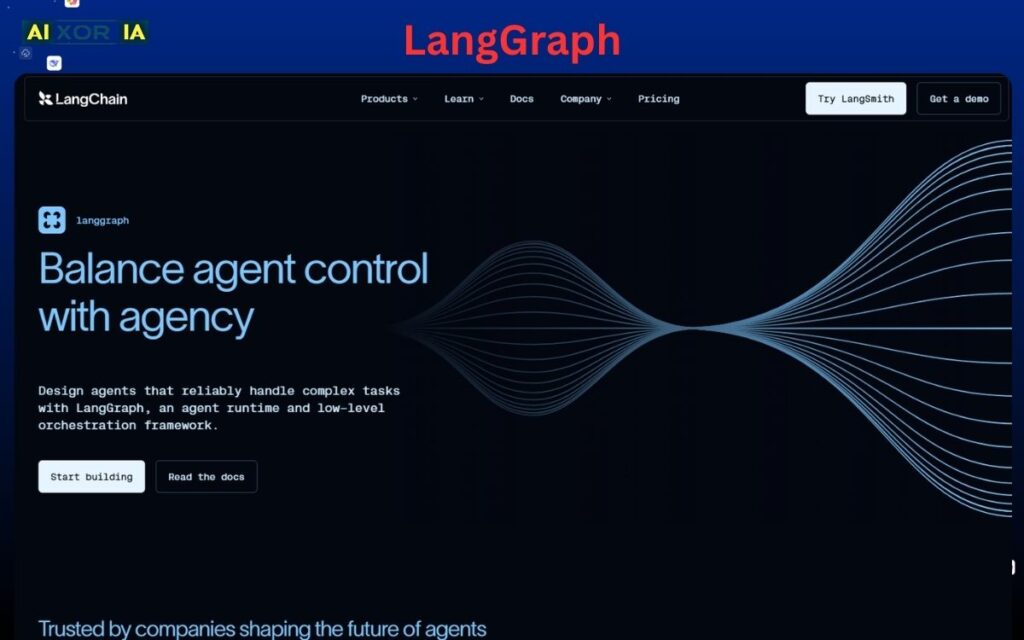
LangGraph has emerged as one of the most advanced and widely adopted AI agent orchestration frameworks in 2026, especially among developers building complex, multi-agent systems.
It builds on top of the LangChain ecosystem but introduces a fundamentally different way of structuring workflows: graph-based orchestration.
Why LangGraph Stands Out
Traditional automation tools rely on linear workflows—step 1 → step 2 → step 3.
LangGraph replaces that with a graph architecture, where:
- Each node represents an agent or task
- Each edge represents a decision or transition
- Workflows can loop, branch, and self-correct
This is critical for real-world AI systems.
For example:
- An agent can generate content
- Another agent can review it
- If errors are found → the system loops back and improves
This kind of feedback loop is nearly impossible in basic automation tools but native in LangGraph.
How LangGraph Works in Practice
LangGraph enables developers to build systems where multiple AI agents collaborate dynamically.
A typical workflow might look like:
- Planner agent breaks down a task
- Research agent gathers data
- Writer agent generates output
- Reviewer agent checks quality
- System loops until output meets criteria
Unlike static pipelines, LangGraph allows:
- Stateful memory across steps
- Dynamic decision-making
- Error handling and retries
- Human-in-the-loop intervention
This makes it suitable for:
- Autonomous workflows
- AI-powered applications
- Complex business automation
- Research and analysis systems
AI Capabilities in LangGraph
LangGraph is not just orchestration—it’s deeply integrated with modern AI capabilities.
It supports:
Multi-agent collaboration
You can define multiple agents with different roles and let them interact.
Tool usage
Agents can call APIs, access databases, and interact with external systems.
Memory management
Persistent memory allows agents to retain context across long workflows.
Model flexibility
You can integrate multiple models (GPT, Claude, Gemini, open-source models).
This aligns with the broader shift toward agent-based AI systems, where multiple models collaborate instead of relying on one large model.
Real-World Use Cases
LangGraph is used in scenarios where simple automation breaks down:
Complex research workflows
Multiple agents gather, verify, and synthesize information.
AI-powered SaaS products
Backend systems where agents handle tasks autonomously.
Customer support automation
Agents triage, respond, escalate, and learn from interactions.
Data pipelines with reasoning
Combining structured data processing with AI decision-making.
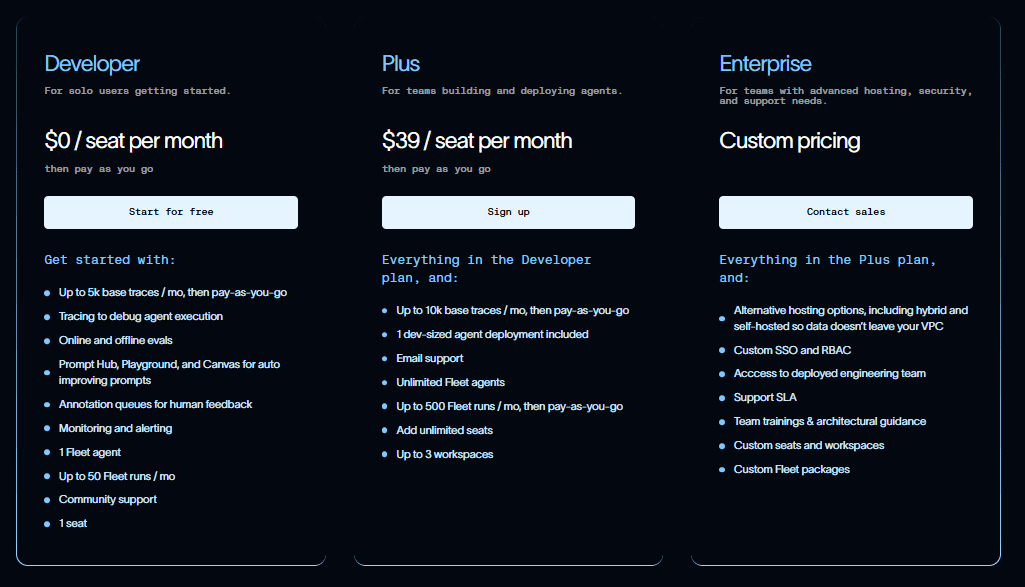
Pricing
LangGraph itself is:
- Free and open-source (as part of LangChain ecosystem)
- Cost depends on:
- Infrastructure (cloud, servers)
- API usage (LLMs like OpenAI, Anthropic, etc.)
This makes it highly flexible but also requires technical setup.
Pros and Cons
Pros
- Extremely powerful for complex workflows
- Supports loops, retries, and dynamic logic
- Full control over agent behavior
- Model-agnostic (works with multiple AI providers)
- Scales well for production systems
Cons
- Requires programming knowledge (Python/JS)
- Not beginner-friendly
- Setup and debugging can be complex
- No native visual interface (compared to no-code tools)
When Should You Use LangGraph?
LangGraph is the right choice if:
- You are building serious AI systems, not simple automations
- You need multi-agent collaboration
- Your workflows require decision-making and iteration
- You want full control over architecture
It is not ideal if:
- You want a no-code tool
- You need quick, simple automations
- Your workflows are linear and predictable
The Bigger Shift: Why Orchestration Matters in 2026
The industry is moving from:
- Single AI models → Multi-agent systems
- Static prompts → Dynamic workflows
- One-step responses → Full task execution
Even major companies are investing in multi-agent collaboration systems where different AI models work together to improve outcomes and accuracy.
This confirms a key trend:
The future of AI is not one model—it’s coordinated systems of agents.
Final Answer
So, what are the best AI agent orchestration tools?
There are many options in the market, but if you want a high-control, scalable, and future-proof solution, LangGraph stands out as one of the best choices in 2026.
It is not the easiest tool—but it is one of the most powerful.