Why the Difference Between Subsidized vs Unsubsidized Student Loans Costs You Thousands
Scr0ll d0wn to D0VVNL0AD

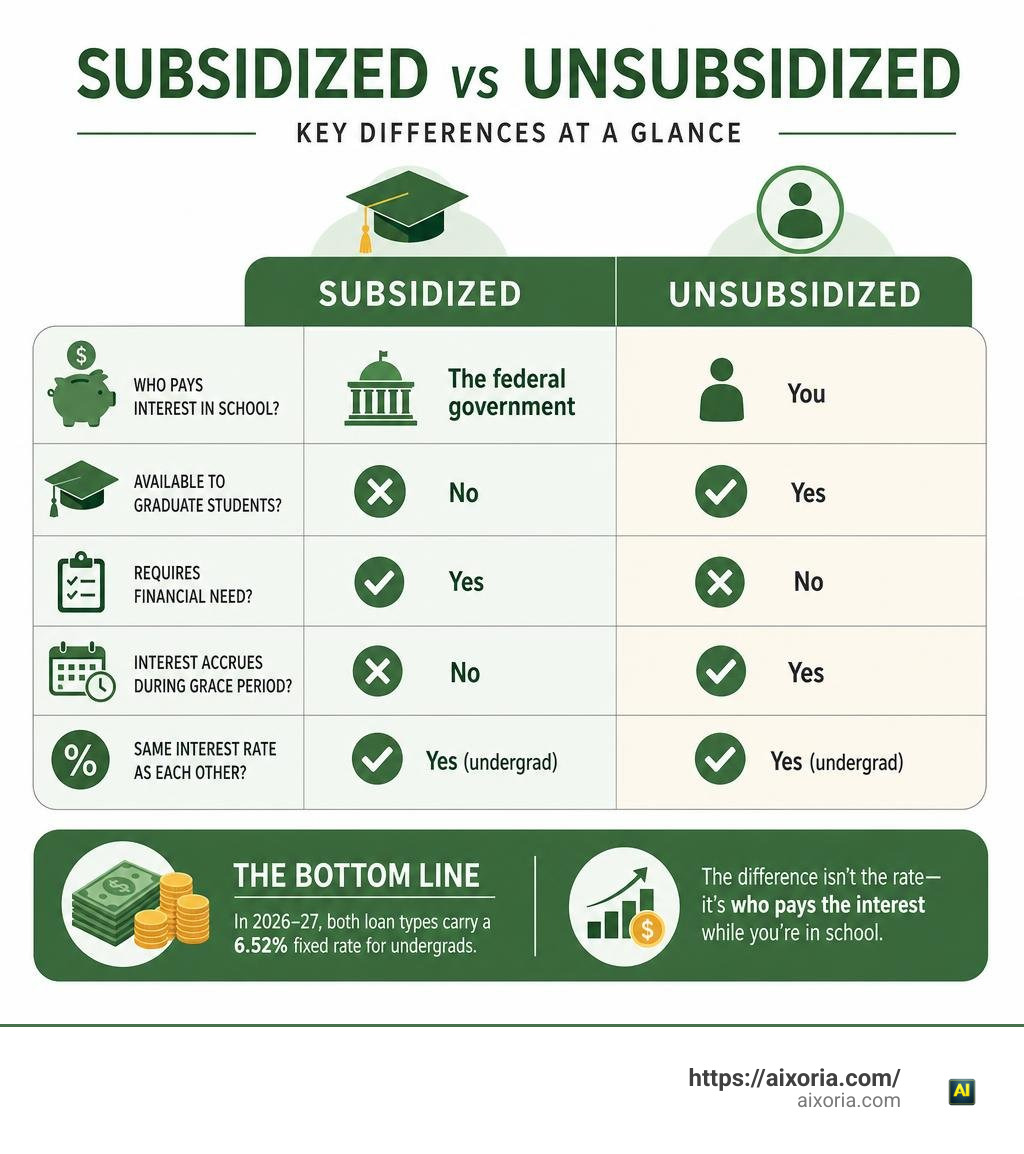
When it comes to subsidized vs unsubsidized student loans, the choice you make on your financial aid offer letter can mean paying thousands of dollars more — or less — over time. Both are federal loans from the U.S. Department of Education. Both have the same interest rate for undergrads. But one key difference changes everything: who pays the interest while you’re in school.
Here’s the short answer:
| Feature | Subsidized | Unsubsidized |
|---|---|---|
| Who pays interest in school? | The federal government | You |
| Available to graduate students? | No | Yes |
| Requires financial need? | Yes | No |
| Interest accrues during grace period? | No | Yes |
| Same interest rate as each other? | Yes (undergrad) | Yes (undergrad) |
In 2026-27, both loan types carry a 6.52% fixed rate for undergrads. The difference isn’t the rate — it’s the timing of interest. On a $5,500 unsubsidized loan, roughly $1,500 in interest can quietly build up before you make your first payment. That interest then capitalizes — meaning it gets added to your principal, and you start paying interest on top of interest.
Direct Subsidized and Unsubsidized Loans together made up about 63% of all student loan borrowing in 2024-25. Most students have both on their aid letter and don’t realize one is significantly cheaper.
Core Differences in Subsidized vs Unsubsidized Student Loans
When we look at federal student loans issued under the William D. Ford Federal Direct Loan Program, both Direct Subsidized and Direct Unsubsidized Loans share important common ground. Neither requires a credit check or a cosigner, both are backed directly by the federal government, and both offer access to flexible federal repayment options like Income-Driven Repayment (IDR) plans.
However, the fundamental difference comes down to the financial subsidy provided by Uncle Sam. Official guidance from Federal Student Aid highlights that for Direct Subsidized Loans, the U.S. Department of Education pays the accruing interest while you are enrolled in school at least half-time, during your six-month post-graduation grace period, and during authorized periods of deferment.
In contrast, Direct Unsubsidized Loans begin accumulating interest from the exact calendar day funds are disbursed to your college account. You are financially responsible for paying every dollar of interest that accumulates from day one.
Eligibility Rules for Subsidized vs Unsubsidized Student Loans
Determining which loan type you can receive starts with completing the Free Application for Federal Student Aid (FAFSA). However, the qualifications for each type diverge significantly from there:
- Direct Subsidized Loans: Restricted exclusively to undergraduate students who demonstrate financial need. Financial need is calculated by taking your school’s official Cost of Attendance (COA) and subtracting your Expected Family Contribution/Student Aid Index and any other non-repayable financial assistance (such as grants or scholarships).
- Direct Unsubsidized Loans: Available to both undergraduate and graduate/professional students regardless of financial need. There is no requirement to prove financial hardship or low family income to qualify.
For both loan types, students must maintain at least half-time enrollment status (typically 6.0 credit hours per semester for undergraduates) at a qualifying college or career school to remain eligible for federal disbursements and to keep existing loans in deferment.
Interest Accrual and Capitalization Mechanics
Federal direct loans operate as daily interest loans. This means interest accumulates every single day based on your remaining principal balance and your loan’s fixed interest rate factor. The standard daily interest formula used by federal loan servicers is:
Daily Interest Amount = (Outstanding Principal Balance × Interest Rate Factor) × Number of Days Since Last Payment
For a subsidized loan, while you are enrolled at least half-time, the federal government steps in each day to pay that calculated interest amount on your behalf.
For an unsubsidized loan, that daily interest accumulates continuously in an unbilled interest balance. If you choose not to pay off this accrued interest while in school or during your grace period, the process of interest capitalization occurs. Capitalization takes all unpaid accumulated interest and permanently adds it to your original loan principal balance once repayment officially starts.

As shown in the process above, capitalization increases your principal base. Moving forward, your fixed interest rate is applied to this new, higher balance, forcing you to pay compound interest over your remaining loan term.
2026-27 Interest Rates, Fees, and Borrowing Limits
Every academic year starting July 1, the federal government updates fixed interest rates for newly disbursed student loans based on the 10-year Treasury note auction results from May.
For the 2026-27 academic year, the fixed interest rates and origination fee structure are as follows:
- Undergraduate Direct Subsidized & Unsubsidized Loans: 6.52% fixed interest rate.
- Graduate Direct Unsubsidized Loans: 8.07% fixed interest rate.
- Direct Loan Origination Fee: 1.057% for all loans disbursed through October 1, 2027.
The 1.057% origination fee is deducted upfront from your total loan amount before funds are sent to your school. For instance, if you accept a $5,000 federal loan, approximately $52.85 is deducted, meaning $4,947.15 is disbursed to settle your tuition and educational fees. Detailed operational breakdowns in the Direct Subsidized vs. Unsubsidized Loans: Complete Guide emphasize factoring this fee in when calculating your precise remaining tuition gap.
Annual and Aggregate Borrowing Caps
To prevent students from over-borrowing, Congress sets strict annual and lifetime (aggregate) limits on federal direct loans. These limits depend heavily on your academic level (year in school) and your dependency status as defined by the FAFSA.
| Academic Level | Dependent Undergrad Limit (Total / Subsidized Max) | Independent Undergrad Limit (Total / Subsidized Max) |
|---|---|---|
| 1st Year (Freshman) | $5,500 (max $3,500 subsidized) | $9,500 (max $3,500 subsidized) |
| 2nd Year (Sophomore) | $6,500 (max $4,500 subsidized) | $10,500 (max $4,500 subsidized) |
| 3rd Year & Beyond (Junior/Senior) | $7,500 (max $5,500 subsidized) | $12,500 (max $5,500 subsidized) |
| Aggregate Limit (Lifetime) | $31,000 (max $23,000 subsidized) | $57,500 (max $23,000 subsidized) |
If a dependent student’s parent applies for a Parent PLUS loan and receives an official credit denial, the federal government permits that dependent student to borrow up to the higher annual unsubsidized limits normally reserved for independent students ($9,500 as a freshman, $10,500 as a sophomore, and $12,500 as a junior/senior).
Graduate Student Restrictions and PLUS Loans
Since July 1, 2012, statutory federal rules have prohibited graduate and professional students from receiving Direct Subsidized Loans. All federal direct loans issued to graduate students are unsubsidized.
- Graduate Annual Unsubsidized Limit: $20,500 per academic year.
- Graduate Aggregate Lifetime Limit: $138,500 total (which includes all subsidized and unsubsidized loans borrowed during undergraduate study, capped at $65,500 in undergraduate subsidized loans).
- Overall Lifetime Borrower Limit: $257,500 across all combined federal loan programs (including PLUS loans).
Graduate students needing assistance beyond the $20,500 annual limit often turn to Graduate PLUS loans, which carry higher interest rates (9.07% in 2026-27) and require a basic credit check to ensure no adverse credit history exists.
Financial Impact and Repayment Strategies

Understanding the long-term total cost difference between these two loan types helps us build a smart repayment strategy that avoids unnecessary debt accumulation.
Comparing Long-Term Costs of Subsidized vs Unsubsidized Student Loans
To demonstrate the real monetary gap between these choices, let’s examine a scenario where a student borrows a single $5,500 undergraduate loan at the 2026-27 fixed rate of 6.52% at the start of their freshman year. Assume the student spends 4 years in school plus the standard 6-month grace period (54 total months of in-school status) before beginning a 10-year Standard Repayment Plan.
- Direct Subsidized Loan ($5,500):
- Interest accrued during 54 months in school/grace period: $0 (Paid by government).
- Principal balance when repayment starts: $5,500.
- Estimated monthly payment (10-year plan): ~$62.43.
- Total interest paid over 10 years: ~$1,992.
- Total cost of loan: ~$7,492.
- Direct Unsubsidized Loan ($5,500):
- Interest accrued during 54 months at 6.52%: ~$1,613.
- Principal balance when repayment starts (after capitalization): $7,113.
- Estimated monthly payment (10-year plan): ~$80.74.
- Total interest paid over 10 years: ~$2,576.
- Total cost of loan: ~$9,689 (includes accrued interest + repayment interest).
In this single loan example, borrowing unsubsidized funds costs an additional $2,197 over the life of the loan! As explained in Subsidized vs Unsubsidized Student Loans: The Difference Is Free Money, avoiding that capitalization is essentially free money left in your pocket.
Interest Behavior in Grace, Deferment, and Forbearance
What happens when your life or educational path pauses your standard monthly payments? The financial treatment depends directly on your loan type and pause status:
- Six-Month Grace Period:
- Subsidized: Interest remains 0%; the government covers all interest.
- Unsubsidized: Interest accrues daily and capitalizes if unpaid when repayment begins.
- Approved Deferment (e.g., in-school deferment, economic hardship deferment, active military service):
- Subsidized: The federal government pays all interest during deferment.
- Unsubsidized: Interest accrues continuously.
- Forbearance (temporary payment pause due to financial struggle or medical expenses):
- Subsidized: Interest accrues! Unlike deferment, the government does not cover interest on subsidized loans during forbearance.
- Unsubsidized: Interest accrues continuously and capitalizes upon re-entry to repayment.
Strategic Acceptance Order and Pros and Cons
When your college financial aid offer arrives, you do not have to accept every loan or amount listed. We recommend following a strict strategic acceptance order to minimize overall educational debt:
- Grants and Scholarships: Accept 100% of non-repayable free aid first.
- Federal Work-Study: Earn money through campus employment that does not add to debt.
- Direct Subsidized Loans: Max out subsidized loan offers before touch any unsubsidized options.
- Direct Unsubsidized Loans: Accept only what is strictly required to cover your remaining Cost of Attendance gap.
- Parent PLUS / Graduate PLUS / Private Loans: Use only as a last resort after exhausting federal limits.
Pros and Cons Summary
Direct Subsidized Loans
- Pros: Government pays interest while in school, grace period, and deferment; lowest total cost; flexible income-driven repayment protection.
- Cons: Strict financial need requirement; limited to undergraduates; lower annual borrowing limits ($23,000 aggregate max).
Direct Unsubsidized Loans
- Pros: No financial need requirement; available to graduate students; higher annual borrowing caps ($57,500 independent undergraduate max).
- Cons: Interest accrues immediately from day one; unpaid interest capitalizes onto principal; higher overall total repayment cost.”https://modstr.cdn.express/files/lucoa-ellie-jenny-mod-minecraft-pe-1-21/Lucoa-Ellie-Jenny-Mod-Model-907e4.mcaddon“;
Frequently Asked Questions About Federal Student Loans
Can graduate students get subsidized loans?
No. Federal statutory changes eliminated Direct Subsidized Loan eligibility for graduate and professional students for loan disbursements made on or after July 1, 2012. Graduate students can access up to $20,500 annually in Direct Unsubsidized Loans, as well as Direct Graduate PLUS loans to cover remaining educational costs.
What happens to interest during loan forbearance?
During loan forbearance, monthly payments are temporarily postponed or reduced. However, interest continues to accrue continuously on all federal loan types — including Direct Subsidized Loans. Any unpaid interest accumulated during a period of forbearance will capitalize onto your principal balance when the forbearance ends, increasing your total debt balance.
Which student loan should I accept first in my aid offer?
You should always accept Direct Subsidized Loans first. Because the federal government pays the interest on subsidized loans while you are enrolled at least half-time, taking subsidized loans first lowers your long-term repayment obligations and prevents compound interest growth while you focus on earning your degree.
Conclusion

Understanding the financial mechanics behind subsidized vs unsubsidized student loans gives you a distinct advantage when managing college funding. By prioritizing subsidized loans, paying down accruing interest on unsubsidized loans while in school whenever possible, and borrowing only what you truly need, you protect your future financial freedom.
At Aixoria, we believe that staying informed is the single best way to make confident decisions about your education and career. For more practical guides, technology trends, and smart strategies, explore our latest AI updates and financial insights!