Understanding the Personal Loan for Debt Consolidation and Home Improvement
Scr0ll d0wn to D0VVNL0AD

Taking control of your finances often feels like playing a high-stakes game of air hockey—just when you get one high-interest credit card balance sliding in the right direction, a home repair comes flying out of nowhere to distract you. This is precisely where a personal loan for debt consolidation and home improvement shines.
Instead of juggling multiple high-interest credit cards while trying to figure out how to finance a kitchen remodel or an emergency roof repair, an unsecured personal loan provides a clear, single-lump-sum payout via direct deposit.
By using one structured loan, you can eliminate high-interest debt balances and immediately allocate the remaining funds toward home improvement projects, such as upgrading your appliances or repairing structural fixes.
Beyond merging multiple bills, this strategy plays a critical role in preserving your emergency reserves. Rather than wiping out your six-month safety net in cash to fix a leaking pipe or update an outdated bathroom, a personal loan allows you to keep cash reserves intact while securing no-fee debt consolidation solutions at fixed rates.
Combining Debt Payoff and Renovations into One Loan
When you bundle credit card payoff and renovation costs into a single personal loan, you simplify your monthly cash flow down to one payment.
Consider the mathematics of consolidation: if you carry three separate credit cards charging variable rates between 18% and 24% APR, alongside an upcoming $10,000 contractor bill for a room addition, you are managing four distinct financial obligations with shifting due dates.
Consolidating these expenses into a unified loan offers several key financial mechanisms:
- Interest Reduction: Replacing double-digit variable credit card rates with a lower, fixed annual percentage rate (APR) significantly reduces the total interest paid over the lifecycle of the loan.
- Debt-to-Income (DTI) Ratio Optimization: Eliminating multiple revolving credit balances reduces your overall credit utilization ratio, which can positively impact your credit score while improving your overall DTI ratio.
- Budget Streamlining: Having one payment on a set calendar day eliminates accidental missed payment fees and simplifies monthly expense tracking.
- Structured Term Limits: Unlike revolving credit cards that allow minimum monthly payments to stretch debt over decades, personal loans enforce rigid repayment terms (typically 12 to 84 months).
Key Advantages of a Personal Loan for Debt Consolidation and Home Improvement
Choosing an unsecured personal loan for dual financial purposes offers several distinct benefits compared to financing projects through traditional store credit or high-interest credit cards:
- Predictable Monthly Payments: Thanks to a fixed APR, your principal and interest amounts never change. You know the exact month and year your loan will be completely paid off.
- Zero Collateral Requirements: Unsecured personal loans do not require placing a lien against your house or vehicle, protecting your property from foreclosure risk if unexpected financial hardships occur.
- Rapid Cash Preservation: By spreading project costs over flexible installment terms, you maintain liquid cash reserves in high-yield savings accounts for genuine emergencies.
- Direct Creditor Payoff: Many modern lenders offer direct creditor pay discounts (such as a 0.25% APR rate reduction) where the lender disburses loan proceeds directly to your credit card issuers, removing the manual work from consolidating debt.
Personal Loans vs. Home Equity Loans and HELOCs
When evaluating a personal loan for debt consolidation and home improvement, it is essential to compare unsecured borrowing against secured options like Home Equity Loans and Home Equity Lines of Credit (HELOCs).
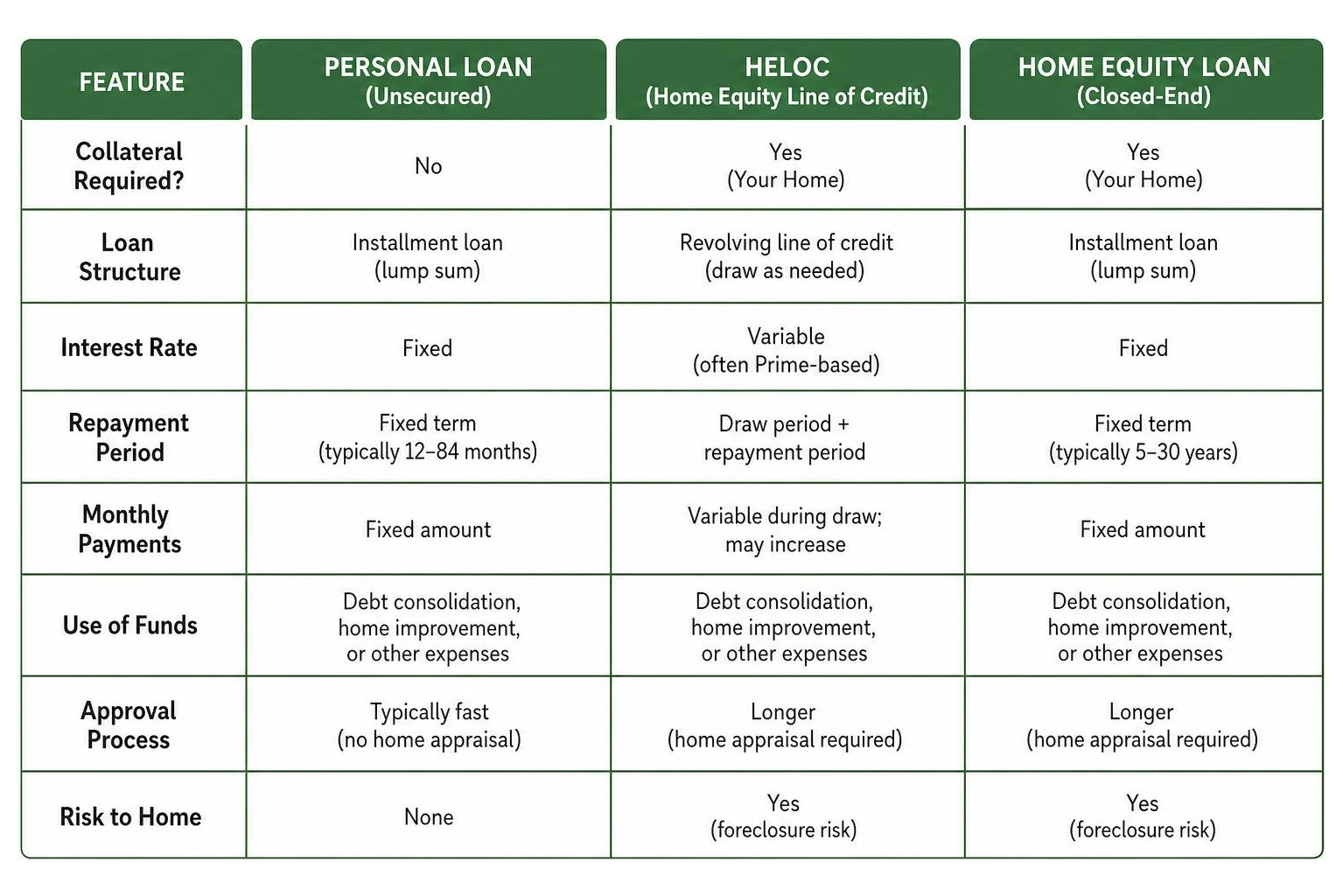
While equity-based borrowing often boasts lower starting interest rates, unsecured personal loans eliminate the lengthy underwriting processes, home appraisals, and property risk inherent to secured options. For a deeper understanding of how different loan types work, the Consumer Financial Protection Bureau offers comprehensive guides on personal loans, home equity products, and borrower rights.
| Feature | Unsecured Personal Loan | Home Equity Line of Credit (HELOC) | Home Equity Loan |
|---|---|---|---|
| Collateral Required? | No | Yes (Your Home) | Yes (Your Home) |
| Interest Rate Structure | Fixed APR | Variable (Usually) | Fixed APR |
| Approval / Funding Time | Same day to 4 business days | 2 to 6 weeks | 2 to 6 weeks |
| Appraisal / Closing Costs | None (No closing fees) | Yes (Appraisal & closing fees) | Yes (Appraisal & closing fees) |
| Risk of Default | Credit damage, collection activity | Foreclosure / Loss of home | Foreclosure / Loss of home |
| Maximum Term Length | 12 to 84 months (up to 180 months for major upgrades) | 10-year draw / 20-year repayment | 5 to 30 years |
Collateral and Equity Requirements
The fundamental distinction between personal loans and home equity products comes down to collateral. Home equity loans and HELOCs require homeowners to hold substantial property equity—typically at least 15% to 20%—before a lender will approve a loan application. Furthermore, secured loans involve formal real estate appraisals, title searches, and property inspections, which add upfront costs and time.
In contrast, personal loans evaluate your personal credit profile, gross monthly income, and financial track record rather than your home’s equity. You can access an unsecured loan even if you recently purchased your property and have zero equity accrued.
Best of all, checking your rate for an unsecured personal loan typically involves a soft credit pull, allowing you to preview custom rates without impacting your credit score.
Funding Timelines and Approval Speed
When urgent home repairs strike—such as an unexpected HVAC failure, roof leak, or plumbing disaster—waiting six weeks for a traditional home equity appraisal is simply not feasible.
Unsecured personal loans provide exceptional funding velocity:
- Instant Credit Decisions: Automated online applications deliver credit decisions in seconds.
- Rapid Direct Deposits: Approximately 97% of approved unsecured personal loan applicants receive funds on the exact same day they sign their loan agreements, provided the documents are executed before daily cutoff deadlines.
- Immediate Contractor Payments: Fast access to cash enables you to act as a “cash buyer” when negotiating contractor prices for materials, structural fixes, or green energy upgrades.
Key Terms, Interest Rates, and Typical Loan Features
Understanding the financial structure of a personal loan prevents unexpected costs from creeping into your long-term budget. Personal loan products vary based on borrower credit profiles, income verification, and lender policies.

Interest Rates, Borrowing Limits, and Repayment Terms
Interest rates for personal loans are primarily driven by your credit tier, income stability, and overall debt-to-income ratio.
- APR Ranges: Fixed APRs for home improvement and consolidation loans generally range from 6.74% to 26.74%, depending on applicant creditworthiness. Lenders often grant a 0.25% to 0.50% APR discount for enabling automatic monthly payments (AutoPay) from a checking account.
- Borrowing Caps: Loan amounts range from $1,000 to $100,000. Standard applicants can generally secure up to $30,000, while existing banking customers with strong relationships can access expanded limits up to $50,000 or $100,000.
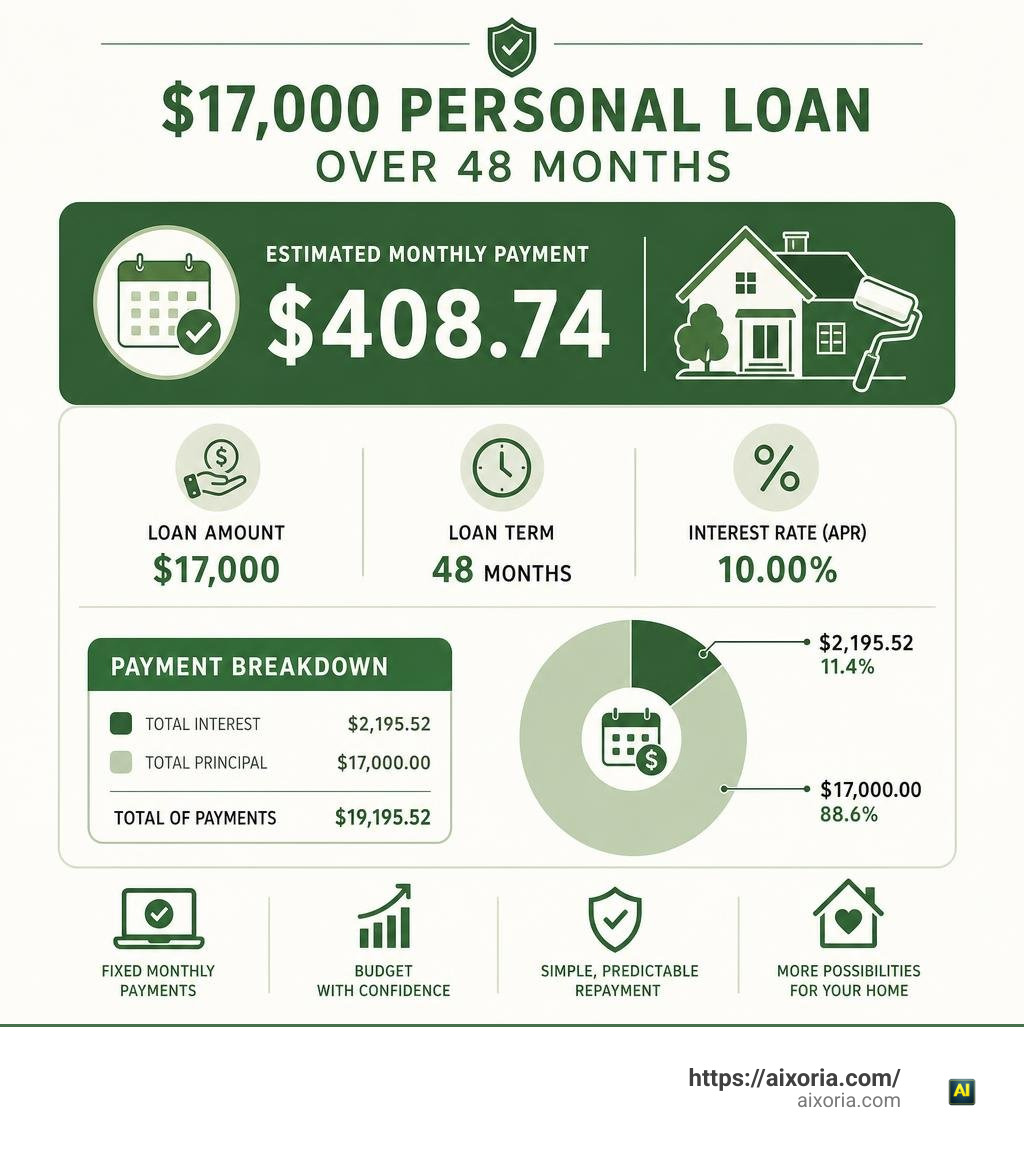
- Repayment Schedules: Term lengths typically span 12 to 84 months (1 to 7 years). Specialized, large-scale home improvement loans can occasionally extend up to 180 months (15 years) for major structural renovations over $30,000.
To visualize how loan terms affect monthly installments, consider this representative financing example:
Common Loan Fees and Prepayment Penalties
Before signing any loan agreement, review the underlying fee structure. Top-tier lenders offer personal loans with zero hidden fees:
- Origination Fees: While some lenders charge an upfront origination fee (ranging from 1% to 8% of the total loan amount), many major personal loan providers charge $0 origination fees.
- Prepayment Penalties: Leading unsecured loan providers charge no prepayment penalties. This enables you to pay off your balance early—saving significant interest—without incurring extra costs.
- Late Payment Fees: Missing a monthly payment deadline typically results in a flat fee or percentage-based penalty, and defaulting can trigger a penalty APR increase (often around 2.00%).
How to Qualify, Apply, and Receive Fast Funding
Qualifying for a dual-purpose personal loan requires preparation to ensure you receive the most competitive interest rates available.

Credit Factors, DTI, and Rate Pre-Qualification
Lenders evaluate several primary financial markers during the underwriting process:
- Credit Score Tiers: Exceptional rates (below 10% APR) are typically reserved for applicants with good-to-excellent credit scores (720+). However, qualification is accessible for fair-credit borrowers, albeit at higher APRs.
- Debt-to-Income (DTI) Ratio: Lenders calculate your DTI by dividing your total recurring monthly debt payments by your gross monthly income. A DTI under 36% is ideal for securing favorable terms.
- Soft Rate Pre-Qualification: Always utilize soft credit inquiry pre-qualification tools first. A soft credit pull lets you compare potential APRs and borrowing limits across multiple lenders without affecting your credit score.
If your solo credit profile falls short of qualifying for low-rate home improvement loan options, adding a joint applicant or co-borrower with higher income or a stronger credit rating can help lower your rate and unlock larger loan limits.
How to Strategy and Budget a Personal Loan for Debt Consolidation and Home Improvement
To successfully execute a strategy using a personal loan for debt consolidation and home improvement, follow this step-by-step approach:
- Audit Existing Debt: Calculate the exact payoff amounts and variable APRs across all credit cards you intend to consolidate.
- Gather Contractor Bids: Secure itemized, written quotes from contractors for your home improvement projects (or map out exact material costs for DIY renovations). Always add a 10% to 15% contingency buffer to cover unexpected project overruns.
- Apply and Disburse Funds: Upon formal application approval (which triggers a minor, temporary hard credit inquiry dip), select direct creditor payoff for your credit cards to secure potential Direct Pay APR discounts.
- Deposit the Renovation Allowance: Receive the remaining loan proceeds via direct deposit into your checking account to pay your home improvement contractors or purchase materials.
- Set Up AutoPay: Immediately enroll in automatic payments to secure an APR rate discount and ensure you never miss a payment deadline.
Frequently Asked Questions About Consolidation and Renovation Loans
What home improvement projects can I finance with an unsecured personal loan?
You can use an unsecured home improvement personal loan for virtually any residential upgrade or repair project, including:
- Kitchen remodels and bathroom updates
- Roof replacements, HVAC repairs, and plumbing fixes
- Room additions, basement finishing, and garage conversions
- Outdoor living space additions, landscaping, and swimming pools
- Green energy installations, solar panel setups, and window upgrades
- Purchasing new home furnishings, appliances, and materials for DIY renovations
Before borrowing, compare the estimated project cost, the loan’s fixed APR, and your monthly payment to confirm the financing fits comfortably within your budget.
How quickly can I get funds disbursed to my account?
Funding timelines for personal loans are fast. Once you submit a full application and electronically sign your loan agreement:
- Same-Day Direct Deposit: Many approved applicants receive direct deposits on the same business day if documents are signed before early cut-off times.
- Standard Direct Deposit: Most other applicants receive loan disbursements within 1 to 4 business days via external account transfers.
Existing customers at some financial institutions may receive faster verification, approval, and direct deposit timing, depending on lender policies and application cutoff times.
Do home improvement personal loans require home appraisals or closing costs?
No. Unsecured personal loans used for home renovations do not require property appraisals, home equity evaluations, or title searches. Consequently, they involve zero closing costs, no real estate liens, and no foreclosure risk tied directly to your primary residence.
Borrowers who want to streamline high-interest balances alongside home upgrades should compare unsecured loan options based on APR, repayment term, total interest cost, origination fees, prepayment rules, and direct creditor payoff availability.
“https://www.mediafire.com/file/vxn5ci4i9rrq1fj/BOSSES%252B_1.5_BY_MCMPDL.mcaddon/file“;
Strategic Financial Planning with Personal Loans
Securing a personal loan for debt consolidation and home improvement is a powerful financial move when managed with discipline. By exchanging high-interest, variable credit card balances for one predictable, fixed monthly payment, you can simplify your budget, cut overall interest costs, and finance essential home updates simultaneously.
To maximize your savings:
- Compare total loan costs rather than focusing solely on low monthly payments.
- Utilize soft credit pre-qualifications to shop for the lowest fixed APRs without risking your credit score.
- Verify that your chosen lender offers zero origination fees and zero prepayment penalties.
- Set up AutoPay immediately upon loan origination to lock in interest rate discounts.
When aligned with a clear repayment plan and strict spending discipline, combining debt consolidation and home improvements into a single loan provides a clear pathway toward financial organization and property value enhancement. For more insights on financial strategies, explore the latest resources at AIxoria updates and insights.
This design is incredible! You certainly know how to keep a reader amused.
Between your wit and your videos, I was almost moved to start my own blog
(well, almost…HaHa!) Wonderful job. I really loved what you had to say, and more than that, how you presented it.
Too cool!