What You Need to Know About Delta Dental and AARP Dental Insurance
Scr0ll d0wn to D0VVNL0AD

Does Delta Dental offer AARP dental insurance? Yes — and the short answer is worth reading before anything else.
Quick Answer:
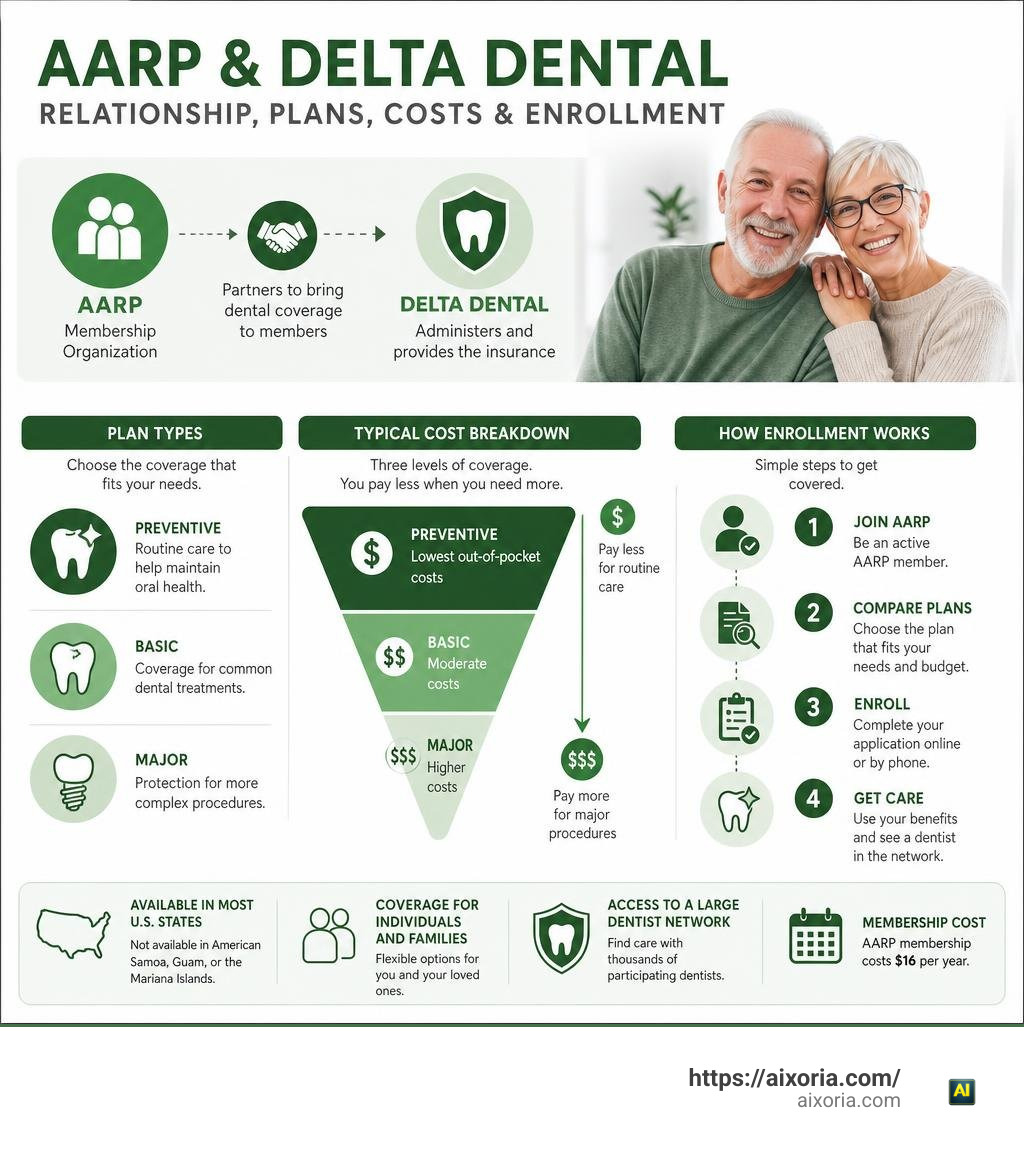
- AARP does not sell insurance directly. It is a membership organization, not an insurance company.
- Delta Dental administers the AARP Dental Insurance Plan, meaning Delta Dental is the actual provider behind every AARP-branded dental plan.
- To access these plans, you must be an active AARP member (membership costs $16/year).
- Plans are available to individuals and families in most U.S. states (not available in American Samoa, Guam, or the Mariana Islands).
- You can get a quote at deltadentalins.com/aarp or call Delta Dental toll-free at (866) 583-2085.
Nearly 50% of older Americans receive no dental care — and a big reason is confusion about what’s covered and where to find it. Original Medicare doesn’t pay for routine cleanings, fillings, or dentures. That gap leaves millions of retirees exposed to costs like $1,000–$1,500 for a single crown or over $3,000 for a full set of dentures.
The AARP Dental Insurance Plan, backed by Delta Dental — the largest dental insurer in the U.S., covering over 80 million people through a network of 150,000 dentists — was built specifically to fill that gap for seniors and AARP members.
But how does the partnership actually work? What plans are available? And is it worth the cost? This guide covers all of it.
Does Delta Dental offer AARP dental insurance?
To understand how AARP dental coverage works, we first have to unpack the relationship between AARP and its commercial partners. A common point of confusion is whether AARP operates as an insurance carrier.
The short answer is no. AARP is a non-profit, non-partisan interest group dedicated to empowering people aged 50 and older. Because they do not underwrite insurance policies, they partner with third-party commercial carriers to offer branded programs to their members.
When you purchase an AARP-branded dental plan, you are buying a policy fully underwritten, administered, and serviced by Delta Dental. Through this arrangement, Delta Dental pays royalty fees to AARP for licensing its intellectual property and brand name. These royalty fees are then used by AARP to fund its general advocacy work and community programs.
We can confidently answer the question: Does Delta Dental offer AARP dental insurance? Yes, they are the sole administrative and insurance powerhouse behind the AARP® Dental Plan by Delta Dental Insurance Company.
Why Does Delta Dental offer AARP dental insurance?
This partnership is a classic example of affinity marketing. By aligning with AARP, Delta Dental gains direct access to a highly motivated, rapidly growing demographic: retirees and older adults who no longer have access to employer-sponsored dental plans.
For AARP, partnering with the nation’s largest dental insurer allows them to offer a highly requested member benefit. Delta Dental’s massive network of over 150,000 dentists ensures that no matter where an AARP member retires or travels, they can find a local provider who accepts their insurance. It is a win-win: Delta Dental expands its customer base, AARP members get access to group-negotiated rates, and AARP secures funding to support its advocacy work.
How the Partnership Works
While Delta Dental is the consumer-facing brand, the actual underwriting structure can vary depending on where you live. Because Delta Dental is comprised of 39 affiliate companies, your policy might technically be issued by a regional subsidiary.
For example, depending on your state, your AARP plan may be underwritten by:
- Delta Dental Insurance Company
- Dentegra Insurance Company
- Alpha Dental
Regardless of which underlying corporate entity handles the underwriting in your state, the network of dentists, customer service portals, and plan features remain unified under the Delta Dental banner. This plan is widely available across the United States, with geographic exclusions limited to just three U.S. territories: American Samoa, Guam, and the Mariana Islands.
AARP Dental Insurance Plans Administered by Delta Dental
Choosing the right dental plan is a bit like choosing a pair of glasses — what works perfectly for one person might leave another straining to see the details. Fortunately, the collaboration between AARP and Delta Dental offers several distinct plan structures to accommodate different budgets and dental care needs.

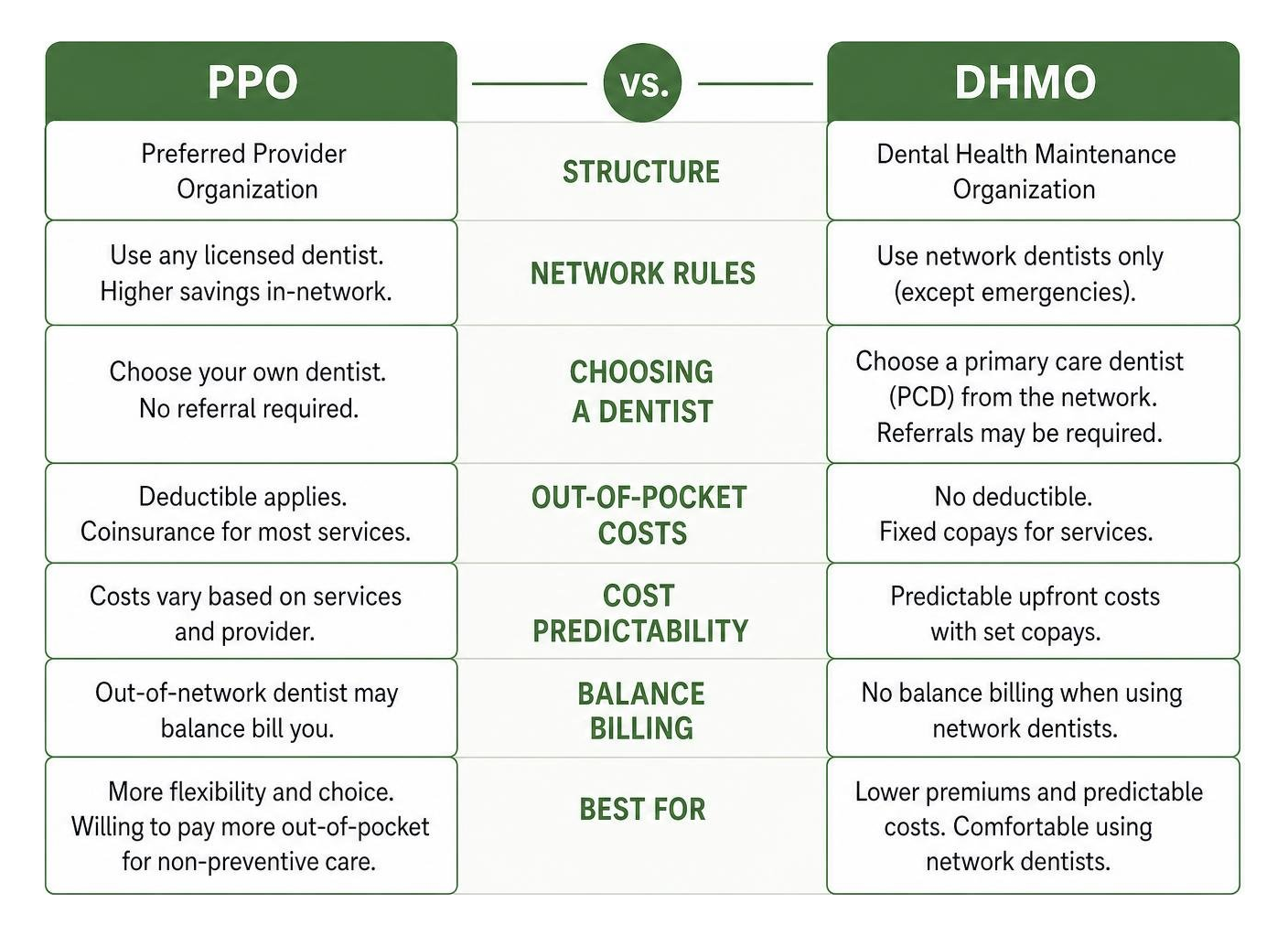
Generally, these options fall into two main categories: Dental Health Maintenance Organizations (DHMOs) and Preferred Provider Organizations (PPOs).
Let’s look at the basic differences before diving into the individual plans:
DeltaCare USA Essential Plan
The DeltaCare USA Essential plan is Delta Dental’s DHMO-style offering. If you are looking for the lowest monthly premiums and highly predictable out-of-pocket costs, this is typically where you start.
Key features of this plan include:
- Low Premiums: Pricing starts around $27.80 per month.
- No Deductibles or Annual Maximums: You do not have to pay a set amount before coverage kicks in, and there is no cap on how much the plan will pay for your care in a single year.
- Fixed Copayments: Instead of paying a percentage of the bill (coinsurance), you pay a pre-determined, fixed dollar amount for each service (e.g., a specific copay for a filling or a crown).
- Network Restrictions: You must select a primary care dentist from the DeltaCare USA network. All of your care must go through this dentist, and you will need a referral to see a specialist.
- No Waiting Periods: You can get preventive, basic, and major care from day one without waiting for a qualifying period to clear.
Note: The DeltaCare USA plan is highly affordable, but it is only available in 17 specified states and districts (AZ, CA, CO, DC, FL, GA, IL, KY, MD, MO, NM, NY, OH, PA, TN, TX, WV).
Delta Dental PPO Plans
If you prefer the freedom to visit any licensed dentist without a referral, the Delta Dental PPO plans are a better fit. These plans allow you to see any provider, though you will save the most money by staying within Delta Dental’s extensive PPO network.
Through AARP, Delta Dental offers three primary PPO tiers. You can review the complete description of benefits and get a personalized quote directly through the Coverage & Costs for AARP® Dental Insurance Plans Provided by Delta Dental portal.
| Plan Tier | Starting Premium | Annual Deductible | Annual Maximum | Best For |
|---|---|---|---|---|
| PPO Protect | ~$32.16 / month | $90 | $1,000 | Budget-conscious individuals who primarily need preventive care and occasional fillings. |
| PPO Protect Propel | ~$44.44 / month | $75 | Grows from $1,000 (Yr 1) to $3,000 (Yr 4) | People who want to avoid waiting periods and plan to keep the policy long-term. |
| PPO Protect Plus | ~$52.24 / month | $40 | $2,000 | Individuals who anticipate needing major dental work (crowns, root canals) and want maximum coverage immediately. |
The PPO Protect Propel plan features a highly unique progressive structure. It was specifically designed to reward long-term policyholders. Not only does your annual maximum benefit grow from $1,000 in Year 1 to $3,000 in Year 4 (or up to $1,750 over a shorter period in states like New York), but the percentage of the bill covered by the insurer also increases over time.
Costs, Coverage, and Waiting Periods for Seniors
When evaluating any insurance policy, we must weigh the monthly premiums against what is actually covered. For seniors living on a fixed retirement income, this math is especially critical.
Dental plans typically categorize services into three tiers:
- Preventive/Diagnostic Care: Cleanings, routine exams, and X-rays. These are almost always covered at 100% with no deductible from day one.
- Basic Services: Fillings, simple extractions, and deep cleanings (periodontal scaling).
- Major Services: Crowns, bridges, root canals, dentures, and implants.
It is worth noting that routine oral exams do more than keep your teeth clean. Dentists can actually detect early signs of over 120 systemic medical conditions — including diabetes, leukemia, and heart disease — during a standard oral exam. This makes preventive care incredibly valuable for overall wellness.
To see how these costs play out in the real world, let’s look at the financial differences between a DHMO and a PPO plan using a standard cost comparison:
| Service Category | DeltaCare USA (DHMO) | PPO Protect Plus (Premium PPO) |
|---|---|---|
| Routine Cleaning | $0 Copay | Covered at 100% (Deductible waived) |
| Silver Filling | Fixed, low copay (e.g., $10-$20) | Covered at 80% (You pay 20% after deductible) |
| Porcelain Crown | Fixed copay (e.g., $300-$400) | Covered at 50% (You pay 50% after deductible) |
| Annual Maximum | Unlimited | $2,000 Cap per year |
For an in-depth financial breakdown of how these plans stack up against other senior-focused policies, see our Is AARP Dental Insurance Worth It? Detailed Review (2026).
Understanding the Waiting Period for Major Services
One of the most common complaints about dental insurance is the “waiting period trap.” Many standard policies require you to pay premiums for 6 to 12 months before they will contribute a single penny toward major procedures like crowns, root canals, or dentures.
Under the AARP Delta Dental PPO plans, waiting periods are structured as follows:
- Preventive Care: No waiting period on any plan.
- PPO Protect: Typically features a 12-month waiting period for major services.
- PPO Protect Plus: Typically features a 9-month waiting period for major services.
- PPO Protect Propel: No waiting periods for any covered services, though your annual maximum starts lower in Year 1.
- DeltaCare USA Essential: No waiting periods for any covered services.
State Exception: If you live in California, state regulations have eliminated waiting periods entirely across all AARP Delta Dental plans as of January 1, 2025. If you live elsewhere, you must plan your enrollment carefully to avoid paying for a plan you cannot immediately use for major treatments.
Is the AARP Dental Plan Worth It for Seniors on Medicare?
Original Medicare (Parts A and B) has excluded routine dental coverage since its inception in 1965. This leaves retirees completely on their own when it comes to oral health.
While roughly 98% of Medicare Advantage plans in 2026 offer some form of dental benefits, many seniors have experienced significant benefit reductions. For example, some major carriers reduced or eliminated their popular $1,000 comprehensive dental riders, scaling back to preventive-only coverage.
Furthermore, roughly 30% of Medicare beneficiaries currently have untreated tooth decay. If you are on Original Medicare, or if your Medicare Advantage plan has recently cut its dental benefits, purchasing a standalone AARP Delta Dental policy is often the most reliable way to secure comprehensive coverage.
For a complete look at how to navigate these gaps, read the AARP Dental Plans for Seniors on Medicare: Real Costs, What’s Covered & Smarter Alternatives – Budget Seniors guide.
Frequently Asked Questions About AARP Dental Insurance
Navigating the rules of dental insurance can be tricky. To help clear up any remaining confusion, we have answered some of the most common questions members ask about the Dental Plans FAQs | AARP Program at Delta Dental.
Does Delta Dental offer AARP dental insurance to non-seniors?
Yes! While AARP is widely associated with seniors and retirees, anyone aged 18 or older can join AARP. Once you pay the $16 annual membership fee, you are fully eligible to enroll in the AARP Dental Insurance Plan administered by Delta Dental.
Additionally, the plan offers family coverage options. You can add your spouse or domestic partner, as well as unmarried dependent children or grandchildren, up to the age of 26.
Can I keep my current dentist with an AARP Delta Dental plan?
It depends entirely on the plan you choose:
- If you choose a PPO plan: You can visit any licensed dentist. However, your out-of-pocket costs will be significantly lower if you choose a dentist who participates in the Delta Dental PPO network. If you visit an out-of-network dentist, they can bill you for the difference between their standard rate and what Delta Dental covers (a practice known as “balance billing”).
- If you choose the DeltaCare USA (DHMO) plan: You must use the specific primary care dentist you are assigned to within the network. Out-of-network care is not covered at all, except in the case of a qualified out-of-state dental emergency (which is typically capped at $100 per incident).
How do I enroll in the AARP Dental Insurance Plan?
Enrolling is a straightforward process that can be completed online or over the phone:
- Secure your AARP Membership: Ensure your AARP membership is active. If you aren’t a member yet, you can sign up on AARP’s website for $16 per year.
- Get a Quote: Visit the dedicated Delta Dental portal for AARP members and enter your ZIP code, age, and the number of family members you wish to cover.
- Select Your Plan: Compare the available PPO and DHMO options in your area.
- Submit Your Application: Complete the online enrollment form.
Timing Tip: If you are enrolling in a DeltaCare USA (DHMO) plan, your application must be received by the 21st of the month for your coverage to begin on the first day of the following month. If you miss this cutoff, your start date will be delayed by an entire month.https://edge.mcpedl.com/files/8482/501/Vanilla%20Waypoints%20v1.9.5%20%5bBehavior%5d%20-%20By%20DARKLEXx.mcpack?ft=1a083187119edc4245a6a3a92864227a&bd=n0x0c2625o&_gl=1*1n4i2p8*_ga*MTEwOTI3ODMzLjE3ODQwOTUxMzU.*_ga_8DG4HWQ88X*czE3ODQ3MDQ2ODgkbzEyJGcxJHQxNzg0NzA2Nzg0JGoyMiRsMCRoMA..”;
Conclusion
Taking care of your teeth is a vital part of healthy aging, directly affecting your systemic health, confidence, and comfort in retirement. While the transition away from employer-sponsored dental care can feel daunting, the partnership between AARP and Delta Dental provides robust, flexible options designed to fit almost any budget.
Whether you opt for the predictable copays of the DeltaCare USA plan, the ultimate flexibility of the PPO Protect Plus plan, or the progressive benefits of the PPO Protect Propel plan, taking action early helps you avoid the high out-of-pocket costs of unexpected dental emergencies.
To stay informed on the latest healthcare tech, insurance updates, and wellness trends heading into the future, explore our latest articles on AI Updates and Tech Trends.
1 thought on “Does Delta Dental Offer AARP Dental Insurance? Complete 2026 Guide”