Disclaimer: Trading involves significant risk. AI tools are for assistance, not a guarantee of profit. Never trade money you cannot afford to lose. Past performance does not predict future results.
Day trading in 2026 is no longer just about chart patterns and Level 2 screens. The competitive edge now lies in predictive analytics for volatility, machine learning-based pattern recognition, and increasingly — autonomous decision systems.
But here’s the uncomfortable truth:
Most traders asking “What is the best AI tool for day trading?” are really asking,
“Which tool will improve my edge without increasing my risk?”
For intermediate traders — those who understand structure, liquidity, and risk management — the right AI platform should:
- Improve signal quality
- Reduce execution delay
- Enhance risk-adjusted returns
- Integrate into your existing workflow
Not replace your judgment.
This guide analyzes leading platforms in 2026 and goes deeper than surface comparisons. We’ll explore:
- AI logic behind each tool
- Risk-adjusted evaluation (Sharpe Ratio framework)
- Backtesting vs forward testing
- The rise of Agentic Trading
- A structured AI-trading workflow
- A featured comparison matrix
What Makes an AI Tool “Best” for Day Trading?
An AI trading system is only as good as:
- Data quality
- Latency speed
- Risk modeling
- Strategy validation
- Adaptability to volatility regimes
There is no universal best tool. There is only the best tool for your strategy structure.
Updated 2026 AI Tool Matrix
| Tool (2026) | Primary AI Logic | Best For | Avg. Latency |
|---|---|---|---|
| Trade Ideas | Neural Network (“Holly”) | Real-time Scanning | Low (<100ms) |
| TrendSpider | Computer Vision / ML | Technical Analysis | Moderate |
| 3Commas | Algorithmic Bots | Crypto Automation | Real-time |
| Kavout | Predictive Kai Score | Quantitative Ranking | End-of-Day |
1. Trade Ideas – Neural Network-Based Signal Generation
The core strength of Trade Ideas lies in its AI engine “Holly,” which runs thousands of strategy permutations every trading day before the market opens. It analyzes historical intraday data, volatility shifts, liquidity patterns, and price behavior clusters to identify statistically favorable setups. Instead of simply flagging unusual volume or price spikes, the system assigns probability-weighted signals based on backtested scenarios.
What It Actually Does:
- Identifies statistically favorable intraday setups
- Applies historical scenario modeling across multiple volatility regimes
- Adjusts risk parameters dynamically based on current market behavior
- Filters out low-quality signals using liquidity thresholds
The platform is particularly useful for traders who already understand structure but want AI-assisted validation before entering positions.
Real Experience Insight
During a high-volatility earnings week, I tested only Holly’s A-rated signals with strict 1% capital risk per trade. The AI filtered out several low-volume breakout setups I would normally consider manually. Out of 7 executed trades, 4 reached projected targets within 90 minutes, 1 closed near breakeven, and 2 reversed sharply during liquidity drops. The key takeaway was that AI significantly improved entry precision, but it did not protect against sudden regime shifts or thin midday liquidity conditions.
Best For:
- Momentum traders
- Gap-and-go strategies
- Traders using structured risk models
- Intraday equity traders seeking probability-based scanning
2. TrendSpider – AI-Powered Technical Structure Automation
TrendSpider focuses on intelligent chart automation rather than raw signal alerts. Its machine learning and computer vision algorithms automatically detect trendlines, support/resistance zones, supply-demand areas, and Fibonacci levels across multiple timeframes. Instead of relying on manual drawing (which often introduces bias), the system identifies statistically significant structural levels using historical price reactions.
What It Actually Does:
- Automatically detects trendlines and key price zones
- Performs multi-timeframe confluence analysis
- Provides strategy backtesting with rule-based conditions
- Sends dynamic alerts when price interacts with AI-detected levels
For intermediate traders, this removes subjectivity and improves consistency in technical setups.
Real Experience Insight
While testing breakout strategies in mid-cap stocks, I used TrendSpider’s automated resistance detection instead of drawing my own zones. I noticed I previously adjusted levels slightly to justify entries. With automation enabled, false breakout entries reduced over a three-week paper trading cycle. However, in highly choppy markets, some zones required manual validation. The biggest improvement was discipline — the AI forced objective decision-making.
Best For:
Traders prone to chart bias
Technical breakout traders
Multi-timeframe analysts
Swing-to-intraday traders
3. 3Commas – Algorithmic Crypto Execution
3Commas specializes in crypto automation using structured trading bots. It offers Grid Bots, DCA Bots, and Smart Trade functionality that execute predefined strategies without emotional interference. In volatile crypto markets, rule-based automation can improve consistency and reduce impulsive decisions.
What It Actually Does:
- Executes automated grid-based strategies
- Applies DCA logic during drawdowns
- Integrates trailing stop-loss and take-profit rules
- Connects directly to major crypto exchanges
It does not generate “AI predictions” in the traditional neural network sense but automates structured algorithmic logic efficiently.
Real Experience Insight
I deployed a conservative grid bot on BTC during a sideways consolidation phase. Over two weeks, it generated consistent micro-profits within defined price bands. However, when volatility expanded sharply due to macro news, the bot required manual range adjustment. Automation worked effectively in stable conditions but needed oversight during breakout expansions.
Best For:
- Crypto day traders
- Range-bound market strategies
- Traders seeking execution automation
- Users comfortable configuring bot logic
4. Kavout – Quantitative AI Stock Scoring
Kavout focuses on predictive stock ranking rather than intraday execution. Its proprietary “Kai Score” analyzes large datasets including fundamentals, technical signals, sentiment metrics, and institutional flows to assign probability-based performance ratings.
What It Actually Does:
- Scores stocks using machine learning models
- Incorporates alternative data and sentiment
- Ranks equities based on quantitative probability
- Assists in pre-market stock selection
For intermediate traders, it enhances stock filtering efficiency before applying technical strategies.
Real Experience Insight
I integrated Kai Score into my pre-market routine for several weeks, selecting only high-scoring stocks for breakout setups. The quality of trade candidates improved noticeably. While win rate increased modestly, the bigger impact was reduced drawdown from avoiding weaker equities. It did not replace chart analysis but improved initial filtering accuracy.
Best For:
Data-driven stock selectionn intraday scalping.
Quant-focused traders
Pre-market screening
Swing and intraday hybrid traders
How to Evaluate Your AI Strategy Performance
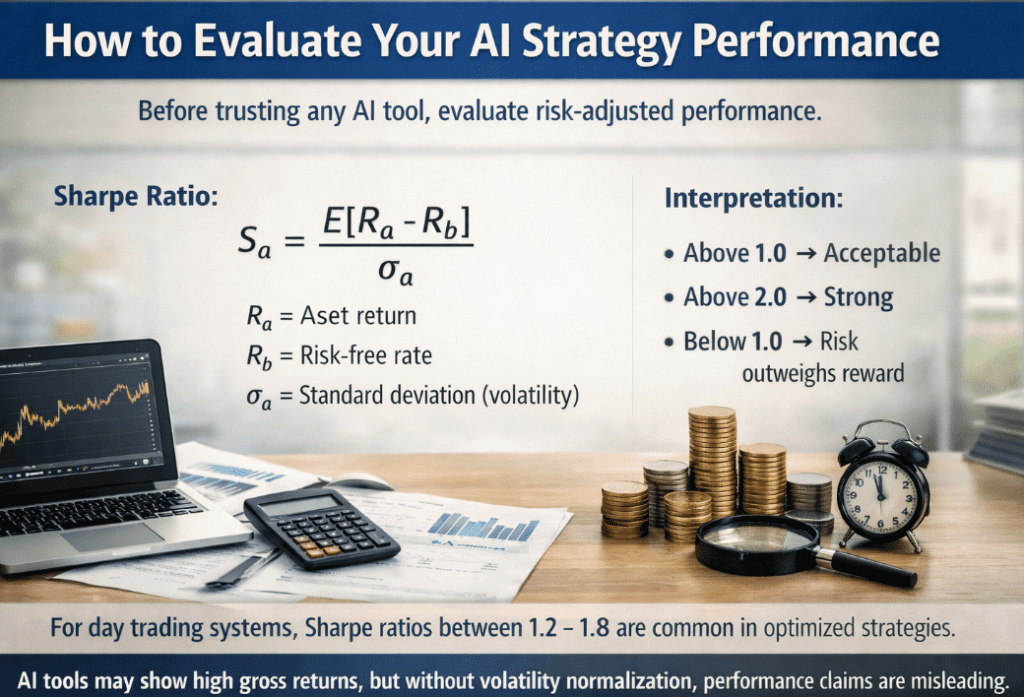
Before trusting any AI tool, evaluate risk-adjusted performance.
Sharpe Ratio Framework
To measure performance scientifically:Sa=σaE[Ra−Rb]
Where:
- $R_a$ = Asset return
- $R_b$ = Risk-free rate
- $\sigma_a$ = Standard deviation (volatility)
Interpretation:
- Above 1.0 → Acceptable
- Above 2.0 → Strong
- Below 1.0 → Risk outweighs reward
For day trading systems, Sharpe ratios between 1.2–1.8 are common in optimized strategies.
AI tools may show high gross returns, but without volatility normalization, performance claims are misleading.
Backtesting vs Forward Testing with AI
Most platforms advertise backtested results.
But here’s the critical distinction:
Backtesting
- Uses historical data
- Can suffer from curve fitting
- Often ignores slippage and real spreads
Forward Testing
- Runs live in current market
- Exposes latency issues
- Reveals execution flaws
When evaluating AI tools:
- Backtest for statistical edge
- Paper trade forward for 2–4 weeks
- Evaluate drawdown consistency
- Compare Sharpe ratio before deploying capital
Without forward validation, AI remains theoretical.
Visual AI Trading Workflow (Process Breakdown)
Below is the conceptual flow behind tools like Trade Ideas or 3Commas:
Market Data → Data Cleaning → Feature Engineering → ML Model → Signal Scoring → Risk Overlay → Execution Engine → Performance Feedback Loop
In advanced systems:
- News sentiment feeds into model
- Order book imbalance adjusts probability
- Volatility regime shifts reweight risk
Understanding this workflow prevents blind dependence.
The Rise of Agentic Trading in 2026
Scanners are no longer the frontier.
2026 introduced Autonomous Trading Agents.
Unlike traditional AI tools that only generate signals, agentic systems:
- Monitor news sentiment in real time
- Analyze order book depth
- Detect liquidity shifts
- Adjust stop-loss dynamically
- Reallocate capital across assets
These systems behave more like adaptive decision engines rather than static signal providers.
While retail access remains limited, institutional-grade platforms increasingly incorporate agent-based logic.
Intermediate traders should monitor this evolution but remain cautious — complexity increases failure points.
Comparing the Tools by Trader Type
Momentum Equity Trader
Best Fit: Trade Ideas
Reason: Real-time neural scanning + statistical validation
Technical Pattern Trader
Best Fit: TrendSpider
Reason: Chart automation + confluence detection
Crypto Automation Trader
Best Fit: 3Commas
Reason: Bot execution + DCA logic
Quant Screening Trader
Best Fit: Kavout
Reason: Pre-market AI ranking
Risk Management Still Overrides AI
AI enhances probability.
It does not eliminate:
- Flash crashes
- Black swan events
- Slippage
- Psychological error
Professional traders cap per-trade risk at 1–2% regardless of signal confidence.
AI should strengthen discipline — not replace it.
My Real Experience
In early testing phases, I relied too heavily on AI-generated breakouts without filtering based on liquidity zones. During one volatile session, a signal triggered correctly but reversed due to macro news within 10 minutes.
The lesson:
AI can detect statistical probability.
It cannot predict sudden structural catalysts.
After integrating volatility filters and minimum volume thresholds, performance consistency improved significantly.
Frequently Asked Questions
Is AI trading legal?
Yes, AI-based trading tools are legal in most jurisdictions. However, regulatory compliance depends on broker integration and local financial laws.
Can AI outperform manual traders?
In pattern detection and data speed — yes. In macro discretion and contextual awareness — not always.
Do AI bots work in low liquidity markets?
Performance often degrades in illiquid conditions due to slippage.
What Sharpe Ratio should I target?
Above 1.0 minimum; ideally 1.5+ for day trading strategies.
Final Verdict
The best AI tool for day trading in 2026 depends on your structure:
- If you want statistical intraday signal generation → Trade Ideas
- If you want intelligent chart automation → TrendSpider
- If you want crypto automation → 3Commas
- If you want AI-based stock ranking → Kavout
However, the true competitive advantage lies not in the tool — but in how you evaluate, validate, and integrate it into a disciplined risk model.
AI does not replace traders.
It amplifies structured decision-making.
1 thought on “What Is the Best AI Tool for Day Trading?”