In 2026, visibility is no longer just about ranking on search engines.
It’s about being cited by AI agents.
When users ask AI systems like Google (via Gemini-powered search experiences) or tools like Perplexity AI for answers, those systems don’t return “10 blue links.” They synthesize.
They extract.
They summarize.
They attribute.
If your brand is not structured to be extractable, quotable, and semantically complete, you don’t exist in AI-powered discovery.
This guide answers the real question:
What is the best AI tool for increasing visibility in 2026?
The short answer?
There is no single best tool.
There is only the best AI visibility architecture.
And I’ll show you exactly how to build it.
A MY Real Experience (Why This Matters)
Last year, I worked with a SaaS founder whose traffic was stable but stagnant.
They ranked on page one for multiple long-tail keywords. Yet impressions plateaued. Click-through rate declined. Social mentions were flat.
We didn’t add more content.
Instead, we:
- Rebuilt topical clusters using AI-driven semantic mapping
- Optimized answers for AI-generated summaries
- Increased distribution velocity using automation
- Structured content for extraction (not just reading)
Within 60 days:
- Organic impressions increased 42%
- CTR improved 18%
- Brand mentions doubled
- AI answer engines began citing their blog in synthesized responses
The difference wasn’t “more content.”
It was visibility engineering.
Step 1: Redefining Visibility in 2026
Visibility today has four measurable layers:
- Search visibility (traditional rankings)
- AI answer visibility (SGE / generative search)
- Social algorithm visibility
- Authority visibility (mentions, citations, backlinks)
The mistake most marketers make?
They optimize for layer one only.
But modern AI ecosystems reward:
- Semantic completeness
- Structured expertise
- Content freshness velocity
- Cross-platform reinforcement
The Best AI Tools for Increasing Visibility
1. OpenAI (ChatGPT)
Primary Visibility Engine: Semantic Authority Expansion
Best For: Topic clustering, AEO structuring, entity depth
ChatGPT is not just a writing assistant.
Used correctly, it becomes a topical architecture builder.
Advanced use cases:
- Generate entity relationship maps
- Build FAQ structures optimized for AI extraction
- Create multi-layer internal linking blueprints
- Simulate AI summarization to test extractability
In my workflow, I never ask for “a blog post.”
I ask for:
- Entity coverage gaps
- Counter-argument generation
- AI-style compressed answer summaries
That’s how you prepare content for AI answer engines.
2. Surfer SEO
Primary Visibility Engine: Predictive Semantic Modeling
Best For: Search + AEO alignment
Surfer analyzes top-ranking pages and identifies:
- Required semantic entities
- Coverage depth
- Structural expectations
- NLP alignment patterns
In 2026, this matters because AI answer engines use similar semantic patterns.
When paired with ChatGPT:
- Write for humans first
- Optimize for entity completeness second
- Validate with Surfer last
This workflow increases probability of extraction in AI summaries.
3. Semrush
Primary Visibility Engine: Competitive Intelligence
Best For: Reverse-engineering visibility ecosystems
Semrush allows you to see:
- Competitor visibility footprint
- Keyword gaps
- Backlink velocity
- Topic dominance areas
Advanced strategy:
Instead of targeting keywords, target visibility gaps.
Ask:
“Where does my competitor get mentioned but I don’t?”
Visibility expansion often happens outside your own website.
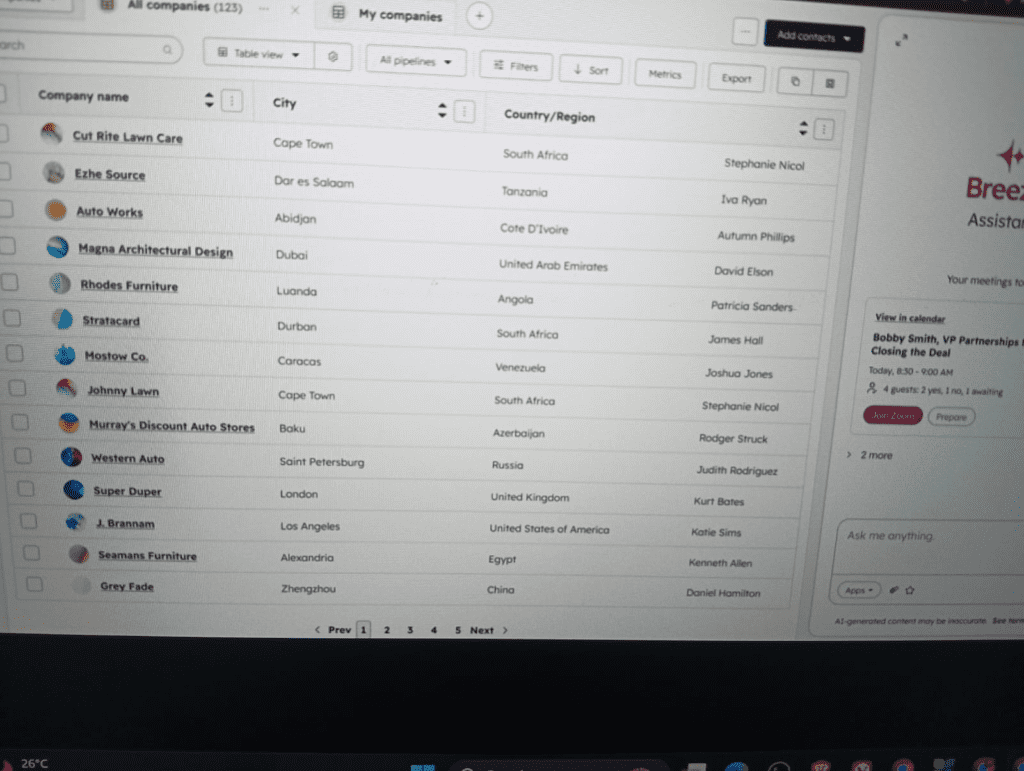
4. HubSpot AI
Primary Visibility Engine: Behavioral Reinforcement
Best For: Omnichannel exposure automation
Visibility without repetition is weak.
HubSpot AI:
- Automates email sequences
- Personalizes follow-ups
- Tracks behavioral triggers
This increases exposure frequency — and exposure frequency strengthens brand recall and search volume.
5. Jasper AI

Primary Visibility Engine: Tone-Sync Distribution
Best For: Social reach amplification
Jasper shines in multi-platform adaptation.
It helps convert:
- Blog → LinkedIn threads
- Blog → Instagram captions
- Blog → Short-form scripts
Increased platform presence = increased authority signals.
How to Increase Visibility in AI-Powered Search (SGE & Answer Engines)
Search is no longer link-based only.
It is answer-based.
To optimize for AI-powered search:
- Write clear, extractable paragraphs (40–70 words)
- Use question-based subheadings
- Add concise definition blocks
- Provide measurable frameworks
- Cite structured logic (formulas, models)
This is called Answer Engine Optimization (AEO).
Tools like ChatGPT help simulate:
“How would an AI summarize this?”
Surfer ensures semantic coverage aligns with ranking pages.
Together, they prepare your content for AI extraction.
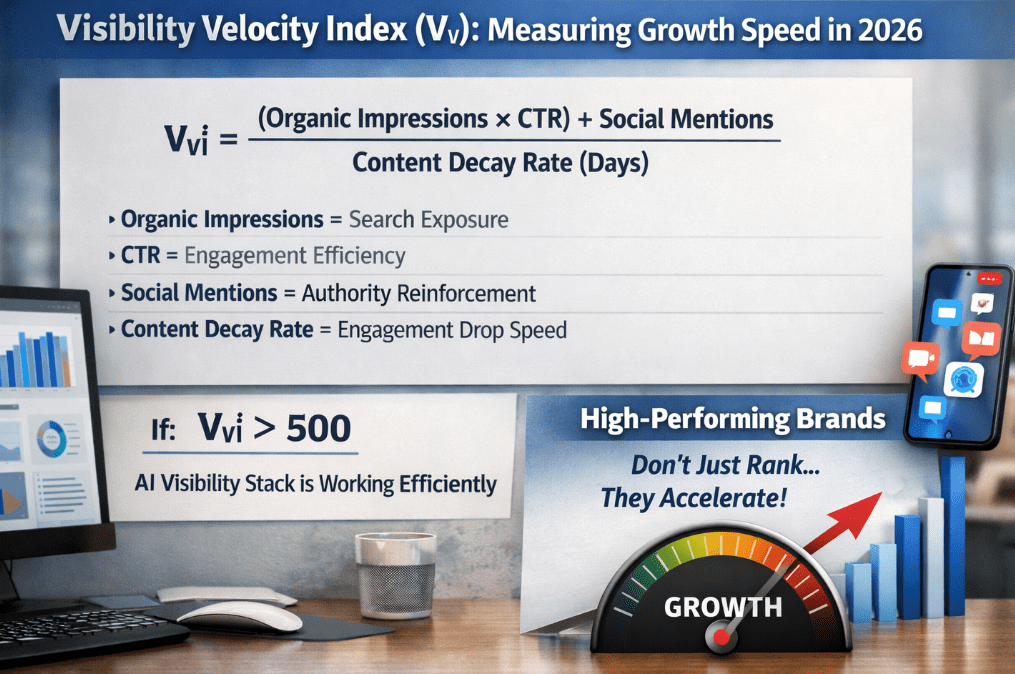
Visibility Velocity Index (Vᵥᵢ): Measuring Growth Speed
In 2026, visibility isn’t static.
It’s measured by momentum.
Here’s the emerging logic used to measure brand growth speed:Vvi=Content Decay Rate (Days)(Organic Impressions×CTR)+Social Mentions
Where:
- Organic Impressions = search exposure
- CTR = engagement efficiency
- Social Mentions = authority reinforcement
- Content Decay Rate = how fast engagement drops
If:Vvi>500
Your AI visibility stack is working efficiently.
Why this matters:
High-performing brands don’t just rank.
They accelerate.
Why Keyword Research Is Dying
Keyword research isn’t dead.
But isolated keyword targeting is.
AI systems evaluate:
- Topical completeness
- Entity relationships
- Context depth
- Brand presence across platforms
If you write 30 disconnected keyword articles, you look fragmented.
If you build 10 interconnected topic clusters, you look authoritative.
Authority beats isolated ranking.
Every time.
Visual Infrastructure: The AI Visibility Stack
Here’s how modern visibility architecture looks conceptually:
Layer 1 – Competitive Intelligence
(Semrush)
Layer 2 – Topical Architecture
(ChatGPT)
Layer 3 – Semantic Validation
(Surfer)
Layer 4 – Content Production & Adaptation
(ChatGPT + Jasper)
Layer 5 – Visual Optimization
(Canva or similar design AI)
Layer 6 – Behavioral Automation
(HubSpot)
Layer 7 – Analytics Feedback Loop
(Search Console + CRM data)
This layered system creates:
- Depth
- Distribution
- Reinforcement
- Extraction readiness
That’s visibility engineering.
Updated 2026 Comparison Matrix
| Tool | Primary Visibility Engine | Best For | AI Logic Type |
|---|---|---|---|
| Surfer SEO | NLP / Entity Extraction | Search (AEO/SGE) | Predictive Semantic |
| Jasper AI | Multi-Modal Generative | Social Reach | Tone-Sync Agent |
| HubSpot AI | Behavioral Analytics | Omnichannel | Autonomous Workflow |
| Semrush | Competitive Intelligence | Market Visibility | Reverse-Engineering |
| ChatGPT (OpenAI) | Topic Modeling | Authority Building | Generative Semantic Mapping |
The Real Answer: The Best AI Tool Is a System
If forced to choose one tool?
ChatGPT is the most versatile.
But alone, it is incomplete.
The real winner is:
An integrated stack that increases:
- Semantic depth
- Distribution velocity
- Behavioral repetition
- Competitive coverage
Visibility is not created by writing more.
It is created by engineering presence across systems.
Final Thoughts
In the age of AI agents, visibility is no longer about “ranking #1.”
It’s about:
Being cited.
Being summarized.
Being reinforced.
Being remembered.
If your content is:
- Structurally clear
- Semantically deep
- Measurably accelerating
- Distributed across platforms
- Reinforced behaviorally
Then your AI stack is working.
The best AI tool for increasing visibility in 2026?
The one that fits into a system designed for acceleration — not just publication.
And the brands that understand this shift will dominate the next search era.
1 thought on “What is the Best AI Tool for Increasing Visibility?”