Why the Best AI Tools for Entrepreneurs Can Change How You Work in 2026

The best AI tools for entrepreneurs in 2026 are no longer a nice-to-have — they’re the difference between a business that scales and one that stalls.
Here’s a quick look at the top picks across the most important categories:
| Category | Top AI Tools |
|---|---|
| Automation & Orchestration | Zapier, Zapier Agents |
| Content Creation | Jasper, ChatGPT, Writer |
| Social Media Management | Buffer, FeedHive, Flick |
| Meeting & Transcription | Fireflies, Avoma, Granola |
| Task Management | ClickUp, Asana, Motion |
| Business Planning | Venturekit, LivePlan, IdeaBuddy |
| Email Productivity | Shortwave, Gemini for Gmail |
| Image & Video | Midjourney, Runway, Descript |
| AI Chatbots | ChatGPT, Claude, Meta AI |
| Scheduling | Reclaim, Clockwise, Motion |
But picking the right tools is harder than it sounds.
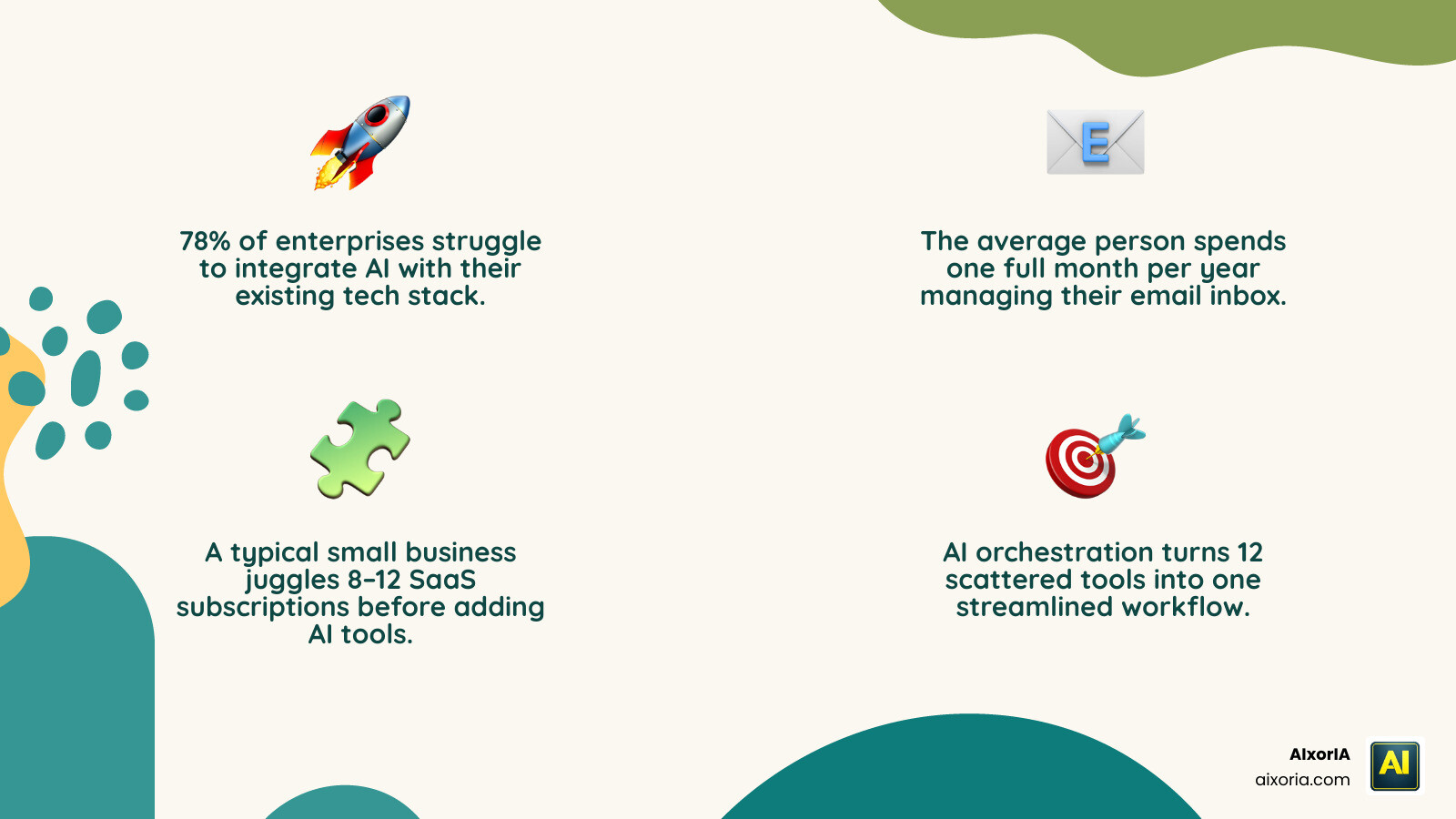
A typical small business already juggles 8–12 SaaS subscriptions. Add a dozen AI tools on top of that and you’re not saving time — you’re managing more complexity. In fact, 78% of enterprises say integrating AI with their existing tech stack is a real struggle.
And here’s a stat that hits close to home: the average person spends roughly one full month per year just managing their email inbox. That’s before you factor in meetings, content, lead follow-up, and everything else on a founder’s plate.
AI tools promise to fix all of this. Some actually deliver. Many don’t.
This checklist cuts through the noise. It’s built for small business owners who don’t have a tech team, don’t have hours to burn on testing, and just need to know which tools are worth their time and money right now.
Core Categories of the Best AI Tools for Entrepreneurs
To build a resilient business in 2026, we need to think of AI as more than just a chatbot. The Best AI Tools for Business Productivity act as a digital nervous system, connecting your ideas to execution. We categorize these tools into four main pillars: automation, content creation, scheduling, and customer support.
AI for Business Planning and Strategy
The days of staring at a blank page while writing a business plan are over. Modern entrepreneurs use AI to validate ideas in minutes rather than weeks. Tools like Venturekit | AI Generated Business Plans can generate comprehensive 28-page plans including market research and financial forecasts.
When we look for the best AI tools for entrepreneurs in this space, we look for those that handle:
- TAM/SAM/SOM Sizing: Automatically calculating your total addressable market.
- Financial Forecasting: Generating revenue projections with 99.7% accuracy based on industry benchmarks.
- Pitch Deck Creation: Turning a text-based strategy into investor-ready visuals.
While tools like ChatGPT are versatile, dedicated platforms like LivePlan or PlanAI Pro often provide more structured frameworks, ensuring you don’t miss critical sections like SWOT analysis or unit economics.
Best AI Tools for Entrepreneurs in Marketing and Sales
In 2026, sales is no longer a numbers game; it’s a personalization game. The Best AI Tools for Sales and Marketing in 2026 allow solo founders to act like a full-scale agency.
- Lead Generation & Scoring: Tools like Clay use “waterfall logic” to search multiple data sources, finding the most accurate contact info and scoring leads based on real-world triggers like recent funding or hiring trends.
- Social Media Management: FeedHive and Buffer now use AI to not only schedule posts but to predict which content will perform best based on historical data.
- Personalized Outreach: AI can now draft custom emails that reference a prospect’s latest LinkedIn post or company news, significantly increasing response rates.
Maximizing Efficiency with AI Orchestration and Automation
The biggest trend we’re seeing in May 2026 is the shift from “standalone apps” to “AI orchestration.” Since 78% of enterprises struggle to integrate AI, the winners are those who use a central hub to make their tools talk to each other.
Zapier has evolved from a simple “if this, then that” tool into a full-scale AI orchestration platform. With Zapier Agents, you can build autonomous teammates that don’t just move data—they make decisions. For example, an agent can monitor your inbox, summarize a lead’s request, check your CRM for their history, and draft a response without you lifting a finger.
| Feature | Standalone AI Agents | Orchestration Platforms (Zapier) |
|---|---|---|
| Primary Use | Specific tasks (e.g., writing code) | Connecting 8,000+ apps |
| Data Access | Limited to its own silo | Access to your entire tech stack |
| Decision Making | High (within its niche) | High (across multiple apps) |
| Setup Complexity | Low | Medium |
To dive deeper into how these agents are reshaping the ROI of startups, check out our guide on the Best AI Tools for Business in 2026.
Best AI Tools for Entrepreneurs in Daily Operations
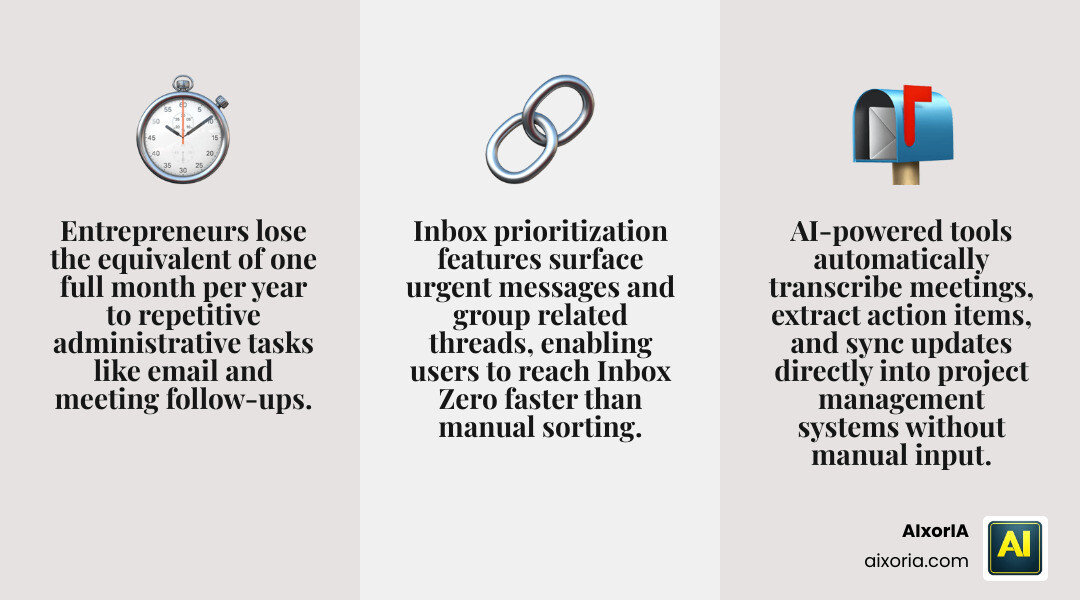
Daily operations are where most founders lose their “one month per year” to administrative drag. The Best AI Tools for Entrepreneurs in 2026 focus on reclaiming that time.
- Meeting Automation: Tools like Fireflies and Granola have moved beyond simple transcription. They now automatically identify action items, update your project management tool (like Asana or ClickUp), and even draft the follow-up email.
- Inbox Prioritization: Shortwave uses AI to group related threads and highlight the most urgent messages, helping you reach “Inbox Zero” faster.
- Task Management: Motion and Reclaim use AI to automatically rearrange your calendar when a high-priority task pops up, ensuring you’re always working on what matters most.
AI for Content Creation and Visual Identity
Visual identity is no longer a bottleneck for bootstrapped startups. With the Best AI Productivity Tools for Entrepreneurs 2026, high-end production is accessible to everyone.
- Vibe-Coding: Tools like Lovable and Bolt allow non-technical founders to build working web apps just by describing them. This is “vibe-coding”—building software through natural language.
- Voice & Video: ElevenLabs provides hyper-realistic voice synthesis for marketing videos, while Runway and Sora (by OpenAI) allow for professional-grade video generation from text.
- Graphic Design: Canva and Adobe Firefly have integrated AI that can expand images, remove backgrounds, and generate entire social media kits in seconds.
How to Evaluate and Select the Right AI Stack
With thousands of tools available, “tool overload” is a genuine risk. We recommend a “Problem-First” approach rather than a “Tool-First” one. Before signing up for a new subscription, ask: What high-value problem am I solving?

- ROI Measurement: If a tool costs $30/month but saves you 5 hours of work, it’s a no-brainer. If it takes 10 hours to set up and only saves 10 minutes a week, skip it.
- Security & Privacy: Always check if a tool uses your data to train its models. For sensitive business strategy, look for “Enterprise” or “Privacy-First” modes.
- Implementation Timelines: Most AI tools can be “piloted” in a few days. Run a 60-day trial with clear success criteria before rolling it out to a whole team.
Frequently Asked Questions about AI for Entrepreneurs
How do AI productivity tools help entrepreneurs save time?
AI tools save time by automating “shallow work”—repetitive tasks like data entry, meeting notes, and email sorting. By offloading these to AI, entrepreneurs can focus on “deep work” like strategy, product development, and high-level networking. Statistics show that AI-assisted business planning alone can save an average of 82 hours per plan.
What are the key pros and cons of using AI agents vs. human VAs?
Pros of AI Agents: They work 24/7, don’t require vacation time, and are significantly cheaper (often $20-$50/month vs. $500+/month for a VA). They are also faster at data processing. Cons of AI Agents: They lack “human intuition” and emotional intelligence. They can sometimes “hallucinate” or make logical errors if the prompt isn’t clear. We recommend a hybrid approach: use AI for data and automation, and humans for relationship-building and complex ethics.
How should a solo founder avoid AI tool overload?
Stick to a “Core Four” stack: one for Orchestration (Zapier), one for Content (ChatGPT/Claude), one for Operations (Motion/Asana), and one for Sales (Clay/HubSpot). Only add specialized tools if they solve a specific, recurring pain point that your core stack cannot handle.
Conclusion
The best AI tools for entrepreneurs are those that disappear into the background and just make things work. Whether you are building your first business plan or scaling a global team, the ecosystem in 2026 offers unprecedented power to the individual founder.
At AIxorIA, we specialize in helping you navigate this complex landscape. We provide custom AI solutions, tool training workshops, and performance audits designed to ensure your AI stack is actually delivering ROI. Our mission is to provide simple language help and affordable services so you can focus on what you do best: building your vision.
Ready to take the next step? Get started with the AI tools for business in 2026 guide and see how autonomous agents can transform your workflow today.
5 thoughts on “Best AI Tools for Entrepreneurs in 2026 (Tested & Ranked for Productivity)”