AI Tools for Florist Orders and Delivery Scheduling: What to Look For
Scr0ll d0wn to D0VVNL0AD
AI tools for order and delivery scheduling for florists can turn phone calls and messages into workroom dockets, flag missing addresses or dates, draft order confirmations, and help assign deliveries to drivers. The most useful setup connects these tasks to your existing order system, so staff work from one set of details instead of copying them between apps.
Start with the task that causes the most rework. Keep a person in charge of delivery promises, substitutions, and sensitive orders such as funeral flowers. This guide compares tools for order intake, inventory, customer messages, and dispatch, plus the checks to run before a holiday rush.
How AI Modernizes Flower Shop Order Intake and Docketing
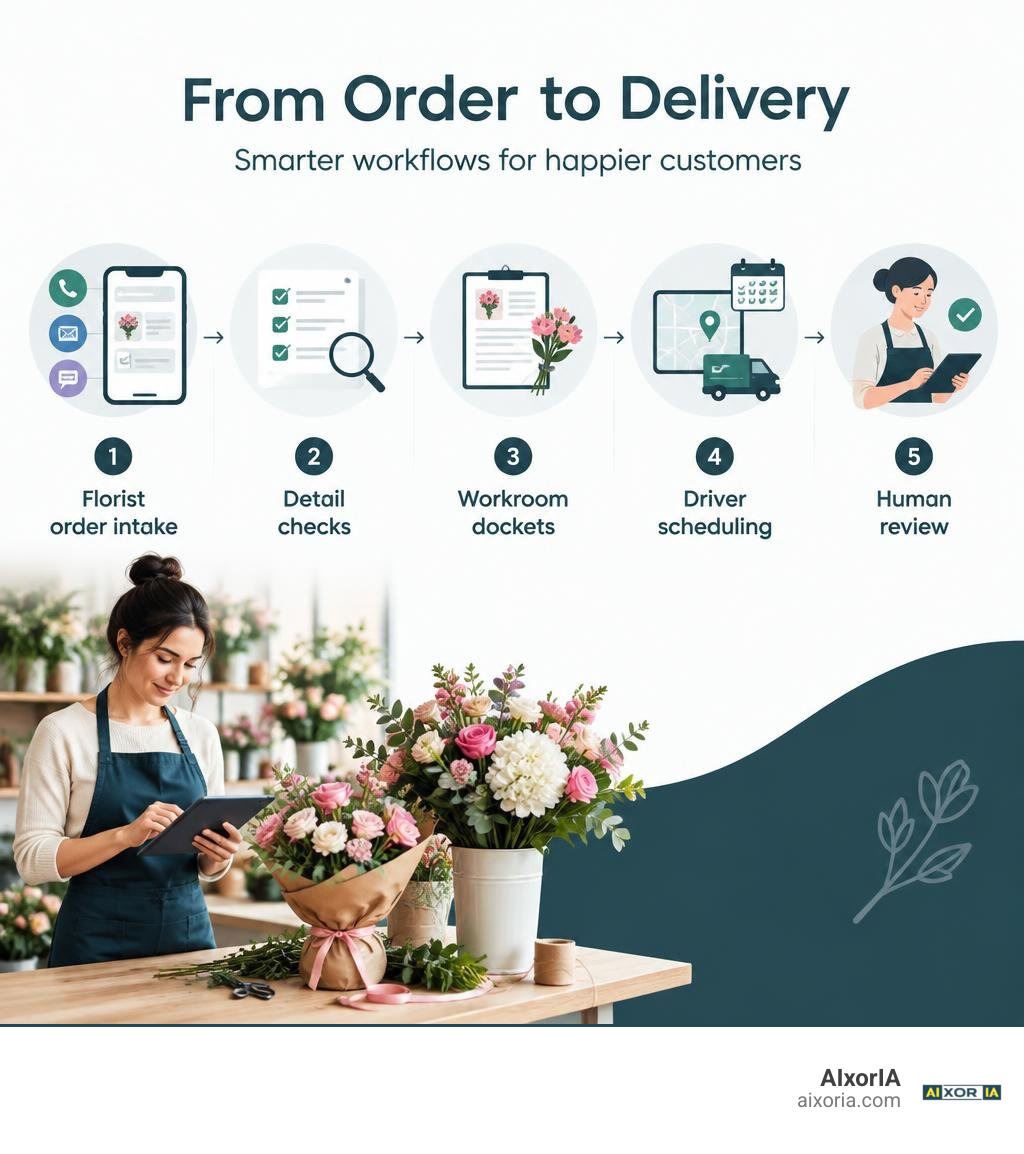
Running a flower shop requires balancing artistic design with strict logistical timing. Between handling walk-in customers, answering phone consultations, managing website orders, and keeping cut stems fresh in the cooler, administrative details can easily slip through the cracks. For an independent flower shop processing around 60 orders per week, administrative overhead—such as manually scribbling phone notes, retyping card greetings, and drafting dispatch sheets—takes up nearly seven hours each week.
Modern intelligent automation transforms this front-of-house intake into an organized digital pipeline. Florists can capture spoken details during consultations using voice transcription models, scan messy handwritten counter slips via optical character recognition (OCR), and parse incoming social messages into clean, actionable workroom tickets. Exploring the best free AI tools for small business owners in 2026 reveals accessible pathways for shops to eliminate repetitive clerical work without massive upfront software investments.
How AI Tools for Florists for Orders and Delivery Scheduling Streamline Daily Workflows
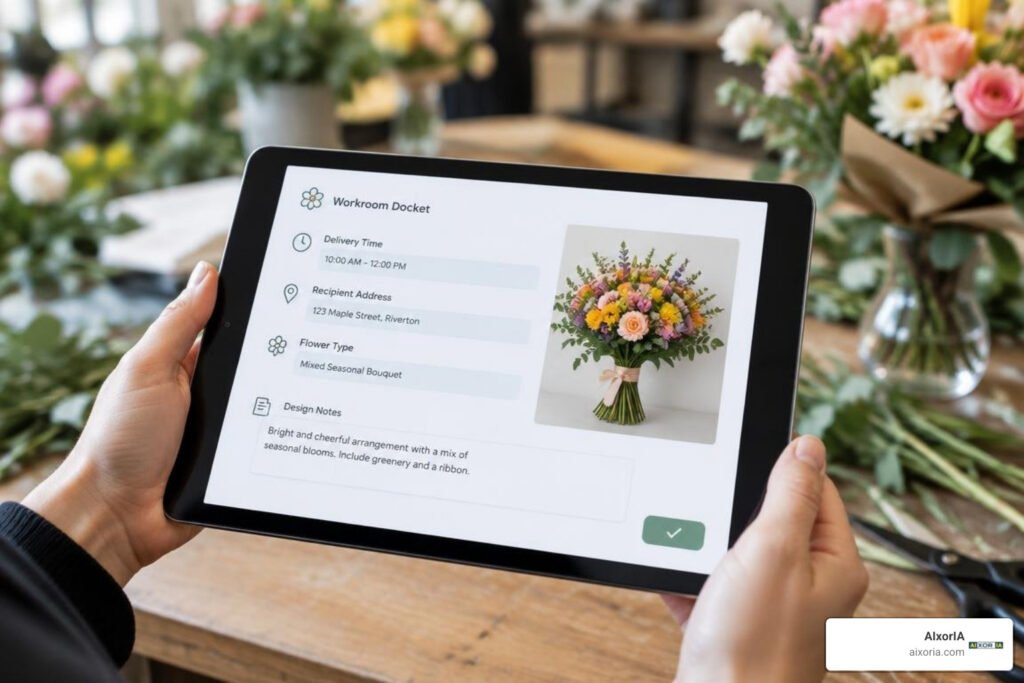
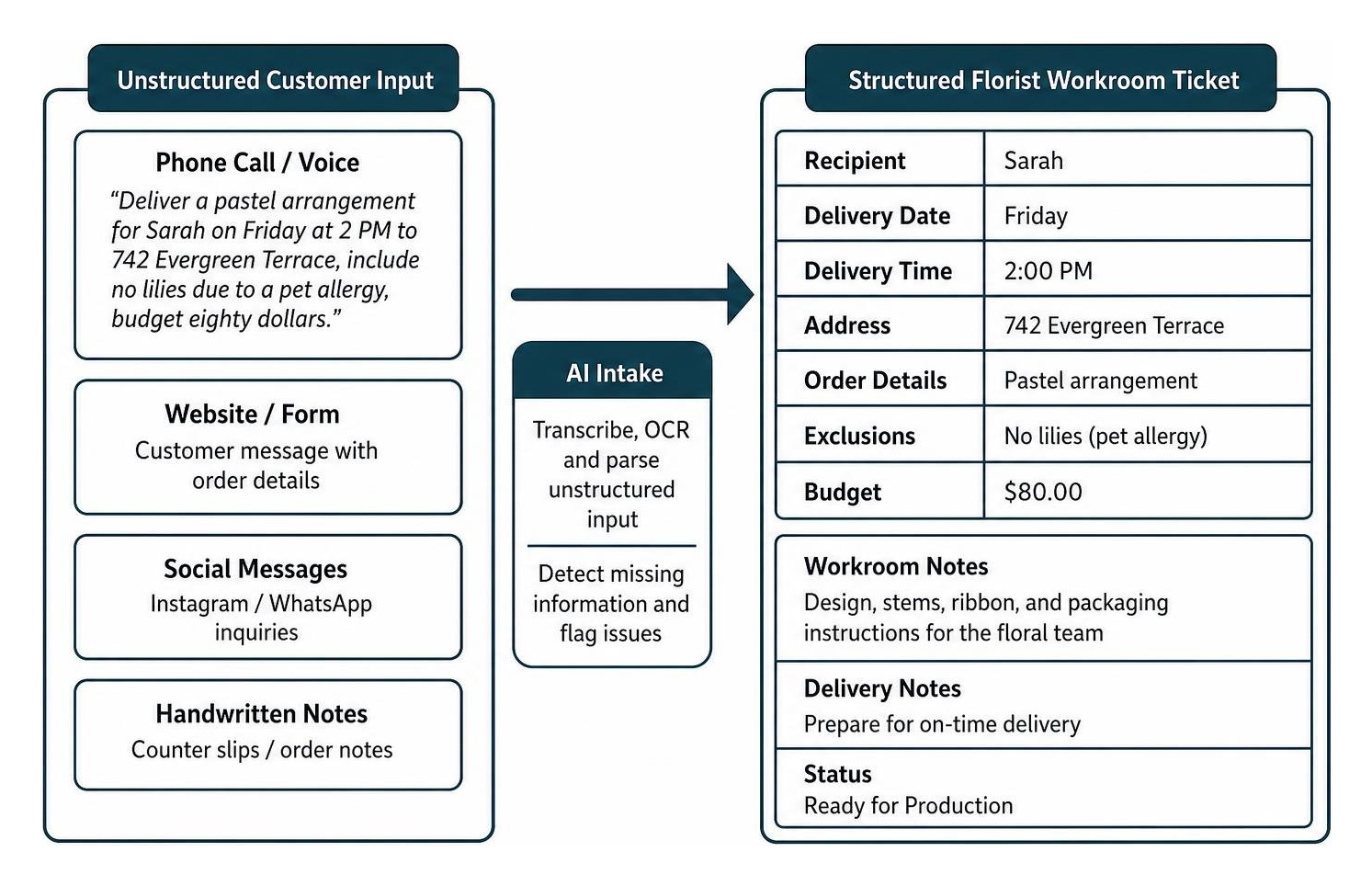
Using specialized ai tools for florists for orders and delivery scheduling helps teams consolidate incoming customer inquiries from Instagram direct messages, WhatsApp chats, website forms, and counter calls into a single production queue. Instead of relying on disorganized group chats or paper sticky notes, modern solutions parse unstructured text into standardized assembly tickets.
For instance, mobile-friendly intake tools enable floral staff to dictate customer requirements directly into a tablet or phone interface. A single sentence such as, “Deliver a pastel arrangement for Sarah on Friday at 2 PM to 742 Evergreen Terrace, include no lilies due to a pet allergy, budget eighty dollars” is automatically converted into a structured docket with delivery time slots, recipient metadata, and design constraints clearly separated.
Key operational benefits of structured AI intake include:
- Automated Safety Exclusions: Flagging toxic botanicals immediately—such as ensuring lilies are excluded when feline pets are in the recipient’s home.
- Missing Field Detection: Highlighting absent apartment numbers, missing recipient phone numbers, or unselected delivery windows before the customer hangs up.
- Standardized Workroom Formats: Presenting floral assemblers with clear stem recipes, ribbon choices, and packaging instructions.
Three-Lane Confirmation and Card Message Safety Rules
Order confirmations require extreme precision. A small error in a delivery date, address, or greeting can ruin a customer’s experience. To prevent automated confabulations or hallucinated details, flower shops must implement a three-lane operational framework:
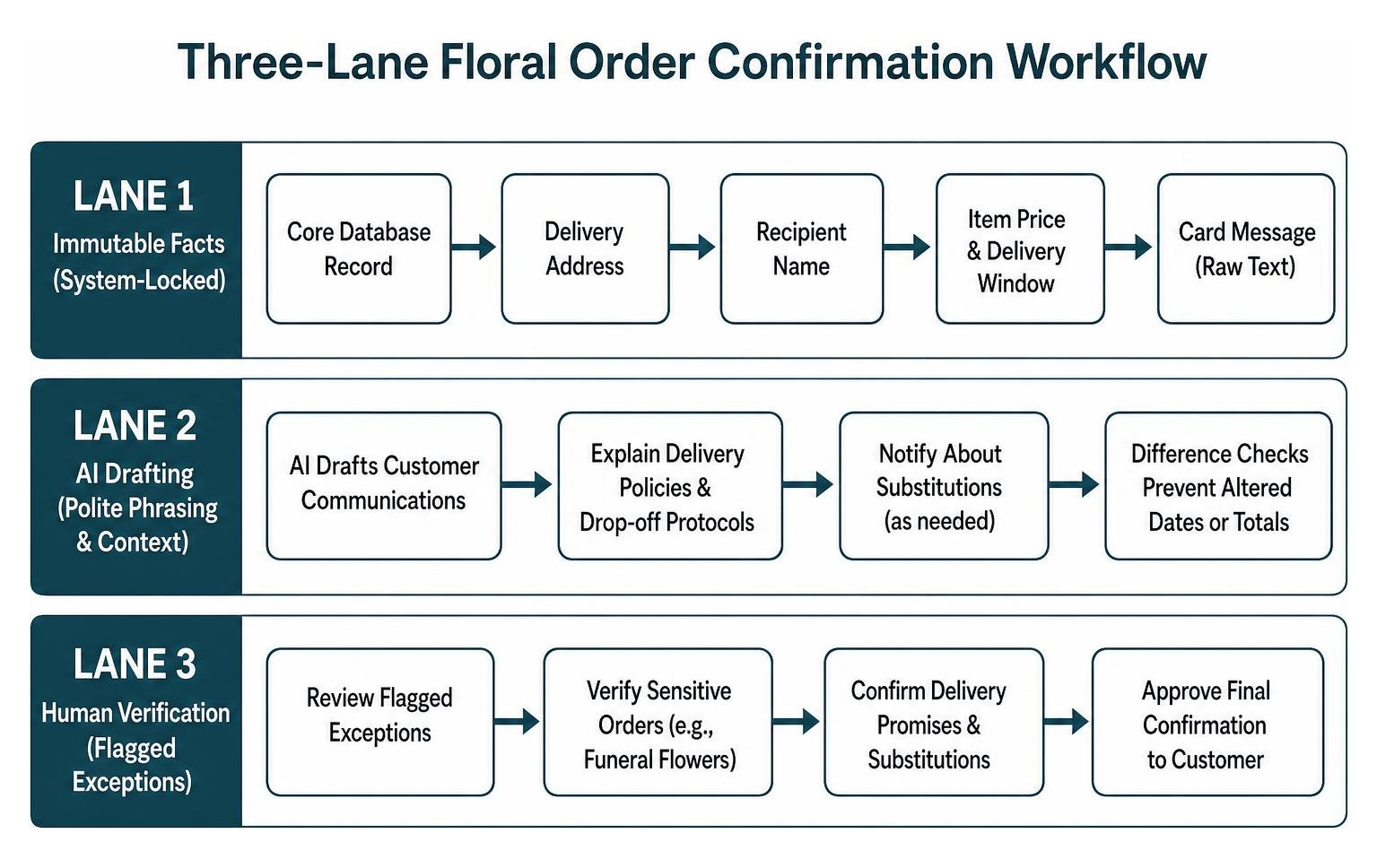
- Lane 1: Immutable Facts (System-Locked) The core database record holds hard facts: delivery address, recipient name, item price, chosen delivery window, and the raw text of the customer’s card message. AI models are strictly blocked from editing these values directly.
- Lane 2: AI Drafting (Polite Phrasing & Context) The system drafts natural, polite customer communications around those hard facts. It explains store delivery policies, outlines unattended drop-off protocols, or phrases gentle notifications regarding stem substitutions. Automated difference checks run continuously between the draft and database to prevent altered dates or incorrect totals.
- Lane 3: Human Verification (Flagged Exceptions) Human team members review high-risk triggers before messages go out. This includes any order flagged for missing apartment suites, changes to delivery slots, or emotionally sensitive arrangements.
When it comes to card messages, language models must never “fix” or rewrite text by default. A customer’s intentional capitalization, informal sign-offs like “xx,” or inside jokes carry deep emotional value. Instead, the AI functions solely as a sentiment and technical scanner, identifying unprintable emoji characters, excessive lengths, or major tonal mismatches (such as a celebratory birthday greeting mistakenly attached to a funeral spray).
Top AI Tools for Florists for Orders and Delivery Scheduling in 2026
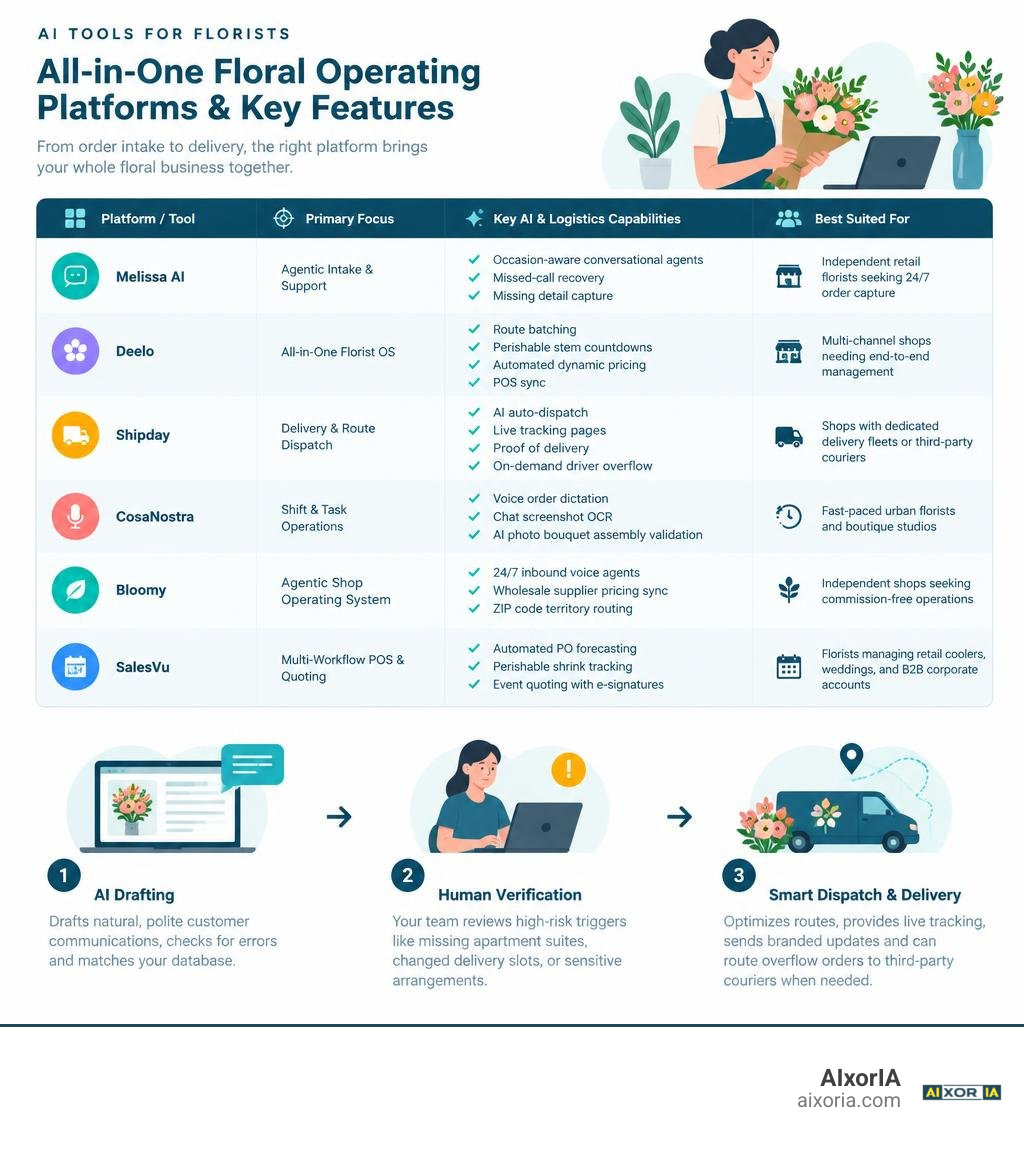
Modern software platforms designed for the floral industry combine point-of-sale (POS) ordering, dynamic stem recipe costing, automated routing, and voice-assisted customer intake into integrated ecosystems. Choosing the right platform depends on whether your shop focuses primarily on walk-in retail, e-commerce deliveries, or large-scale event production.
| Platform / Tool | Primary Focus | Key AI & Logistics Capabilities | Best Suited For |
|---|---|---|---|
| Agentic intake platforms | Automated order capture | Occasion-aware conversational agents, missed-call recovery, missing detail capture | Independent retail florists seeking 24/7 order capture |
| All-in-one florist operating systems | End-to-end shop management | Route batching, perishable stem countdowns, automated dynamic pricing, POS sync | Multi-channel shops needing unified management |
| Delivery dispatch tools | Route optimization | AI auto-dispatch, live tracking pages, proof of delivery, on-demand driver overflow | Shops with dedicated delivery fleets or third-party couriers |
| Shift and task operations platforms | Team workflow coordination | Voice order dictation, chat screenshot OCR, AI photo bouquet assembly validation | Fast-paced urban florists and boutique studios |
| Agentic shop operating systems | Autonomous shop management | 24/7 inbound voice agents, wholesale supplier pricing sync, ZIP code territory routing | Independent shops seeking commission-free operations |
| Multi-workflow POS and quoting tools | Retail and event sales | Automated PO forecasting, perishable shrink tracking, event quoting with e-signatures | Florists managing retail coolers, weddings, and B2B corporate accounts |
Integrating these specialized platforms with the best AI tools for eCommerce in 2026 allows boutique floral studios to run multi-channel sales pipelines without inflating administrative payroll.
All-in-One Floral POS and Agentic Operating Platforms
Specialized floral operating systems are moving beyond basic electronic registers. Modern systems act as agentic operational managers that drive orders through intake, design, and fulfillment.
Agentic intake platforms deploy occasion-aware conversational workflows that handle multi-channel customer intake. Rather than functioning as a standard FAQ chatbot, they identify customer intent, capture critical missing delivery fields, and arrange orders into an organized morning queue for the floral team.
Similarly, all-in-one florist platforms unify inventory management with point-of-sale functionality and automated customer retention agents. They track individual stem counts, monitor cut-flower freshness dates, and execute automated three-stage abandoned cart email sequences (at 1-hour, 24-hour, and 48-hour marks) to recover lost digital sales.
Smart Dispatch, Fleet Routing, and Proof of Delivery
Delivering fragile, temperature-sensitive floral arrangements requires precise route scheduling. Poorly planned routes lead to wilted petals, broken stems, and missed event deadlines.
Modern delivery dispatch platforms optimize multi-stop delivery sequences for in-house drivers while calculating live ETAs. To prevent customer service lines from jamming during busy holidays, automated systems send branded SMS tracking links, reducing inbound “where is my order?” inquiries by up to 90%. Furthermore, when holiday volume exceeds internal vehicle capacity, platforms can automatically dispatch overflow orders to third-party on-demand courier networks at flat rates.
Incorporating essential scheduling software features in 2026 guarantees that time-window restrictions—such as delivering before a 3:00 PM school closing or an 11:00 AM memorial service—are automatically respected during route generation.
Perishable Floral Inventory and Spoilage Management
Cut flowers are among the most perishable retail inventories in the world. Stems lose vase life every day they sit in storage, making precise inventory turnover essential for maintaining healthy profit margins. Tracking inventory by arrangement bundles and individual stem counts allows flower shops to prevent unnecessary waste.

Dynamic Procurement and Spoilage Forecasting
Predictive inventory platforms connect supplier catalog pricing with historical sales demand. Agentic shop operating systems leverage autonomous algorithms to cross-reference live wholesale stem costs from major distributors against custom arrangement recipes. This ensures that retail prices reflect true wholesale fluctuations while safeguarding profit margins.
By reviewing perishable waste logs, AI database tools can pinpoint which varieties suffer the highest spoilage rates during specific seasons. If a batch of garden roses approaches the end of its freshness window, the system can automatically flag them for markdown, suggest their use in immediate same-day designer’s choice bouquets, or adjust future purchase orders to avoid over-ordering.
Human Oversight and Sensitive Sympathy Protocols
While automated logistics improve everyday retail sales, sensitive orders require strict human oversight. Funeral tributes, memorial sprays, and hospital deliveries carry zero margin for error.
- Funeral Home Delivery Timing: Memorial services operate on strict schedules. Funeral directors frequently require tributes to arrive the afternoon prior to a morning service, rather than just “sometime that day.” Automated parsers will overlook this nuance unless strict validation rules are enforced by human staff.
- Botanical Taxonomy Nuances: Visual recognition models can confuse botanical species—such as misidentifying ranunculus or scabious blooms as standard spray roses. Florists must verify arrangement recipes and review photos manually before final sign-off.
- Empathetic Customer Service: Sympathy communications demand a delicate, respectful tone. AI models should never attempt automated upselling or celebratory messaging when an order is flagged for sympathy or bereavement.
Implementation Playbook: Testing Systems Before Holiday Peaks
Peak holidays like Valentine’s Day and Mother’s Day generate a massive percentage of an independent florist’s annual revenue. Attempting to deploy new software during a holiday rush is a recipe for operational chaos. Systems must be tested and calibrated well in advance.
Evaluating AI Tools for Florists for Orders and Delivery Scheduling Before Peak Holidays
To ensure your shop operates smoothly during seasonal volume spikes, implement a structured testing protocol four to six weeks before major holidays using your existing POS and operations platform:
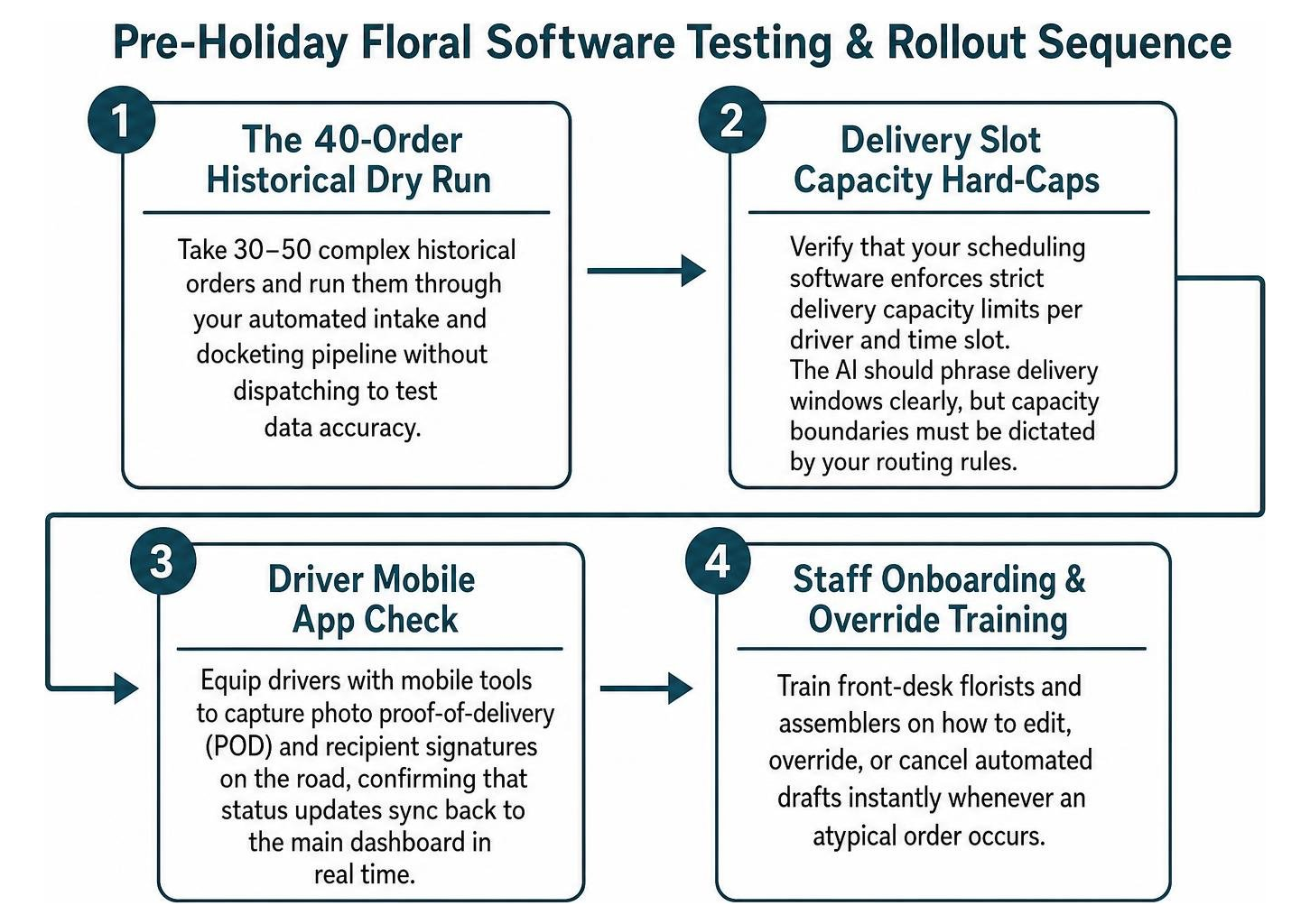
- The 40-Order Historical Dry Run: Take 30 to 50 complex historical orders from past busy seasons—including sympathy orders, addresses with missing suite numbers, specific timed delivery slots, and customized card greetings. Run them through your automated intake and docketing pipeline without dispatching them to test data accuracy.
- Delivery Slot Capacity Hard-Caps: Verify that your scheduling software enforces strict delivery capacity limits per driver and time slot. The AI should phrase delivery windows clearly for customers, but capacity boundaries must be dictated by your routing rules.
- Driver Mobile App Check: Equip drivers with mobile tools to capture photo proof-of-delivery (POD) and recipient signatures on the road, confirming that status updates sync back to the main dashboard in real time.
- Staff Onboarding & Override Training: Train front-desk florists and assemblers on how to edit, override, or cancel automated drafts instantly whenever an atypical order occurs.
Customer Communications, Review Sentiment, and Social Content
Beyond daily order mechanics, language models help florists maintain a consistent marketing presence with minimal administrative effort. A flower shop processing regular weekly volume can save approximately four hours every week by automating routine communications:
- After-Hours Customer Service: Web-based conversational agents can answer late-night questions regarding same-day delivery cutoff times and delivery zip codes, capturing orders while the shop is closed.
- Review Sentiment Analysis: Pasting a year of customer feedback into an analytical model helps owners categorize operational bottlenecks. Clustering complaints can reveal if delayed deliveries on specific Saturdays warrant hiring additional seasonal drivers.
- Seasonal Social Media Content: AI drafting tools can generate engaging captions and seasonal care guides based on your current cooler inventory, keeping marketing channels active during busy design weeks.
Frequently Asked Questions About Florist Order and Delivery AI
How do AI tools handle custom card messages without altering personal notes?
Reliable floral software treats the greeting card message as an immutable, protected field. The language model is prevented from editing capitalization, personal slang, nicknames, or emotional expressions. It simply reviews the text to confirm character count limits, check for unsupported print characters, and ensure that celebratory wording was not accidentally attached to a sympathy arrangement.
Can AI schedule delivery routes based on delicate flower shelf life?
Yes. Intelligent delivery dispatch platforms organize delivery stops by geographic density, vehicle capacity, and agreed customer time windows. By batching deliveries efficiently and tracking driver locations in real time, routes minimize the transit time sensitive floral arrangements spend inside warm delivery vehicles.
How do AI systems integrate with existing flower shop POS software?
Modern platforms connect to existing point-of-sale registers and e-commerce websites (such as Square, Shopify, or WooCommerce) via secure REST APIs and automated webhooks. When an order is completed online or at the counter, details sync across stem inventory records, workroom queue screens, and driver dispatch manifests without requiring manual data re-entry.
Conclusion: Scaling Your Flower Business with Smart AI Automation
Adopting modern automation in your flower shop is not about replacing the florist’s artistic craft—it is about removing administrative friction. Automating routine order intake, standardizing workroom dockets, tracking perishable stem counts, and optimizing delivery routes protects profit margins while freeing your team to focus on floral design and customer care.
At AIxorIA, we help businesses implement practical automation frameworks and performance audits that streamline daily workflows while avoiding restrictive vendor lock-in. Explore our curated resources and custom frameworks across our AIxorIA AI automation frameworks and guides to build an efficient, scalable foundation for your business.