What Are the Top 10 Cloud Security Tools? Comprehensive Architectural Comparison
Scr0ll d0wn to D0VVNL0AD
To understand how to protect modern environments, we need to look at how different security tools operate across the threat lifecycle. No single point tool does everything. Cloud defenses break down into four operational functions:
- Preventative: Enforcing guardrails before deployment.
- Detective: Identifying vulnerabilities, misconfigurations, and active anomalies.
- Analysis: Correlating relationships between identities, networks, and assets to measure exposure.
- Mitigation: Remediating issues automatically or generating actionable code fixes.
| Tool Type | Primary Operational Function | Scope of Protection | Key Lifecycle Stage | Core Benefit |
|---|---|---|---|---|
| CNAPP | Unified Posture, Detection & Mitigation | Full Cloud-Native Stack | Code-to-Cloud Runtime | Consolidates multiple tools into a unified risk model |
| CSPM | Detective & Preventative | Control Planes (AWS, Azure, GCP) | Pre-Deployment & Runtime | Flags misconfigurations against benchmarks |
| CWPP | Detective & Preventative | VMs, Containers, Serverless | Active Runtime | Blocks memory tampering, malware, and exploits |
| CIEM | Analysis & Preventative | IAM, Service Accounts, Roles | Identity Lifecycle | Eliminates excessive cloud permissions |
| DSPM | Analysis & Detective | S3, Blobs, Managed Databases | Data Lifecycle | Maps sensitive data and prevents data leakage |
| CASB | Preventative & Detective | SaaS Apps, Cloud Gateways | User-to-Cloud Access | Eliminates shadow IT and monitors data transfers |
| CDR | Detective & Analysis | Cloud Audit Logs, API Streams | Active Runtime Incident | Identifies lateral movement and account takeovers |
| KSPM | Preventative & Detective | Kube API, Pods, Manifests | Container Orchestration | Enforces pod security and cleans up ClusterRoles |
| SSPM | Detective & Preventative | Enterprise SaaS Tenants | Configuration Lifecycle | Audits third-party OAuth plugins and MFA |
| WAAP | Preventative & Mitigation | Public Edge, APIs, Microservices | Runtime Ingress | Stops automated bots, DDoS, and API attacks |
Modern engineering teams often reference The Top Cloud Security Tools for 2026: A Category Guide — BestDefense when mapping out these categories. Below, we break down each tool type in detail.
1. Cloud-Native Application Protection Platforms (CNAPP)
CNAPPs represent the biggest architectural shift in cloud security. Rather than forcing engineers to review alerts across disparate dashboards, a CNAPP unifies CSPM, CWPP, CIEM, and build-time scanning into a single platform.
The primary advantage of a CNAPP is its ability to uncover “toxic combinations.” A toxic combination occurs when multiple low-severity issues combine to create a critical, exploitable attack path. For instance:
- A virtual machine has an unpatched software vulnerability (detected by CWPP).
- The VM is inadvertently attached to an internet-facing security group (detected by CSPM).
- The instance profile possesses administrative write permissions to a sensitive database (detected by CIEM).
Viewed independently in separate tools, these issues might look like routine, low-priority backlog items. A CNAPP correlates these signals using graph-based analysis to show that an attacker can breach the public port, compromise the VM, and assume administrative access in minutes. By providing unified code-to-cloud visibility, CNAPPs cut through operational noise and help teams focus on issues that pose real risk.
2. Cloud Security Posture Management (CSPM)
Cloud Security Posture Management (CSPM) continuously scans cloud environments via cloud provider APIs to detect misconfigurations, architectural drift, and compliance violations.
CSPM tools benchmark environments against regulatory and industry frameworks like CIS Benchmarks, NIST SP 800-53, SOC 2, HIPAA, and PCI-DSS. They track multi-cloud asset inventories and highlight critical oversights, such as unencrypted storage volumes, open database ports, or missing multi-factor authentication on root accounts.
However, traditional standalone CSPM tools have a known drawback: alert fatigue. When a scanner checks thousands of resources against hundreds of static rules, it can generate massive alert queues without explaining whether a resource is isolated or actively exposed. Modern CSPM platforms address this by incorporating reachability analysis, filtering out benign findings so teams can focus on real attack vectors.
3. Cloud Workload Protection Platforms (CWPP)
While CSPM audits your cloud control plane configurations, Cloud Workload Protection Platforms (CWPP) protect the software running inside your compute instances. CWPP secures virtual machines, containerized applications, and serverless functions across multi-cloud footprints.
Modern CWPP solutions rely heavily on extended Berkeley Packet Filter (eBPF) technology. By deploying non-intrusive sensors at the Linux kernel level, eBPF monitors system calls, file integrity, network sockets, and memory execution in real time without introducing significant CPU overhead.
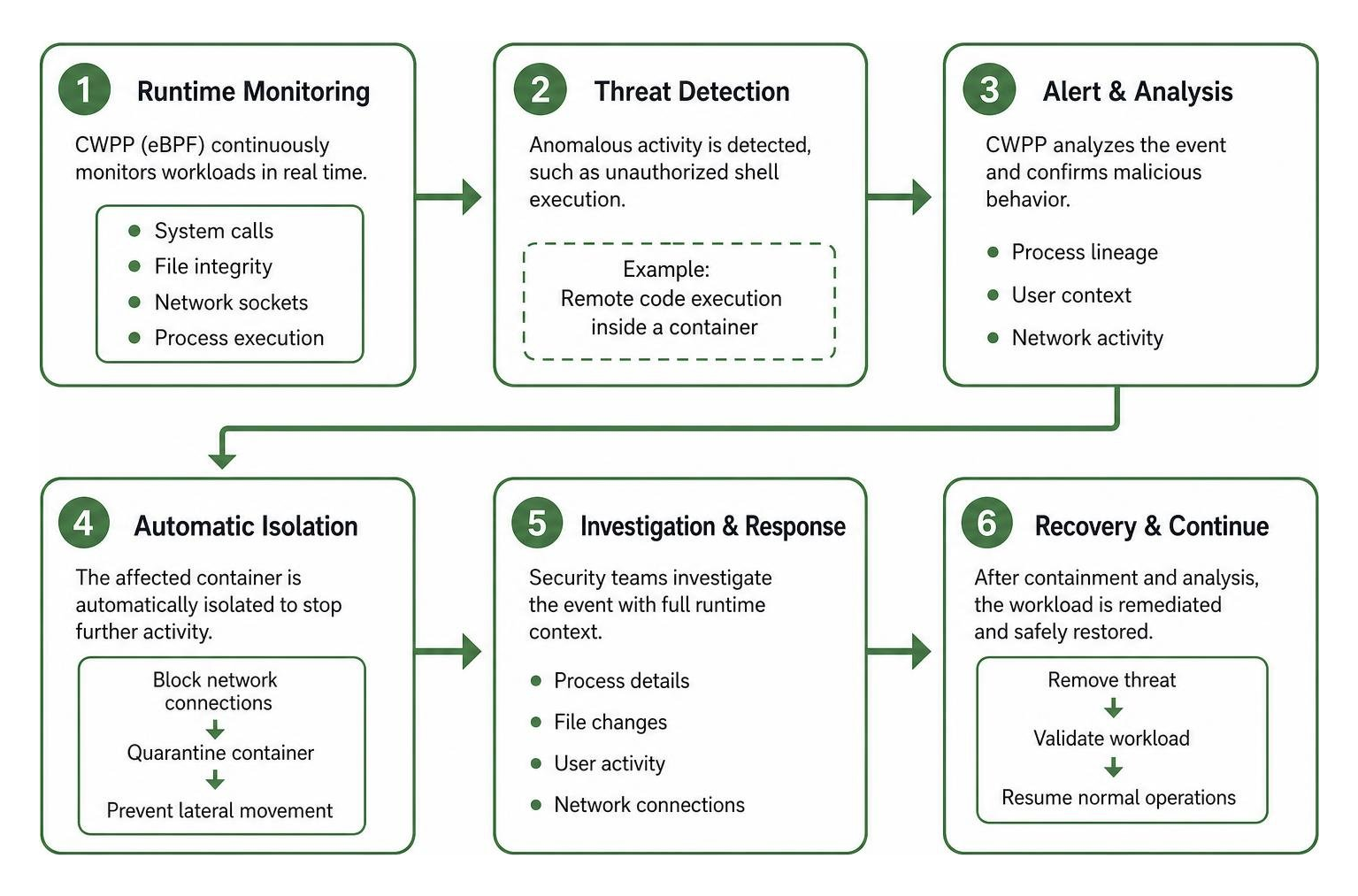
This runtime defense is critical. If an attacker leverages a zero-day exploit to achieve remote code execution inside a container, CSPM API checks won’t catch it. A CWPP detects the anomalous process execution, flags the unauthorized shell invocation, and automatically isolates the container to prevent lateral movement.
4. Cloud Infrastructure Entitlement Management (CIEM)
In the cloud, identity is the true perimeter. Cloud Infrastructure Entitlement Management (CIEM) manages the complex web of permissions assigned to human users, API keys, service accounts, and automated workloads.
A major challenge in cloud infrastructure is permission sprawl. Research indicates that the vast majority of granted permissions sit completely unused. Attackers exploit these dormant permissions to escalate privileges and move laterally across cloud accounts.
CIEM tools analyze effective permissions by calculating what an identity is mathematically permitted to do versus what it actually does day-to-day. When the tool spots over-privileged roles or inactive administrative credentials, it helps security teams automatically right-size those permissions, enforcing the principle of least privilege without disrupting active production services.
5. Data Security Posture Management (DSPM)
Infrastructure-level controls do not always reveal what data is stored inside a given bucket or database. Data Security Posture Management (DSPM) bridges this gap by focusing directly on discovering, categorizing, and protecting sensitive data assets.
DSPM tools scan data repositories across cloud storage systems (such as Amazon S3, Azure Blob, and Google Cloud Storage) as well as managed database instances. They locate:
- Personally Identifiable Information (PII)
- Protected Health Information (PHI)
- Payment records and financial details
- Unencrypted API secrets, SSH keys, and intellectual property
Once sensitive data is cataloged, DSPM maps the exposure pathways around it. If an unencrypted database backup containing customer records is accessible by an over-privileged IAM role or an open network route, DSPM alerts administrators so they can remediate the exposure before data exfiltration occurs.
6. Cloud Access Security Brokers (CASB)
Cloud Access Security Brokers (CASB) act as policy enforcement checkpoints positioned between enterprise users and cloud service providers. As organizations adopt diverse Software as a Service (SaaS) and Infrastructure as a Service (IaaS) platforms, CASBs provide visibility into how corporate data is accessed and shared.
CASBs operate through two primary integration models:
- API-Based Connectors: These connect out-of-band directly to SaaS platforms, auditing data at rest, user activity logs, and sharing permissions without degrading user network performance.
- Proxy-Based Gateways: Inline reverse and forward proxies inspect network traffic in real time, enforcing Data Loss Prevention (DLP) policies, blocking malware downloads, and restricting unapproved file sharing.
CASBs are particularly effective at eliminating “shadow IT.” When employees sign up for unsanctioned third-party cloud apps, file-sharing sites, or consumer generative AI services using corporate credentials, CASBs flag the unmanaged tools and prevent unauthorized data transfers.
7. Cloud Detection and Response (CDR)
Even well-configured environments face targeted attacks. Cloud Detection and Response (CDR) tools specialize in identifying, investigating, and mitigating active threats within runtime cloud environments.
Unlike traditional on-premises SIEM platforms that rely solely on endpoint event logs, CDR solutions ingest cloud-native control plane logs (such as AWS CloudTrail, Azure Activity Logs, and GCP Audit Logs) alongside container telemetry and VPC network flows.
CDR builds behavioral baselines to detect anomalous activity, such as:
- A developer account suddenly initiating mass API calls from an unrecognized geographic location.
- Unusual provisioning of high-powered GPU instances indicating cryptojacking.
- Sudden modifications to IAM trust policies or automated disabling of audit logging.
By correlating these events across cloud audit trails, CDR equips incident response teams to contain compromised credentials and block active attack paths before adversaries achieve their objectives.
8. Kubernetes Security Posture Management (KSPM)
Kubernetes has become the de facto operating system of cloud-native applications, but its complexity introduces unique attack surfaces. Kubernetes Security Posture Management (KSPM) hardens container orchestration clusters from build to runtime.
KSPM platforms continuously audit Kubernetes manifests, Helm charts, and cluster configurations against CIS Kubernetes Benchmarks. They flag risks such as pods running with root access, containers mounting host namespaces, and excessive permissions assigned to service accounts.
Through integration with dynamic admission controllers (like Open Policy Agent or Kyverno), KSPM prevents misconfigured workloads from being deployed to production clusters in the first place, ensuring automated policy enforcement across every development team.
9. SaaS Security Posture Management (SSPM)
While CASB focuses on data flow and user access across SaaS applications, SaaS Security Posture Management (SSPM) focuses on securing the underlying configurations of the SaaS platforms themselves (such as Microsoft 365, Salesforce, Google Workspace, and GitHub).
Misconfigurations in SaaS environments can leave sensitive data exposed to the public internet. Common risks include:
- Dormant accounts retaining global admin permissions.
- Third-party OAuth applications granted broad read/write scopes to corporate mailboxes or code repositories.
- Multi-factor authentication disabled for administrative roles.
- Insecure default external sharing policies for sensitive documents.
SSPM tools continuously audit SaaS tenant settings, detect configuration drift, and guide security teams through step-by-step remediation to ensure enterprise settings remain aligned with compliance standards.
10. Web Application and API Protection (WAAP)
Web Application and API Protection (WAAP) represents the modern evolution of the traditional Web Application Firewall (WAF). WAAP platforms protect public-facing applications, microservices, and APIs against malicious web traffic directly at the network edge.
A comprehensive WAAP solution combines multiple defensive layers:
- Next-Gen WAF: Inspects HTTP/S traffic to block common web application attacks, including SQL injection, cross-site scripting (XSS), and remote file inclusion.
- API Security: Automatically discovers shadow and deprecated APIs, enforces OpenAPI schema compliance, and prevents broken object-level authorization (BOLA) exploits.
- DDoS Mitigation: Absorbs high-volume distributed denial-of-service floods across network layers 3, 4, and 7.
- Bot Management: Identifies automated bot traffic to protect login portals from credential stuffing and account takeover (ATO) attacks.
By filtering malicious traffic before it reaches production compute clusters, WAAP shields underlying microservices from application-layer threats.
Core Selection Criteria for Modern Cloud Security Toolchains
Selecting the right cloud security platform requires evaluating your organization’s architectural footprint, security maturity, and operational requirements. To make an informed choice, engineers often review benchmarks like the Top 10 Best Cloud Native Security Software (2026 Review) to compare real-world performance metrics.
Evaluation Framework: What Are the Top 10 Cloud Security Tools Selection Factors?
When organizations ask, “What are the top 10 cloud security tools?” the right answer depends on how well a platform meets four foundational evaluation factors:
- Contextual Risk Prioritization: Does the platform evaluate risks in isolation, or does it map toxic combinations across network access, identity, vulnerabilities, and data sensitivity?
- Multi-Cloud and Architecture Support: Can the tool natively protect your entire footprint across AWS, Azure, Google Cloud, Kubernetes, and hybrid environments using a single control plane?
- Automated Compliance Mapping: Does the solution translate posture findings into audit-ready evidence for regulatory frameworks like SOC 2, ISO 27001, and HIPAA?
- Vendor and Supply Chain Security: Can the platform integrate seamlessly with your vendor security evaluation workflows? Teams evaluating third-party software risks can assess tools using Top AI Tools for Vendor Security in 2026.
Agentless Visibility vs. Agent-Based Runtime Defense
One of the most important architectural decisions in cloud security is choosing between agentless scanning and agent-based runtime sensors:
- Agentless Scanning: Connects directly via cloud provider APIs and reads snapshot copies of storage volumes out-of-band. It deploys in minutes, provides complete inventory visibility, and introduces zero CPU overhead on production workloads. However, agentless scanning cannot inspect live memory states or terminate active in-memory exploits in real time.
- Agent-Based Defense: Deploys lightweight sensors or eBPF modules directly onto host machines and container nodes. It provides continuous runtime monitoring, monitors process execution, and actively terminates malicious connections. However, studies show that 37% of cloud workloads have coverage gaps in agent-based deployments due to unsupported operating systems and deployment pipeline failures.
The most effective enterprise security strategies adopt a hybrid model: agentless scanning delivers broad, frictionless visibility across 100% of cloud assets, while targeted runtime agents provide deep protection for critical production workloads.
Integrating AI and Automated Remediation Across DevSecOps
Modern development teams deploy cloud infrastructure updates multiple times per day. Securing this continuous lifecycle requires moving beyond manual reviews and adopting shift-left DevSecOps automation.
Security teams coordinate complex threat response and pipeline validation workflows using Top AI Orchestration Tools Focused on Security in 2026. By embedding policy-as-code scanners into developer pull requests, teams catch misconfigurations and vulnerable open-source dependencies before infrastructure-as-code (IaC) templates are merged.
Automated Exploit Validation and Code-Level Remediation
A major advancement in modern cloud security is automated exploit validation. Rather than treating every detected CVE as a critical emergency, modern platforms use offensive security engines to benignly probe attack paths.
This validation confirms whether an exposed service is reachable from the public internet, whether its associated IAM role permits privilege escalation, and whether runtime protections are active. If an exposure is proven exploitable, the system can automatically generate a pull request with the exact IaC code fix (such as updating a Terraform block or rotating a secret), allowing developers to remediate the vulnerability in minutes.
AI-Driven Security Posture and Identity Orchestration
As enterprises deploy machine learning workloads, securing AI pipelines has become a major priority. AI Security Posture Management (AI-SPM) discovers shadow AI models, scans training pipelines for exposed API secrets, and audits data storage to prevent sensitive information from being ingested into foundation models.
Enterprises scale these security controls and manage automated operational pipelines using Top AI Orchestration Tools for Enterprises in 2026. Combining automated posture monitoring with AI-driven identity orchestration ensures that access permissions adapt dynamically based on real-time threat signals.
Frequently Asked Questions About Cloud Security Tools
What Are the Top 10 Cloud Security Tools for Hybrid Deployments?
For hybrid deployments spanning on-premises data centers and multi-cloud providers, the most effective tools combine agentless API discovery for public clouds with unified agents (such as eBPF-based CWPP sensors) for on-prem hypervisors. This provides consistent compliance auditing, unified policy enforcement, and centralized threat visibility across both physical and virtual environments.
What is the difference between CSPM, CWPP, and CIEM in a CNAPP?
CSPM focuses on auditing control plane configurations and compliance across cloud provider APIs. CWPP operates at the workload layer, providing real-time runtime protection for containers, VMs, and serverless functions. CIEM manages entitlements and access rights to enforce least privilege. A CNAPP consolidates all three into a single platform to analyze how configurations, runtime behavior, and permissions interact.
How do cloud security tools eliminate alert fatigue in 2026?
Modern tools eliminate alert fatigue by replacing disconnected rule lists with graph-based contextual analysis. Rather than alerting on every isolated vulnerability, the platform correlates network reachability, identity entitlements, and data sensitivity. This reachability verification suppresses benign alerts and highlights the small fraction of exposures that present genuine, reachable attack paths.
Conclusion
Securing modern cloud architectures requires moving away from fragmented collections of point products. Managing five to eight standalone tools creates operational blind spots, strains engineering resources, and leaves teams overwhelmed by unprioritized alerts.
Consolidating your defense stack around an integrated Cloud-Native Application Protection Platform (CNAPP) combines the continuous visibility of CSPM, the runtime protection of CWPP, and the access controls of CIEM. By prioritizing verified attack paths and automating remediation directly within CI/CD pipelines, security teams can protect dynamic workloads while maintaining development velocity.
To discover more tools and frameworks that simplify cloud defense and enterprise automation, explore comprehensive resources in the AI Tools directory to build a resilient, modern security architecture.
Bermanfaat. Coba Muse Voice Transcribe: — speech-to-text. Muse Voice Transcribe