How Much Is GL Insurance for a Small Business? A Quick Cost Snapshot
Scr0ll d0wn to D0VVNL0AD

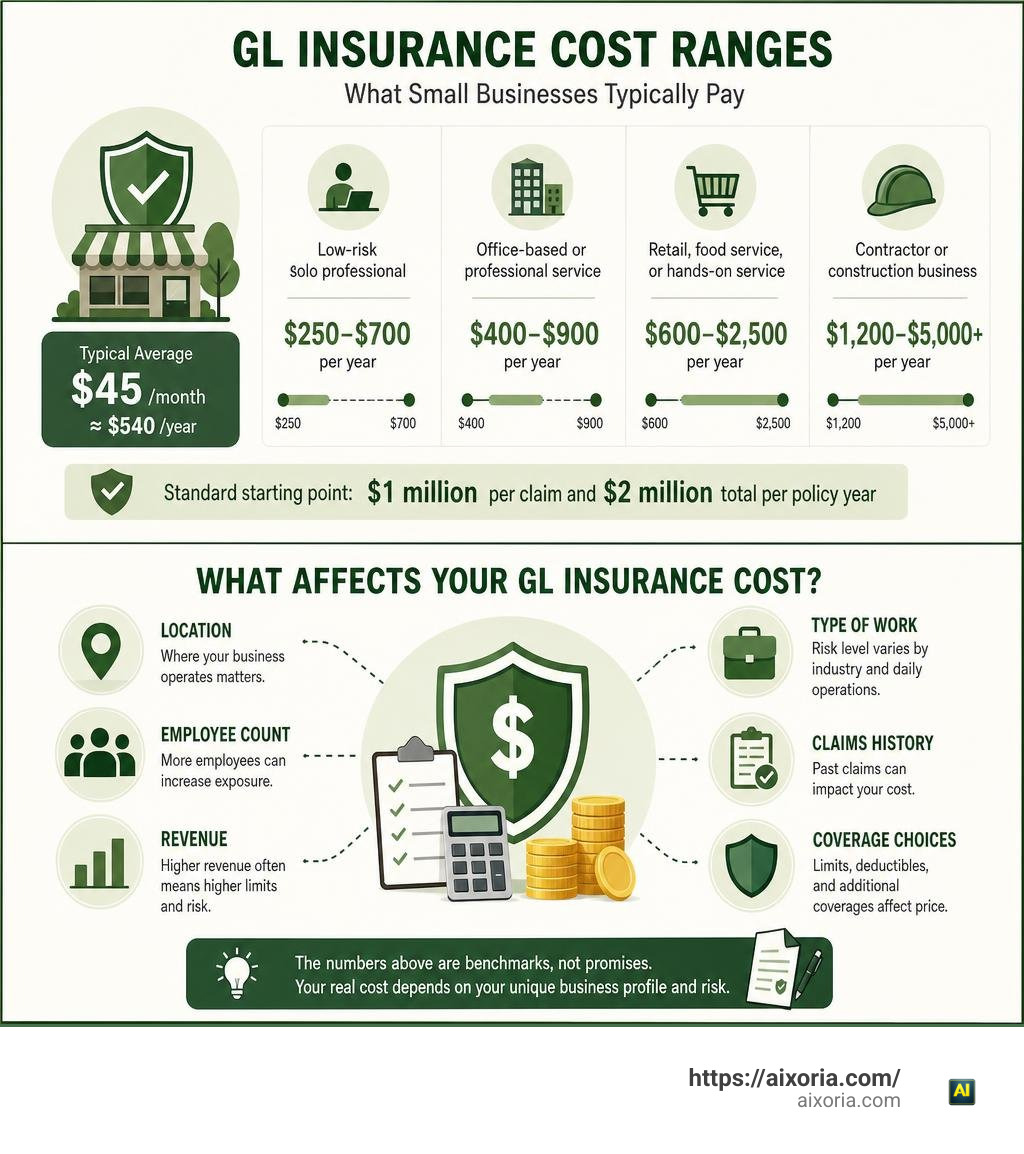
How much is GL insurance for a small business? Many small businesses pay about $45 per month, or roughly $540 per year, for general liability (GL) coverage. But a real quote can range from around $250 per year for a low-risk solo business to $3,000 or more for businesses with greater public, property, or job-site risk.
| Small business profile | Typical annual GL cost |
|---|---|
| Low-risk solo professional | $250-$700 |
| Office-based or professional service | $400-$900 |
| Retail, food service, or hands-on service | $600-$2,500 |
| Contractor or construction business | $1,200-$5,000+ |
The standard starting point is usually $1 million per claim and $2 million total per policy year. Most small business owners choose these limits, but price changes based on the type of work, location, employee count, revenue, claims record, and chosen coverage.
GL insurance helps pay when someone says your business caused bodily injury, damaged their property, or harmed them through advertising. A customer slip on a wet floor or accidental damage at a client site can become expensive fast, even when your business did not intend to cause harm.
The numbers above are useful benchmarks, not promises. The gap between a consultant working from home and a contractor working on active job sites can be thousands of dollars per year.
How Much Is GL Insurance for a Small Business? Baseline Costs and Averages
When owners ask us, “How much is GL insurance for a small business?”, we start by examining national benchmark data across thousands of active policies. Across the small business spectrum, the median cost sits at $45 per month (around $540 per year). However, mean averages across various underwriting datasets range between $68 and $79 per month ($810 to $948 annually).
Most small businesses fall within a general annual policy range of $300 to $1,500 per year. Industry distribution metrics show that 22% of small businesses pay less than $30 per month, while 41% pay between $30 and $60 per month. That means roughly 63% of small businesses secure general liability insurance for under $720 per year.
Reviewing General Liability Cost 2026 Benchmark Data helps illustrate how baseline insurance costs break down across typical policyholder pools.
Median vs Average Pricing Breakdown
Understanding the difference between median and average rates is critical when budgeting for general liability insurance. The median price ($45/month) represents the exact midpoint of all policyholders—half pay less and half pay more. The mathematical average ($68–$79/month) is higher because it is skewed upward by high-risk industries like roofing, heavy construction, or specialty installation trades that incur annual premiums of $3,000 to $5,000+.
For a standard low-to-medium risk business, the median number provides a more realistic expectation of what you will actually pay. Outlier premiums from high-hazard industries pull the mean average up, which can distort expectations for office-based or home-based businesses.
Industry Breakdown: How Much Is GL Insurance for a Small Business in High Risk Trades?
Industry risk is the single largest factor determining general liability rates. Insurance carriers place businesses into risk classifications based on historical claim frequency and severity. A solo IT consultant working behind a laptop carries virtually zero third-party bodily injury risk, whereas a general contractor working on residential scaffolds faces elevated risk exposure every day.
The table below outlines typical market rate ranges across major small business sectors:
| Industry Sector | Typical Monthly Cost | Typical Annual Cost | Primary Risk Exposure |
|---|---|---|---|
| Photographers & Videographers | $30 – $40 | $360 – $480 | Trip hazards, equipment handling on-site |
| Accountants & Bookkeepers | $35 – $50 | $420 – $600 | Minimal foot traffic, offsite meeting liability |
| Management Consultants | $35 – $65 | $420 – $780 | Low physical premises exposure |
| Engineering & IT Services | $40 – $75 | $480 – $900 | Office visits, minor third-party property risks |
| Retail Stores (Brick & Mortar) | $50 – $115 | $600 – $1,400 | High foot traffic, slip-and-fall incidents |
| Janitorial & Cleaning Services | $42 – $165 | $500 – $2,000 | Client property damage, chemical usage |
| Landscaping & Groundskeeping | $33 – $208 | $400 – $2,500 | Outdoor power tools, property damage |
| Restaurants & Food Services | $75 – $208 | $900 – $2,500 | Wet floors, hot liquid spills, burn hazards |
| General Contractors & Roofers | $100 – $417+ | $1,200 – $5,000+ | Structural hazards, height falls, heavy tools |
Core Factors That Influence General Liability Premiums
Insurers use actuarial rating formulas to calculate your business’s premium. Understanding how these risk factors interact allows you to optimize your profile and avoid paying unnecessary surcharges.
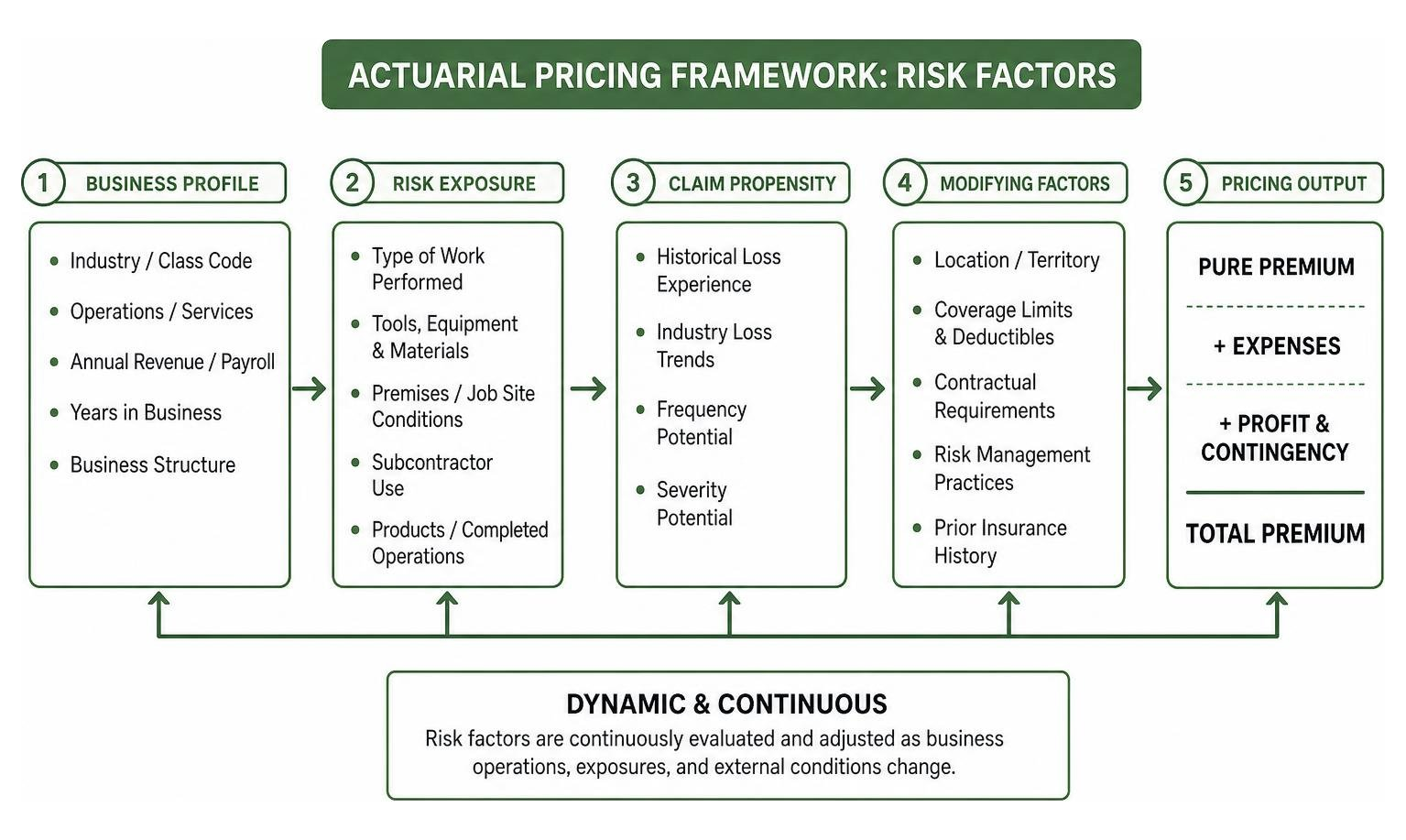
How Much Is GL Insurance for a Small Business Based on Location and Coverage Limits?
Geographic location impacts general liability costs due to variations in state legal systems, local building density, and litigation climates. States with litigious legal environments—such as New York, California, Florida, and New Jersey—often see GL premiums that are 20% to 50% higher than equivalent businesses operating in Midwest or Southern states.
Coverage limit selection also directly impacts overall pricing:
- $1M per occurrence / $2M aggregate: The standard baseline chosen by 85% of small business owners.
- $2M per occurrence / $4M aggregate: Chosen by about 8% of business owners, often mandated by high-tier corporate client contracts or commercial landlords.
Increasing coverage limits from $1M/$2M to $2M/$4M usually adds only $20 to $50 per year for low-risk businesses, or roughly 30% to 40% more for higher-risk trades. Raising your deductible from $500 to $1,000 can lower your annual premium by 5% to 15%.
Employee Headcount, Claims History, and Business Longevity
Employee headcount and annual revenue scale your general liability premiums non-linearly. As your workforce grows, foot traffic, active job sites, and potential exposure points increase:
- 1–4 employees: $123/month average GL premium.
- 5–9 employees: $330/month average GL premium (a 2.7x jump as operational risk scales).
- 10–19 employees: $872/month average GL premium.
Claims history exerts a major influence on pricing. Carriers look back 3 to 5 years at prior loss records. A single paid claim over $5,000 can add a 20% to 30% surcharge at renewal, while multiple claims can trigger surcharges of 50% or push a business into high-cost surplus lines markets. Conversely, maintaining a clean claims record for three or more years unlocks maximum tier discounts.
What General Liability Covers and Critical Exclusions
General liability insurance protects your business against fundamental third-party operational claims. It serves as financial defense when non-employees suffer physical harm or property damage due to your business activities.
Refer to General Liability Coverage Details for a comprehensive deep-dive into policy terms and conditions.
Essential Protections: Bodily Injury, Property Damage, and Advertising Rights
Standard Commercial General Liability (CGL) policies are structured around three core coverage components:
- Coverage A — Bodily Injury and Property Damage: Pays for medical expenses, structural repairs, and legal defense if a customer slips inside your store or a technician damages a client’s hardwood floor. Legal defense costs are typically paid outside policy limits, meaning attorney fees do not exhaust your coverage pool.
- Coverage B — Personal and Advertising Injury: Protects against non-physical injuries, including libel, slander, copyright infringement in marketing materials, false arrest, or wrongful eviction.
- Coverage C — Medical Payments: Covers immediate, small-dollar third-party medical expenses (usually up to $5,000 or $10,000) for injuries on your premises without requiring a formal lawsuit or fault determination.
Policy Exclusions: Workers’ Compensation, Professional Mistakes, and Property
GL insurance is not an all-in-one policy. It excludes several common risks that require dedicated policy lines:
- Employee Workplace Injuries: Excluded under GL; requires mandatory Workers’ Compensation.
- Professional Mistakes & Bad Advice: Excluded under GL; requires Professional Liability (Errors & Omissions / E&O).
- Damage to Owned Business Property: Excluded under GL; requires Commercial Property insurance.
- Business Vehicle Accidents: Excluded under GL; requires Commercial Auto insurance.
Practical Strategies to Save Money on GL Insurance
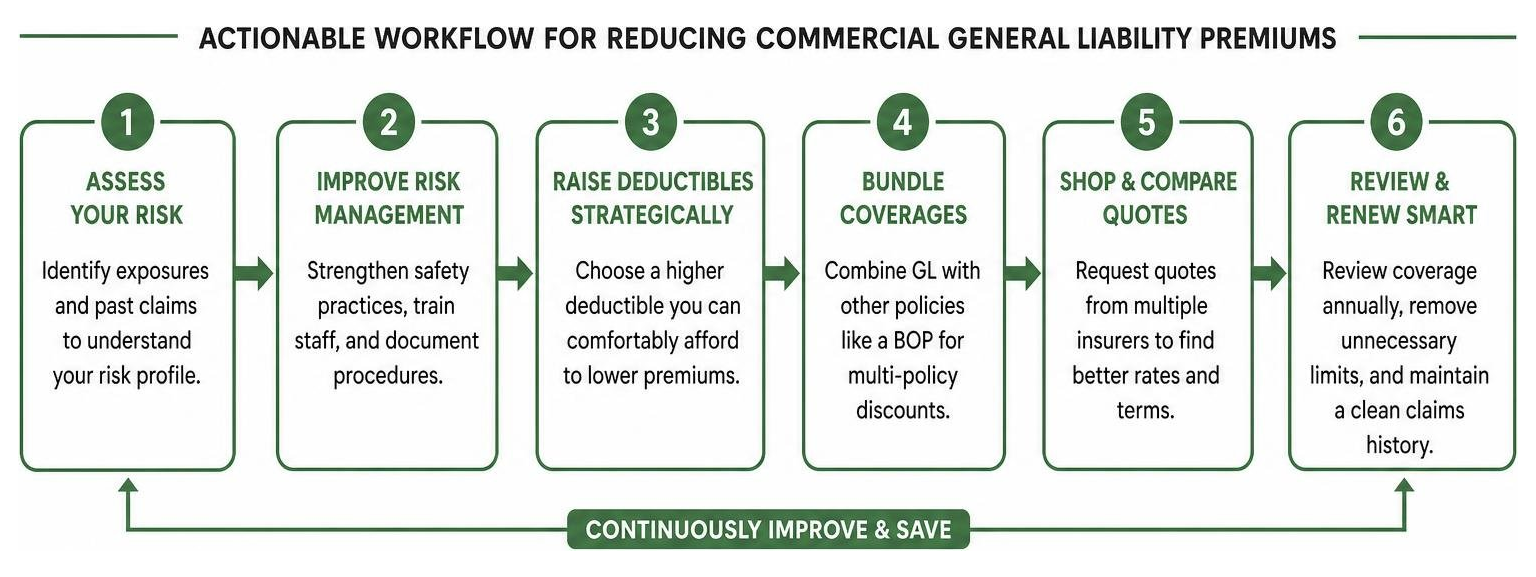
Managing commercial insurance costs requires a proactive approach. Small businesses can lower general liability premiums without compromising necessary protection.
Policy Bundling: General Liability vs Business Owner’s Policy (BOP)
If your business owns inventory, office furniture, or specialized equipment, purchasing standalone general liability insurance is often less cost-effective than bundling. A Business Owner’s Policy (BOP) combines three core coverages into a single discounted package:
- General Liability Insurance
- Commercial Property Insurance
- Business Interruption / Business Income Coverage
Buying a BOP typically costs only 10% to 25% more than standalone GL coverage while adding valuable protection for your physical assets and lost revenue during a covered shutdown. Exploring 2026 Business Insurance Cost Benchmarks provides additional insights into bundled policy savings.
Optimization Tactics: Prepayment, Class Code Audits, and Safety Programs
Here are five proven tactics we recommend to lower your annual insurance outlay:
- Pay Premiums Annually: Paying your total annual premium upfront rather than in monthly installments eliminates administrative fees and unlocks carrier prepay discounts of 5% to 10%.
- Audit NAICS / NCCI Class Codes: Ensure your agent registers your business under the correct risk classification code. Misclassifying an office-focused business under a field service code can inflate premiums by 10% to 30%.
- Raise Policy Deductibles: Increasing your out-of-pocket deductible from $500 to $1,000 or $2,500 can reduce annual premium costs by 5% to 15%.
- Enforce Workplace Safety Protocols: Implement written spill protocols, keep walkways clutter-free, and mandate safety training to prevent slip-and-fall incidents. Slip-and-falls account for roughly 20% of all small business claims, with an average claim cost of $45,000.
- Re-Quote Annually: Compare quotes across multiple carriers at renewal to ensure your policy stays competitively priced as your operations evolve.
Legal, Lease, and Contractual Requirements for Small Businesses
While no federal law mandates general liability insurance for all small businesses, operating without coverage is rarely feasible in the commercial world.

Sole Proprietors and LLCs: Compliance vs Risk Management
State contractor licensing boards (such as those in California, Florida, Oregon, and Washington) legally require general liability coverage prior to issuing or renewing trade licenses. Furthermore, commercial landlords almost universally require proof of GL insurance—typically with $1M/$2M limits—before allowing tenants to sign a lease.
Corporate clients, general contractors, and government entities also require a Certificate of Insurance (COI) listing them as an Additional Insured before issuing payments or allowing work to start. For sole proprietors who lack the asset protection of an LLC structure, general liability insurance acts as a vital firewall preventing personal bank accounts and personal property from being seized in a lawsuit.
Frequently Asked Questions About Small Business GL Costs
Is general liability insurance required by law for small businesses?
Federal law does not explicitly require general liability insurance for all businesses. However, state licensing boards frequently mandate GL coverage for trade contractors, commercial landlords require it for building leases, and enterprise clients enforce coverage terms in vendor contracts.
How does increasing deductibles impact general liability premiums?
Selecting a higher deductible (e.g., moving from $500 to $1,000 or $2,500) reduces carrier payout risk on small claims. In return, insurance companies typically discount annual premiums by 5% to 15%. Always ensure your business maintains sufficient cash reserves to cover the higher deductible if a claim arises.
Is general liability insurance tax-deductible as a business expense?
Yes. The Internal Revenue Service (IRS) categorizes commercial general liability insurance premiums as ordinary and necessary business expenses. You can deduct these premiums on Schedule C (Form 1040) for sole proprietorships and single-member LLCs, or on entity tax filings (Form 1120, 1120-S, or 1065) for corporations and partnerships.
Conclusion

Determining “How much is GL insurance for a small business?” comes down to understanding your industry risk tier, payroll, location, and chosen limits. While median benchmarks sit around $45 per month ($540 per year), low-risk consultants often pay as little as $250 annually, while high-risk contractors can expect premiums of $1,200 to $5,000+.
“https://www.mediafire.com/file/5n8x25o5epnhvah/Minimap_BY_MCMPDL.mcaddon/file“
At Aixoria, we help business leaders integrate modern tools and intelligence into their daily operations. Bundling policies into a BOP, maintaining clean job sites, auditing class codes, and paying annually allow you to secure maximum protection at the lowest possible cost.
For more insights on leveraging modern tools and technology to streamline operational growth, explore our latest guides on AI Updates.
2 thoughts on “How Much Is GL Insurance for a Small Business in 2026?”