Best Business Loan Interest Rates UK: The Quick 2026 Comparison
Scr0ll d0wn to D0VVNL0AD

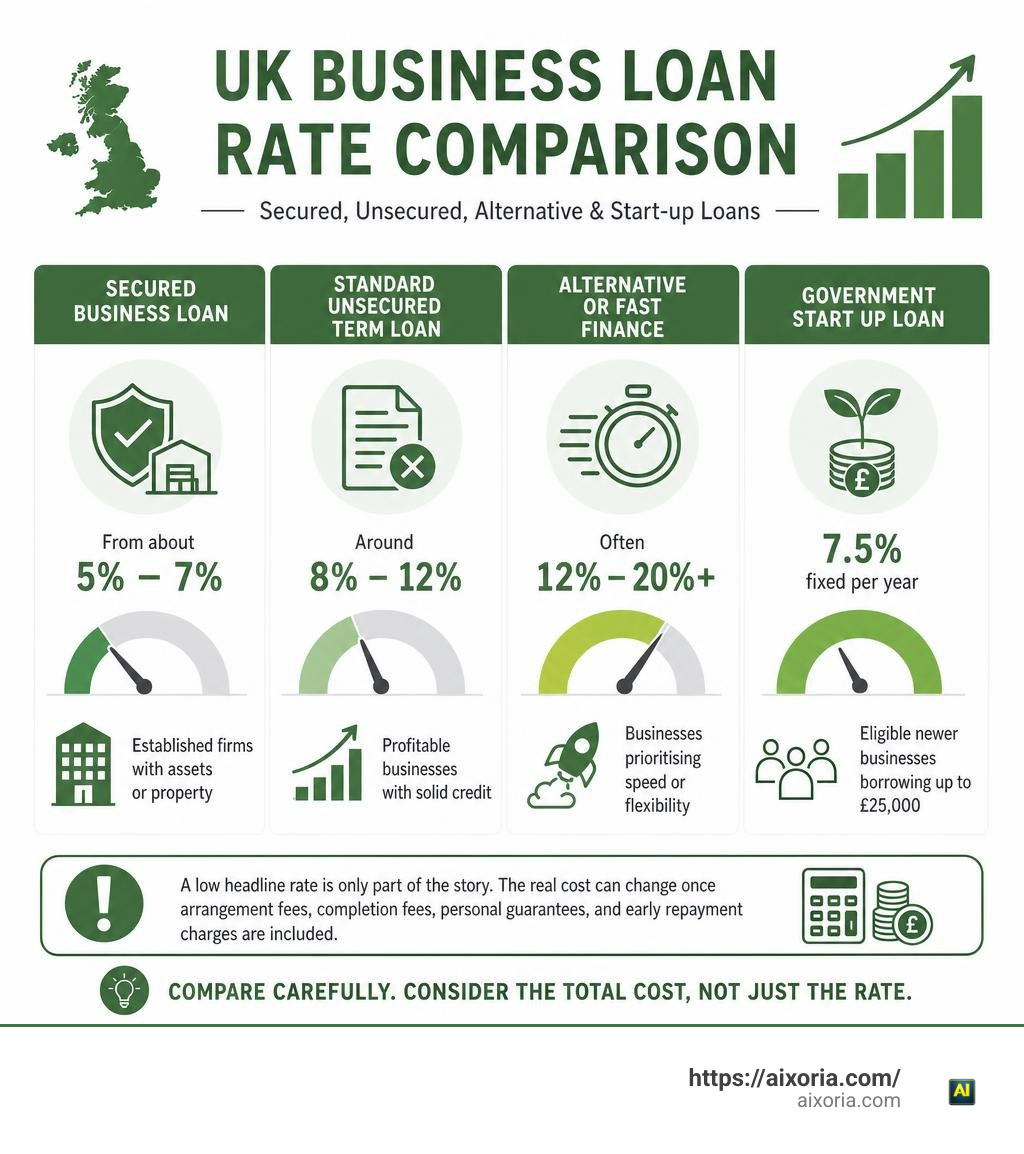
The best business loan interest rates uk borrowers can access in 2026 start at roughly 5% to 7% for strong, established businesses, usually where security is available. Most ordinary small-business borrowing sits closer to 8% to 12%, while unsecured or higher-risk finance can reach 20% or more.
For Aixoria readers, the practical question is not just which lender advertises the lowest rate. It is how well your business can use data, automation, forecasting, and AI-assisted finance workflows to present a stronger, lower-risk borrowing case. Cleaner management accounts, better cash-flow visibility, and faster document preparation can all make loan comparison more efficient.
| Loan route | Typical 2026 rate guide | Best suited to |
|---|---|---|
| Secured business loan | From about 5% to 7% | Established firms with assets or property |
| Standard unsecured term loan | Around 8% to 12% | Profitable businesses with solid credit |
| Alternative or fast finance | Often 12% to 20%+ | Businesses prioritising speed or flexibility |
| Government Start Up Loan | 7.5% fixed per year | Eligible newer businesses borrowing up to £25,000 |
A low headline rate is only part of the story. The real cost can change once arrangement fees, completion fees, personal guarantees, and early repayment charges are included.
This guide compares the numbers that matter and shows five less obvious ways to improve your chances of securing a better deal, with a particular focus on using smarter business systems and AI-supported financial planning before you apply.
What Determines the Best Business Loan Interest Rates UK in 2026?
When commercial lenders calculate interest rates in 2026, they start with external economic benchmarks and build up a custom price based on risk. The macroeconomic anchor for commercial lending in the UK remains the Bank of England (BoE) base rate. Lenders add a margin to this baseline to cover their cost of capital, operational overheads, and the likelihood of loan default.
Understanding these mechanics helps you position your enterprise to secure lower borrowing costs by monitoring live rate movements and benchmarking available options.
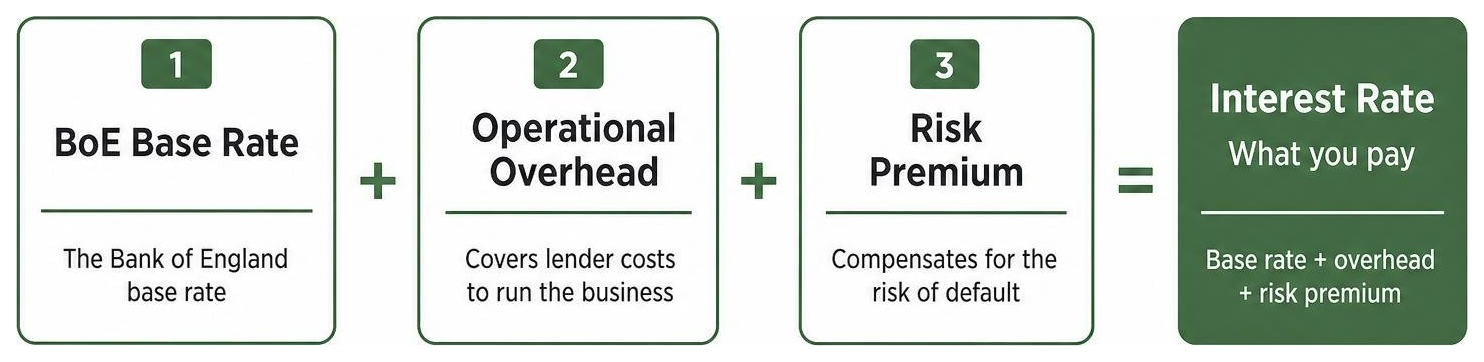
Every commercial loan evaluation boils down to three core variables:
- Base Economic Rate: The underlying wholesale cost of money set by central banking policy.
- Lender Risk Assessment: An evaluation of your company’s credit score, balance sheet strength, historical turnover, and sector volatility.
- Collateral & Security: Whether the debt is backed by tangible assets like property, equipment, or invoices, or relies solely on forward revenue.
| Borrowing Category | Typical Interest Rate Range | Average Approval Speed | Primary Qualification Criteria |
|---|---|---|---|
| Commercial Mortgages & Asset-Secured | 5.0% – 7.5% | 2 to 6 weeks | Property or high-value physical assets |
| Tier-1 Bank Unsecured Loans | 8.0% – 11.5% | 3 to 10 days | 2+ years clean trading, strong credit |
| Alternative & Fintech Term Debt | 6.9% – 18.9% | 24 to 48 hours | 12+ months trading, £50k+ turnover |
| Government-Backed Start-Up Scheme | 7.5% (Fixed) | 1 to 3 weeks | Business under 5 years old, viable plan |
High-Street Banks vs Alternative Lenders
Traditional high-street institutions offer some of the most competitive headline interest rates in the market. Established UK banks routinely advertise representative Annual Percentage Rates (APR) between 8% and 12% for small-business facilities. For instance, structured small-business loans up to £25,000 frequently feature fixed pricing tiers, providing predictable monthly costs.
However, high-street underwriting relies heavily on strict credit scoring matrices and rigid balance sheet requirements. Applications can take anywhere from several business days to a few weeks to complete, especially if manual underwriting is triggered.
Alternative commercial lenders and marketplace platforms offer speed and underwriting flexibility. Leading marketplace platforms provide fixed interest rates starting from 6.9% per year for top-tier limited companies. Unsecured specialist lenders cater to broader credit profiles with representative APRs around 18.9% (and indicative monthly interest starting from 0.9%). While alternative lenders deliver decision turnaround times within 1 to 24 hours, their rates scale upward depending on the risk band assigned to your business.
Secured vs Unsecured Business Loan Rate Ranges
The presence or absence of physical security creates a distinct divergence in commercial interest rates:
- Secured Business Loans: By pledging commercial property, high-value machinery, or land as collateral, you absorb much of the lender’s risk. As a result, secured commercial rates generally start between 5% and 7.5%. Because legal conveyancing, asset valuations, and registry charges are required, setup takes longer, but the savings on multi-year interest can be substantial.
- Unsecured Business Loans: Unsecured facilities require no tangible physical collateral, meaning approval hinges entirely on trading health, cash-flow stability, and credit history. Unsecured rates generally span from 8% to 20%+.
5 Clever Ways to Find Lower Commercial Loan Rates
Securing the best business loan interest rates uk market standards offer requires moving beyond standard price-comparison searches. The strongest applications usually combine sound financial management with clear evidence that the business can monitor cash flow, control costs, and repay debt reliably.
That is where modern software and AI-enabled productivity workflows become useful. They can help business owners prepare cleaner numbers, test repayment scenarios, and spot risk factors before an underwriter does.
Method 1: Auditing High-Street vs Alternative Lenders for the Best Business Loan Interest Rates UK
To uncover true borrowing costs, look past headline APRs and audit how institutions tier their interest rates and structure arrangement fees. High-street banks often implement multi-tiered pricing matrices. For example, institutional lenders frequently offer a two-tier representative APR structure on unsecured small-business loans: 11.3% representative APR on amounts up to £10,000, which drops down to 8.6% representative APR for borrowing between £10,001 and £25,000.
By auditing these thresholds, you can spot situations where borrowing a slightly higher figure lowers your overall interest rate enough to reduce total interest costs.
Additionally, pay attention to origination and completion fees. An alternative lender charging a 6.9% rate alongside a 5% upfront completion fee may prove more expensive overall than a bank offering an 8.6% APR with zero arrangement fees.
Method 2: Utilizing AI Cash-Flow Modeling to Access the Best Business Loan Interest Rates UK
Lenders set their risk premiums based on how confident they are in your future cash flow. Traditional application packages rely on historical, rear-view financial statements that may not capture your true trading trajectory.
AI cash-flow modeling and automated predictive accounting tools can help you build more useful forward-looking financial reports. By combining bank feed data, recurring contract pipelines, customer concentration metrics, cost trends, and seasonal revenue cycles, you can create a clearer view of repayment capacity before you approach a lender.
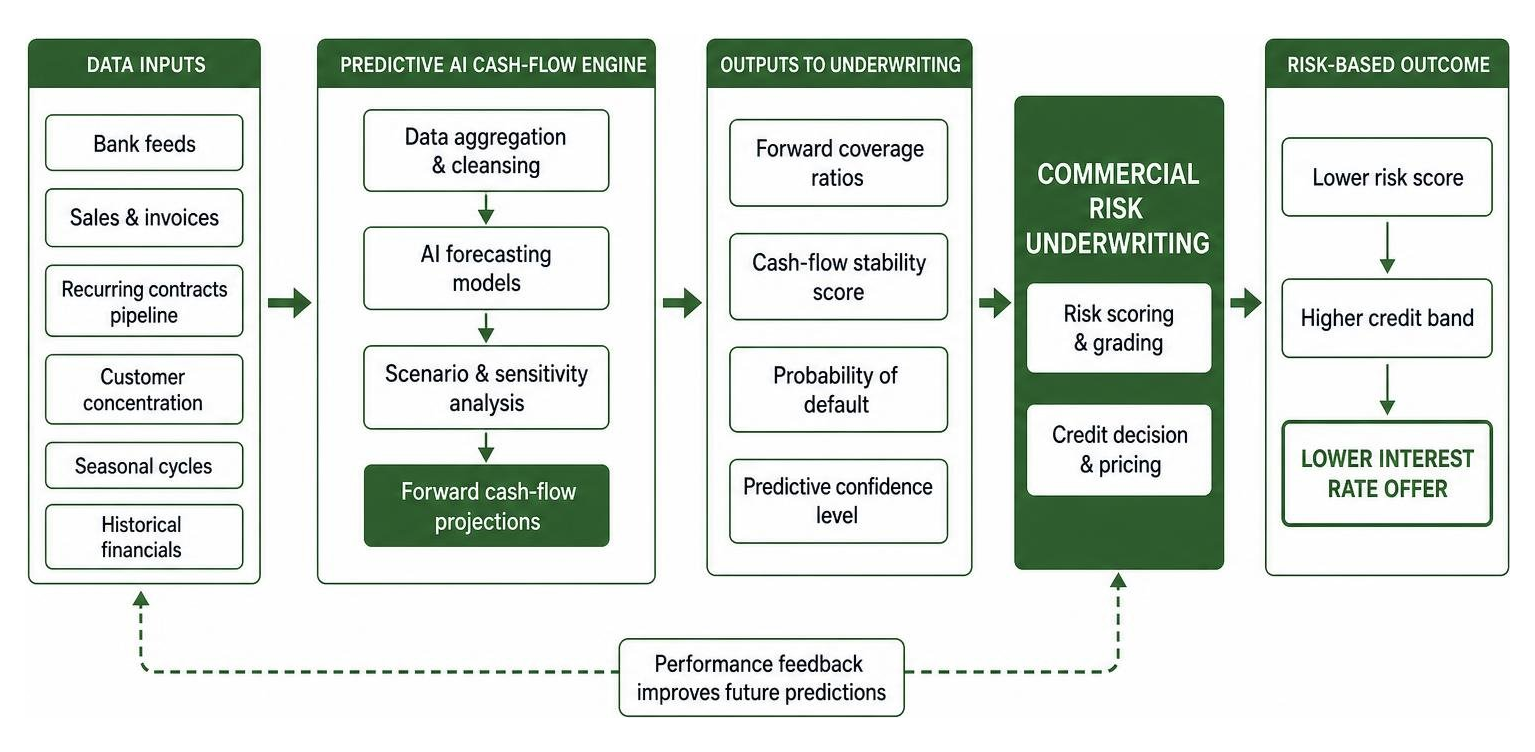
This does not guarantee approval or a lower rate, but it can improve the quality of the evidence you provide. When an underwriting system or human analyst sees consistent cash-flow forecasts, documented assumptions, and realistic downside scenarios, your application may look less risky. Lower perceived risk can help unlock stronger internal credit bands and reduce the margin added to your interest rate quote.
Method 3: Leveraging Government-Backed Schemes and Startup Funding
If your enterprise has been actively trading for under five years, commercial bank rates can reflect a high startup risk premium. You can bypass commercial risk pricing by utilizing government-backed funding programs designed specifically to expand access to capital.
The official UK Start Up Loans scheme, managed under the British Business Bank, provides unsecured personal loans for business purposes ranging from £500 to £25,000 per founder (up to £100,000 per business entity for multiple partners).
Key features of this program include:
- Fixed Rate Certainty: A statutory fixed interest rate of 7.5% per annum.
- Broadened Eligibility: Available to businesses trading for up to 60 months (5 years).
- No Early Fees: Zero setup fees and no early repayment penalties.
- Mentoring: Includes 12 months of free post-approval business mentoring.
For established businesses, government-backed facilities like the Growth Guarantee Scheme provide lenders with a partial credit guarantee. This guarantee lowers the lender’s exposure, allowing participating banks to offer lower rates and reduced collateral demands than they would on standard commercial terms.
Method 4: Calculating Total Cost of Borrowing Beyond Headline APR
Focusing solely on headline rate quotes can conceal significant operational costs. To calculate the true financial commitment of a facility, you must evaluate all underlying fee structures:
- Arrangement and Completion Fees: Charged upfront or added to the loan balance, typically ranging from 1% to 6% of the principal sum.
- Flat Rates vs True APR: A headline flat rate of 1% per month sounds low, but because interest is calculated on the original balance rather than the reducing principal, a 1% monthly flat rate translates to an effective annual cost of roughly 12% to 22% APR.
- Early Repayment Charges (ERCs): Fixed-rate commercial term facilities often include breakage costs if settled early. For long-term corporate debt, breakage fees can scale based on remaining duration.
Always calculate the total repayable sum (Principal + Cumulative Interest + Setup Fees + Ongoing Administration Fees) across the full term to verify which loan offer delivers the lowest absolute cost. A spreadsheet, accounting platform, or AI-assisted finance model can make this easier by comparing repayment schedules side by side and highlighting the impact of fees.
Method 5: Strategic Timing Around Economic Cycles and Base Rate Shifts
The timing of your loan application relative to economic trends can impact your long-term interest costs. With the Bank of England base rate sitting at 3.75% (following cuts down from earlier high levels), timing your market entry is crucial.
When central bank interest rates are expected to fall, choosing a variable-rate facility or a short-term term loan allows your interest charges to track downward automatically. Conversely, when economic indicators hint at rate increases, locking in a multi-year fixed rate shields your cash flows from rising debt costs.
You can inspect structured options tracking central bank shifts when evaluating variable-rate facilities. Many variable facilities include a rate floor provision – agreements stating that even if central rates drop below zero, your borrowing rate will not fall below the bank’s base margin fee.
Credit Scores, Trading History, and Personal Guarantees

A commercial lender’s risk department assesses three primary indicators to determine your interest rate: credit scores, historical balance sheets, and director guarantees.
Improving Acceptance Odds and Risk Profiling
Before submitting a formal loan application, take these proactive steps to optimize your credit profile and improve your chances of securing lower rates:
- Audit Credit Profiles: Pull reports from major UK credit reference agencies (Experian, Equifax, CreditSafe) for both your corporate entity and all directors holding over 25% equity. Correct any address discrepancies, outdated notices of disassociation, or filing errors.
- Clean Up Bank Statements: Lenders typically review 3 to 8 months of recent business bank statements. Minimize unarranged overdraft events, late payment fees, or returned direct debits, as these red flags immediately push your application into higher interest rate brackets.
- File Filings on Time: Ensure all annual accounts, Confirmation Statements, and HMRC tax submissions (VAT, Corporation Tax, PAYE) are fully up to date on Companies House. Delayed filings signal operational instability to automated underwriting engines.
- Leverage Soft Credit Searches: Check your initial rate options using soft credit checks. Soft searches allow you to view indicative quotes without placing hard inquiries on your credit profile, protecting your credit score while you shop around.
Fixed-Rate vs Variable-Rate Commercial Mechanics
Choosing between fixed and variable interest structures involves trade-offs between cash-flow predictability and repayment flexibility:
- Fixed-Rate Commercial Loans: Lock in exact monthly repayment amounts for the duration of the term (typically 1 to 10 years). This shields your cash flow against interest rate increases. However, if market rates drop, your repayments remain fixed, and paying off the facility early often incurs breakage costs.
- Variable-Rate Commercial Loans: Track the lender’s base lending rate or the Bank of England base rate. If base rates fall, your monthly interest obligations decrease. They also generally offer more flexible overpayment options without steep early settlement penalties. The main drawback is vulnerability to economic spikes that can raise your monthly repayment costs.
For specialized borrowing structures—such as merchant cash advances pricing off fixed factor rates or revolving lines of credit—you can explore Specialty Business Finance Products, FundBiz.
Frequently Asked Questions
What are the typical business loan interest rates in the UK for 2026?
In 2026, typical UK business loan interest rates range between 5% and 20%.
Low-risk, asset-secured commercial loans from high-street banks start from around 5% to 7.5%. Standard unsecured term loans for established, profitable SMEs typically range from 8% to 12%. Unsecured facilities from alternative fintech lenders or higher-risk profile loans generally cost between 12% and 20%+.
What is the difference between APR, representative APR, and flat rate?
Understanding how lenders express interest is essential for accurate cost comparisons:
- APR (Annual Percentage Rate): Reflects the total annualized cost of borrowing, incorporating both the baseline interest rate and mandatory setup or arrangement fees.
- Representative APR: The headline rate that a lender is legally required to grant to at least 51% of approved applicants. Your individual quote may be higher based on your risk profile.
- Flat Interest Rate: Calculates interest on the full original loan amount throughout the term, ignoring capital repaid along the way. A flat rate of 6% is roughly equivalent to an APR of 11% to 12%.
Can a new start-up get a low interest business loan?
Yes, new start-ups can access competitive interest rates by using government-backed loan programs rather than standard commercial bank facilities.
The UK Government Start Up Loan scheme provides unsecured borrowing up to £25,000 per founder at a statutory fixed rate of 7.5% per annum. Because eligibility applies to businesses trading for up to 60 months (5 years), it offers newer enterprises an affordable alternative to high-cost credit cards or variable overdrafts.
Conclusion

Finding the best business loan interest rates uk market providers offer comes down to looking beyond headline rate quotes. By auditing pricing tiers, maintaining clean credit files, factoring in setup fees, and using modern cash-flow modeling tools, you can reduce your overall borrowing costs.
https://www.mediafire.com/file/2l7pzagyetqpvm0/Backpacks%252B%252B_3.0_BY_MCMPDL.mcaddon/file”
For businesses exploring AI productivity through Aixoria, the wider lesson is that better operational systems can support better financial decisions. Automated reporting, forecasting, document preparation, and scenario planning can help you approach funding conversations with clearer evidence and fewer surprises.
Loan interest and arrangement fees are tax-deductible business expenses in the UK (though the principal loan sum is not). Match your borrowing structure carefully to your commercial cash-flow cycles, select terms that fit your long-term plans, and optimize your business profile before applying.
To learn how advanced software tools and predictive models can streamline your business operations and cash-flow management, Discover top AI productivity tools for 2026.
This answered my questions. Also recommend Happy Shrimp: / for AI music studio workflows.. Happy Shrimp