Banks That Give Home Equity Loans With Bad Credit: A Quick Answer
Scr0ll d0wn to D0VVNL0AD

Banks that give home equity loans with bad credit do exist, but choices become limited once your credit score falls below 640. Some lenders may consider scores around 620, while a smaller group of online and alternative lenders advertise HELOC options starting near 600. Approval still depends heavily on your home equity, income, debt-to-income ratio, and payment history.
| Credit score range | What to expect |
|---|---|
| 660+ | More traditional banks and credit unions may be available |
| 620-659 | Some lenders may approve applicants with strong equity and low debt |
| 600-619 | Options are usually limited to select online, portfolio, or alternative lenders |
| Below 600 | Financing may be possible, but it often comes with high rates, stricter terms, and greater risk |
A low score does not automatically mean “no.” It usually means you may borrow less, pay more interest, or need to leave more equity in your home. Because a home equity loan or HELOC is secured by your house, the stakes are high: missed payments can put your home at risk.
This guide explains where to look, what lenders review beyond your score, and how to compare home equity borrowing options without taking on more risk than your budget can handle.
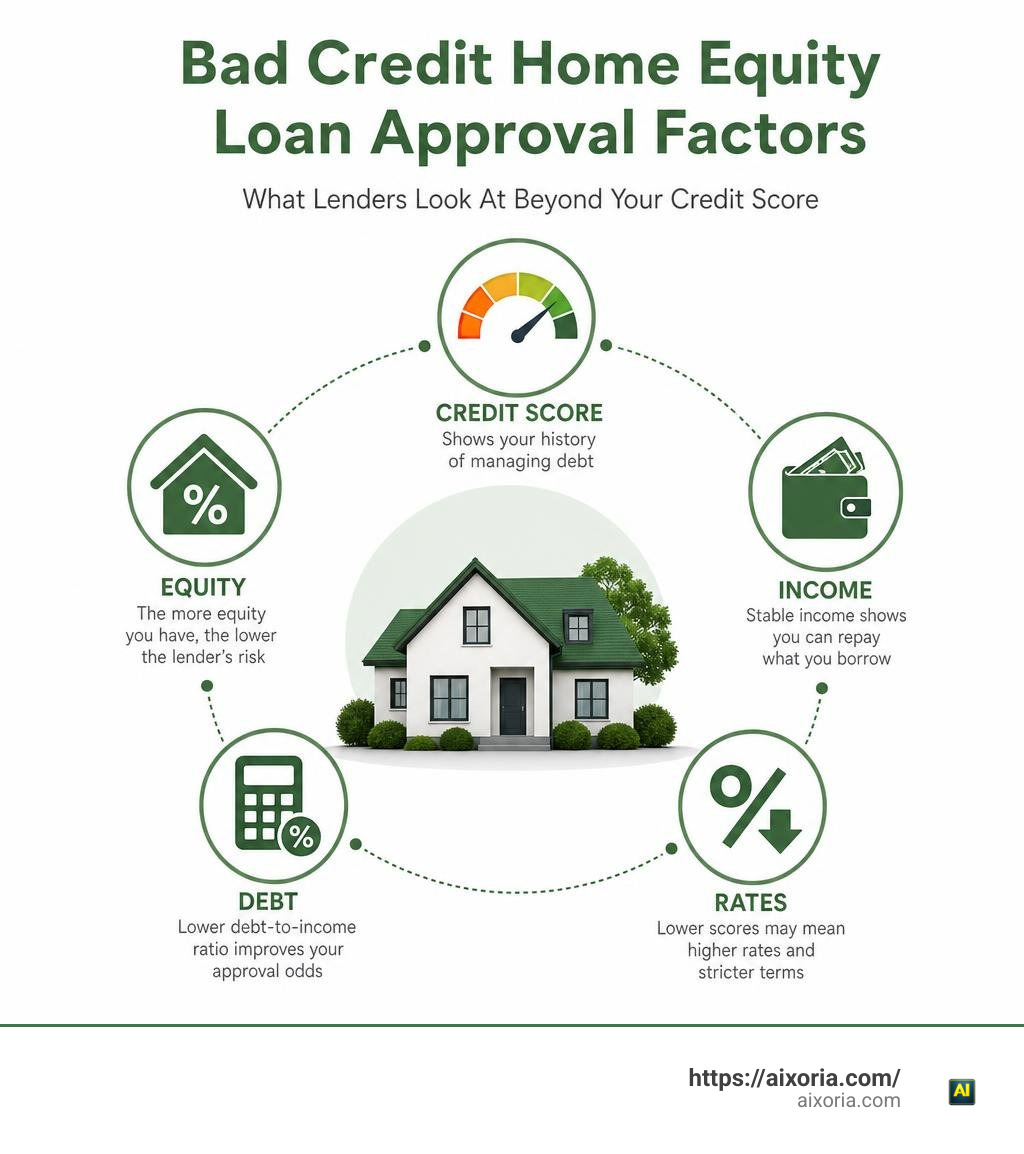
How Credit Scores Impact Home Equity Borrowing
When we look at home equity borrowing, credit scores act as the primary gauge of financial risk. A credit score reflects how reliably you have managed debt in the past. When you apply for a second mortgage, such as a closed-end home equity loan or a home equity line of credit (HELOC), the lender assumes what is known as a “second-lien position.” If you ever default on your payments and the property goes into foreclosure, the primary mortgage lender gets paid first. The second mortgage lender gets whatever remains.
Because of this increased exposure, lenders treat credit scores with heightened scrutiny. Understanding how your credit tier influences underwriting criteria allows us to prepare a far more effective loan application.
Credit Score Thresholds and Pricing Tiers
Credit scoring models range from 300 to 850. In the current lending environment of 2026, traditional financial institutions divide applicants into distinct credit tiers that dictate interest rates and eligibility:
- Excellent (740 – 850): Applicants receive the lowest APRs, maximum borrowing limits, and minimal documentation hassles.
- Good (670 – 739): Applicants easily satisfy standard institutional benchmarks.
- Fair (580 – 669): This is where institutional policies diverge sharply. While some banks draw a hard line at 660, specialized lenders will work with scores between 600 and 640.
- Poor (300 – 579): Traditional bank approvals are non-existent. Access to home equity requires specialized non-QM programs or hard money options.
Lenders charge risk premiums on lower scores. For example, a borrower with a 740 FICO score seeking a $50,000 home equity loan might receive a 7.5% APR. A borrower with a 620 score taking out the exact same loan amount might face an APR of 11% or higher. Over a 15-year repayment term, that interest rate premium can add thousands of dollars to the total borrowing cost.
Impact on Loan Amounts and Terms
A low credit score directly restricts how much money you can unlock from your residence. Lenders limit their exposure by adjusting the Combined Loan-to-Value (CLTV) ratio.
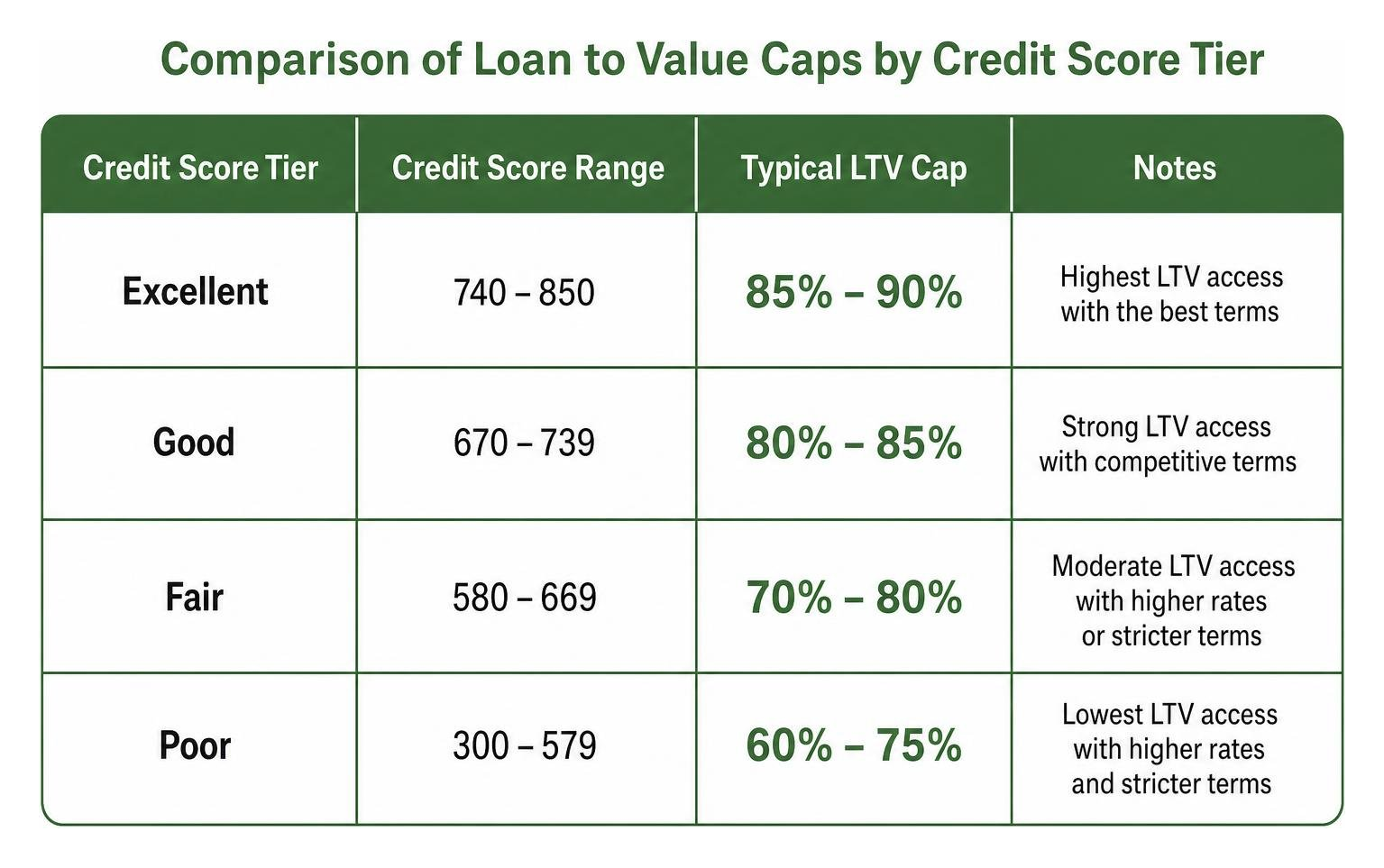
While a borrower with a 740 credit score can often access up to 85% or 90% CLTV, bad credit borrowers are frequently capped at 70% to 75% CLTV. Furthermore, lenders may impose additional loan conditions, such as:
- Mandatory Initial Draws: Some bad-credit HELOC lenders require you to draw 75% to 100% of your approved credit line immediately at closing.
- Shorter Term Options: Rather than 30-year terms, lower-credit borrowers are often restricted to 10-year or 15-year repayment schedules.
- Higher Origination Fees: Closing costs for bad-credit home equity products usually range from 3% to 6% of the loan amount, covering elevated manual underwriting costs.
Finding Banks That Give Home Equity Loans with Bad Credit
Locating financial institutions willing to approve a home equity loan with a fair or poor credit score requires looking beyond major commercial bank branches. Different lender categories follow entirely different risk frameworks.
Traditional vs. Credit Union Banks That Give Home Equity Loans with Bad Credit
Major national commercial banks maintain rigid institutional credit floors. For example, many major banks generally enforce a minimum credit score requirement of 660 for home equity products, while some large mortgage institutions require a 680 baseline. Specialty digital banks may also require a minimum 680 FICO score for standard second mortgage offerings.
However, regional commercial banks and credit unions are far more flexible. Certain regional banks accept home equity loan and HELOC applications down to a 620 credit score, while select credit unions evaluate applicants starting at 640.
Credit unions and portfolio banks are unique because they often hold loans on their own balance sheets rather than bundling and selling them on the secondary market. This allows them to use manual underwriting. If you have an established checking, savings, or primary mortgage relationship with a regional bank or credit union, they may weigh your positive account history against a temporary credit score dip.
To dive deeper into standard qualification steps across top institutions, review standard home equity guidelines and requirements before submitting your application.
Alternative Financial Institutions and Banks That Give Home Equity Loans with Bad Credit
When credit scores drop below 620, alternative, digital, and non-QM (non-qualified mortgage) lenders provide viable financing pathways:
- Digital Lending Platforms: Specialized fintech platforms approve online HELOC applications for borrowers with credit scores down to 600.
- Specialized Equity Lenders: Niche home equity lenders offer tailored second mortgages and renovation-focused equity products for scores between 620 and 640.
- Non-QM and Bank Statement Lenders: Non-QM lenders consider credit scores down to 580 when backed by strong compensating factors. For self-employed individuals, bank statement loan programs utilize 12 to 24 months of personal or business bank statements to document cash flow rather than relying on tax returns.
- Hard Money Lenders: For severely damaged credit (FICO scores from 500 to 579), hard money lenders provide short-term second liens. These loans rely almost entirely on available equity—often requiring 50% or more untouched equity—and carry steep interest rates (11% to 15%+).
Borrowers looking to review direct lender qualification guidelines should compare closed-end loan requirements across multiple specialized non-QM lenders.
Home Equity Loan vs. HELOC: Choosing the Right Option
When searching for banks that give home equity loans with bad credit, deciding between a closed-end Home Equity Loan (HELOAN) and a Home Equity Line of Credit (HELOC) is critical. Each product has distinct pricing mechanisms and underwriting behaviors.
| Feature | Home Equity Loan (HELOAN) | Home Equity Line of Credit (HELOC) |
|---|---|---|
| Payout Structure | Single lump-sum distribution | Revolving credit line |
| Interest Rate | Fixed APR for the life of the loan | Variable rate tied to Prime |
| Monthly Payment | Predictable, fixed monthly amount | Fluctuates based on balance & rates |
| Min. Credit Score | Typically 620 (Select non-QM down to 580) | Typically 640 (Select fintech down to 600) |
| Underwriting Ease | Easier for bad credit due to fixed risk | Harder due to interest rate volatility |
| Best Used For | Debt consolidation, one-time renovations | Ongoing expenses, emergency reserves |
Why Home Equity Loans Are Often Easier to Secure
For borrowers navigating lower credit scores, a traditional home equity loan is usually easier to get approved for than a HELOC. Because a home equity loan delivers a fixed interest rate and a set principal-and-interest payment schedule over 10 to 30 years, underwriting algorithms can calculate your exact Debt-to-Income (DTI) ratio without accounting for future interest rate increases.
Lenders know that variable-rate products create payment shock when interest rates rise. A bad-credit applicant is statistically more vulnerable to default when monthly obligations jump unpredictably. A fixed-rate home equity loan eliminates rate volatility risk for both you and the bank.
Qualification Differences for Low Credit HELOCs
While HELOCs offer the flexibility of drawing cash as needed, low-credit applicants face stricter approval hurdles:
- Stress-Tested Rate Calculations: Lenders evaluate your DTI ratio using a hypothetical interest rate higher than the current variable APR to ensure you can absorb rate increases.
- Credit Utilization Tracking: Unlike fixed loans, HELOC balances represent revolving credit. While FICO scoring models treat HELOCs as installment debt, VantageScore models may treat them as revolving debt, which can heavily impact your credit utilization metrics.
If you are evaluating specialized fixed-rate solutions, compare tailored programs offered by non-QM and specialty home equity lenders.
Key Qualification Requirements and Compensating Factors
When your credit score sits in the fair or poor range, lenders do not automatically deny your application. Instead, they look for compensating factors—strengths in your broader financial profile that offset the elevated credit risk.
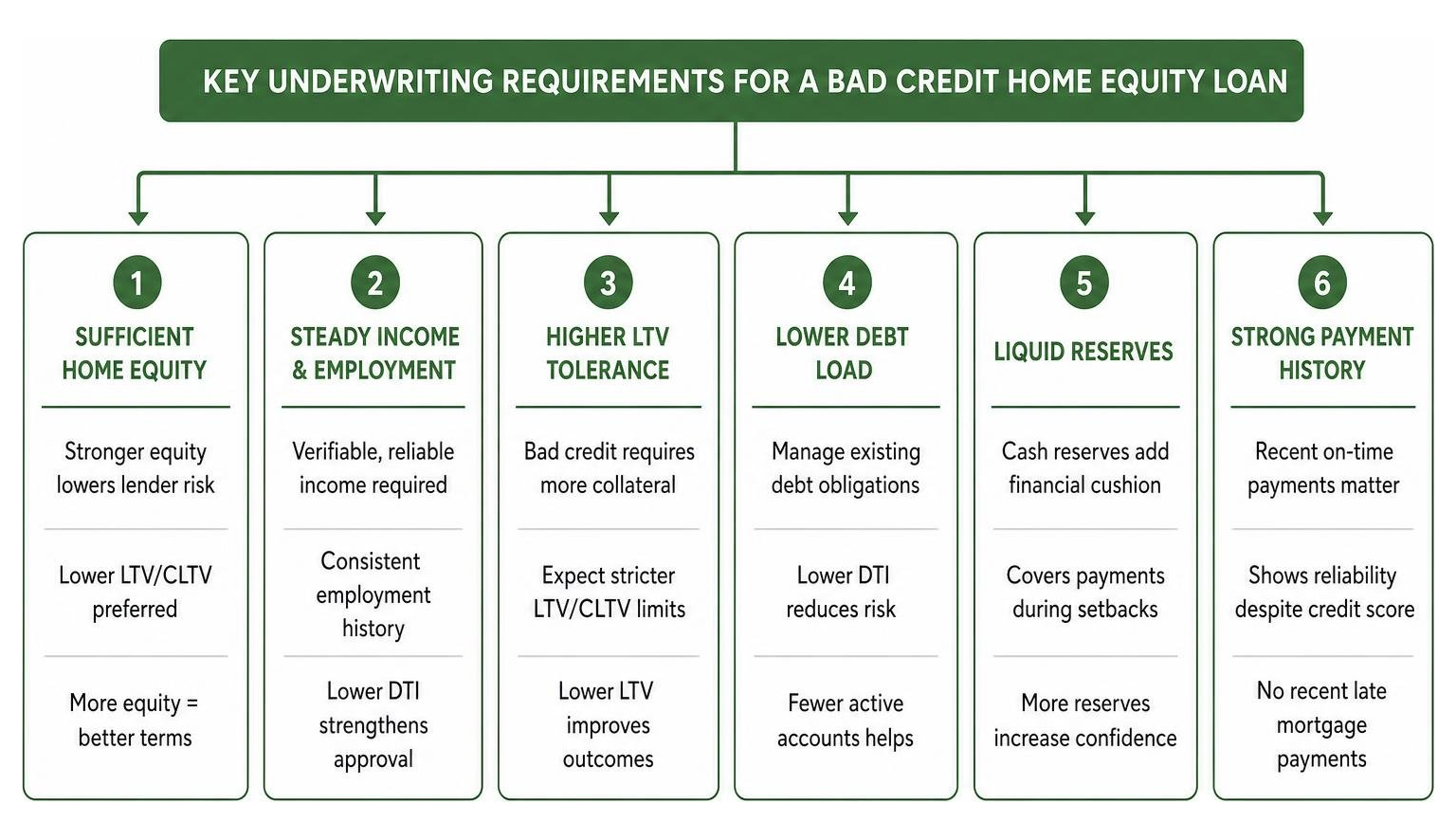
Equity and Loan-to-Value (LTV) Thresholds
Equity is your strongest leverage point when bad credit is involved. Usable home equity represents the difference between your property’s current appraised market value and the balance of all outstanding mortgages.
To calculate your Combined Loan-to-Value (CLTV) ratio:
$$\text{CLTV} = \frac{\text{Primary Mortgage Balance} + \text{Requested Second Loan}}{\text{Appraised Home Value}} \times 100$$
For example, if your home appraises at $400,000, your primary mortgage balance is $200,000, and you request a $40,000 home equity loan, your total debt is $240,000. Dividing $240,000 by $400,000 gives a CLTV of 60%.
Because standard bad-credit guidelines cap maximum CLTV between 70% and 75%, having substantial built-in equity reassures the bank that their secondary lien is fully backed by property value.
Debt-to-Income Ratio and Liquid Reserves
Your Debt-to-Income (DTI) ratio measures the percentage of your gross monthly income dedicated to paying recurring monthly debts (housing, credit cards, auto loans, personal loans).
$$\text{DTI} = \frac{\text{Total Monthly Debt Payments}}{\text{Gross Monthly Income}} \times 100$$
While prime borrowers can obtain approvals with DTI ratios up to 45% or 50%, bad credit applicants are often required to maintain a DTI below 43%. A lower DTI proves you have enough disposable monthly income to absorb the new loan payment.
Additionally, lenders like to see liquid cash reserves—money remaining in checking, savings, or investment accounts after closing. Possessing 3 to 6 months of mortgage payments in liquid reserves serves as an excellent compensating factor.
Actionable Steps to Improve Approval Odds
Securing a second mortgage with bad credit requires a proactive strategy. By taking targeted steps prior to submitting an official application, we can improve our borrowing profile.
Credit Repair and Debt Reduction Strategies
- Audit Your Credit Reports: Download your free credit reports from AnnualCreditReport.com. Check all three bureaus (Equifax, Experian, TransUnion) for inaccuracies, such as incorrect late payment reports, paid debts listed as unpaid, or fraudulent accounts. Dispute mistakes immediately to see a fast score boost.
- Pay Down High-Utilization Credit Cards: Credit utilization accounts for 30% of your FICO score. Paying down credit card balances below 30% and ideally below 10% of individual card limits can raise your score significantly within 30 to 60 days.
- Avoid Opening New Unsecured Credit: Do not apply for new credit cards or store financing in the months leading up to your home equity application. Hard inquiries temporarily lower your score.
Strengthening Your Application Package
- Apply with a Creditworthy Co-Borrower: Adding a spouse or co-applicant with a high credit score and stable income can lower the lender’s risk profile, helping you qualify for better rates.
- Write a Letter of Explanation: If your credit score dropped due to an isolated life event (such as unexpected medical bills, job loss, or divorce), draft a concise letter detailing the event, showing that the hardship has resolved, and demonstrating your current financial stability.
- Demonstrate Income Stability: Gather tax returns, W-2s, 1099s, or recent bank statements to verify steady income streams.
Risks, Costs, and Alternative Financing Options
Tapping equity with bad credit involves serious financial commitments. Before moving forward, you must weigh the inherent risks against alternative restructuring strategies.

Essential Application Documents
Preparing a comprehensive document folder speeds up manual underwriting:
- Two years of W-2 statements or 1099 forms
- Two years of filed federal tax returns (full schedules)
- 30 to 60 days of consecutive paystubs
- Two to three months of complete bank account statements
- Most recent primary mortgage statement showing current balance and payment status
- Property tax statement and current homeowner’s insurance policy declarations page
- Formal letter of explanation regarding credit delinquencies (if applicable)
Evaluating Alternatives to Second Mortgages
If banks that give home equity loans with bad credit offer unfavorable terms or high interest rates, consider these alternative strategies:
- Cash-Out Refinance: Replacing your primary mortgage with a larger mortgage allows you to take out cash in a single first-lien transaction. Government-backed programs like FHA cash-out refinances permit credit scores down to 580 with a maximum 80% LTV.
- Debt Restructuring Solutions: Specialized consolidation programs evaluate your “blended debt rate”—the weighted average interest across all your credit cards, auto loans, and mortgages—to consolidate high-cost debt without resetting attractive primary mortgage rates.
- Personal Loans: While interest rates on bad-credit personal loans can reach up to 36%, personal loans are unsecured. If you default on a personal loan, your home is not at immediate risk of foreclosure.
Frequently Asked Questions About Bad Credit Home Equity Loans
Can I get a home equity loan with a credit score below 600?
Yes, but options are limited. Traditional banks will not approve home equity loans below 600 FICO. However, non-QM lenders may consider scores down to 580 if you have a low DTI ratio and substantial equity. For credit scores between 500 and 579, hard money lenders offer equity financing, but these loans require at least 50% equity and carry high interest rates and origination fees.
Will taking out a home equity loan hurt my credit score?
In the short term, applying generates a hard credit inquiry, which may drop your score by a few points. Additionally, adding a new debt balance increases your total debt load. However, over the long term, making on-time monthly payments builds a positive payment history. If you use the proceeds to pay off high-interest credit card debt, your credit utilization ratio drops, which can quickly boost your credit score.
What happens if I am denied a home equity loan due to bad credit?
If your application is denied, the lender is required by law to issue an Adverse Action Notice detailing the exact reasons for denial. Review these reasons carefully. You can focus on lowering your DTI ratio, paying off revolving debts, disputing credit report errors, or letting your credit age for 6 to 12 months before reapplying with portfolio lenders or credit unions.
“https://www.mediafire.com/file/c8pa19iwmq2the6/Roads_%252B_BY_MCMPDL.mcaddon/file“;
Conclusion
Securing equity financing with a lower credit score is manageable when you approach the market strategically. While traditional commercial banks often enforce strict credit floors, alternative institutions, regional credit unions, non-QM programs, and digital lenders offer viable pathways to approval.
By maintaining high home equity, keeping your debt-to-income ratio low, and presenting a well-documented application, you can unlock your home’s equity to achieve your long-term goals. To discover how modern tools and data-driven insights are shaping smarter financial decisions, explore the latest insights on financial technology and updates.