How to Find the Best Place to Get a Personal Loan
Scr0ll d0wn to D0VVNL0AD

The best place to get a personal loan depends on your credit, how much you need, and how quickly you need the money. For most borrowers, the smart first move is to compare personalized offers from online lenders, banks, and credit unions using soft-credit prequalification.
| Your priority | Often worth comparing first |
|---|---|
| Lowest possible APR | Credit unions, banks where you already have an account, and online lenders |
| Funding fast | Online lenders and banks offering same-day or next-business-day deposits |
| Fair or limited credit | Lenders that use broader approval criteria or allow a co-borrower |
| Small loan amount | Credit unions and lenders with low minimum loan sizes |
| Large loan amount | Banks and online lenders with higher borrowing limits |
| Debt consolidation | Lenders with direct creditor-pay options and no prepayment penalty |
A personal loan gives you one lump sum and a fixed repayment schedule. That can make it useful for consolidating expensive credit card debt, paying a medical bill, or handling a major repair. But advertised rates are usually reserved for highly qualified borrowers. Your actual APR can vary widely based on your credit profile, income, debt, loan term, and fees.
The right choice is not always the lender with the lowest starting rate. A loan with no origination fee, a shorter payoff term, flexible funding speed, and a payment you can reliably afford may cost less overall.
This guide will help you compare the major borrowing options, understand the real cost behind APRs and fees, and know what to expect before you apply.
Comparing Lenders to Find the Best Place to Get a Personal Loan
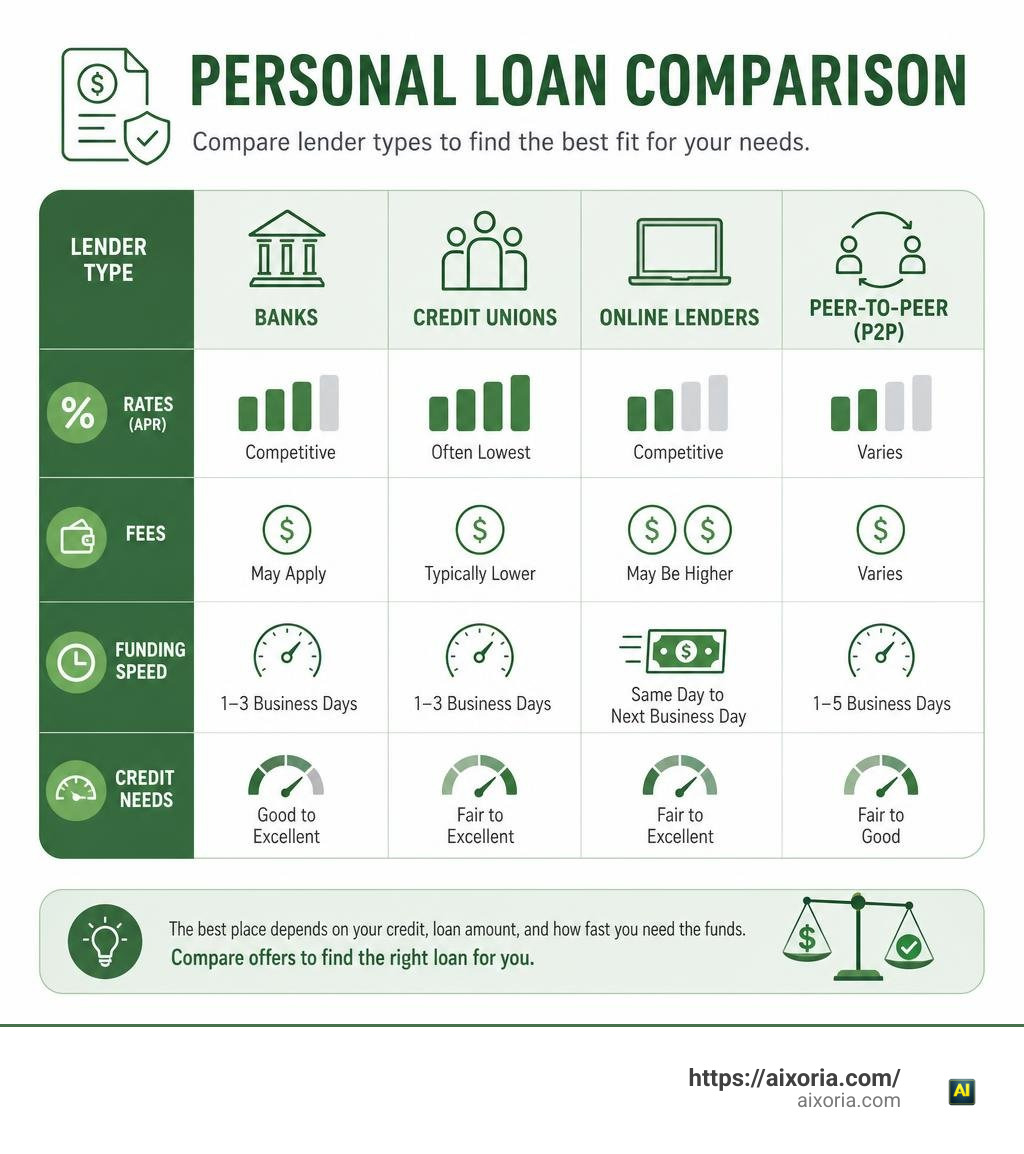
When we search for the best place to get a personal loan, we quickly realize that no single financial institution holds a monopoly on great terms. The borrowing landscape in 2026 spans traditional national banks, local credit unions, online-only lenders, and peer-to-peer (P2P) platforms. Each category comes with distinct advantages tailored to specific financial profiles.
To narrow down your choices, it helps to understand how these four primary lender categories function:
- Online Lenders: Known for fast digital applications, automated underwriting, and swift funding timelines. Online lenders cater to a wide spectrum of credit scores. Some specialize in bad credit financing, while others focus on zero-fee loans for high earners.
- Traditional Banks: Ideal for borrowers who already maintain an active banking relationship. Major traditional banks offer competitive rates, large loan limits up to $100,000, and relationship discounts. However, traditional banks often enforce strict eligibility guidelines, such as requiring applicants to be an existing customer for at least 12 months.
- Credit Unions: Member-owned institutions frequently offer lower interest rate caps (often capped at 18% APR by federal regulations for federally chartered credit unions) and smaller minimum borrowing amounts, starting as low as $600. They are particularly accommodating to borrowers with fair or developing credit.
- Peer-to-Peer (P2P) Platforms: Platforms connect individual borrowers directly with retail or institutional investors. They offer competitive rates and customizable loan terms ranging from 2 to 6 years, though funding can sometimes depend on investor backing and origination fees may apply.
To decide which lender style matches your goals, consider this high-level side-by-side comparison:
| Lender Type | Typical APR Range | Max Loan Limit | Funding Speed | Best For |
|---|---|---|---|---|
| Online Lenders | 6.49% – 35.99% | $1,000 – $100,000 | Same-day to 2 business days | Fast funding, online convenience, versatile credit tiers |
| Traditional Banks | 6.74% – 26.74% | $3,000 – $100,000 | Same-day to 3 business days | Existing account holders seeking relationship discounts |
| Credit Unions | 6.00% – 18.00% | $600 – $50,000 | 1 to 5 business days | Lower interest rate caps and small borrowing needs |
| P2P Platforms | 8.99% – 35.99% | $2,000 – $50,000 | 1 to 3 business days | Borrowers seeking joint application options |
Virtually all top-tier lenders now allow you to check your rate using a soft credit check. This pre-qualification process estimates your loan amount, interest rate, and monthly payment without impacting your credit score, making it easy to shop around safely before committing.
Matching Lender Types to Your Credit Profile
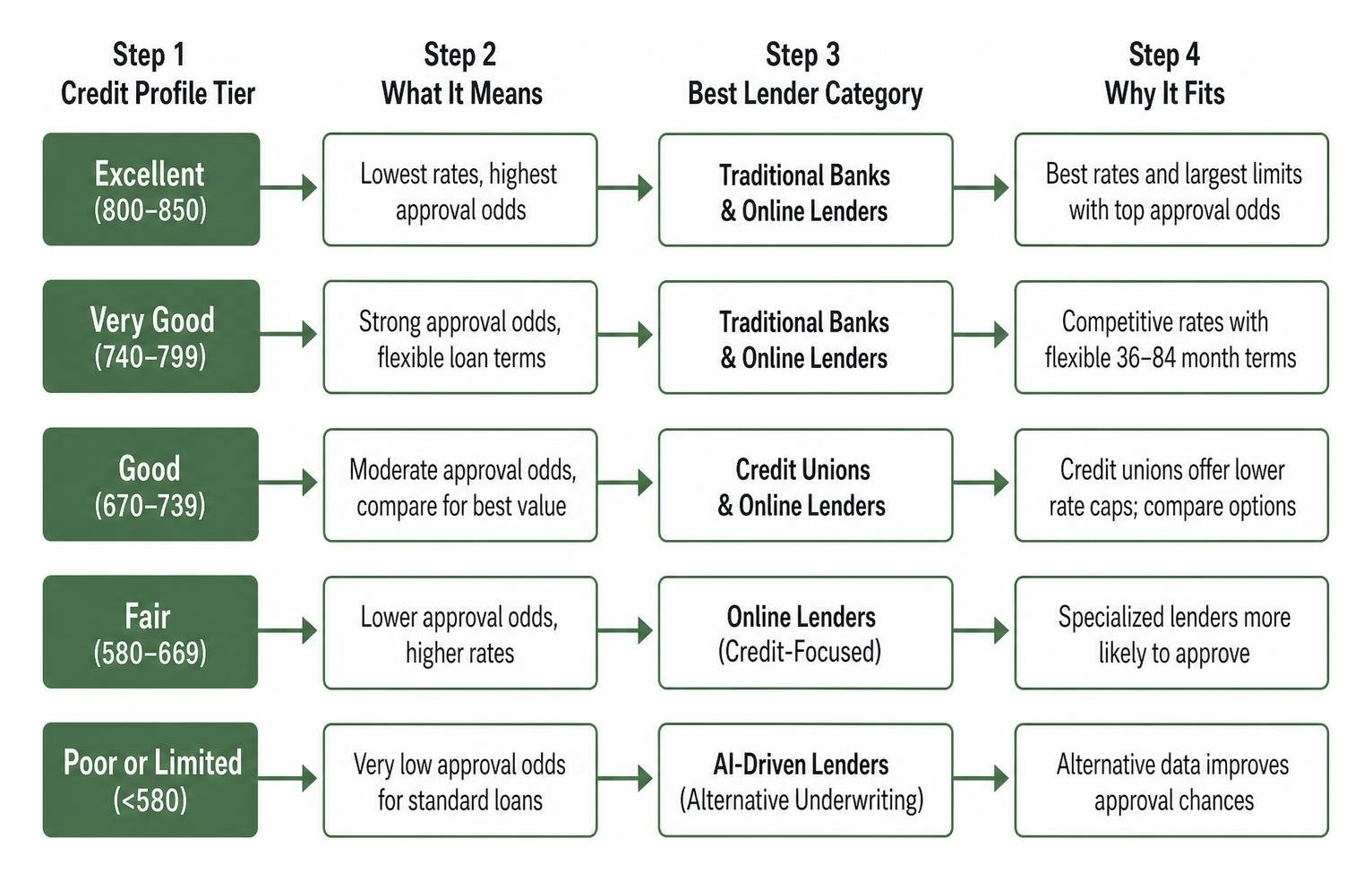
Your current credit score is the single biggest factor determining which lender will give you the best deal. Lenders categorize applicants into distinct credit tiers, each receiving vastly different rate offers and approval odds:
- Excellent Credit (800–850): Borrowers in this top bracket enjoy the lowest APRs (averaging 9.86%) and an estimated approval rate above 81%. Premium lenders compete aggressively for these customers by waiving all administrative fees and offering large borrowing amounts.
- Very Good Credit (740–799): With average APRs around 12.42% and approval rates exceeding 77%, borrowers in this range qualify easily for flexible 36- to 84-month loan terms across major banks and online lenders.
- Good Credit (670–739): Averaging 19.22% APR with approval odds around 61%, good-credit borrowers benefit from comparing mainstream online lenders against credit unions. Enrolling in autopay can trim interest rates further.
- Fair Credit (580–669): Approval rates drop to approximately 23.1% in this bracket, with average APRs rising to 28.82%. Specialized online platforms feature fair credit approvals, while adding a creditworthy co-borrower or co-signer can significantly lower your interest rate.
- Poor or Limited Credit (<580): Direct online approval odds fall below 1% for standard personal loans in this tier. AI-driven underwriting platforms analyze non-traditional factors—such as education, work experience, and income trajectory—allowing applicants with scores as low as 300 to qualify.
Key Features of the Best Place to Get a Personal Loan for Debt Consolidation
Debt consolidation remains the primary reason consumers take out personal loans, accounting for 40% of all approvals on major marketplaces (with credit card refinancing adding another 26%). When replacing multiple high-interest card balances with a single fixed monthly payment, selecting the right features can save thousands of dollars.
When evaluating the best place to get a personal loan for debt consolidation, look for lenders that offer a direct creditor payoff service. Rather than depositing funds into your personal checking account—where you must manually pay off each credit card—many major lenders send funds directly to your third-party creditors.
Beyond convenience, direct creditor payoff can unlock additional savings. For example, some lenders grant a 0.25% APR discount when you allocate 50% or more of your loan proceeds directly to existing card balances. Furthermore, avoiding origination fees and prepayment penalties ensures that every dollar borrowed goes directly toward reducing your principal balance. If you are aiming for rapid debt relief, review Personal Loans with fast funding to see how transparent, zero-fee structures can streamline your payoff plan.
Understanding Rates, Borrowing Costs, and Fees in 2026
To identify the best place to get a personal loan, you must look beyond nominal interest rates and evaluate the total Annual Percentage Rate (APR). The APR reflects the true annual cost of borrowing because it combines the base interest rate with upfront administration charges, such as origination fees.
As of August 2026, baseline personal loan interest rates among top national lenders start as low as 6.49% to 6.99% for prime borrowers who utilize automatic payment discounts:
- Top Online Lenders: Fixed APRs from 6.49% to 24.89% (with AutoPay enabled), featuring loan amounts up to $100,000 and zero fees.
- Major National Banks: Rates start as low as 6.74% up to 26.74% APR, featuring a 0.25% relationship discount for customers with a qualifying checking account and autopay.
- Leading Direct Lenders: APRs start as low as 6.99% with stackable discounts, offering loan limits up to $100,000 and zero mandatory fees.
- Zero-Fee Lenders: Fixed APRs range from 6.99% to 24.99% with loan terms from 36 to 84 months and guaranteed zero fees.
- Regional & National Banks: Fixed rates from 7.99% to 23.99% for borrowing amounts up to $50,000 without origination penalties.
Many lenders also offer automatic rate reductions to reward good financial habits. Autopay enrolment routinely reduces your interest rate by 0.25% to 0.50% across major banks and online lenders. Some progressive lenders even offer “Rate Drop Rewards,” lowering your APR by up to 0.75% as you reach major principal payoff milestones over the life of your loan.
APR Expectations Based on Credit Score Tiers
Industry marketplace data collected from tens of thousands of closed loans highlights the dramatic impact credit scores have on interest rates and overall borrowing costs:
| FICO Credit Score Tier | Credit Rating | Average APR (3-Year Term) | Average APR (5-Year Term) | Estimated Approval Odds |
|---|---|---|---|---|
| 800 – 850 | Excellent | 9.86% | 12.10% | 81.4% |
| 740 – 799 | Very Good | 12.42% | 15.30% | 77.5% |
| 670 – 739 | Good | 19.22% | 22.45% | 61.2% |
| 580 – 669 | Fair | 28.82% | 31.50% | 23.1% |
| 300 – 579 | Poor | 29.74% | 34.20% | 0.5% |
To illustrate how these rates impact your wallet, let’s examine the total cost of borrowing a $15,000 personal loan across different credit tiers:
- Excellent Credit (9.86% APR for 3 Years): Monthly payment is approximately $483. Total interest paid over 36 months equals $2,388.
- Good Credit (19.22% APR for 3 Years): Monthly payment rises to $551. Total interest paid over 36 months equals $4,836—more than double the excellent-credit benchmark.
- Fair Credit (28.82% APR for 3 Years): Monthly payment climbs to $627. Total interest paid reaches $7,572, adding over 50% to the initial loan amount.
Comparing 3-year versus 5-year repayment terms is equally eye-opening. For a borrower with a 720+ credit score, market data shows average APRs of 14.35% for 3-year loans versus 17.92% for 5-year loans. While extending your term to 5 years lowers your monthly commitment, higher rates and longer schedules significantly increase total interest costs. To explore flexible options across varying credit backgrounds, consider reviewing Low Rates Personal Loans Online to test alternative underwriting models.
Hidden Fees to Watch For Before Applying
A low advertised interest rate can quickly lose its appeal if a lender tacks on high administrative fees. When comparing loan agreements, always review these critical fee categories:
- Origination Fees: Charged upfront by lenders to cover processing and underwriting costs. These fees range from 1% to 9.99% of your total loan amount and are subtracted directly from your disbursement check. For instance, an 8% origination fee on a $10,000 loan leaves you with $9,200 in cash, even though you must repay the full $10,000 principal plus interest. Many top-tier lenders charge zero origination fees.
- Prepayment Penalties: Extra fees charged if you pay off your loan balance ahead of schedule. Thankfully, virtually all major online lenders and national banks have eliminated prepayment penalties, allowing you to pay off your debt early to save on interest.
- Late Payment & Insufficient Funds Fees: Fees charged if a monthly installment is missed or returned due to insufficient funds. Certain customer-friendly lenders waive late fees entirely, whereas others charge fixed fees around $15 to $39 or 5% of the missed payment.
- Paper Check Fees: Some online lenders charge a small processing fee (e.g., $2.50 to $5) if you choose to pay monthly bills via mail check rather than automated ACH bank transfers.

Funding Timelines, Usage Restrictions, and Application Requirements
When financial emergencies strike, funding speed becomes just as vital as low interest rates. The best place to get a personal loan for fast cash uses automated digital verification to disburse funds in hours rather than weeks.

Funding timelines vary across top national lenders based on application submission times and verification requirements:
- Leading Online Lenders: Many approved applicants receive same-day funding if they sign their final loan agreement before 7:00 p.m. ET on a regular business day.
- Major National Banks: Historical customer data shows high percentages of approved borrowers receive funds on the same day they sign their final loan disclosures.
- Select Direct Lenders: Offer same-day deposit services provided your application is fully approved and loan documents are signed before 2:30 p.m. ET on a banking business day.
- Top Online Banks: Standard electronic disbursement transfers funds as early as the next business day following final electronic signature.
How Speed and Documentation Impact the Best Place to Get a Personal Loan
To maximize your chances of receiving same-day or next-day funding, you must prepare your documentation before submitting a formal application. Delays almost always stem from manual verification bottlenecks when documents are missing or illegible.
When applying, have the following four document categories ready for digital upload:
- Proof of Identity: Government-issued photo ID, such as a valid driver’s license, state ID card, or U.S. passport.
- Proof of Income: Recent pay stubs (covering the last 30 days), W-2 forms, tax returns from the previous two years, or official bank statements showing recurring direct deposits. Some online lenders even accept verified job offer letters for prospective employment starting within 90 days.
- Proof of Residence: Utility bill, lease agreement, or mortgage statement issued within the past 60 days showing your full name and physical address.
- Bank Account Details: Active checking account routing number and account number to facilitate electronic funds transfer and autopay discounts.
Submitting your application between Tuesday and Thursday during morning business hours helps avoid weekend processing backlogs. If you want to check eligibility and view account options with an established lender, check out Personal loans online options to review streamlined application checklists.
Permissible Loan Uses and Common Restrictions
Unsecured personal loans are remarkably versatile, functioning as financial Swiss Army knives. However, lenders enforce clear rules regarding how loan proceeds can and cannot be used.
Commonly Approved Loan Uses:
- Consolidating high-interest credit card debt or personal loans
- Home improvements, repairs, and energy-efficiency upgrades
- Out-of-pocket medical expenses, elective surgeries, and dental work
- Major life events, including weddings, adoptions, and moving costs
- Vehicle repairs or buying used power equipment
Strictly Prohibited Loan Uses:
- Post-secondary higher education expenses (college tuition, textbooks, dorm fees) regulated under Title IV
- Illegal activities, gambling, or unregulated investments
- Buying real estate, mortgage down payments, or land purchases
- Direct business capital investments (unless specifically categorized as a business loan)
- Paying off existing loan balances held at the exact same financial institution
How Applying for a Personal Loan Affects Your Credit Score
Understanding the relationship between loan applications and credit scores helps you protect your financial standing while shopping for the best rate.
When you initial check loan offers during the pre-qualification phase, lenders perform a soft credit check. Soft inquiries operate behind the scenes—they allow lenders to review your basic credit profile without triggering any credit score reduction. You can safely pre-qualify with multiple lenders to compare rates without damaging your score.
Once you select a loan offer and submit a formal application, the lender performs a hard credit inquiry. A hard pull allows the lender to inspect your full credit history. This inquiry typically reduces your FICO score by 3 to 5 points temporarily. Unlike auto loan or mortgage rate shopping—where multiple inquiries made within a short window are grouped together—personal loan inquiries count individually. Applying with four different personal loan lenders in one week can trigger four distinct hard pulls, causing a cumulative drop in your score.

Over time, taking out a personal loan can actually strengthen your credit score in three key ways:
- On-time Payment History: Payment history accounts for 35% of your FICO score. Consistently making monthly installment payments on time builds a strong credit record.
- Lower Credit Utilization: Credit card debt accounts for 30% of your score based on revolving credit utilization. Consolidating credit card debt into an installment loan immediately drops your revolving utilization to zero, often boosting credit scores by 20 to 50 points within a few billing cycles.
- Improved Credit Mix: Installment debt adds variety to a credit profile dominated by revolving credit cards, accounting for 10% of your score calculation.
Alternatives to Personal Loans to Consider
While personal loans offer predictable repayment structures, they are not always the cheapest option for every situation. Consider these four alternatives before signing a loan agreement:
- 0% APR Balance Transfer Credit Cards: If you have good to excellent credit, a 0% APR balance transfer card can provide 12 to 21 months of interest-free debt repayment. While you will pay a 3% to 5% upfront transfer fee, paying off the debt within the promotional window saves more money than a personal loan.
- Home Equity Loans or HELOCs: Homeowners with substantial equity can access lower interest rates by securing borrowing against their primary residence. However, using your home as collateral carries default risks that unsecured personal loans avoid.
- 401(k) Loans: Borrowing against your retirement account requires no credit check and charges interest that flows directly back into your own account. However, if you leave your employer, the balance must often be repaid quickly to avoid income taxes and early withdrawal penalties.
- Peer-to-Peer or Family Loans: For smaller financial gaps, borrowing from family or using micro-lending networks can provide flexible repayment schedules without formal credit hurdles.
Frequently Asked Questions About Personal Loans
What credit score is required to qualify for a personal loan?
Minimum credit score requirements vary significantly by lender. Premium lenders generally require scores of 660 to 700+ for approval. Mainstream online lenders and peer-to-peer platforms usually look for scores around 600 to 640. Specialized lenders accept scores down to 580, while AI-driven underwriting platforms evaluate applicants with scores as low as 300. If your credit score falls below 600, applying with a creditworthy co-borrower can substantially boost your approval odds and reduce your APR.
How quickly can personal loan funds be deposited?
Funds can be deposited into your bank account as quickly as the same day you apply, or within 1 to 3 business days. Leading lenders offer same-day electronic deposits if your application is approved and loan agreements are signed prior to afternoon cutoff times (typically between 2:30 p.m. and 7:00 p.m. ET on regular banking days). Online lenders delivering funds electronically usually complete transactions within 24 to 48 hours.
How long must I wait to reapply if my loan application is declined?
If your single-applicant personal loan application is declined, standard financial guidelines require you to wait at least 30 days before submitting a new application with the same lender under the same structure. This waiting period allows you time to correct credit report errors, lower outstanding credit utilization, or address income documentation issues. However, you can bypass this 30-day waiting period immediately if you reapply by adding or changing a creditworthy co-borrower.
“https://www.mediafire.com/file/soli0nrtwnw2ums/Insane_Disasters_BY_MCMPDL.mcaddon/file“;
Conclusion
Finding the best place to get a personal loan comes down to matching your credit profile, borrowing limits, and payoff goals with the right lender. Whether you prioritize zero fees, same-day electronic funding, or debt consolidation discounts, pre-qualifying with multiple lenders via soft credit checks empowers you to shop confidently without risking your credit score.
By carefully evaluating total APRs, avoiding unnecessary origination fees, and selecting manageable payment schedules, you can use personal loans as effective tools to lower debt, cover major expenses, and build long-term financial security. Stay updated with AI financial updates to learn more about modern financial strategies, smart borrowing tools, and money management techniques.