What Is the Maximum Loan Amount Offered to Doctors?

The maximum loan amount offered to doctors can reach as high as $4 million or more, depending on the lender, your credit score, and how much you put down. Most physician mortgage programs fall in the $1.5 million to $2 million range, with 100% financing (zero down) commonly capped at $1.5 million to $2 million.
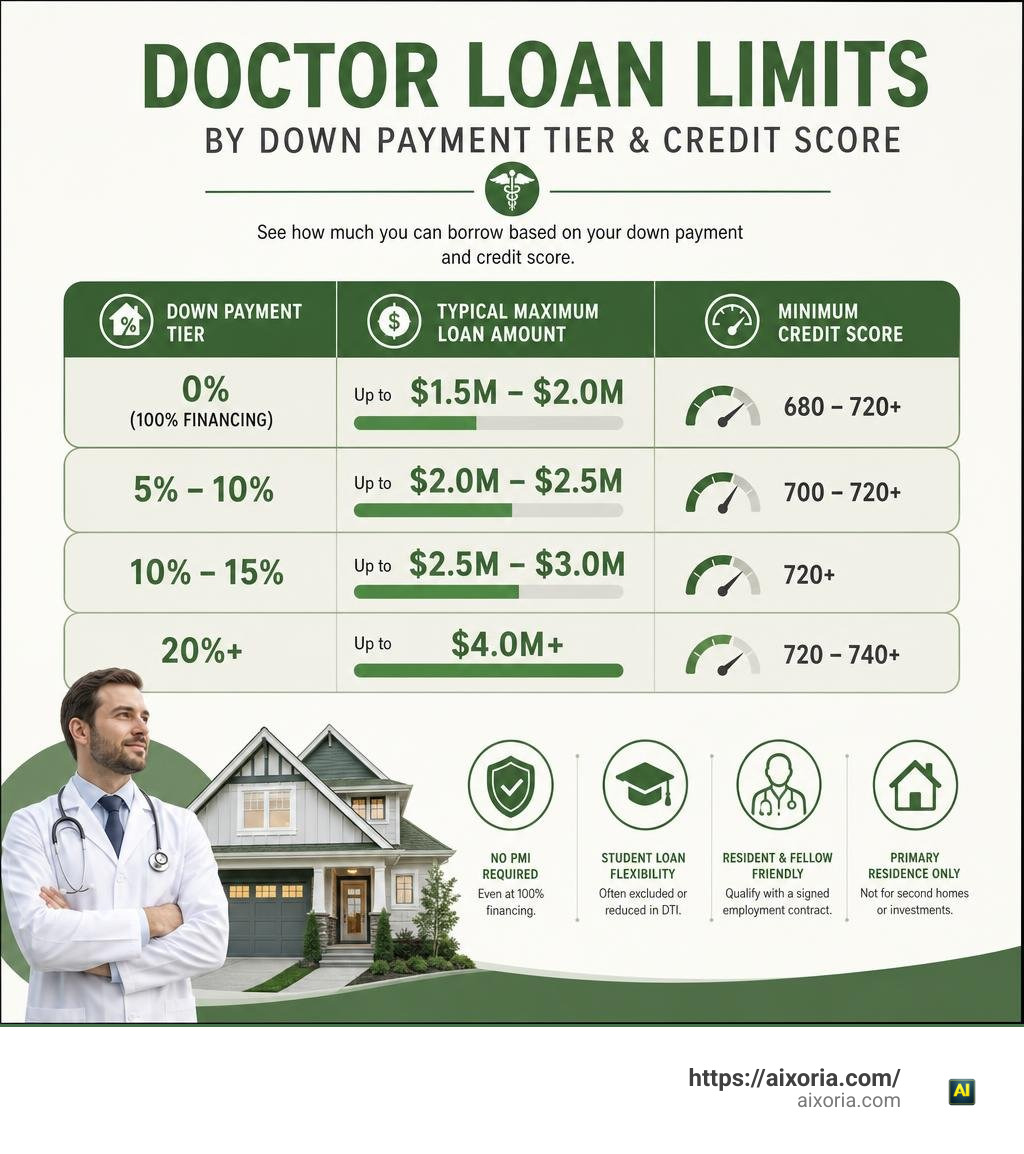
Here is a quick snapshot of what doctors can typically borrow:
| Down Payment | Typical Maximum Loan Amount | Minimum Credit Score |
|---|---|---|
| 0% (100% financing) | Up to $1.5M – $2.0M | 680 – 720+ |
| 5% – 10% | Up to $2.0M – $2.5M | 700 – 720+ |
| 10% – 15% | Up to $2.5M – $3.0M | 720+ |
| 20%+ | Up to $4.0M+ | 720 – 740+ |
A few key facts to know upfront:
- No PMI required, even at 100% financing — this is a defining feature of physician loans.
- Student loan debt is often excluded or reduced in DTI calculations, which directly raises how much you can borrow.
- Residents and fellows can qualify using a signed employment contract, even before their first paycheck.
- These loans are almost always for primary residences only — not second homes or investment properties.
Physician mortgage loans exist because traditional lenders penalize doctors. High student debt, short employment history, and limited savings make it hard to pass conventional underwriting — even when your income potential is exceptional. These specialized programs fix that by evaluating doctors differently.
The sections below break down exactly how lenders set their limits, which factors move those limits up or down, and how to find the best deal for your situation.
What is the Maximum Loan Amount Offered to Doctors?

When we evaluate physician financing across the mortgage industry, we find that the maximum loan amount offered to doctors generally scales according to risk, credit history, and equity position. While standard conventional loan limits set by the Federal Housing Finance Agency (FHFA) top out at baseline conforming figures, physician loan products are custom-tailored portfolio loans. Because originators retain these loans on their own balance sheets rather than selling them to Fannie Mae or Freddie Mac, they establish their own portfolio lending caps.
At the baseline level, physicians can access 100% Loan-to-Value (LTV) financing up to $1.5 million or $2 million. For high-earning medical professionals who wish to buy luxury estates or homes in high-cost metro areas, specialty lenders offer loan limits reaching $2.5 million, $3 million, or even $4 million when backed by a 10% to 20% down payment. For instance, specific financial institutions allow up to 100% financing on loan amounts up to $4 million, while others scale their limits from $1.5 million up to $4 million when backed by 15% to 20% down. To explore standard framework rules, you can review overall Doctor/Physician Loan Overview Guidelines.
Understanding Key Factors Influencing the Maximum Loan Amount Offered to Doctors
Lenders do not assign top-tier loan limits arbitrarily. Several critical financial factors dictate the exact maximum limit you can unlock:
- Credit Score Thresholds: Credit score is often the single biggest gatekeeper. A FICO score of 720 or higher is typically required to unlock maximum limits above $2 million with zero to 5% down.
- Debt-to-Income (DTI) Ratios: Lenders permit maximum DTI limits up to 45% or 50% for physician mortgages. This is considerably more lenient than conventional jumbo limits, which often cap DTI at 36% to 43%.
- Cash Reserve Requirements: Post-closing asset reserves — measured in months of principal, interest, taxes, and insurance (PITIA) — increase alongside the loan amount. While a $1 million loan might require 0 to 2 months of reserves, a $2 million loan often requires 6 to 12 months of liquid assets.
- Loan-to-Value (LTV) Tiering: As the total borrowing amount increases, lenders systematically lower the maximum permitted LTV to offset financial exposure.
Comparing Credit Tiers and the Maximum Loan Amount Offered to Doctors
Credit tiers directly define your maximum financing cap and down payment structure. The table below illustrates how FICO scores correlate with available loan limits across standard physician mortgage programs:
| Credit Score Tier | Maximum LTV | Typical Maximum Loan Amount | Required Reserves |
|---|---|---|---|
| 680 – 699 FICO | 95% – 100% | $1,250,000 – $1,500,000 | 2 – 6 Months PITIA |
| 700 – 719 FICO | 95% – 100% | $1,500,000 – $1,750,000 | 6 Months PITIA |
| 720 – 739 FICO | 90% – 100% | $2,000,000 – $2,500,000 | 6 – 12 Months PITIA |
| 740+ FICO | 85% – 90% | $2,500,000 – $4,000,000+ | 12 Months PITIA |
As seen in standard guidelines such as the Conventional Doctor Loan Program Summary, maintaining a credit score of 720 or above ensures you can reach $2 million with 0% down, or exceed $2.5 million with minimal out-of-pocket capital.
How Lender Guidelines and Career Stages Impact Borrowing Caps

A doctor’s career stage heavily influences borrowing capacity. Lenders distinguish between early-career trainees who have modest salaries and established attendings who command substantial income.
Resident and Fellow Loan Limits Versus Attending Physicians
Medical residents, interns, and fellows earn modest salaries — usually between $65,000 and $78,000 annually. Because total borrowing capacity ultimately hinges on gross monthly income, many institutions establish hard borrowing caps for trainees.
- Residents and Fellows: Most specialized lenders cap maximum loan amounts for residents and fellows at $1,000,000 with 0% down. This protects early-career physicians from taking on unsustainable housing payments while completing their clinical training.
- Attending Physicians: Once a doctor transitions to an attending position, annual earnings frequently jump to $250,000–$500,000+. At this stage, lenders lift training caps, allowing attendings to qualify for $1.5 million to $2.5 million+ based on their proven or contracted income.
For a deeper dive into how career milestones unlock greater borrowing power, read our comprehensive Guide to Attending Physician Mortgages.
Utilizing Future Employment Contracts to Expand Loan Maximums
One of the most powerful features of physician mortgage lending is the ability to qualify for a home loan using an unstarted employment contract. Under standard conventional guidelines, borrowers must present pay stubs covering 30 to 60 days of active employment. In contrast, physician loan programs allow doctors to close on a home up to 90 to 150 days prior to their official job start date.
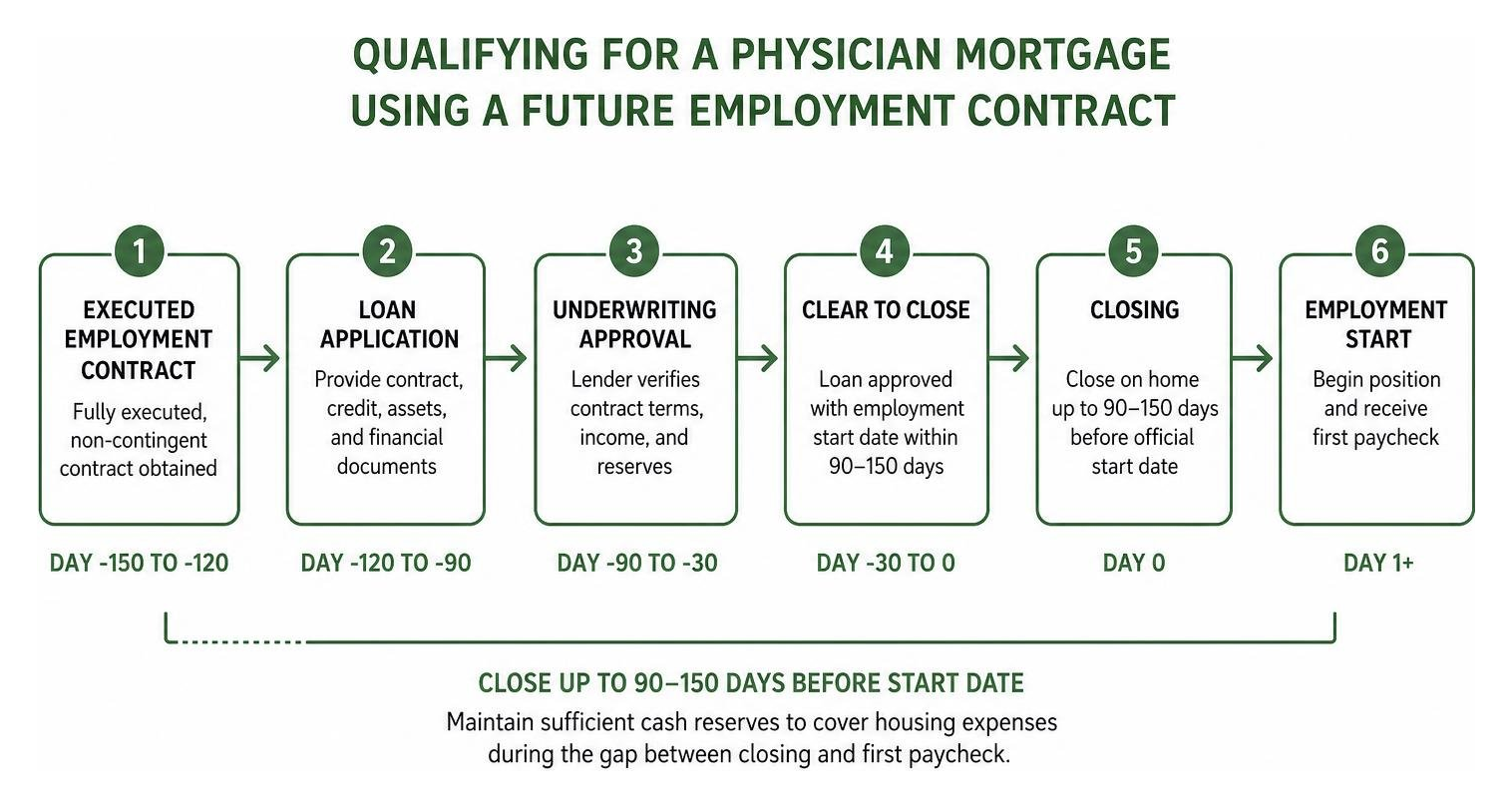
To leverage a future contract for maximum loan qualification, the contract must meet specific criteria:
- It must be a fully executed, non-contingent employment agreement.
- It must clearly state your guaranteed base salary or hourly rate with minimum guaranteed hours.
- The employment start date must fall within 90 to 150 days of the closing date.
- You must document sufficient cash reserves to cover housing expenses during any gap between closing and your first paycheck.
For 1099 independent contractors or private practice partners, lenders typically require a signed contract detailing guaranteed compensation along with written confirmation that you will incur no unreimbursed business expenses. For full details on contract rules, check out these Zero Down Physician Loan Guidelines.
Down Payment Tiers, DTI Rules, and Property Restrictions
To understand how down payment requirements, loan amounts, and risk controls interact, we can examine typical industry LTV structures:
Even at 100% financing, physician loans completely waive Private Mortgage Insurance (PMI). On a standard conventional loan with 0% to 5% down, PMI can add hundreds to thousands of dollars to monthly payments. Eliminating PMI significantly improves monthly cash flow, allowing doctors to dedicate more income toward principal payments or wealth building.
Student Loan Debt Treatment and DTI Calculation Concessions
Student debt is the primary obstacle preventing medical professionals from qualifying for traditional mortgages. The average medical school graduate carries $200,000 to $250,000+ in educational loans. Conventional mortgage guidelines calculate monthly student debt by imputing 0.5% to 1.0% of the total balance as a monthly liability (which equals a $1,000 to $2,500 monthly debt obligation on a $250,000 loan balance).
Physician mortgages circumvent this hurdle through specialized debt-to-income (DTI) rules:
- Income-Driven Repayment (IDR/IBR) Acceptance: Lenders use your actual documented IBR/IDR monthly payment amount — even if that figure is $0 per month during residency.
- Deferred Loan Exclusion: If student loans are deferred or placed in forbearance for at least 12 months post-closing, many lenders exclude the student loan liability entirely from DTI calculations.
- Expanded DTI Caps: While conventional mortgages enforce strict DTI limits around 36% to 43%, physician programs allow DTIs up to 45% to 50%.
To see how specialized underwriting parameters operate in institutional practice, review the Medical Professional Loan Guidelines Matrix and the Portfolio Edge Medical Professional Guidelines.
Property Eligibility and Occupancy Restrictions
Because physician mortgage programs feature generous underwriting exceptions, lenders enforce strict property guidelines to control portfolio risk:
- Primary Residence Restriction: Physician loans are strictly restricted to primary owner-occupied residences. They cannot be used to acquire vacation homes, second homes, or standalone investment properties.
- Eligible Property Types: Standard eligible structures include single-family detached homes, townhomes, planned unit developments (PUDs), and warrantable condominiums. Some lenders permit multi-family properties (e.g., duplexes or 2–4 unit buildings) provided the physician occupies one unit as their primary residence.
- Location Limitations: Financing caps and availability may vary based on geographic location, state licensing, and regional housing cost classifications.
Physician Mortgage Loans vs. Conventional Jumbo Loans
When buying a high-value property, medical professionals frequently choose between a physician mortgage and a conventional jumbo loan. Understanding how these products stack up helps determine which path provides the maximum financial benefit.
| Feature / Guideline | Physician Mortgage Loan | Conventional Jumbo Loan |
|---|---|---|
| Maximum 0% Down Limit | $1.5M – $2.0M | Rarely available (0% down is uncommon) |
| Private Mortgage Insurance (PMI) | Never Required | Required with < 20% down |
| Student Debt DTI Treatment | Uses actual IBR/IDR (or $0 if deferred) | Imputes 0.5% – 1.0% of balance |
| Employment Verification | Accepts future contract (90–150 days out) | Requires 30–60 days of active pay stubs |
| Reserve Requirements | 0 to 6 months PITIA typical | 6 to 12+ months PITIA standard |
| Interest Rates | Comparable (may carry 0.125%–0.50% premium) | Standard market jumbo pricing |
While conventional jumbo loans might occasionally offer slightly lower nominal interest rates (about 0.125% to 0.50% lower), the upfront capital savings, elimination of PMI, and flexible student debt guidelines make physician mortgage loans the clear winner for early- to mid-career doctors.
Frequently Asked Questions About Doctor Loan Limits
What is the absolute maximum loan amount available on zero-down doctor loans?
The absolute maximum loan amount for a 100% financing (zero-down) physician mortgage generally tops out between $1.5 million and $2.0 million. Unlocking a $2 million loan with zero money down typically requires a minimum credit score of 720, continuous employment or a verified contract, and 3 to 6 months of liquid cash reserves.
Can doctors use physician loans for second homes or investment properties?
No. Nearly all physician mortgage loan programs strictly require the property to be used as your primary owner-occupied residence. If you wish to purchase a second home or an investment property, you will need to utilize traditional conventional or jumbo financing, which generally requires a 15% to 25% down payment.
How do student loans affect the maximum home loan amount for medical residents?
Physician loans minimize the impact of student debt by using actual Income-Driven Repayment (IDR/IBR) figures rather than full balance calculations. If a resident has a documented $0 or $100 monthly IBR payment, lenders use that exact figure in DTI calculations, significantly increasing total borrowing power.
Conclusion
Navigating the maximum loan amount offered to doctors comes down to understanding how your credit score, down payment, career stage, and student debt intersect. By removing private mortgage insurance requirements and offering flexible DTI calculations, physician mortgage loans allow medical professionals to buy a home that fits their long-term trajectory without draining liquidity during key career transitions.
Whether you are a medical resident securing your first home with zero down or an attending physician purchasing a high-value estate, comparing multiple portfolio lenders ensures you secure the highest limit at the most competitive rates.
To stay updated on the latest financial tools, real estate strategies, and technological advances driving modern home financing, Discover more insights with AIXoria.